
消费行业

Search documents
做消费品,不适合聪明人
新消费智库· 2026-03-02 13:02
Core Viewpoint - The article emphasizes that being overly intelligent or clever is not suitable for founders in the consumer goods industry, as success relies more on patience, consistency, and execution rather than on clever ideas or quick thinking [1][2][4][44]. Group 1: Characteristics of Successful Founders - Founders should not be overly clever, which is defined as having too many ideas and being too quick to change strategies [2][3]. - Successful founders are characterized by their patience, willingness to focus on details, and ability to endure the slow nature of the consumer goods industry [38][41][46]. - They should avoid constantly seeking new opportunities and instead focus on maintaining product stability and brand consistency [17][19][22]. Group 2: Nature of the Consumer Goods Industry - The consumer goods industry is described as a slow-paced sector where success takes time, with cycles of five years for products and ten years for brands [12][13]. - It requires a focus on basic operations, standardization, and stability rather than innovation and rapid changes [28][30][36]. - The industry is not a capital game; it is about maintaining a consistent product and brand positioning over time [8][12]. Group 3: Risks of Overthinking - Overly clever founders may become impatient and start looking for alternative opportunities when growth is slow, which can lead to instability in their brands [15][20][21]. - The tendency to constantly innovate and change can result in a lack of brand recognition and consumer loyalty [35][36]. - Founders who focus on clever strategies may overlook the importance of foundational work and consistency in building a successful consumer brand [32][34].


ETF 及指数产品网格策略周报(2026/2/25)
华宝财富魔方· 2026-02-27 11:25
Core Viewpoint - The article discusses the ETF grid strategy, focusing on specific ETFs that are expected to benefit from upcoming policy changes and market trends, particularly in the consumer and healthcare sectors in Hong Kong [2][3][5]. Group 1: Hong Kong Consumer 50 ETF - The Hong Kong Consumer 50 ETF (159268.SZ) is highlighted as a key focus, with historical data indicating that the period between the Spring Festival and the Two Sessions often leads to market speculation on policy expectations, particularly in the consumer sector [2]. - High-frequency data from the People's Bank of China shows that during the Spring Festival of 2026, transaction volumes reached 393.02 billion transactions, amounting to 13.12 trillion yuan, reflecting a 37.45% increase in transaction volume and a 19.26% increase in transaction value compared to the previous year [2]. - The ETF tracks the National Index of Hong Kong Consumer Theme, with a significant portion of its holdings in "new consumption" sectors such as trendy products and new-style tea drinks, which may exhibit higher elasticity under favorable policy expectations [3]. Group 2: Hong Kong Healthcare ETF - The Hong Kong Healthcare ETF (159366.SZ) has seen increased investment from southbound funds, with net purchases exceeding 150 billion HKD as of February 24, 2026, indicating strong liquidity in the healthcare sector [3]. - Data from the National Medical Products Administration shows that in 2025, the total value of authorized transactions for innovative drugs exceeded 130 billion USD, with over 150 transactions, marking a historical high [5]. - As of February 15, 2026, there have been 39 external authorization transactions for Chinese innovative drugs, with upfront payments totaling approximately 29.53 billion USD, showcasing the significant improvement in China's drug development capabilities [5]. Group 3: Securities and Insurance ETF - The Securities and Insurance ETF (512070.SH) reflects a robust bond issuance environment, with total bond issuance by brokerages reaching 426.04 billion yuan as of February 20, 2026, representing a year-on-year increase of 243.97% [7]. - The approval of bond issuance has reached 322 billion yuan in 2026, providing brokerages with low-cost long-term funding, which enhances their operational capabilities in various capital-intensive businesses [7]. - Recent regulatory measures aimed at optimizing refinancing processes are expected to benefit brokerage firms' investment banking operations, aligning with the policy direction of supporting strong firms while limiting weaker ones [8].

[2月26日]指数估值数据(港股科技类指数回调,还会起来吗;红利指数估值表更新)
银行螺丝钉· 2026-02-26 13:57
Core Viewpoint - The article discusses the recent performance of A-shares and Hong Kong stocks, highlighting the cyclical nature of market trends, particularly in technology and growth sectors, and the importance of understanding valuation metrics for dividend indices [2][3][6]. Group 1: Market Performance - The major indices, including the Shanghai Composite and Shenzhen 300, have shown mixed results, with large-cap stocks declining while small-cap indices have slightly increased [2]. - The Hong Kong stock market has been experiencing a downturn, with significant volatility in technology and healthcare indices [2]. - Since May 2024, the Hang Seng Technology Index has increased by 71%, with three distinct waves of growth followed by corrections [2][6]. Group 2: A-shares and Hong Kong Stocks - A-shares have also exhibited similar patterns of short-term surges followed by corrections, often characterized by a "three up, one down" or "three up, two down" trend [2][6]. - The growth in A-shares and Hong Kong stocks is often accompanied by substantial fluctuations, particularly in technology stocks, which tend to be more volatile than the broader market [6]. Group 3: Earnings and Valuation - The performance of technology indices is closely linked to the earnings growth of the underlying companies, with significant increases in earnings leading to corresponding rises in index values [6]. - Recent earnings growth for Hong Kong technology stocks has been robust, with some companies reporting a doubling of profits year-on-year, which has driven index performance [6]. - However, there are concerns about a slowdown in earnings growth for both A-shares and Hong Kong stocks, particularly in the technology sector, which may impact future index performance [6]. Group 4: Investment Strategies - The article emphasizes the importance of maintaining a balanced investment approach, combining growth-oriented technology stocks with value-oriented dividend stocks to stabilize overall portfolio performance [8][10]. - The article also provides a valuation table for various dividend indices, highlighting their earnings yields, price-to-earnings ratios, and other key metrics for investor reference [11][12].

在智能浪潮中构建竞争力?你需要这张中国消费45年实战图鉴
第一财经· 2026-02-09 06:41
Core Insights - The article discusses the transition of technology from concept to practical application in the consumer industry, emphasizing the role of AI and smart innovation as a core engine for sustainable growth [1] - The "Opening Things" theme in the white paper explores the innovation paths and core dynamics of consumer brands in the smart era, providing a systematic analysis of the evolution of the consumer market [1] Summary by Sections Evolution of Consumer Market - The white paper includes a timeline that traces the evolution of the Chinese consumer market from 1980 to 2025, highlighting the four stages of technological advancement: 1. Tool-based phase (1980-2000) where technology served as an efficiency-enhancing tool [3] 2. Information phase (2001-2010) where information boundaries were broken, leading to an extension of vision [3] 3. Network phase (2011-2018) where digital connections redefined social interactions and identities, achieving an extension of relationships [3] 4. Intelligent phase (2019-present) where technology aids decision-making and fosters creativity, resulting in an extension of thought [3] Importance of the Timeline - The timeline illustrates how technology has evolved from being a mere tool to becoming an integral part of the ecosystem, thus driving value innovation in the Chinese consumer industry [3] - Understanding this timeline is crucial for brands to build long-term competitiveness amidst uncertainty, providing a solid perspective for decision-making [3] White Paper Availability - The white paper, along with the timeline, is available for pre-sale at a discounted price, aimed at helping brands and practitioners grasp the trends in smart innovation [4]

美联储“鹰派赘婿”凯文·沃什上位:全球金融变局下的中国投资新逻辑
Sou Hu Cai Jing· 2026-02-05 01:55
Core Viewpoint - The nomination of Kevin Warsh as the next Federal Reserve Chairman by President Trump signals a potential major shift in global monetary policy, with immediate impacts on financial markets, including a significant drop in gold and silver prices [1][3]. Group 1: Kevin Warsh's Profile and Policy Stance - Kevin Warsh, at 55, has a background that includes being the youngest Federal Reserve Governor and has experience during the financial crisis, which shapes his policy approach [4]. - Warsh is characterized as a "hawkish inflationist" and "balance sheet hawk," criticizing the Fed's prolonged stimulus measures and advocating for a reduction in the balance sheet to control inflation [5]. Group 2: Global Market Implications - Warsh's potential policies may lead to a dual approach of "preemptive rate cuts and active balance sheet reduction," creating a complex liquidity environment globally [9][10]. - The dollar's status as a global reserve currency will be influenced by Warsh's policies, with short-term rate cuts possibly weakening the dollar, while long-term balance sheet reductions may support its value [11]. Group 3: Impact on China - China may face short-term pressures from capital flows and currency fluctuations due to reduced dollar liquidity, but long-term opportunities may arise from a weaker dollar strategy that enhances export competitiveness [14]. - The emphasis on AI and anti-inflation measures by Warsh aligns with China's strategic focus on new productive forces, potentially attracting global capital in sectors like AI and high-end manufacturing [14]. Group 4: Investment Strategies - In the primary market, investment strategies should focus on hard technology sectors, consumer upgrades, and cross-border opportunities, emphasizing risk management and long-term value [16][18]. - In the secondary market, a balanced approach of risk aversion and strategic positioning is recommended, with a focus on sectors benefiting from domestic policy support and potential interest rate changes [19][20].

释放经济潜能,激发发展动能
Xin Hua Ri Bao· 2026-02-03 00:07
Core Viewpoint - The central economic work conference emphasizes the necessity of "five musts" to effectively address economic challenges, with a focus on fully tapping economic potential as a primary strategy for high-quality development [1] Group 1: Economic Potential and Innovation - The essence of tapping economic potential is to release suppressed social productive forces, enhancing material and technological supply capabilities [2] - Jiangsu aims to avoid ineffective accumulation of supply and instead foster advanced productivity through innovation and quality improvement [2] - The province will leverage its complete industrial chain and rich application scenarios to drive breakthroughs in key technologies and accelerate the application of major scientific achievements [2] Group 2: Service Manufacturing and Organizational Change - Jiangsu will integrate services deeply into the manufacturing lifecycle, encouraging businesses to expand into collaborative R&D, design, and comprehensive solutions [3] - The province aims to restructure industrial quality and enterprise organization by promoting market-driven changes and resource integration through mergers and acquisitions [3] Group 3: Domestic Market and Consumption - Enhancing consumer spending is crucial for economic growth, especially in a populous and consumption-driven province like Jiangsu [4] - The province will focus on improving both consumer capacity and willingness, addressing challenges related to supply exceeding demand [4] - Initiatives will include lowering costs of living and expanding social safety nets to boost consumption among low-income groups [4] Group 4: Spatial Structure and Regional Growth - Jiangsu is set to optimize its economic space by fostering high-growth and resilient economic units, enhancing collaboration among various regions [7] - The province will adjust its production layout in line with national policies, leveraging regional advantages to optimize productivity across the entire province [7] Group 5: Marine Economy Development - The marine economy is identified as a key area for high-quality development, with Jiangsu's marine GDP surpassing 1 trillion yuan [9] - The province will enhance the integration of marine innovation resources and development spaces, promoting collaboration between river and sea industries [9] Group 6: Shipbuilding and Deep-Sea Industry - Jiangsu will advance the shipbuilding industry by focusing on the intelligent and green upgrade of major ship types, aiming to create competitive marine equipment manufacturing [10] - The province will support deep-sea technology research and the development of high-value resources, enhancing capabilities in deep-sea monitoring and control systems [11]
跌跌不休的消费股没希望了吗?给你一点信心
雪球· 2026-01-28 08:50
Core Viewpoint - The A-share market has shown a stark contrast this year, with small-cap and technology stocks rising while financial and consumer sectors have faced declines [3][4]. Group 1: Financial Sector Analysis - The financial sector has not been severely impacted, as the recent downturn is attributed to state intervention, suggesting a potential rebound once state support is withdrawn [4]. - The insurance sector has shown resilience, with significant gains observed, indicating that funds are being repositioned within the market [36][39]. Group 2: Consumer Sector Analysis - The consumer sector, particularly traditional categories like food and beverage, is struggling, with some stocks nearing their lows from previous downturns [5][6]. - The author has previously advised exiting investments in the liquor sector, indicating a cautious stance on traditional consumer stocks [7][8]. - Despite the challenges, there are signs of potential recovery in consumer spending, driven by the return of cross-border capital flows [10][12]. Group 3: Investment Challenges - The difficulty of investing in consumer stocks has increased, as changing consumer preferences and high valuations pose risks [11][15]. - Traditional consumer stocks may transition to dividend stocks due to a lack of growth, complicating investment decisions [18][20]. - The pace of recovery in consumer spending is expected to be slow, with a shift in policy focus from investment in goods to investment in human welfare [23][24]. Group 4: Market Dynamics - The market is experiencing increased volatility and divergence, making trading more challenging [46]. - The state’s intervention in the market is seen as a means to stabilize and support fund allocation, with potential for a more balanced market once restrictions are lifted [43][44].

研究称消费仍是美国经济增长最大驱动力,AI支出仅排第二
Xin Lang Cai Jing· 2026-01-27 00:27
Core Insights - The narrative that artificial intelligence (AI) is the lifeblood of the U.S. economy appears to be exaggerated, as consumer spending remains the primary driver of GDP growth, with AI-related capital expenditure being the second [1][5][6]. Economic Contributions - AI-related investments contributed approximately 90 basis points (0.9%) to actual GDP growth from Q1 to Q3 of 2025, accounting for about 40% of the average actual GDP growth during that period [2][6]. - When adjusting for imports, the net average contribution of AI-related investments drops to between 40 to 50 basis points, representing 20% to 25% of actual GDP growth for the same quarters [2][6]. Sectoral Insights - Investment in software and computers is identified as the most significant contributor to GDP growth from AI, rather than the focus on data centers [2][6]. - A report from Bespoke Investment Group indicated that AI-related spending categories accounted for only 15% of quarterly GDP growth in Q2 and Q3 of 2025, with their overall contribution to GDP being less than 5% [2][6]. GDP Growth Trends - The actual GDP growth rate for Q3 2025 was significantly higher than expected at 4.3%, while Q2 also exceeded expectations at 3.3%. However, Q1 experienced a decline of 0.3%, marking the first quarterly negative growth since early 2022 [3][7].

特朗普的“中选经济强心针”:超大规模退税即将到来,平均金额高达3500美元!
Hua Er Jie Jian Wen· 2026-01-25 12:05
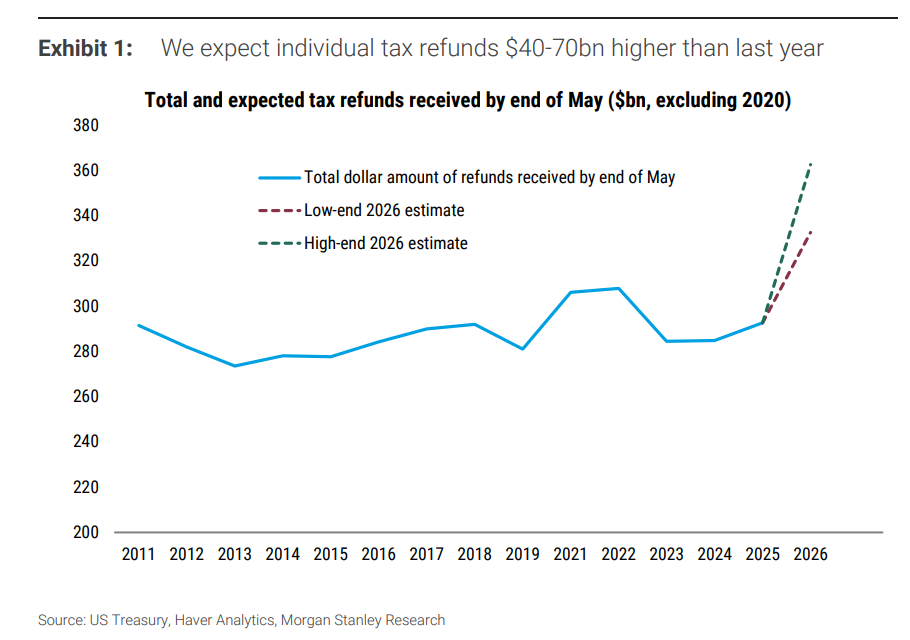
Core Viewpoint - The U.S. consumers are set to experience an unprecedented "cash rain" due to the One Big Beautiful Bill Act (OBBBA), with personal income expected to surge in Q1 2026, driven by retroactive tax measures [1] Group 1: Tax Refunds and Consumer Impact - The total personal tax refunds are projected to reach approximately $350 billion (around 2.5 trillion RMB) by the end of May, marking a 20% year-on-year increase [1] - Morgan Stanley estimates that this year's personal tax refunds will be $40 billion to $70 billion higher than last year, with the average refund amount increasing by $550 to a historical high of about $3,500 [1] - The tax benefits primarily stem from deductions on overtime pay, tips, senior deductions, car loan interest, and increased child tax credits [4] Group 2: Economic Implications for Investors - The substantial tax refunds are expected to provide short-term support for consumer spending, particularly in the first half of the year, despite anticipated slow growth in actual consumption in early 2026 [7] - This fiscal stimulus signals a direct improvement in household balance sheets, especially for middle and high-income households [7] - Morgan Stanley predicts that the actual disposable personal income will grow at an annualized rate of 4.1% in Q1 2026, reversing the stagnant trend observed in the second half of 2025 [12] Group 3: Consumption Behavior and Economic Data - Historical data indicates that only about 30-40% of tax refunds are typically spent in the first quarter after receipt, with higher-income and senior beneficiaries likely to save or pay down debt rather than spend [12] - The OBBBA is expected to boost actual consumption by only 20 basis points, with an overall GDP impact of approximately 40 basis points [12] Group 4: Broader Economic Context - Despite the fiscal stimulus, trade tensions and high tariffs continue to pose challenges, with the effective tariff rate rising to 16% and expected to remain high [13][16] - The U.S. economy is projected to experience moderate GDP growth, with Morgan Stanley raising the Q4 2025 GDP growth tracking value to 2.1% [14][16] - The Federal Reserve is expected to maintain its current interest rate stance, emphasizing steady economic growth while acknowledging inflationary pressures from tariffs [14][16]
财政部及央行新闻发布会解读:财政金融协同,助力开门红
Shenwan Hongyuan Securities· 2026-01-21 11:04
Group 1: Policy Signals - The Ministry of Finance and the central bank are focusing on stimulating domestic demand, enhancing support for technological innovation, and activating private investment as key areas for policy collaboration[1] - Personal consumption loan interest subsidies have increased significantly, with the maximum subsidy per loan rising from 500 yuan to 3000 yuan, and credit card installment payments now included[1] - The central bank has lowered the interest rates on various structural monetary policy tools by 0.25 percentage points to guide financing costs down[1] Group 2: Addressing Key Issues - In 2025, new household loans dropped to 3600 billion yuan, a decrease of 22910 billion yuan from 2024, indicating a significant decline in consumer credit growth[2] - The overall credit growth rate fell to 6.4% in 2025, with a 1.0 percentage point decline attributed to the drop in household loans[2] - Fixed asset investment decreased by 3.8% in 2025, with equipment purchases showing a growth rate of 11.8%, highlighting the need for policy support to stabilize investment[3] Group 3: Expected Outcomes - Fiscal interest subsidies are expected to stabilize financial data and stimulate domestic demand, despite challenges in loan write-offs and low net interest margins for commercial banks[4] - The expansion of consumer loan interest subsidies is anticipated to support stable consumer spending, particularly in service consumption, as households shift their spending patterns[4] - New policy financial tools, if further enhanced, could provide an additional 1.5 percentage points in fiscal interest subsidies, thereby boosting investment in new infrastructure projects[4]