
医疗创新

Search documents
汇丰匡正:透视AI生态内外新机遇,聚焦亚洲优质多元新图景
Jin Rong Jie Zi Xun· 2025-12-30 09:08
Core Insights - The global economy is seeking balance amid major power competition and technological changes, with China focusing on resilient growth and structural upgrades towards high-quality development [1] - The investment market in 2026 is expected to benefit from the continued investment wave driven by the large-scale application of artificial intelligence (AI), leading to productivity leaps and sustained corporate profit growth [3] Group 1: AI and Sector Impacts - AI is expanding its application boundaries beyond technology into finance, manufacturing, healthcare, and consumer sectors, with financial institutions, especially large banks, likely to optimize business models through AI [4] - The debate over whether AI investments represent a bubble has led to significant volatility in AI stocks, but the consensus is that AI is not an asset bubble, as most returns in the recent bull market have come from profit growth rather than P/E ratio expansion [5] Group 2: Regional Market Analysis - In Asia, the stock market is expected to outperform the global average, benefiting from being a global tech hardware manufacturing hub and a large consumer market, with a focus on technology leaders, high-yield stocks, and quality bonds [6] - China is anticipated to continue implementing economic stimulus policies aimed at boosting consumption and stabilizing the real estate market, with a focus on technology self-reliance and high-quality development [7] - The Singapore market is highlighted for its role in supply chain diversification and as a wealth management hub, with a positive outlook on real estate investment trusts and banking sectors due to high dividend yields [7]

外资将继续增持中国资产!汇丰匡正:以韧性应对环球新变局
券商中国· 2025-12-21 12:40
Core Viewpoint - The global market in 2026 is expected to focus on resilience, with an emphasis on Asia and opportunities within and outside the AI ecosystem [1][2] Group 1: Investment Themes and Strategies - HSBC's investment theme for Q1 2026 is "Resilience in Response to Global Changes," reflecting a diversified regional strategy and a reduction in the overweight position in the US market [2] - The "barbell strategy" for the A-share market includes maintaining positions in high-tech growth sectors while also investing in high-yield quality stocks to balance policy direction and potential uncertainties from overseas markets [4] Group 2: Asian and Emerging Markets Outlook - Asia is highlighted as a key growth engine, with positive policy factors expected to continue supporting the Chinese stock market in 2026 [4] - Emerging markets like the UAE and South Africa are noted for their attractive valuations and structural opportunities, indicating a shift of global funds towards these regions [5] Group 3: Foreign Investment in China - There is a trend of foreign investors under-allocating to Chinese assets, primarily due to a focus on short-term trading opportunities rather than long-term structural factors [6] - The potential for China's technology sector to enhance its valuation and the global diversification trend are seen as significant variables for future foreign investment [6] Group 4: AI Ecosystem Opportunities - The rapid adoption of AI is expected to be a major theme in 2026, with opportunities extending across various industries, including finance and utilities, driven by digital infrastructure and power demand growth [7][8] - The healthcare sector is also positioned favorably due to attractive valuations and advancements in medical innovation [8] Group 5: Market Sentiment and Risks - HSBC maintains a moderate risk appetite for the global market, with no signs of a slowdown in AI-driven investment trends [9] - Key risks include potential delays in US interest rate cuts and challenges in the AI supply chain, which could impact asset prices and corporate profitability [9][10]

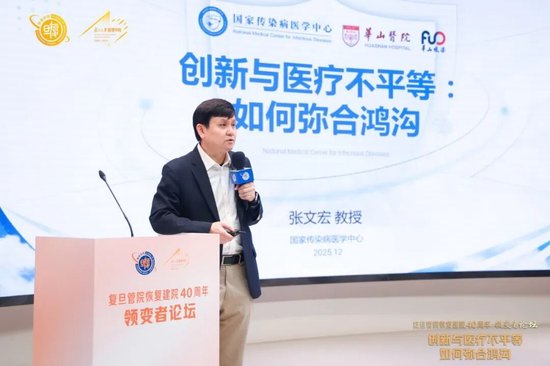
张文宏教授谈医疗创新:平等与公正是关键
Xin Lang Cai Jing· 2025-12-20 03:21
Core Viewpoint - The discussion emphasizes the importance of bridging the gap in healthcare inequality through innovation and sustainable practices, highlighting the need for equitable access to medical technologies and resources [2][20]. Group 1: Innovation and Inequality - Innovation can significantly transform healthcare but may also exacerbate social inequalities if not managed properly [4][22]. - The true driving force behind innovation comes from society, and sustainable innovation must create value for human well-being [5][22]. - Historical disparities in healthcare resources between urban and rural areas in China have prompted government reforms aimed at reducing these gaps [5][23]. Group 2: Economic Barriers in Healthcare - Traditional healthcare disparities stem from economic barriers, including high costs of advanced therapies such as gene therapy and personalized cancer treatments [6][23]. - Economic disparities lead to imbalanced distribution of healthcare resources, creating a divide between "medical wealth" and "medical poverty" [7][23]. - Limited payment capabilities prevent many patients from accessing available treatments, further widening the healthcare gap [8][23]. Group 3: Innovations to Reduce Costs - Innovations are necessary to reduce costs and narrow healthcare disparities, exemplified by the TB-TRUST oral regimen for tuberculosis, which significantly lowers treatment costs and improves success rates [9][24]. - The treatment costs for hepatitis C have dramatically decreased over time due to patent expirations and technological advancements, demonstrating how innovation can eventually bridge healthcare gaps [9][24]. Group 4: Aging Society and New Inequalities - The aging population may deepen existing healthcare disparities, as complex technologies like AI diagnostics may reduce patient autonomy and exacerbate information asymmetry [10][27]. - The emergence of anti-aging technologies could create a "super longevity class," while those unable to afford such treatments may be viewed as burdens [10][27]. - Enhancing digital literacy is crucial to ensure equitable access to digital healthcare resources, particularly for older adults and those with lower education levels [13][28]. Group 5: Policy Initiatives for Healthcare Equity - The "Strong Foundation Project" initiated in 2015 aims to enhance healthcare equity by supporting the establishment of county-level medical communities, which are essential for local healthcare delivery [14][16]. - The development of medical alliances has improved the distribution of quality healthcare resources, particularly in remote areas, allowing more individuals to receive care closer to home [16][29]. - Continued efforts are needed to leverage policy advantages to enhance healthcare service capabilities and achieve the goal of healthcare equality in China [29].
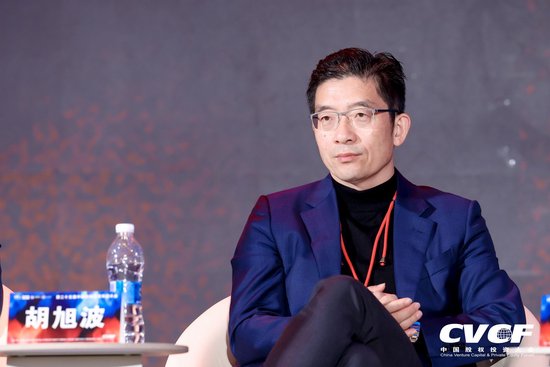
启明创投胡旭波:人工智能公司有泡沫,但行业没有泡沫
Xin Lang Cai Jing· 2025-12-04 11:25
Core Viewpoint - The discussion at the 25th China Private Equity Annual Conference highlighted the ongoing debate about the artificial intelligence bubble, with a focus on investment opportunities in technology and medical innovation sectors [2][4]. Group 1: Investment Focus - Qiming Venture Partners primarily invests in technology and medical innovation industries, with a significant emphasis on the application layer of artificial intelligence as a key investment direction for the year [2][4]. - In the medical innovation sector, the main theme of investment is the globalization of China's pharmaceutical innovation capabilities, including innovative drugs and medical devices [2][4]. Group 2: Industry Perspective - The firm supports investments that integrate companies into the global medical industry chain, encompassing research and development innovation and the establishment of a comprehensive commercialization system [2][4]. - Despite the presence of bubbles in many companies within the artificial intelligence and medical innovation fields, the firm does not believe that the overall industry is experiencing a bubble [2][4].
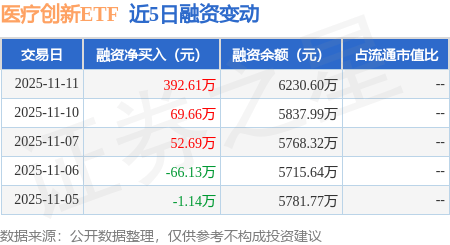
医疗创新ETF:11月11日融资净买入392.61万元,连续3日累计净买入514.96万元
Sou Hu Cai Jing· 2025-11-12 01:58
Core Insights - The Medical Innovation ETF (516820) experienced a net financing purchase of 3.9261 million yuan on November 11, 2025, with a total financing balance of 62.306 million yuan, marking a continuous net purchase over the last three trading days totaling 5.1496 million yuan [1][2]. Financing Activity Summary - On November 11, 2025, the financing net purchase was 3.9261 million yuan, with a financing balance of 62.306 million yuan, reflecting a 6.73% increase from the previous day [2][3]. - The financing balance on November 10, 2025, was 58.3799 million yuan, with a net purchase of 0.6966 million yuan, indicating a 1.21% increase [2][3]. - On November 7, 2025, the financing balance was 57.6832 million yuan, with a net purchase of 0.5269 million yuan, showing a 0.92% increase [2][3]. - The financing balance on November 6, 2025, was 57.1564 million yuan, with a net decrease of 0.6613 million yuan, reflecting a -1.14% change [2][3]. - The financing balance on November 5, 2025, was 57.8177 million yuan, with a negligible net decrease of 0.00114 million yuan, indicating a -0.02% change [2][3].
医疗创新ETF:10月13日融资净买入115.12万元,连续3日累计净买入287.52万元
Sou Hu Cai Jing· 2025-10-14 02:51
Core Insights - The Medical Innovation ETF (516820) experienced a net financing purchase of 1.1512 million yuan on October 13, 2025, with a total financing balance of 50.8295 million yuan, indicating a positive market sentiment towards the ETF [1][3]. Financing Activity Summary - On October 13, 2025, the financing net purchase was 1.1512 million yuan, with a financing balance of 50.8295 million yuan, reflecting a 2.32% increase from the previous day [2][4]. - Over the past three trading days, the cumulative net financing purchase reached 2.8752 million yuan, with 13 out of the last 20 trading days showing net financing purchases [1]. - The financing balance increased by 1.1512 million yuan on October 13, 2025, compared to the previous trading day [4]. Market Sentiment Indicators - An increase in financing balance suggests a strengthening bullish sentiment in the market, while a decrease would indicate a more cautious or bearish outlook [5].
医药牛市下半场,借道医疗创新ETF(516820.SH)布局底部核心资产
Xin Lang Cai Jing· 2025-08-21 02:22
Core Viewpoint - The market is experiencing a rotation from high valuation sectors to reasonably valued sectors, with a notable rebound in core assets in the medical innovation space [1] Group 1: Market Performance - On August 21, the market showed a "high-low cut" trend, with medical devices, traditional Chinese medicine, and vaccines leading in gains [1] - The Medical Innovation ETF (516820.SH) rose by 1.28%, with key stocks such as Pizhou Pharmaceutical (600436) up 4.84%, Mindray Medical (300760) up 3.73%, and Yuyue Medical (002223) up 2.43% [1] Group 2: Investment Opportunities - Funds are shifting towards undervalued sectors, with core assets in medical innovation gradually rebounding [1] - The top ten component stocks in the Medical Innovation ETF are mostly valued below the historical 20th percentile, indicating a significant safety margin [1] - Investors who missed the first half of the medical sector rally can position themselves in the Medical Innovation ETF (516820) to capitalize on the recovery [1]


突发!一公募基金暂停大额申购
Sou Hu Cai Jing· 2025-08-09 10:41
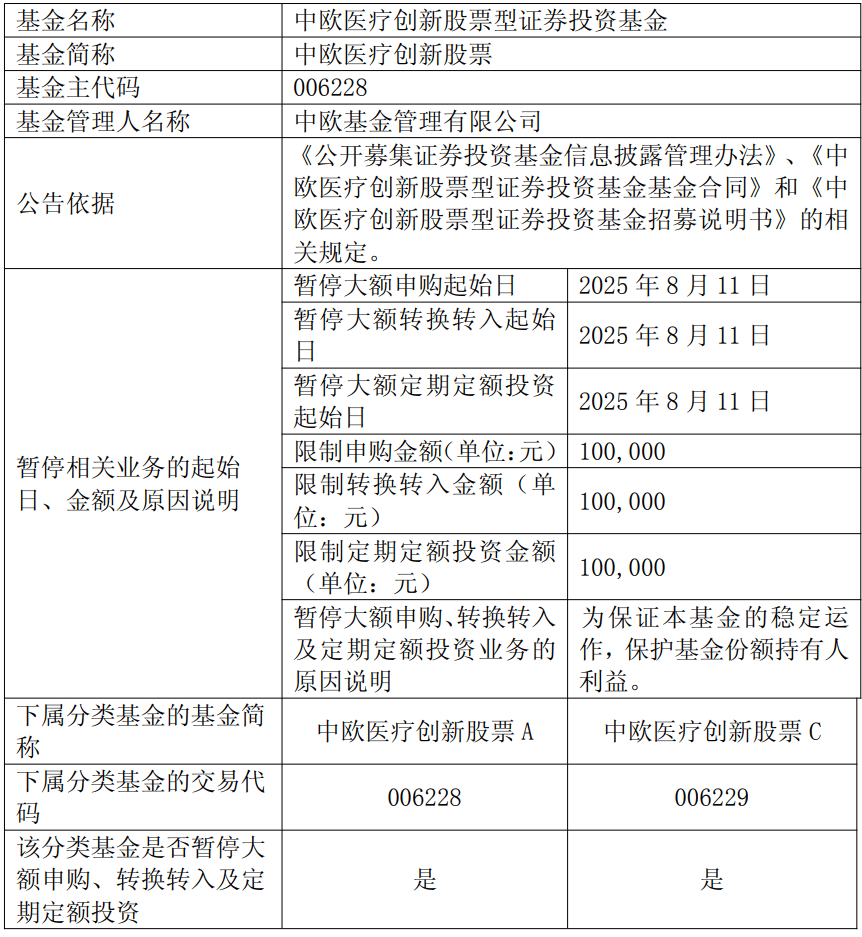
Group 1 - The core announcement is that the China Europe Medical Innovation Equity Fund will restrict subscription, conversion, and regular investment amounts starting from August 11, 2025, to ensure stable operation and protect the interests of fund shareholders [1][2]. - The maximum amount for a single or cumulative subscription, conversion, or regular investment for any category of fund shares is set at 100,000 yuan [1][2]. - The fund, established in February 2019 and managed by Ge Lan, primarily invests in stocks related to the medical innovation sector, aiming to achieve returns that exceed the performance benchmark while strictly controlling investment portfolio risks [2][3]. Group 2 - As of the end of the first half of the year, the fund's top ten holdings include companies such as Sangfor Technologies, Kelun-Botai Biotech, and WuXi Biologics [3]. - The fund's main code is 006228, and it has two sub-funds: China Europe Medical Innovation Stock A (006229) and China Europe Medical Innovation Stock C [2]. - The fund's management company is China Europe Fund Management Co., Ltd., which is responsible for the fund's operations and compliance with relevant regulations [2].
迪拜与中国将共同开启合作共赢新时代
Guo Ji Jin Rong Bao· 2025-07-23 07:47
Core Insights - Strategic partnerships are essential for unlocking growth opportunities in the evolving global economy, with Dubai emerging as a key hub for Chinese enterprises seeking global expansion [1] - The economic complementarity between China and Dubai opens doors for mutual growth, supported by significant trade and investment figures [1][2] Group 1: Trade and Investment - China has been Dubai's largest trading partner for several consecutive years, with non-oil trade projected to exceed $80 billion in 2024, reflecting a 19% annual growth rate [1] - From 2015 to 2023, China's total investment in Dubai reached $5.4 billion, with over 6,000 Chinese companies registered as active members of the Dubai Chamber by mid-2025 [1] - Dubai's strategic location connects Asia, Africa, and Europe, making it a vital gateway for the Belt and Road Initiative [1] Group 2: Economic Agenda and Growth Sectors - Under the Dubai Economic Agenda (D33), the city aims to double its economy by 2033, focusing on high-growth sectors such as AI, fintech, healthcare innovation, clean energy, and advanced manufacturing [2] - China's expertise in these sectors aligns well with Dubai's development goals, creating vast opportunities for collaboration [2] Group 3: Technology and Innovation - Technology is a key area of cooperation, with Dubai building a vibrant innovation ecosystem that welcomes global tech leaders [2] - The D33 agenda sets a target of generating an additional $27 billion annually from digital transformation projects, presenting significant market opportunities for Chinese tech companies [2] Group 4: E-commerce and Logistics - The rapidly expanding consumer market in the Middle East aligns with China's strengths in e-commerce and logistics, with Dubai's advanced infrastructure providing an ideal platform for Chinese businesses to scale operations [3] - Long-term success in the region relies on relationship maintenance and compliance with local regulations, emphasizing the importance of trust and local integration [3] Group 5: Support and Networking - The Dubai Chamber serves as a critical gateway for Chinese enterprises, offering market insights, business connections, and support for regional expansion [4] - The Chamber has established a strong influence network in China, with offices in Shenzhen, Shanghai, and Hong Kong, highlighting the importance of the Chinese market in Dubai's global strategy [3][4] Group 6: Events and Engagement - The Dubai Chamber organizes significant events to deepen interactions with Chinese businesses, such as the Dubai Business Forum held in Beijing, which attracted 800 Chinese business leaders and investors [5] - These initiatives aim to facilitate practical dialogues and convert consensus into actionable cooperation, fostering a win-win partnership between Dubai and Chinese enterprises [5]