
半导体制造设备

Search documents
谁真正控制着芯片供应?
半导体行业观察· 2026-02-11 01:27
Core Insights - Semiconductor manufacturing equipment is the most constrained link in the chip supply chain, determining the capacity ramp-up and process node scaling of wafer fabs [2] - The delivery cycle for advanced equipment can take months, leading to wafer shortages and increased chip prices during any disruptions [2] - Despite the recovery of equipment supply since the 2020-2022 period, demand remains strong, driven by AI servers, HBM, and increased capital expenditures from foundries and IDMs [6] Group 1 - The global equipment investment is projected to reach approximately $130 billion by 2025, with China being the largest investor despite U.S. export controls [6] - The supply chain faces several challenges, including the complexity of equipment components sourced from a few suppliers, which creates structural bottlenecks [9] - The long certification cycles for alternative suppliers exacerbate supply disruptions, as wafer fabs require proven performance before switching suppliers [9] Group 2 - Geopolitical factors are reshaping market dynamics, with U.S. export restrictions altering order flows and prompting China to accelerate domestic equipment development [9] - Global logistics and material trade remain fragile, with reliance on specialized inputs that often require international integration [10] - The demand for on-site support and spare parts is increasing, which can limit service capabilities in certain regions [10] Group 3 - Yole Group anticipates three major transformations in the semiconductor equipment ecosystem, focusing on regionalization and collaboration with subsystem suppliers [11] - The diversification of technology will shift the location of bottlenecks, as advanced packaging and heterogeneous integration create new equipment demands [12] - Key players in the semiconductor equipment market include ASML, Applied Materials, Lam Research, and Tokyo Electron, with emerging Chinese OEMs like Naura and AMEC gaining traction [12]



美股异动丨泛林集团盘前涨约6%,开盘势创历史新高,Q3业绩指引大超预期
Ge Long Hui A P P· 2026-01-29 09:32
Group 1 - The core viewpoint of the article highlights that Lam Research Corporation (LRCX.US) reported better-than-expected financial results for Q2 of fiscal year 2026, leading to a pre-market stock price increase of approximately 6% to $253.4, potentially reaching a historical high [1] Group 2 - For Q2, Lam Research's revenue reached $5.34 billion, representing a 22% year-over-year increase, exceeding expectations by $100 million [1] - The non-GAAP earnings per share (EPS) for the quarter was $1.27, surpassing the forecast by $0.10 [1] - Looking ahead, the company anticipates Q3 revenue to be between $5.4 billion and $6 billion, significantly above the previous expectation of $5.3 billion [1] - The projected EPS for Q3 is expected to be between $1.25 and $1.45, higher than the market consensus of $1.20 [1]

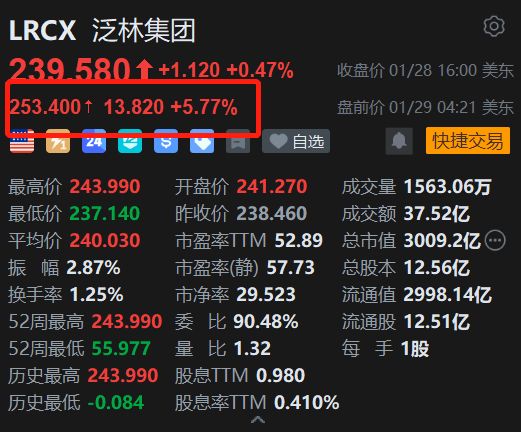
业绩全线“爆表”!泛林集团(LRCX.US)营收大涨22% Q3指引远超市场预期
智通财经网· 2026-01-29 00:29
Core Insights - Lam Research Corporation (LRCX.US) reported better-than-expected Q2 FY2026 earnings, with revenue of $5.34 billion, a 22% year-over-year increase, exceeding expectations by $100 million [1] - The company’s adjusted gross margin was 49.7%, surpassing the previous forecast of 48.6%, and the adjusted operating margin was 34.3%, higher than the anticipated 32.9% [1] - The stock price increased by over 5% in after-hours trading, reaching $254.33, a 6.23% rise at the time of reporting [1] Revenue Breakdown - Revenue from mainland China accounted for 35%, Taiwan for 20%, South Korea for 20%, and Japan for 10% [1] Future Outlook - Lam Research expects Q3 revenue to be between $5.4 billion and $6 billion, significantly above the previous estimate of $5.3 billion [1] - Projected earnings per share for Q3 are anticipated to be between $1.25 and $1.45, exceeding the market consensus of $1.20 [1] Management Commentary - CEO Tim Archer highlighted the company's expanding product and service portfolio, driving the market towards smaller and more complex 3D devices and packaging [2] - The company is enhancing execution speed across its operations to support customer growth amid the acceleration of artificial intelligence [2] Financial Position - As of the end of Q4 2025, cash and cash equivalents decreased to $6.2 billion from $6.7 billion at the end of Q3 2025, primarily due to reduced cash for capital return activities and capital expenditures [2]
半导体制造设备市场扩大,或于2027年达到顶峰
Shang Wu Bu Wang Zhan· 2026-01-07 16:19
Core Insights - The global semiconductor manufacturing equipment sales are projected to reach $133 billion in 2023, marking a 13.7% year-on-year increase [1] - The market is expected to continue growing, reaching $145 billion in 2026 and $156 billion in 2027, setting new historical records [1] - The rapid growth is attributed to the expanding demand for AI, which drives investments in high-end logic chips, memory chips, and advanced packaging and testing [1] Market Segmentation - The wafer manufacturing equipment market is anticipated to grow by 11.0% in 2023, reaching $115 billion [1] - Semiconductor testing equipment sales are expected to surge by 48.1% this year, totaling $11.2 billion [1] - Assembly equipment sales are projected to increase by 19.6%, reaching $6.4 billion [1]
中科仪IPO闯关遇坎:“免费”备用泵模式引质疑
仪器信息网· 2025-11-24 09:06
Core Viewpoint - The article discusses the second round of inquiry from the Beijing Stock Exchange regarding the IPO application of China Academy of Sciences Shenyang Instrument Co., Ltd. (referred to as "the company"), focusing on market competition, sustainability of performance growth, and inventory risks associated with its unique "backup pump" business model [2][3][4][6]. Group 1: Market Competition - The inquiry emphasizes the challenges the company faces in a competitive market, particularly against competitors like Ebara and Kashi yama, who provide vacuum equipment for the integrated circuit sector [3]. - The company’s products still show slight gaps in reliability and stability compared to international leaders, particularly in advanced process technology accumulation [3]. - The exchange requires the company to explain the technology iteration cycles of its main competitors and analyze its competitive strategies in the integrated circuit field [3]. Group 2: Sustainability of Performance Growth - The company's revenue from the photovoltaic sector has seen a dramatic decline, raising doubts about the sustainability of its performance growth [4]. - Revenue from dry vacuum pumps in the photovoltaic sector dropped from a peak of 176 million yuan in 2023 to just 302,700 yuan in the first half of 2025, indicating a cliff-like drop [4]. - The company’s gross margin in the photovoltaic sector is lower than that of similar products, and the performance of major clients in this sector is continuously declining [5]. Group 3: Inventory Risks and Backup Pump Business Model - The inquiry highlights the inventory risks associated with the company's backup pump business model, where backup pumps are provided to clients without separate charges, leading to a significant increase in inventory from 139 million yuan to 410 million yuan [6]. - The rising inventory levels are accompanied by a declining inventory turnover rate, raising concerns about the commercial substance of this model and its implications for future orders [6]. - Financial data shows that while revenue increased from 698 million yuan to 1.082 billion yuan from 2022 to 2024, net profit saw a stark decline of 67.8% in 2024, indicating volatility in profitability [6]. Group 4: Fundraising and Financial Health - The company plans to raise 825.48 million yuan, with cash reserves of 594.84 million yuan as of June 2025, prompting the exchange to request details on the planned use of funds and expected cash inflows post-IPO [7]. - The company has highlighted risks associated with fluctuations in the stock prices of its holdings in listed companies, which could significantly impact its financial performance [8].

【环球财经】日本对美出口连续7个月同比下降
Xin Hua Cai Jing· 2025-11-21 03:26
Core Insights - Japan's exports to the United States have been declining for seven consecutive months since April 2023, primarily due to U.S. tariff policies [1] - In October, Japan's exports to the U.S. fell by 3.1% year-on-year to 1.75 trillion yen (approximately 15.7 billion USD), with significant declines in automotive, semiconductor manufacturing equipment, and pharmaceuticals [1] - The trade deficit has persisted for four months, with October's trade deficit reaching 231.8 billion yen, despite an overall export increase of 3.6% to 9.7663 trillion yen [1] Export Performance - The decline in exports to the U.S. is largely attributed to a 7.5% decrease in automotive exports, a 49.6% drop in semiconductor manufacturing equipment, and a 30.8% reduction in pharmaceuticals [1] - Automotive exports remain the largest factor contributing to the ongoing decline in Japan's exports to the U.S. [1] Trade Deficit Context - The continuous decline in exports to the U.S. has led to a trade deficit, which is a significant factor in the depreciation of the yen [1] - Exports to Asia and the European Union have increased, helping to offset some of the losses from U.S. exports [1]
上海市进口出口连续七个月“双增长”
Xin Hua Cai Jing· 2025-11-14 08:07
Core Insights - Shanghai's total import and export value reached 3.71 trillion yuan in the first ten months of the year, marking a 5.2% increase year-on-year, which is 1.6 percentage points higher than the national average growth rate [1] - In October alone, Shanghai's import and export value was 367.98 billion yuan, with exports at 161.53 billion yuan and imports at 206.45 billion yuan, reflecting year-on-year growth of 3.5% and 2.8% respectively [1] Group 1: Trade Performance - Cumulative exports from Shanghai in the first ten months totaled 1.64 trillion yuan, up 10.5% year-on-year, while cumulative imports reached 2.07 trillion yuan, a 1.3% increase [1] - Shanghai's trade with emerging markets such as ASEAN, the Middle East, and Africa saw significant growth, with imports and exports of 530.31 billion yuan, 133.36 billion yuan, and 122.22 billion yuan respectively, representing year-on-year increases of 12.6%, 19.7%, and 26.8% [1] - Trade with major BRICS countries like Brazil and India also grew, with respective import and export values of 92.35 billion yuan and 81.34 billion yuan, showing increases of 7.8% and 31.6% [1] Group 2: Emerging Products and Sectors - Exports of emerging products such as electric passenger vehicles, lithium batteries, and solar cells reached 131.43 billion yuan, reflecting an 11.7% year-on-year increase, with growth rates exceeding 25% in the last six months [2] - The export of green shipping equipment, particularly liquid cargo ships, surged to 27.46 billion yuan, marking a substantial year-on-year increase of 115% [2] - Imports of high-tech products showed significant growth, with semiconductor manufacturing equipment, computers and components, and aircraft and parts increasing by 29.6%, 18.3%, and 92.4% respectively [2] Group 3: Consumer Goods - The import of consumer goods in Shanghai performed well, with dairy products, dried and fresh fruits, and beef seeing year-on-year increases of 16.2%, 15.3%, and 10.8% respectively, indicating a gradual release of domestic consumption vitality [2]
2025年8月中国半导体制造设备进口数量和进口金额分别为0.47万台和32.03亿美元
Chan Ye Xin Xi Wang· 2025-10-29 03:03
Core Insights - The report by Zhiyan Consulting highlights the market dynamics and investment outlook for the semiconductor manufacturing equipment industry in China from 2025 to 2031 [1] Import Data Summary - In August 2025, China imported 4,700 semiconductor manufacturing equipment units, representing an 18.5% year-on-year decline [1] - The import value for the same period was $3.203 billion, showing an 8.2% year-on-year increase [1] Industry Analysis - Zhiyan Consulting is recognized as a leading industry consulting firm in China, specializing in in-depth industry research and providing comprehensive consulting services [1] - The firm emphasizes its commitment to delivering quality services and market insights to empower investment decisions [1]

日本上半财年对美出口同比大降
Xin Hua Wang· 2025-10-22 07:28
Core Viewpoint - Japan's exports to the United States have significantly decreased due to the impact of U.S. tariffs on automobiles and steel, leading to a substantial reduction in Japan's trade surplus with the U.S. [1] Group 1: Trade Statistics - In the first half of the fiscal year 2025 (April to September 2023), Japan's exports to the U.S. fell by 10.2% to 9.71 trillion yen (approximately 64 billion USD) [1] - The trade surplus with the U.S. decreased by 22.6% to 3.32 trillion yen (approximately 22 billion USD) [1] - The decline in exports was primarily driven by a 22.7% drop in automobile exports, which constitute over one-third of Japan's total exports to the U.S. [1] Group 2: Global Trade Overview - Japan's total exports increased slightly by 0.2% year-on-year to 53.65 trillion yen (approximately 352 billion USD) [1] - Japan's imports decreased by 3.2% year-on-year to 54.88 trillion yen (approximately 360 billion USD) [1]
2025年4月中国半导体制造设备进口数量和进口金额分别为0.48万台和31.07亿美元
Chan Ye Xin Xi Wang· 2025-10-22 01:13
Core Insights - The report by Zhiyan Consulting highlights a decline in China's semiconductor manufacturing equipment imports in April 2025, with a total of 4,800 units imported, representing a year-on-year decrease of 9.9% [1] - The import value for the same period was $3.107 billion, showing a year-on-year decline of 8.8% [1] Industry Overview - The data is sourced from Chinese customs, indicating a significant trend in the semiconductor manufacturing equipment sector [1] - Zhiyan Consulting is recognized as a leading industry consulting firm in China, specializing in in-depth industry research and providing comprehensive consulting services [1]
