
地方融资平台

Search documents
2026年: 回顾这25年的融资模式演变, 从纷繁复杂到华山自古一条路
Sou Hu Cai Jing· 2026-01-04 12:41
Core Viewpoint - The article discusses the evolution of infrastructure financing policies in China, highlighting significant shifts in government strategies over the years to balance infrastructure development with debt control and risk management [2]. Development Stage (Early 2000s - 2008) - The development of infrastructure financing began with the China Development Bank's advocacy for developmental finance, reaching its first peak around 2008. Prior to this, local financing platforms were emerging but lacked proper guidance, leading to disorganized growth [3]. - The introduction of the self-balancing concept linked local infrastructure projects with fiscal revenues, resulting in a surge of loans for land reserve, urban village renovation, urbanization, and new rural construction [3]. Control Platform Stage (2010 Onwards) - In response to the growing unmanageable debt from local financing platforms, the State Council issued a notice in 2010 to control new financing from these platforms. This included a classification of debts into three categories based on their repayment sources [4]. Enlightened Channel Stage (2014 Onwards) - By 2014, it became evident that merely controlling financing platforms was ineffective. The State Council introduced policies to promote special bonds and Public-Private Partnerships (PPP), marking the beginning of a new era of project investments amounting to trillions [5]. Blocking Dark Channels Stage (2018-2019) - A series of regulations were implemented in 2018 and 2019 to prohibit new hidden debts and halt the use of land revenue for special bonds and PPP projects. This marked a significant tightening of financing regulations [6]. Precipice of Change (2019-2024) - The period following 2019 has seen a dramatic shift in infrastructure financing, particularly with the decline of the fixed-income model, which relied on government guarantees rather than project revenues for debt repayment [7][8]. Fixed-Income Model Decline - The fixed-income borrowing model, which included local government bonds and PPPs, has faced increasing scrutiny and regulation, leading to a significant reduction in its viability. The model's reliance on government credit rather than project profitability has been identified as a fundamental flaw [9]. Urban Renewal and Integration of Village Renovation (2025) - The concept of urban renewal has evolved significantly, now encompassing a wide range of urban construction activities, including the renovation of urban villages and redevelopment of inefficient land. This shift represents a major expansion of the urban renewal concept [10][11]. - The integration of urban village renovation into the urban renewal framework positions it as a key pathway for infrastructure financing, marking a significant change in the financing landscape [11].


融资平台退出和城投公司转型的路径探析——基于金融债权视角
Sou Hu Cai Jing· 2025-11-12 14:10
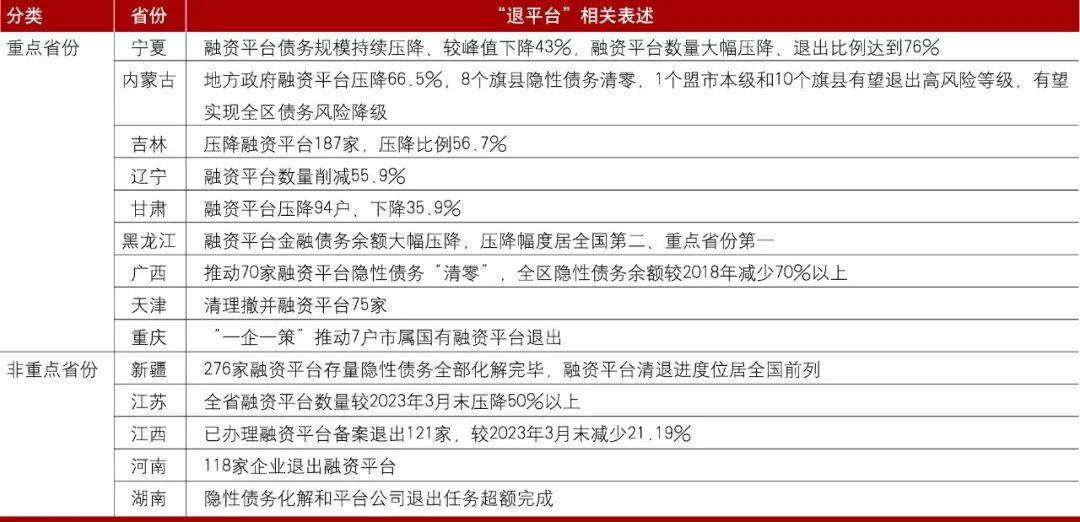
Core Viewpoint - Local debt risk is considered one of the three major "gray rhinos" in the economic field, crucial for the overall construction of Chinese-style modernization. The exit of financing platforms and the market-oriented transformation of urban investment companies are essential for establishing a long-term mechanism to prevent and resolve local debt risks, as well as achieving "development through debt reduction" [1]. Financing Platform Exit Situation - The local debt, primarily carried by financing platforms, has played a significant role in promoting local economic and social development. A series of government documents since 2010 have aimed to regulate and reduce the functions of these platforms, culminating in the 2024 "Document No. 150," which mandates the complete exit of financing platforms by June 2027, requiring them to clear hidden debts and transform into market-oriented entities [2][3]. Progress and Path of National Financing Platform Exit - By 2025, significant progress has been made in reducing the number of financing platforms, with a total reduction of 4,680 platforms, accounting for over two-thirds of the annual decrease. Some provinces, such as Ningxia and Inner Mongolia, have achieved exit rates of 76% and 66.5%, respectively, surpassing the national average [3][4]. Challenges and Difficulties in Financing Platform Exit - The exit process faces several challenges, including pressure to clear hidden debts, difficulties in obtaining consent from financial creditors, and unclear operational standards. The current economic environment, characterized by declining land transfer revenues and tight finances, exacerbates these challenges [6]. Urban Investment Company Transformation Path - Urban investment companies are experiencing a "three weaknesses" phenomenon in operations, management, and assets. The transformation process is focused on market-oriented, refined, and specialized development, with a shift towards becoming state-owned capital investment/operation companies, urban comprehensive operators, or industrial groups [7][8]. Transition to State-Owned Capital Investment/Operation Companies - The primary model involves integrating industrial investment with state-owned asset management, focusing on optimizing state capital layout and enhancing value preservation and appreciation. This transition is guided by national policies and aims to improve operational efficiency [9]. Transition to Urban Comprehensive Operators - Urban comprehensive operators are expected to provide a full range of services, from planning and construction to operation and management. This transition requires a clear urban development strategy and the expansion of diversified business operations [13][14]. Transition to Industrial Companies - The trend of urban investment companies rebranding as "industrial investment" reflects a strategic intent to alleviate local debt pressure and effectively promote industrial development. This involves optimizing industrial park operations and leveraging regional resource advantages [16][17]. Recommendations for Financing Platform Exit and Urban Investment Company Transformation - To achieve effective exit and transformation, a top-level design approach is necessary, focusing on short-term survival and long-term development. This includes establishing clear exit goals, optimizing asset and debt structures, and enhancing financial support mechanisms [19][20][21].
从“加快剥离政府融资功能”到“出清”,地方融资平台或“减量提质”
Sou Hu Cai Jing· 2025-08-12 08:26
Core Viewpoint - The recent meeting of the Central Political Bureau emphasizes the need to actively and steadily resolve local government debt risks, prohibiting the addition of new hidden debts, and effectively advancing the clearance of local financing platforms [1] Group 1: Policy Development - The term "clearance" signifies a more thorough approach than merely "separating" government financing functions, indicating a requirement for the complete exit of non-transformable "shell" platforms [4] - The shift from "accelerating the separation of government financing functions" to "clearance" reflects a deepening of policy implications, focusing on the complete removal of platforms that cannot transition to market-oriented entities [3][4] Group 2: Implementation Strategy - The phrase "forceful, orderly, and effective" outlines a clear action plan for the clearance of financing platforms, emphasizing a strong commitment to the task while ensuring a controlled and gradual process [6] - "Forceful" indicates a decisive policy direction, mandating that local financing platforms exit by no later than June 2027, with 2025 being a significant year for platform exits [5][7] - "Orderly" stresses the importance of avoiding chaotic exits that could lead to new risks, advocating for a categorized approach based on the specific circumstances of each platform [5][7] - "Effective" focuses on achieving genuine transformation post-clearance, ensuring that platforms can operate independently in the market and sever ties with government credit [6] Group 3: Challenges and Perspectives - The transition process for financing platforms faces significant challenges, particularly for counties and platforms lacking quality assets, making financing and industrial transformation difficult [4] - The determination to clear local financing platforms is underscored by the need to manage hidden debts effectively, as failure to do so could lead to their proliferation [4]
中央政治局会议定调下半年经济工作,释放哪些信号?
Sou Hu Cai Jing· 2025-07-31 11:32
Economic Outlook - The meeting emphasized the need to maintain a stable yet progressive approach to economic work, focusing on employment, enterprises, markets, and expectations [1][3] - China's economy is showing a steady improvement, with key economic indicators performing well, despite facing risks and challenges [1][2] GDP Performance - In the first half of the year, China's GDP reached 66,053.6 billion yuan, growing by 5.3% year-on-year [2] - The high-tech industry, representing new productive forces, saw a significant increase of 9.5% in value added [2] Policy Measures - The meeting highlighted the importance of maintaining policy continuity and stability while enhancing flexibility and foresight in economic policies [3] - There is an expectation for more proactive fiscal policies and a stable monetary policy to support economic growth [3][4] Local Government Debt Management - The meeting addressed the need to manage local government debt risks and prohibited the creation of new hidden debts [5] - Emphasis was placed on the effective use of government bonds and improving funding efficiency [5] Market Competition and Industry Adjustment - The meeting discussed the need to optimize market competition and address issues of disorderly competition among enterprises [7] - Policies aimed at curbing low-price competition and managing excess capacity in key industries will continue [7] Urban Renewal Initiatives - The meeting reiterated the importance of high-quality urban renewal, aligning with previous central government directives [8][9] - Future policies are expected to support sustainable urban renewal models and attract social capital for participation [9]