
基础化工业

Search documents
国新证券每日晨报-20260330
Guoxin Securities Co., Ltd· 2026-03-30 03:24
Domestic Market Overview - The domestic market experienced a low opening followed by a rise, with the Shanghai Composite Index closing at 3913.72 points, up 0.63% [4][8] - The Shenzhen Component Index closed at 13760.37 points, up 1.13%, while the ChiNext Index rose by 0.71% [4][8] - A total of 25 out of 30 sectors in the CITIC industry classification saw gains, with significant increases in pharmaceuticals, basic chemicals, and non-ferrous metals [4][8] - The total trading volume of the A-share market was 186.38 billion yuan, continuing to decline from the previous day [4][8] Overseas Market Overview - The three major U.S. stock indices all closed lower, with the Dow Jones down 1.73%, the S&P 500 down 1.67%, and the Nasdaq down 2.15% [2][4] - Amazon's stock fell nearly 4%, leading the decline in the Dow [2][4] - The Nasdaq China Golden Dragon Index dropped by 1.90%, with notable declines in stocks like Pony.ai, which fell nearly 6% [2][4] Industry Insights - In the first two months of the year, the total profit of industrial enterprises above designated size reached 102.456 billion yuan, a year-on-year increase of 15.2%, accelerating by 14.6 percentage points compared to the previous year [9] - The revenue of these enterprises grew by 5.3% year-on-year, improving by 4.2 percentage points from the previous year, indicating favorable conditions for profit recovery [9] - Among 41 industrial categories, 26 saw profit growth accelerate or a reduction in decline, with over 60% of industries experiencing a rebound [9] News Highlights - Several small and medium-sized banks have lowered deposit rates, focusing on optimizing their deposit structures [10] - The Ministry of Ecology and Environment held a meeting to address air pollution prevention in the Yangtze River middle reaches urban agglomeration [11] - Two major aluminum plants in the Middle East were attacked, potentially impacting the global supply chain [13]
国泰海通晨报-20260312
GUOTAI HAITONG SECURITIES· 2026-03-12 01:20
Group 1: China Energy Construction (中国能建) - The report maintains a "Buy" rating for China Energy Construction, with a target price of 3.86 yuan, corresponding to a PE ratio of 17.5 times for 2026 [3][4]. - The company is actively participating in the "East Data West Computing" initiative, leveraging its advantages in "data-energy integration" and "computing-electricity synergy" to promote the low-carbon transformation of the energy sector [4][5]. - China Energy Construction has received approval from the China Securities Regulatory Commission for a private placement to raise up to 9 billion yuan, which is expected to enhance its capital structure and support its growth initiatives [3][5]. Group 2: LianKe Technology (联科科技) - The report maintains a "Buy" rating for LianKe Technology, with a target price of 34.92 yuan, reflecting an expected EPS growth of 43.4% from 2026 to 2028 [7][9]. - The company is expanding its production capacity for high-purity sodium silicate, which is crucial for improving product quality and achieving self-sufficiency in key raw materials [9]. - LianKe Technology's revenue for 2025 is projected to reach 2357.13 million yuan, with a year-on-year growth of 4.03%, driven by increased sales in silica and carbon black products [8][9]. Group 3: Industry Trends - The report highlights the significant growth opportunities in strategic emerging industries, particularly in renewable energy, hydrogen energy, and energy storage technologies, with a focus on projects like the Jilin Songyuan hydrogen energy industrial park [5][6]. - The construction of new energy projects is expected to accelerate, with the company having secured over 76 million kilowatts of domestic renewable energy development indicators by mid-2025 [5]. - The report notes that the National Grid's fixed asset investment during the 14th Five-Year Plan period is projected to reach 4 trillion yuan, a 40% increase compared to the previous plan, indicating robust growth in the energy infrastructure sector [5].
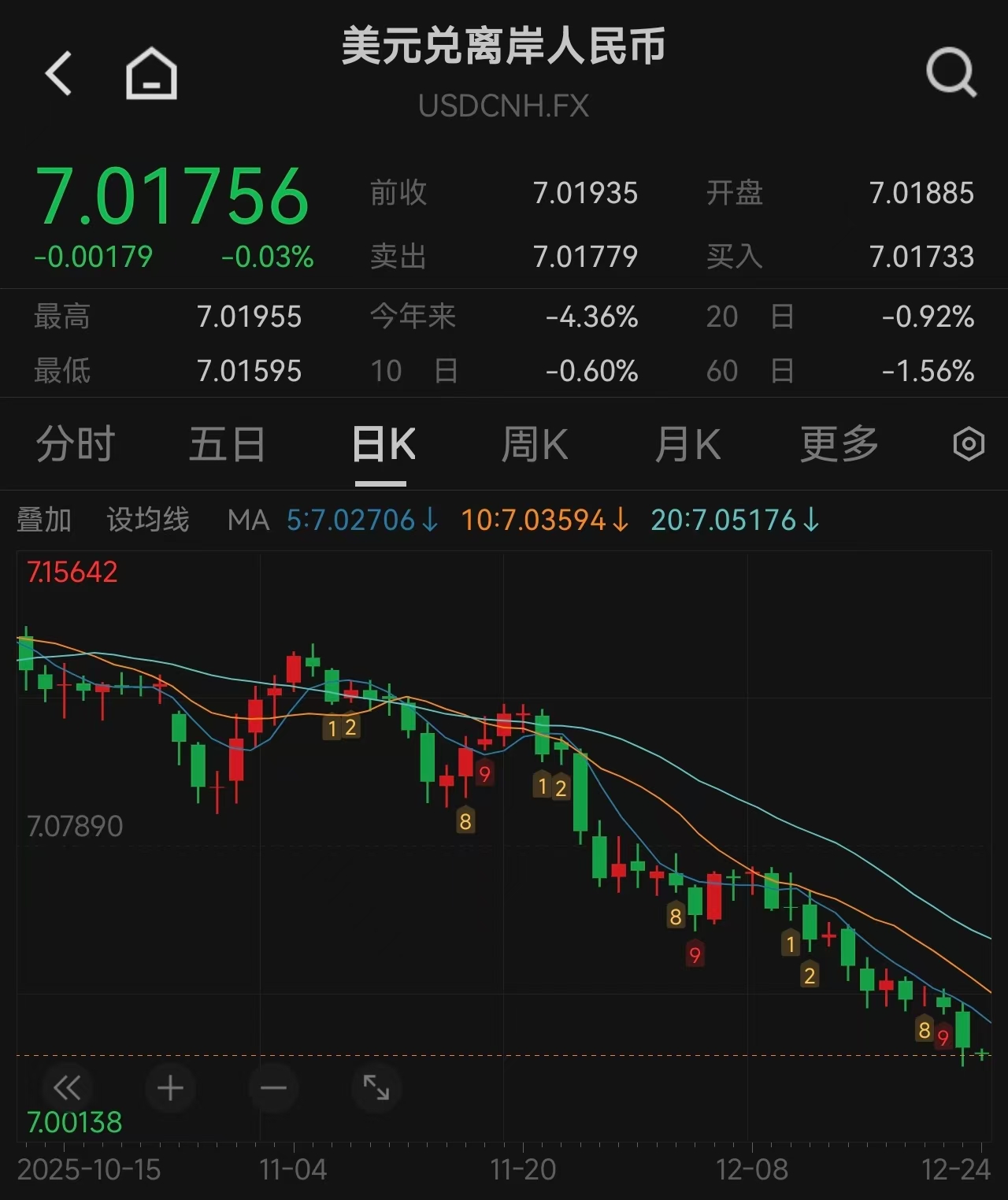
人民币创14个月新高,对A股市场影响几何?谁喜谁忧?这些板块迎“汇率红包”
Jin Rong Jie· 2025-12-24 01:33
Core Viewpoint - The offshore and onshore RMB have both strengthened against the USD, reaching their highest levels in 14 months, which is expected to attract foreign investment into Chinese assets [1][3]. Group 1: Impact of RMB Appreciation - The appreciation of the RMB enhances the attractiveness of RMB-denominated assets, particularly for foreign investors focused on exchange rate gains [3]. - Historical data indicates that during periods of RMB appreciation, foreign capital, represented by "northbound funds," tends to show accelerated net inflows, favoring liquid, well-valued assets that align with China's economic growth [3]. - The current A-share market is at a historically low valuation, and the strengthening RMB may catalyze long-term foreign capital to reassess and increase allocations to Chinese assets, potentially stabilizing or boosting market indices [3]. Group 2: Beneficiaries and Losers - Export-oriented industries, such as home appliances, electronics, textiles, and machinery, are likely to suffer as RMB appreciation reduces their price competitiveness in international markets, potentially eroding exchange gains and profit margins [3][4]. - Beneficiaries of RMB appreciation include industries with significant dollar-denominated liabilities, such as airlines, which will see improved financials due to reduced exchange losses [4]. - Cost-importing sectors, like paper and basic chemicals, will benefit from lower raw material costs due to RMB appreciation, enhancing their profit margins [4]. Group 3: Market Sentiment and Trends - The psychological impact of RMB appreciation is significant, as it signals economic stability, effective policy, and international capital recognition, which can fundamentally boost market risk appetite [4]. - In an appreciating currency environment, "core assets" are likely to perform better, with large-cap value stocks benefiting from their close ties to the macroeconomy and foreign capital preferences [4]. - The importance of sustained RMB appreciation is emphasized, as lasting trends rather than short-term fluctuations will have a more profound impact on the A-share market [4][5].

沪指重返3500点!这些方向开始领跑
Sou Hu Cai Jing· 2025-07-09 04:54
Group 1 - A-shares have shown a structural market characteristic, with strong performance in consumer sectors such as food and beverage, and retail, as well as certain technology sectors like AI applications and innovative pharmaceuticals [2][4] - The top five performing industries in A-shares include agriculture, media, food and beverage, electrical equipment, and retail, indicating a growing interest in agricultural assets and a recovery in consumer spending [2] - The bottom five performing industries in A-shares are electronics, steel, basic chemicals, non-ferrous metals, and storage chips, with the decline in non-ferrous metals linked to proposed US tariffs on copper [2] Group 2 - In the Hong Kong market, the healthcare sector has seen a rise due to active innovative drug concepts, despite potential US tariffs on pharmaceuticals [3] - The top three performing industries in Hong Kong include healthcare, industrial, and energy, while the bottom three are materials, information technology, and real estate, reflecting external pressures from US tariff policies and global tech supply-demand imbalances [3] - The current market characteristics indicate that A-shares are driven by policy and sectoral improvements, while Hong Kong stocks are more influenced by external factors such as US tariffs and global technology cycles [4] Group 3 - Short-term market hotspots are concentrated around policy-driven sectors and improving industry conditions, with a focus on performance in the upcoming earnings reports [4] - The breakthrough of the Shanghai Composite Index above 3500 points is expected to further boost market confidence, with potential policy signals from the July Politburo meeting influencing capital flows [4]