塑料和橡胶

Search documents
今年8-11月巴西对美国出口下降
Shang Wu Bu Wang Zhan· 2025-12-23 16:46
Core Insights - Brazilian exports to the United States are projected to decline significantly due to increased tariffs imposed by the U.S. government, with an estimated total decrease of approximately $1.5 billion from August to November 2025 [1] Industry Impact - A total of 21 industries in Brazil are expected to experience a year-on-year decline in exports to the U.S. during the specified period [1] - The most affected sectors include food, plastics and rubber, wood, metals, and transportation equipment, indicating a broad impact across various industries [1]
400亿转型金融落地 广东发布2项转型金融标准助力低碳转型
2 1 Shi Ji Jing Ji Bao Dao· 2025-12-11 05:17
Group 1 - The green low-carbon transition of traditional high-carbon industries is essential for Guangdong's high-quality development and is a key measure to achieve the "dual carbon" goals [2][9] - The "2025 Guangdong Green Finance Reform and Innovation Promotion Conference" held on December 10 in Nansha, Guangzhou, announced the release of two standards: the "Guangdong Province Paper Industry Transition Financial Implementation Guidelines" and the "Guangzhou City Transition Financial Implementation Guidelines" [2][9] Group 2 - Transition finance aims to provide funding support for high-emission economic activities to transition to low or zero emissions, serving as a crucial tool for promoting sustainable development in high-energy-consuming industries [3][10] - In 2024, Guangdong's paper and paperboard production is projected to reach 26.48 million tons, accounting for 16.7% of the national total; Guangzhou's green petrochemical and new materials industry has surpassed 400 billion yuan in output value, with over 1,600 enterprises [3][10] - The "Guangdong Province Paper Industry Transition Financial Implementation Guidelines" is the first provincial-level group standard in China to support the low-carbon transition of the paper industry, organized by various financial and industry associations [3][10] Group 3 - The guidelines include a project directory for financial support in the paper industry, covering 39 specific technical paths across four categories: energy structure optimization, energy-saving processes and equipment, clean production, and waste resource utilization [4][11] - The "Guangzhou City Transition Financial Implementation Guidelines" is the first transition financial standard in Guangzhou, covering the chemical raw materials, pharmaceutical manufacturing, and rubber and plastic products industries [5][12] Group 4 - The two standards provide clear operational guidelines for low-carbon transition activities in key industries such as paper, chemicals, plastics, and pharmaceuticals, helping to direct financial resources more accurately and systematically towards transition areas [5][12] - A recent matching event under these guidelines facilitated collaboration between 135 enterprise projects and banking institutions, with total bank credit exceeding 40 billion yuan [6][13] - The projects span across 19 cities in Guangdong, demonstrating a significant regional synergy effect in transition finance and biodiversity finance [6][13]


2025年广东绿色金融改革创新推进会暨转型金融标准发布会成功举办
Xin Lang Cai Jing· 2025-12-10 10:33
Core Viewpoint - Guangdong is positioning itself as a leader in green finance reform and innovation, focusing on accelerating the green transformation of its economy and society in line with the "dual carbon" strategy and the upcoming "14th Five-Year Plan" completion and "15th Five-Year Plan" preparation [1][9]. Group 1: Standards Leading Traditional Industry Transformation - Transition finance aims to provide funding support for high-emission economic activities to shift towards low or zero emissions, which is crucial for sustainable development in high-energy-consuming industries [1][10]. - The "Guangdong Province Paper Industry Transition Finance Implementation Guidelines" is the first provincial standard in China to support the low-carbon transition of the paper industry, covering 39 specific technical paths [2][10]. - The "Guangzhou Transition Finance Implementation Guidelines" is the first transition finance standard in Guangzhou, covering the chemical, pharmaceutical, and rubber and plastic manufacturing industries [3][11]. Group 2: Project Implementation and Green Finance Collaboration - In 2024, Guangdong's paper and board production is projected to reach 26.48 million tons, accounting for 16.7% of the national total, while the green petrochemical and new materials industry in Guangzhou has surpassed 400 billion yuan in output [4][12]. - A recent event facilitated collaboration between 135 enterprise projects and banking institutions, resulting in over 40 billion yuan in credit approvals, with projects spanning various sectors including paper, chemicals, and biodiversity [5][13]. - The financing is directed towards operational funding, project construction, equipment upgrades, and green product development, ensuring financial resources are effectively utilized for green transition activities [5][13]. Group 3: Expert Insights and Future Directions - The event featured discussions from industry experts and financial institutions on the trends and challenges of green low-carbon transitions, sharing practical cases to foster collaboration and innovation in green finance [6][14]. - The launch of the 2026 Guangdong Green Finance Innovation Case Collection and Promotion Activity aims to further promote green finance reform and innovation achievements [7][15]. - The successful hosting of the conference marks a significant step in Guangdong's innovation in transition finance and biodiversity finance, emphasizing the need for collaborative participation and practice in green finance development [7][15].
资本市场服务宁波塑料和橡胶产业研讨交流会举办
Qi Huo Ri Bao Wang· 2025-10-30 18:22
Core Insights - The seminar aimed to enhance the integration of capital markets with the plastic and rubber industries in Ningbo, supporting the city's goal of creating a trillion-yuan industrial cluster [1] Group 1: Event Overview - The seminar was organized by the Ningbo Securities and Futures Industry Association in collaboration with various local industry associations, attracting nearly 100 representatives from the plastic and rubber sectors and financial institutions [1] - The theme of the event was "Integration of Industry and Finance to Reduce Costs and Increase Efficiency" [1] Group 2: Key Discussions - Experts discussed macroeconomic conditions, industry policies, financing strategies, hedging, and e-commerce empowerment [2] - Insights were shared on the current domestic and international economic landscape, highlighting opportunities and challenges for the plastic and rubber industries [2] - A unique "Industry Collaborative Group Purchasing" model was proposed to address supply-demand mismatches using digital tools [2] Group 3: Future Directions - The seminar is part of a broader initiative to implement national policies aimed at enhancing capital market functions and supporting healthy industry development [3] - Future activities will include more industry-finance connection events and collaboration with various industry associations to foster efficient communication and cooperation [3]
美国8月ISM制造业PMI连续六个月萎缩,新订单改善,价格指数再回落
Sou Hu Cai Jing· 2025-09-02 20:05
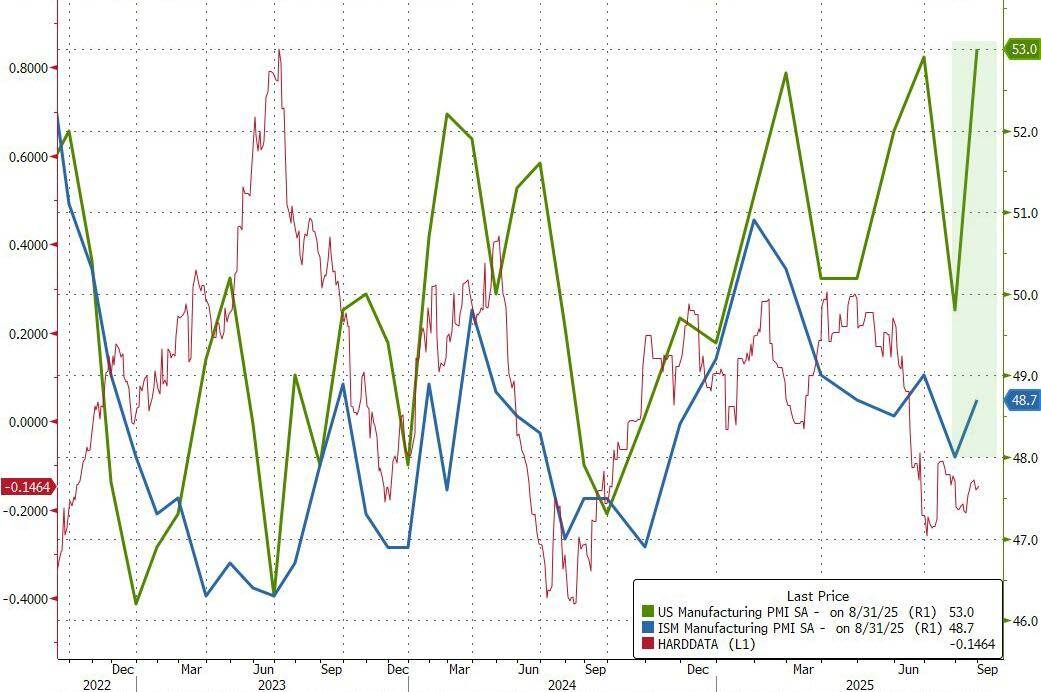
Core Insights - The ISM reported that U.S. manufacturing activity contracted for the sixth consecutive month in August, primarily due to a decline in output, indicating ongoing challenges in the manufacturing sector [1] - However, the new orders index expanded for the first time since the beginning of the year, and the prices index reached its lowest level since February, suggesting a reduction in price volatility caused by tariffs [1] Manufacturing Index Summary - The ISM manufacturing index for August was 48.7, below the expected 49 and previous value of 48, indicating continued contraction as it remains below the neutral level of 50 [1] - The new orders index rose to 51.4, significantly above the expected 48 and previous 47.1, marking the largest monthly increase since early last year [3] - The output index fell to 47.8, dropping 3.6 points and indicating a return to contraction for the first time in three months [3] - The employment index slightly increased to 43.8 but remains one of the weakest levels since the pandemic, below the expected 45 and previous 43.4 [3] - The prices paid index was 63.7, lower than the expected 65 and previous 64.8, indicating a decrease in price pressures [3] Industry Performance - The ISM survey indicated that 10 industries experienced contraction, particularly in paper products, wood, plastics and rubber, and transportation equipment manufacturing, while 7 industries showed expansion [5] - The overall demand remains weak due to tariff uncertainties, with 69% of manufacturing GDP in contraction, although the proportion of industries in severe contraction has slightly decreased [6] Economic Context - Consumer spending in July grew at the fastest pace in four months, driven mainly by expenditures on big-ticket items like automobiles [7] - The Markit manufacturing PMI for August was reported at 53, slightly below the expected 53.3, indicating a robust performance in the manufacturing sector [8] - The chief economist at S&P Global noted that the manufacturing sector showed strong expansion over the summer, with increased hiring to meet new orders and backlogs, suggesting potential economic uplift in Q3 [9]