
大众快消品

Search documents
2026年消费的风往哪吹?机构热议估值修复与三大长期赛道
2 1 Shi Ji Jing Ji Bao Dao· 2025-12-31 12:46
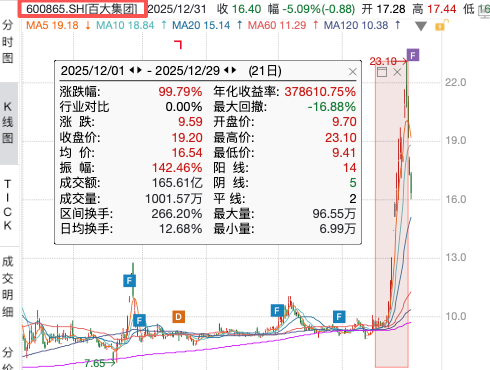
Group 1 - A clear policy "warm wind" is blowing towards the consumption sector, with the national financial work conference emphasizing "greatly boosting consumption" as a key task for the coming year [1] - The first batch of 625 billion yuan for the 2026 consumption goods replacement fund plan has been quickly allocated, reflecting a coherent determination from central to local levels to stimulate domestic demand [1] - Recent market reactions show significant inflows into cyclical and consumer sectors, with trading heat in sectors like retail and consumer services exceeding the 80th percentile [1][2] Group 2 - Several consumer retail stocks have experienced sharp price increases, with Baida Group's stock price doubling in the past month and other companies like Shanghai Jiubai and Lihua shares also seeing substantial gains [4][5] - Despite the market heat driven by policies and funds, many public funds have shown poor performance, with few of the leading stocks being heavily held by institutions [5][6] - The divergence between market performance and institutional holdings indicates a profound shift in investment logic, with institutions reallocating from traditional consumption to sectors like pharmaceuticals and technology [6] Group 3 - The consumption sector's valuation has reached historical lows, creating a foundation for a potential recovery [7][8] - Analysts suggest that the current valuation levels in the consumption industry are attractive compared to historical and international benchmarks, with a focus on identifying companies that can adapt to changing market conditions [8][9] - The dividend yield of the main consumption index has reached 3.89%, indicating a potential for increased market attention on traditional consumption sectors benefiting from domestic consumption policies [9] Group 4 - There is significant internal differentiation within the consumption sector, with some new consumption stocks showing promise while traditional sectors like liquor and white goods remain weak [10][11] - Marginal improvements in the fundamentals of the consumption sector have been observed, with certain industries like real estate-related sectors showing signs of stabilization and profit recovery [11] Group 5 - Long-term investment logic is being restructured, focusing on overseas expansion, new consumption models, and evolving consumer demands [12][13] - The "outbound strategy" is highlighted as a key growth area, with companies that can leverage their domestic competitive advantages in international markets expected to perform well [13][14] - The changing consumer landscape, driven by a new generation of middle-class consumers, is influencing consumption patterns and investment priorities [15] Group 6 - Looking ahead to 2026, there is a structural optimism regarding the consumption sector, with expectations of a return to balanced growth as the real estate cycle stabilizes [16] - Key areas of focus for future investment include overseas expansion, innovative pharmaceuticals, and gaming sectors, with traditional consumer sectors also expected to see growth [16][17] - The long-term value of consumption remains, but the investment approach has evolved, emphasizing the need to align with emerging trends and structural changes in the market [18]

又有大佬力挺白酒了!
Sou Hu Cai Jing· 2025-12-23 08:04
Group 1: Overall Consumption Industry Insights - The consumption industry has its own cyclical规律 that is not influenced by economic growth rates [3][4] - The past 30-40 years in China have seen a modernization process that occurs in new cycles every decade, with only a few companies successfully navigating these cycles [4] - The current phase from 2022 onwards is characterized as a period of restructuring and breaking through in the consumption industry, with a shift in real estate and population dynamics [4] Group 2: Insights on the Liquor Industry - The liquor industry operates on a ten-year cycle influenced by policy, economy, and industry factors, with significant downturns during peak periods [5][6] - Despite a decline in overall demand, leading companies in the liquor sector are expected to adapt and regain market share due to their resilient business models [6][7] - The industry is anticipated to enter a proactive adjustment phase by the second half of next year, with stabilization in wholesale prices [7][8] Group 3: Consumer Goods Trends - In the fast-moving consumer goods sector, the gap in revenue and profitability between the top two companies has widened, indicating increased industry concentration and stability among leading firms [9] - For durable consumer goods like automobiles and home appliances, there is a trend of manufacturing in China while design and marketing are increasingly handled overseas, leading to strong performance in international markets [9] - The service consumer goods sector is shifting from serving manufacturers to focusing on consumer needs, creating opportunities for companies that can meet broad consumer demands and provide unique experiences [9] Group 4: Long-term Value in Consumer Goods - The absolute value of consumer goods is largely independent of short-term performance fluctuations, with long-term value being the core focus for investment [10] - The cash flow discount model indicates that recent performance contributes minimally to overall value, emphasizing the importance of long-term sustainability and stability in investment decisions [10]

灵活把握A+H超额收益 行业均衡型基金受青睐
Zheng Quan Shi Bao· 2025-09-10 22:38
Group 1 - In August, A-shares led global stock markets, with equity funds performing well, particularly those focused on the TMT (Technology, Media, and Telecommunications) sector, while pharmaceutical sector funds saw declines [1] - A total of 32 equity funds achieved returns exceeding 40% in August, indicating a significant shift in market dynamics [1] - The "霸榜" (top ranking) trend previously dominated by the North Exchange and pharmaceutical-themed funds has changed, with technology-heavy funds now leading [1] Group 2 - The fund managed by Wu Yuanyi, Guangfa Value Core A, achieved a nearly one-year return of 101.36% as of September 5, outperforming its benchmark by 67.56% with a Sharpe ratio of 2.66 [1] - Guangfa Value Core A, established in January 2021, is a full-market fund that can invest in A-shares and Hong Kong Stock Connect, showcasing a stable stock position and diversified industry allocation [1] - The fund's top ten holdings account for approximately 50% of its net value, with a balanced distribution across various sectors including pharmaceuticals, automotive, electronics, textiles, machinery, and computers [1] Group 3 - Wu Yuanyi dynamically adjusts the stock allocation between A-shares and Hong Kong stocks based on market conditions, increasing the Hong Kong stock allocation from about 11% at the end of Q1 2024 to over 31% by the end of Q4 2024 [2] - The fund has effectively captured both beta and alpha returns in the recent Hong Kong market rally, focusing on innovative pharmaceuticals and new consumption sectors [2] - Recent quarterly reports indicate strong performance from newly added stocks, with significant price increases for stocks like Weixin Bio and Haoyuan Pharmaceutical, showcasing effective stock selection capabilities [2] Group 4 - Looking ahead, the focus will be on fast-moving consumer goods, innovative pharmaceuticals, high-end manufacturing, robotics, and AI sectors [3] - The fast-moving consumer goods sector is recovering first due to its "high frequency and low price" characteristics [3] - In the pharmaceutical innovation sector, China is transitioning from auxiliary research to becoming a global leader in original innovative drugs [3]