
恒生中国企业指数

Search documents
港股春节前投不投、怎么投?机构:定价逻辑有变,重点布局三大方向
凤凰网财经· 2026-02-09 12:40
Group 1 - The core viewpoint of the article emphasizes the decision-making dilemma for investors in the Hong Kong stock market regarding whether to hold stocks or cash as the market approaches the Chinese New Year holiday, with a prevailing sentiment leaning towards holding stocks due to the noticeable "calendar effect" before the holiday [1][2]. Group 2 - The "calendar effect" in the Hong Kong stock market is similar to that of the A-share market, with historical data indicating an 82% probability of the Hang Seng Index rising in the last three trading days before the holiday. However, the probability of an increase in the month following the holiday drops to about 60% [2][3]. - A review of the past decade shows that the probability of the Hang Seng Index, Hang Seng Tech Index, and Hang Seng China Enterprises Index rising in the week before the holiday is 70%, 90%, and 70% respectively, while the probabilities for the week after are 60%, 70%, and 70% respectively, indicating a decline post-holiday [3]. - Changes in pricing logic for the Hong Kong market are noted, with a significant decrease in correlation with the US market and a stronger correlation with the A-share market, suggesting that if the A-share market experiences a strong rally, the Hong Kong market may follow suit [3]. Group 3 - The AI industry chain and other technology sectors are highlighted as areas of focus for brokers, with the Hang Seng Tech Index recently breaking through its annual line, indicating a release of emotional suppression. This could lead to a recovery in market sentiment and capital inflow [4]. - The research suggests that the valuation attractiveness of the Hong Kong market has increased after recent adjustments, with expectations of a fluctuating upward trend around the Chinese New Year. Key sectors to watch include consumer, precious metals, energy, and technology, particularly those benefiting from AI advancements [5].


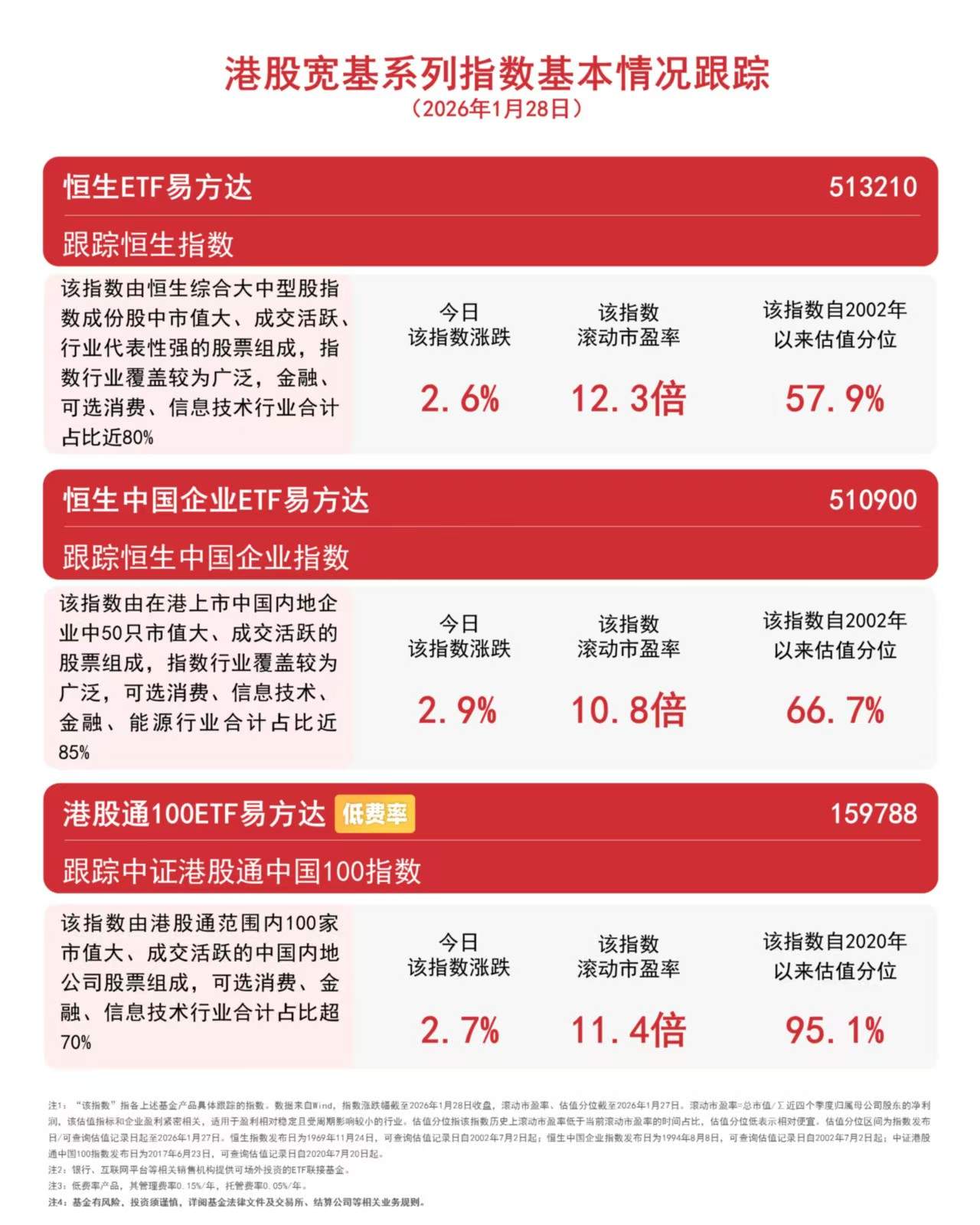
恒生指数跳空大涨创近4年新高,恒生ETF易方达(513210)、恒生中国企业ETF易方达(510900)助力布局港股核心资产
Mei Ri Jing Ji Xin Wen· 2026-01-28 14:42
Group 1 - The Hang Seng Index rose by 2.6%, reaching a nearly four-year high, while the Hang Seng China Enterprises Index increased by 2.9%, and the CSI Hong Kong Stock Connect China 100 Index climbed by 2.7% [1] - Huatai Securities analysis indicates that foreign and southbound capital continues to flow in, with the sentiment index returning to a neutral range, leading to an increase in bullish expectations [1] - The Hong Kong stock market is expected to continue its rebound in the first quarter, with a focus on growth potential and a less steep decline [1] Group 2 - Key sectors to watch include the AI chain (semiconductors, software) and innovative pharmaceuticals, with an emphasis on high-quality consumer leaders and an overweight position in the upstream of the cyclical and power chains [1]

恒生指数公司9条港股指数被纳入公募基金业绩比较基准要素库
Zhi Tong Cai Jing· 2026-01-28 10:57
Core Viewpoint - The China Securities Investment Fund Industry Association has officially released an announcement regarding the performance benchmark element library for public funds, which includes a total of 155 indices in its first batch [1] Group 1: Index Inclusion - Among the 155 indices included in the first batch of the element library, 9 indices belong to the Hang Seng Index Company [1] - Out of the 6 broad-based indices in the Hong Kong market included in the library, 4 are under the Hang Seng Index Company [1] Group 2: Index Categories - Category One includes the Hang Seng Index, Hang Seng Composite Index, Hang Seng Technology Index, Hang Seng Consumer Index, and Hang Seng Healthcare Index [1] - Category Two includes the Hang Seng China Enterprises Index, Hang Seng Stock Connect Index, Hang Seng High Dividend Yield Index, and Hang Seng Stock Connect Low Volatility Dividend Index [1]
全球资本2026年开年布局中国:股票与人民币成“双重押注”核心标的
Jin Shi Shu Ju· 2026-01-14 03:33
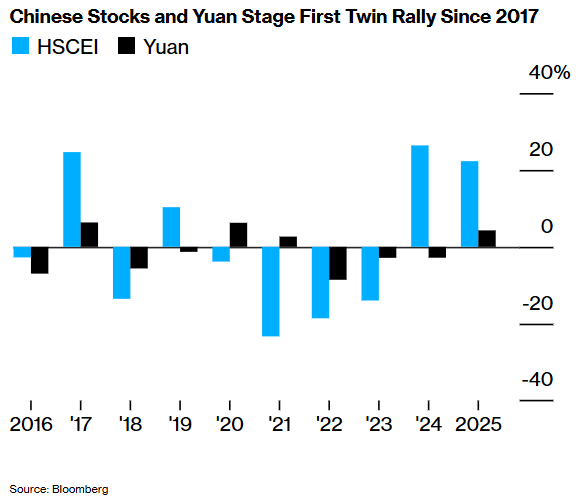
Core Viewpoint - Investors are increasingly betting on Chinese stocks and currency as global uncertainty rises, with major investment firms raising their assessments of China's stock market due to attractive valuations, supportive industrial policies, and optimistic profit outlooks [1][6]. Group 1: Stock Market Performance - The Chinese stock market and the Renminbi have experienced their first simultaneous rise since 2017, with a key index tracking Hong Kong-listed Chinese companies rising over 22% last year, marking it as one of the best-performing major indices globally [4][5]. - The A-share market has reached a four-year high, with the recent trading volume hitting a record 3.65 trillion yuan (approximately 523 billion USD), significantly above the past five-year average daily trading volume of 1.13 trillion yuan [10]. - Goldman Sachs has raised its year-end target for the CSI 300 index to 5,200 points, indicating a potential 9% upside from recent closing prices, and has increased its profit growth forecast for China from 4% in 2025 to 14% in 2026 and 2027 [7]. Group 2: Currency Outlook - The Renminbi is expected to strengthen, with predictions of it reaching 6.25 against the USD by the end of 2026, supported by strong exports and trade surpluses [11][12]. - Major financial institutions, including Citigroup and Bank of America, are optimistic about the Renminbi, with forecasts suggesting it could appreciate to 6.8 against the USD this year [11]. - The recent rise in the Renminbi has been linked to improved risk sentiment and returns calculated in USD, which could further support the stock market [4][11]. Group 3: Sectoral Insights - Analysts remain optimistic about various sectors, including healthcare, battery supply chains, and agriculture, with a renewed focus on underperforming sectors like real estate and real estate credit [11]. - The narrative around Chinese artificial intelligence has shifted investor sentiment positively, leading to a potential structural bull market despite economic fundamentals not fully supporting a broad bull run [10][11].


本周热点:涨涨涨涨涨
集思录· 2026-01-09 11:07
Core Viewpoint - The article discusses the significant increase in various stock indices at the beginning of the year, highlighting a positive market sentiment compared to the previous year's performance [1]. Index Performance Summary - The Sci-Tech Innovation Board Index has risen by 10.19% this year, while the convertible bond equal-weight index has increased by 5.44% [1]. - Other notable indices include: - The Sci-Tech 50 Index up by 9.80% - The CSI 500 Index up by 7.92% - The CSI 1000 Index up by 7.03% - The Shenzhen Component Index up by 4.40% - The Shanghai Composite Index up by 3.82% [1].

恒指公司:2025年恒指上升27.8% 为2017年以来最佳表现
智通财经网· 2025-12-31 12:07
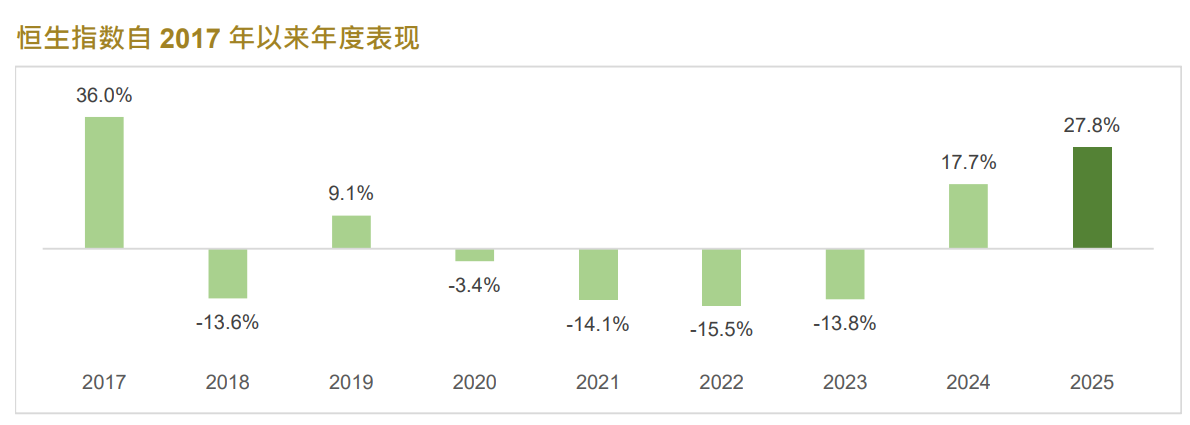
Group 1 - The Hang Seng Index (HSI) rose by 27.8% in 2025, marking its best performance since 2017, following a 17.7% increase in 2024 [1] - The rise in the HSI was driven by record capital inflows from the Hong Kong Stock Connect, optimism about the future of artificial intelligence, and interest rate cuts [1] - The HSI outperformed two other flagship indices: the Hang Seng China Enterprises Index (up 22.3%) and the Hang Seng Tech Index (up 23.5%) [1] Group 2 - The Hang Seng Composite Index (HSCI) increased by 31.0% in 2025, with mid-cap stocks leading the gains at 31.6%, followed by large-cap stocks at 30.8% and small-cap stocks at 28.8% [2] - Among industry indices in the HSCI, the materials sector had the best performance, rising by 161.3%, while utilities had the worst performance with a 5.7% increase [2] - The Hang Seng High Dividend Yield 30 Index led the high dividend indices with a rise of 38.1% in 2025 [2] Group 3 - The Hang Seng Climate Change 1.5°C Target Index performed well, with an annual increase of 31.2% [3]
每经记者专访恒生指数公司行政总裁巫婉雯:我们是如何吸引海外资金流入香港的?
Mei Ri Jing Ji Xin Wen· 2025-11-19 14:31
Core Insights - The Hang Seng Index Company has evolved from a small service company to an international index provider, reflecting the growth of Hong Kong's financial market over more than half a century [1][2] - In 2025, the Hong Kong stock market is expected to rebound strongly, with IPO fundraising returning to the top globally and the Hang Seng Index experiencing a year-to-date increase of over 30% [1][2] Market Performance - The Hang Seng Index is projected to have an upward potential of approximately 7000 points in 2025, with the information technology sector contributing the most at around 2000 points, followed by finance and consumer sectors each contributing about 1900 points [2] - The healthcare sector, despite its 3% weight, is expected to contribute over 400 points, with the Hang Seng Healthcare Index showing a year-to-date increase of over 73% [2] Index Reform and Composition - The Hang Seng Index has undergone significant reforms since its inception in 1969, expanding its constituent stocks from 33 to 88, with a market capitalization coverage of 66% [3][4] - The weight of the consumer sector in the index has increased by 15 percentage points to approximately 30%, while the financial sector's weight has decreased by 13 percentage points to around 30% [3] Product Development and Market Demand - There is a growing demand for thematic indices, particularly in technology and high-yield sectors, with the company launching 15 new indices in 2025, seven of which focus on yield and strategy [6] - The Hang Seng Technology Index has seen significant growth in overseas markets, with assets under management (AUM) in Europe and the US increasing threefold and fourfold, respectively [6] Global Market Engagement - The company has expanded its business to cover 37 markets globally, with a notable presence in Malaysia, where products tracking the Hang Seng Index account for 70% of the local market's turnover [8] - The company aims to enhance Hong Kong's role as a "super connector" by continuously seeking opportunities to launch index products that attract foreign investment [8] Investor Trends - The biotechnology sector has seen a surge in interest, driven by the mainland market, with the number of ETFs tracking this sector increasing from 8 to 13 and AUM doubling to 28 billion RMB [10][11] - There is a notable difference in investment focus between domestic and foreign investors, with overseas investors particularly interested in technology indices [13]
机构研判港股2026年前景: 基本面“接棒”驱动行情 看好四类资产配置价值
Zhong Guo Zheng Quan Bao· 2025-11-04 20:37
Core Viewpoint - The outlook for the Hong Kong stock market in 2026 is optimistic, driven by fundamental improvements and the potential for AI industry catalysis, which may enhance the net asset return (ROE) of related sectors, particularly the Hang Seng Technology Index [1][2][3]. Market Performance - The Hong Kong stock market rebounded significantly since early 2024, with major indices reaching new highs in 2025. As of November 4, 2023, the Hang Seng Index, Hang Seng Technology Index, and Hang Seng China Enterprises Index have increased by 29.37%, 30.22%, and 25.83% respectively this year [1][2]. Market Adjustments - The market experienced notable adjustments in April and October 2023, leading to a high-level consolidation phase. Investors are particularly focused on whether the market can maintain its upward momentum and set new highs in 2026 [2][3]. Earnings Growth - It is predicted that the revenue growth rate for non-financial overseas Chinese companies will reach 4% in 2026, with operating profit growth expected to be 13%. This profit growth is attributed to cost reduction, efficiency improvements, and advancements in AI applications [2][3]. Valuation Insights - Current valuations of the Hong Kong stock market are considered low, especially in the technology sector, providing ample room for further upward movement. Historical comparisons indicate that the market is undervalued, suggesting significant potential for valuation recovery [3][4]. Capital Inflows - There is a high certainty of incremental capital inflows into the Hong Kong market in 2026, with net inflows from southbound funds exceeding 1.27 trillion HKD since 2025, marking a historical high. The inflow structure is expected to become more balanced [4][5]. Domestic and Foreign Investment - Domestic institutional investors, including public funds and insurance companies, are increasingly influencing the pricing power in the Hong Kong market. It is anticipated that net inflows from southbound funds could exceed 1.5 trillion RMB in 2026 [5][6]. Sector Focus - The technology sector, particularly driven by AI advancements, is expected to be the main focus for the Hong Kong market in 2026. Additionally, there is a recommendation to pay attention to innovative pharmaceuticals and brokerage firms, which are anticipated to perform well due to favorable market conditions [6].
恒指公司:10月恒生综合指数下跌3.9% 能源业表现较佳涨6.6%
Zhi Tong Cai Jing· 2025-11-04 07:32
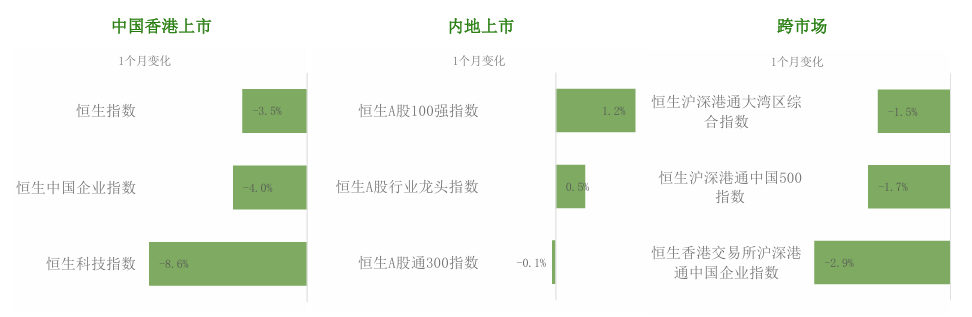
Market Performance - The Hang Seng Index and the Hang Seng China Enterprises Index fell by 3.5% and 4.0% respectively in October, while the Hang Seng Composite Index dropped by 3.9% [1] - The Hang Seng Technology Index, which tracks leading technology companies in Hong Kong, experienced a significant decline of 8.6% [1] - The Hang Seng Shanghai-Shenzhen-Hong Kong 500 Index recorded a 1.7% decrease, and the Hang Seng A-Share 300 Index saw a slight decline of 0.1% [1] Sector Performance - The energy sector showed strong performance in October with a gain of 6.6%, while the healthcare sector performed poorly, declining by 11.0% [3] ESG Indices - The Hang Seng Sustainable Development Enterprises Index in Hong Kong had a relatively better performance with a decline of only 0.6%, whereas the Hang Seng A-Share Sustainable Development Enterprises Benchmark Index in mainland China showed a positive performance with an increase of 0.8% [5] Thematic Indices - The Hang Seng Hong Kong Stock Connect Mainland Banks Index performed well in Hong Kong with a gain of 4.5%, while the Hang Seng A-Share Power Grid Equipment Index also performed well in mainland China with an increase of 3.2% [7] Factor Indices - The Hang Seng Large and Mid-Cap Dividend Yield All-Select Index fell by 2.8%, but it outperformed other factor indices in the Hong Kong market [10] - The Hang Seng A-Share Value All-Select Index increased by 0.3%, and the Hang Seng Shanghai-Shenzhen-Hong Kong Dividend Yield All-Select Index decreased by 0.7%, both showing better performance in their respective markets [10] - The Hang Seng Shanghai-Shenzhen-Hong Kong Greater Bay Area Composite Index declined by 1.5% [10] Asset Management - As of October 31, the total assets under management for passive tracking products of the Hang Seng Index series amounted to approximately $114.7 billion, reflecting a decrease of 0.9% [10] - The assets under management for exchange-traded products linked to the Hang Seng Index, Hang Seng China Enterprises Index, and Hang Seng Technology Index were approximately $24.4 billion (-10.5%), $6.8 billion (-0.4%), and $43.1 billion (+3.5%) respectively [10]
美联储若将降息,港股历史表现如何?
Capital Securities· 2025-09-17 11:17
Group 1: Federal Reserve Rate Cut Expectations - The market anticipates the Federal Reserve will initiate a rate cut in September, with discussions focusing on the magnitude of the cut, speculated to be between 25 to 75 basis points, with a 74% probability for a 75 basis point cut as of September 14, 2025[2][11] - Historical data indicates that Hong Kong stocks are more sensitive to changes in U.S. monetary policy due to the linked exchange rate system between the Hong Kong dollar and the U.S. dollar[10] Group 2: Historical Performance of Hong Kong Indices - In previous rate cut cycles, the three major Hong Kong indices (Hang Seng Index, Hang Seng Tech Index, Hang Seng China Enterprises Index) typically exhibit a volatile pattern in the 30 trading days leading up to the cut, followed by a period of adjustment post-cut[22][29] - The Hang Seng Tech Index tends to show smaller declines immediately after a rate cut and greater gains in the subsequent period compared to the other indices[29][31] Group 3: Market Reactions Post Rate Cut - On average, the three indices tend to decline in the two trading days before the cut, rise on the day before, and then drop on the day of the cut and the following two days[33][39] - After a rate cut, the Hang Seng Tech Index has historically shown a stronger recovery, with average returns of 1.03% in the four weeks following the cut, compared to 0.08% for the Hang Seng Index[19][24] Group 4: Comparison with Previous Rate Cut Cycles - The current environment is more complex than previous rate cut cycles in 2019 and 2024, with persistent inflation and economic slowdown concerns[49][51] - Historical examples of "recessionary rate cuts" show that the performance of the indices can vary significantly based on economic fundamentals and corporate earnings, indicating that a recessionary context does not guarantee a decline in stock prices[56][62] Group 5: Risk Factors - Potential risks include historical data bias, extrapolation risks, and the possibility that the magnitude and frequency of rate cuts may be lower than expected[61]
