
新能源电池制造

Search documents
宁德时代:基层员工全面涨薪!
Sou Hu Cai Jing· 2025-12-05 04:29
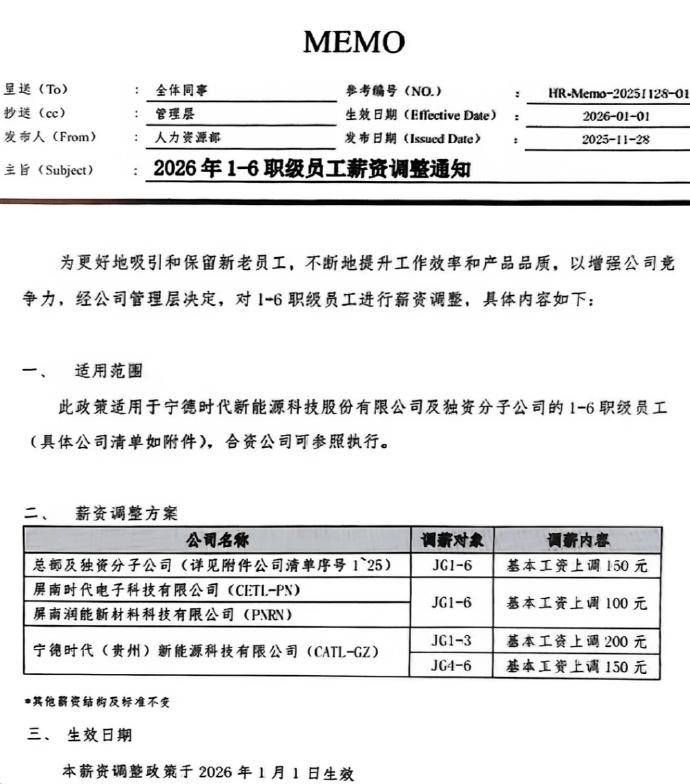
Core Viewpoint - Ningde Times announced a salary increase for grassroots employees starting January 1, 2026, with a monthly basic salary increase of 150 yuan, reflecting the company's recognition of the value of grassroots labor and its commitment to sharing development results with employees [5][11][12]. Group 1: Salary Adjustment Details - The salary adjustment applies to grassroots employees at various subsidiaries, with specific increases: 150 yuan for JG1-6 employees at the main company and subsidiaries, and 200 yuan for JC1-3 employees at CATL-GZ [3][5]. - The total number of grassroots employees affected is approximately 90,000, leading to an additional monthly labor cost of over 13 million yuan for the company [7][8]. - The comprehensive income for production line employees, including overtime, is estimated to be around 7,500 yuan per month under a single rest day system [6]. Group 2: Employee Sentiment and Market Context - The salary increase has garnered mixed reactions from the public, with some expressing that the increase is insufficient, while others appreciate any raise amid a challenging job market [4][9]. - In contrast to other companies struggling with recruitment and retention, Ningde Times' proactive salary adjustment is seen as a sincere effort to stabilize its workforce and enhance employee motivation [18][25]. Group 3: Compensation Structure - Ningde Times has established a comprehensive compensation structure that includes various salary components tailored to different employee roles, ensuring competitive pay based on performance and market standards [15][16]. - The company adheres to the principle of equal pay for equal work, with a focus on performance-based compensation across four main employee categories: R (Research), M (Manufacturing), S (Supply Chain), and F (Functional Support) [15][16]. Group 4: Implications for Employee Engagement - The salary increase, although modest, sends a significant message about the company's respect for grassroots labor and its willingness to invest in employee welfare [11][12]. - The case of Ningde Times highlights the importance of balancing fair compensation with genuine employee engagement, as seen in the contrasting approach of another company that issued an apology for a minimal salary increase [25][27].


中伟新材港股IPO,A+H股还能打吗?
Sou Hu Cai Jing· 2025-11-11 12:18
Core Viewpoint - Zhongwei New Materials Co., Ltd. (hereinafter referred to as "Zhongwei New Materials", 2579.HK) has launched its Hong Kong IPO, with the subscription period from November 7 to November 12, and is expected to officially list on November 17. This company, already listed on A-shares (300919.SZ), is the second core enterprise in the new energy battery manufacturing sector to achieve A+H listing after CATL [1][2]. Market Position - Zhongwei New Materials holds a leading position in the global new energy materials sector, primarily engaged in the research, production, and sales of battery materials centered around precursor cathode active materials (pCAM). Since 2020, the company's shipments of nickel and cobalt-based pCAM have ranked first globally for five consecutive years [3]. - In 2024, the sales value of all pCAM products from Zhongwei New Materials is expected to be the highest globally, with a market share of 21.8%. The global market shares for nickel-based and cobalt-based pCAM are projected to be 20.3% and 28.0%, respectively [3]. Financial Performance - The company has demonstrated robust growth, with revenue increasing from 30.3 billion yuan in 2022 to 40.2 billion yuan in 2024, reflecting a compound annual growth rate (CAGR) of 15.1%. In the first half of 2025, revenue reached 21.3 billion yuan, marking a year-on-year growth of 6.1% [3][4]. Strategic Initiatives - Since 2020, Zhongwei New Materials has initiated a vertical integration strategy, establishing a comprehensive operational system that covers upstream new energy metal mining, smelting, refining, and the production and recycling of new energy materials [5]. - The company has developed a full range of material products, including nickel, cobalt, phosphorus, sodium, and manganese-based materials. It holds rights to three laterite nickel mines in Indonesia, phosphate mine equity in China, and lithium salt mines in Argentina, ensuring stable raw material supply [6]. Global Expansion - Zhongwei New Materials has established production bases in Indonesia, China, Morocco, and South Korea, enhancing its global footprint [7]. - By the first half of 2025, revenue from direct customers outside mainland China accounted for 50.6% of total revenue, surpassing domestic market revenue for the first time [8]. IPO and Investment Appeal - The pricing of Zhongwei New Materials' H-shares shows a significant discount compared to A-shares, making it attractive for investors. As of November 10, the closing price of A-shares was 50.15 yuan, while the H-share subscription price range is 34-37.8 HKD, representing a discount of approximately 30% [9]. - The IPO has attracted nine cornerstone investors, collectively subscribing to approximately 213 million USD worth of shares, accounting for about 44.3% of the offering. These investors include notable industry capital and investment institutions, with a six-month lock-up period [10]. Future Growth Potential - The long-term outlook for the new energy sector remains positive, with the company's forward-looking investments in solid-state batteries and sodium-ion batteries expected to create new growth trajectories [11].
21社论丨供需逐步改善,持续规范市场竞争秩序
21世纪经济报道· 2025-10-16 00:07
Group 1 - The core consumer price index (CPI) has shown a positive trend, with a year-on-year increase of 1% for the core CPI, marking the first return to this level in 19 months, despite the overall CPI being -0.3% [1] - The producer price index (PPI) has decreased by 2.3% year-on-year, but the decline has narrowed for two consecutive months, indicating a recovery in industrial prices from both the purchasing and factory levels [1][2] - The structural changes in CPI and PPI reflect improvements in market competition and supply-demand relationships, driven by the ongoing construction of a unified national market and effective capacity governance in key industries [1][2] Group 2 - Service prices have maintained a year-on-year increase of 0.6%, with significant growth in medical and household services, indicating a dual effect of consumption upgrades and policy guidance [2] - The recovery in traditional industries such as coal and steel is attributed to improved supply-demand dynamics and deepened capacity governance, marking a significant shift in market competition [2][3] - The new Anti-Unfair Competition Law, effective from October 15, aims to address challenges in the digital economy and provides a legal basis for curbing "involutionary" competition, particularly price wars that disrupt market order [3][4] Group 3 - The positive effects of optimized market order are extending from traditional industries to emerging sectors, with significant narrowing of price declines in industries like photovoltaic equipment and new energy battery manufacturing [3] - The law's core breakthrough is the prohibition of forced or disguised forced sales below cost by platform operators, empowering regulatory authorities to address disruptive pricing behaviors [3][4] - The focus of market competition is expected to shift from price wars to value wars, encouraging companies to innovate and enhance service quality, fostering a healthier and more sustainable market environment [4][5]

供需逐步改善,持续规范市场竞争秩序
2 1 Shi Ji Jing Ji Bao Dao· 2025-10-15 22:47
Group 1 - The core viewpoint of the articles highlights a synchronized improvement in CPI and PPI, indicating positive structural changes in China's price dynamics [1][2] - CPI year-on-year is at -0.3%, but core CPI has risen for five consecutive months, reaching a growth rate of 1%, marking the first return to this level in 19 months [1] - PPI year-on-year is at -2.3%, with the decline narrowing for two consecutive months, reflecting a recovery in prices from the purchasing to the factory level in the industrial sector [1] Group 2 - The structure of CPI shows a steady recovery in industrial consumer goods and some service prices, signaling an optimization of market competition and effective governance [1][2] - Service prices maintain a year-on-year increase of 0.6%, with significant growth in healthcare and household services, indicating the dual effects of consumption upgrades and policy guidance [2] - The improvement in PPI is attributed to substantial enhancements in supply-demand structures across multiple industries, particularly in traditional sectors like coal and steel [2][3] Group 3 - The positive effects of order optimization are extending from traditional industries to emerging sectors, with significant narrowing of price declines in photovoltaic equipment and new energy battery manufacturing [3] - The newly revised Anti-Unfair Competition Law aims to address challenges in the digital economy and provides a legal basis for curbing "involutionary" competition [3][4] - The law prohibits platform operators from forcing or indirectly compelling sellers to sell below cost, empowering regulatory authorities to address disruptive pricing behaviors [3][4] Group 4 - The implementation of the new law is expected to systematically optimize market competition rules, shifting the focus from price wars to value wars among enterprises [4] - This shift encourages companies to invest in technological innovation, quality enhancement, and service optimization, fostering a healthier market environment [4] - The changes are anticipated to lead to a more rational, healthy, and sustainable development path for the Chinese market, benefiting both businesses and consumers [4]
21社论丨供需逐步改善,持续规范市场竞争秩序
2 1 Shi Ji Jing Ji Bao Dao· 2025-10-15 22:37
Group 1: CPI and PPI Trends - The Consumer Price Index (CPI) shows a year-on-year decline of 0.3%, but the core CPI has risen for the fifth consecutive month, reaching a growth rate of 1%, marking the first return to this level in 19 months [1] - The Producer Price Index (PPI) has a year-on-year decline of 2.3%, with the rate of decline narrowing for two consecutive months, indicating a recovery in prices from the purchasing to the factory level in the industrial sector [1] Group 2: Structural Changes in Prices - Excluding energy, industrial consumer goods prices have increased by 1.8%, with a month-on-month increase of 0.3 percentage points, indicating a steady upward trend in prices due to improved market competition [1] - Service prices have maintained a year-on-year increase of 0.6%, with significant growth in healthcare and household services, reflecting the dual effects of consumption upgrades and policy guidance [2] Group 3: Supply and Demand Improvements - The improvement in supply and demand structures has led to price stabilization and recovery in traditional industries such as coal and steel, indicating effective governance of market competition [2] - The price decline in emerging industries like photovoltaic equipment and new energy battery manufacturing has significantly narrowed, showing a reduction in disorderly competition [3] Group 4: Legal and Regulatory Changes - The newly revised Anti-Unfair Competition Law, effective October 15, addresses challenges in the digital economy and provides a legal basis for regulating "involution" competition [3] - The law prohibits platform operators from forcing or indirectly forcing sellers to sell below cost, empowering market regulators to address disruptive pricing behaviors [3] Group 5: Future Market Dynamics - The implementation of the new law is expected to elevate competition from price wars to value wars, encouraging companies to focus on innovation, quality improvement, and service optimization [4] - This shift aims to create a more rational, healthy, and sustainable market environment, benefiting both businesses and consumers [4]
时代万恒: 致同会计师事务所(特殊普通合伙)关于辽宁时代万恒股份有限公司2024年报告的信息披露监管工作函的回复
Zheng Quan Zhi Xing· 2025-07-01 16:31
Core Viewpoint - The company reported a significant decline in revenue from its new energy battery manufacturing business, with a revenue of 395 million yuan in 2024, a year-on-year decrease of 38.70%, while the gross profit margin increased by 4.54 percentage points to 29.57% [2][3]. Financial Performance - The company's 2024 financial statements were audited, and a clean audit report was issued [1]. - The year-end inventory balance was 120 million yuan, an increase of 13% year-on-year, with work-in-progress and finished goods rising by 43% [2]. Customer Analysis - The top five customers for the lithium battery business in 2024 included STIHL, Baoshide, Guangdong Xinbao, Shanghai Qiwei, and Guangdong Dongling, with significant changes in sales amounts and customer rankings compared to 2023 [4]. - Baoshide's sales decreased by 59.72%, while STIHL's sales were 3,957.20 million yuan, showing a 12.78% increase in sales quantity [4]. Revenue and Margin Analysis - The lithium battery business revenue for 2024 was 258 million yuan, a decrease of 48.6%, but the gross profit margin increased to 28.44%, up by 3.50 percentage points [12]. - The average sales price for lithium batteries decreased by 21% to 5.71 yuan per unit, while the average cost dropped by 26% to 3.99 yuan per unit [13]. Market and Competitive Landscape - The global market for lithium batteries in electric tools is expected to grow, with a projected 25.4% increase in shipments, reaching 2.63 billion units in 2024 [9]. - The competition in the lithium battery market is intensifying, leading to price reductions and margin pressures [9]. Inventory Management - The company shifted from a "pure order production" model to a "production plus proactive inventory" model to meet domestic customer demands, resulting in increased inventory levels [16]. - The year-end inventory for the lithium battery business was 94.76 million yuan, with a significant portion locked in orders, indicating no immediate risk of obsolescence [21]. Credit Policy and Receivables - The company has a credit policy that includes prepayment and credit sales, with a credit period ranging from 30 to 120 days [21]. - As of December 31, 2024, accounts receivable from Baoshide amounted to 54.62 million yuan, with 43.24 million yuan exceeding the normal credit period [21].

交通银行安徽省分行:“双轮驱动”为新能源产业充能
Ren Min Wang· 2025-06-30 02:20
Group 1 - The integration of "technology-finance-industry" is becoming a key engine for cultivating new productive forces in the era of technological innovation [1] - The supply chain financing model introduced by Bank of Communications Anhui Branch has provided timely financial support to leading enterprises in the new energy sector, addressing the financing difficulties faced by upstream small and micro enterprises [2] - The "Common Growth Plan" strategic cooperation agreement initiated by Bank of Communications Anhui Branch aims to create a new paradigm of symbiosis between banks and enterprises, featuring a tiered interest rate pricing mechanism and a "loan + direct investment" model [3] Group 2 - A 22 million yuan supply chain loan has been crucial for Anhui Yijiatong Battery Co., Ltd., enabling it to expand production capacity and invigorate the entire supply chain [2] - The agreement has been signed with over 1,000 technology-based enterprises, resulting in nearly 6.7 billion yuan in loans, significantly boosting the output value of the new energy industry [3]
