水果加工

Search documents
荔枝“破季”火出圈 巾帼专家守鲜甜
Xin Lang Cai Jing· 2026-02-05 23:24
Core Viewpoint - The innovative freezing technology developed by the research team at the Guangdong Academy of Agricultural Sciences is transforming the lychee industry, addressing long-standing preservation challenges and enhancing product offerings, thereby increasing market reach and profitability for farmers [1][2][3]. Group 1: Technological Innovations - The breakthrough in ultra-low temperature freezing technology allows lychees to be preserved for over a year without significant loss of quality, maintaining over 80% of their nutritional content [2]. - The research team has developed a comprehensive technical system that includes a no-ice preservation system for e-commerce, reducing post-harvest loss by 15%, and an air transport preservation system that extends shelf life by 30% for exports [3]. - A new production line for frozen lychees is expected to reach an output of 2,000 tons, utilizing a "shared factory + shared technology" model to lower costs for farmers and cooperatives [3]. Group 2: Product Development - The team is also focusing on deep processing of lychees, creating new products such as lychee ice cream, which incorporates over 40% fermented lychee juice, enhancing flavor and health benefits [4]. - Innovative techniques have been established to produce dietary fiber from lychee pomace, achieving a yield of up to 58.55%, and new lychee rice wine products have been developed, gaining popularity among consumers [4]. Group 3: Future Outlook - The research team aims to continue optimizing technologies and developing market-driven products to expand the global reach of Guangdong lychees and improve the livelihoods of local farmers [5].
南非罐装水果业者:中国行业经验值得借鉴
Xin Lang Cai Jing· 2026-01-31 09:10
Core Insights - The South African canned fruit industry is looking to learn from China's advancements in brand building, marketing, and technological innovation, which are seen as valuable references for local producers [1][2] - The World Fruit Processing Congress, held every two years, will take place in Beijing, China in 2025 and in South Africa in 2027, providing a platform for deepening industry dialogue between South Africa and major producing countries, including China [1] - The canned food sector is viewed as a vital part of the food industry, integrating agricultural raw materials, manufacturing, technology, value chains, and market demand [1] Industry Developments - South Africa's canned fruit producers association represents over 300 fruit producers, indicating a significant industry presence [1] - The association has invested heavily in research and development, including the cultivation of the "Keisie" peach variety specifically for canned processing [2] - There is a growing recognition of the potential for South African products in the Chinese market, particularly as consumer demand shifts towards high-quality and specialty products [2] Market Opportunities - The signing of a trade agreement in late 2025 will allow South African fresh stone fruits like peaches, plums, and prunes to enter the Chinese market, which is expected to increase trade volume and enhance consumer trust in South African agricultural products [2] - Canned fruits are highlighted for their long shelf life, which is crucial in ensuring stable supply and enhancing food safety amid global supply chain uncertainties [2]
山东新泰:特色片区领跑乡村振兴新赛道
Qi Lu Wan Bao· 2026-01-20 02:59
Core Insights - The article highlights the successful agricultural practices in Dingjiazhuang Village, where the cultivation of "glass crisp" celery has led to significant income for local farmers, showcasing a model for rural revitalization through specialized agricultural development [1][2] Group 1: Agricultural Development - Dingjiazhuang Village has a history of over 300 years in celery cultivation, which is now recognized as a non-material cultural heritage of Tai'an City, with an annual production of over 400,000 pounds [1] - The village's farmers, on average, earn nearly 50,000 yuan annually from celery cultivation, with one farmer reporting an income of 16,000 yuan from 1,500 square meters of celery greenhouses [1] Group 2: Market and Infrastructure - The Qingyun Street area is leveraging the New Tai Agricultural Market, which has an annual transaction volume exceeding 4 billion yuan, to expand its vegetable base and modern agricultural greenhouse construction [2] - A project named "Fruit Fragrance Qingyun" is under construction with an investment of 35 million yuan, expected to produce over 10 million bottles of fruit canned goods annually, generating sales revenue exceeding 30 million yuan [3] Group 3: Strategic Development - Qingyun Street is implementing a development strategy that includes an industrial belt along the river and two zones focusing on agricultural tourism and vegetable branding, aiming to stimulate rural development [2] - The area is also developing multiple agricultural and e-commerce projects to create a comprehensive economic belt that integrates ecological picking, sightseeing, and deep processing [3]
从鲜果到食品的“突围”
Zhong Guo Jing Ji Wang· 2026-01-19 07:29
Core Viewpoint - The article discusses the challenges of preserving tropical fruits in Guangdong's Lingnan region and highlights the innovative technologies developed by the Guangdong Academy of Agricultural Sciences to enhance fruit processing and extend shelf life, particularly for lychee [1][2]. Group 1: Preservation Technology - The "frozen dormancy" technology allows lychee to maintain its fresh taste and appearance for months, overcoming traditional preservation methods that lead to rapid spoilage [2][3]. - This technology involves rapid pre-cooling, sterilization, and precise packaging, followed by immersion in a liquid medium at -40 degrees Celsius to achieve effective preservation [2][3]. - The result is that lychee can be stored for over a year, enabling year-round sales and reducing seasonal market pressures [3]. Group 2: Processing Innovations - The research institute has developed a "super high pressure+" non-thermal sterilization technology that effectively kills bacteria without damaging the fruit's flavor and nutritional value [4]. - Innovations in juice processing, including the use of DMDC for sterilization and self-absorbing fermentation technology, have improved the quality and production speed of fruit vinegar and wine [4][5]. - A new energy-efficient juice concentration technology has been created to minimize common issues like color darkening and sedimentation during processing [5]. Group 3: Market Impact - The advancements in processing technology have led to a significant increase in the quality of fruit products, allowing for the development of various new products such as juice drinks and sparkling water [6]. - The research institute's support has enabled local farmers to sell their lychee more effectively, increasing their income and reducing waste during peak harvest seasons [6]. - The institute has provided technical support to multiple agricultural parks and has expanded its assistance to other regions for various fruit industries, enhancing overall agricultural productivity [6].
【着力优化营商环境 助推高质量发展】 庄浪:招商引资蓄能 产业发展加速
Xin Lang Cai Jing· 2026-01-11 01:44
Group 1 - Zhuanglang County is implementing the "introducing large, strong, and leading enterprises" initiative to boost economic development through effective investment attraction [1] - The county has successfully attracted Qin'an Xueyuan Fruit Co., Ltd., a national key leading enterprise in agricultural industrialization, to establish a modern apple industry park [1] - The apple industry park focuses on the entire apple supply chain, utilizing digital technology for industry upgrades, including advanced sorting lines that ensure product standardization and quality stability [1] Group 2 - The digital sorting line project, with an investment of over 80 million yuan, has been completed and is operational, processing over 10 million pounds of apples annually [2] - The project has created stable jobs for over 120 local residents and has positively impacted around 2,500 fruit farmers through a benefit-sharing mechanism [2] - Zhuanglang County aims to enhance the quality and efficiency of the apple industry, increasing product value and farmers' income through strategic positioning in organic apple production [2] Group 3 - The county government is committed to supporting high-quality enterprise development by focusing on key areas such as resource allocation, industrial chain support, and market expansion [3] - Zhuanglang County is enhancing its business environment by improving policy precision and service quality, including measures like online processing and green channels for project approval [3] - The goal is to transform the "soft power" of the business environment into "hard support" for development, ensuring a consistent acceleration in investment attraction and economic growth [3]
【“十五五”开好局起好步】奋发进取 绘就乡村振兴新图景
Yang Shi Wang· 2026-01-10 11:50
Group 1 - The core viewpoint emphasizes the importance of advancing rural revitalization through the development of profitable industries, as highlighted by President Xi Jinping [1] - In Hubei's Jia Yu County, the annual output value of vegetable planting has surpassed 6.5 billion yuan, with plans to promote high-yield, resilient cabbage varieties in collaboration with research institutions [1] - The total output value of modern agricultural industrial parks in China has exceeded 3 trillion yuan [3] Group 2 - In Chongqing's Wanzhou National Modern Agricultural Industrial Park, the citrus harvest is expected to drive total output value to exceed 10 billion yuan through green processing and ecological branding [2] - In Xinjiang's Xuedu Village, tourism has become a major resource, with over half of the 700 residents engaged in the tourism industry, supported by new offerings like bonfire parties [3] - In Heilongjiang's Mohe North Pole Village, over 300 unique hotels and guesthouses have been established, attracting more than 700,000 tourists since winter began [3] - Yunnan plans to train over 500,000 individuals in various skills to support rural revitalization efforts [3] - Zhejiang has introduced the first local standard for "new farmers," addressing talent needs in the rural revitalization process [3]
印度尼西亚首柜冷冻榴莲出口中国
Guang Xi Ri Bao· 2026-01-08 03:07
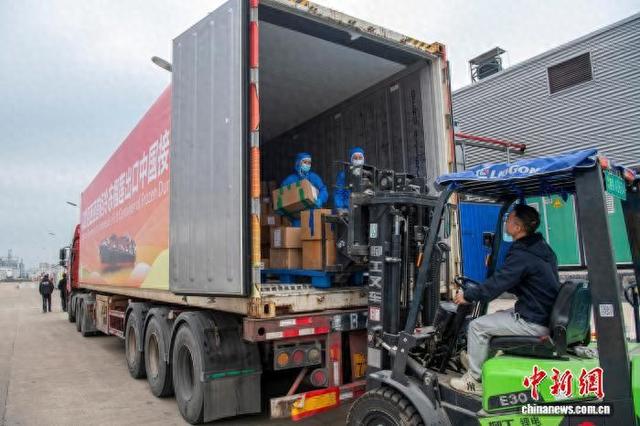
Core Insights - The export ceremony for frozen durians from Indonesia to China took place in Qinzhou City, marking the direct entry of Indonesian frozen durians into the Chinese market [1] - The shipment contained 23 tons of frozen durian flesh and puree, imported by Guangxi Jiarong Food Technology Co., Ltd., which departed from Jakarta Port on December 26, 2025, and arrived at the Qinzhou Comprehensive Bonded Zone on January 5, 2026 [1] - The frozen durians will be processed into various deep-processed products such as sliced durians, frozen durian flesh, freeze-dried durians, and durian puree [1] Industry Developments - Qinzhou Port, as a key international gateway for the Western Land-Sea New Corridor, has opened 44 ASEAN routes by 2025, covering major ports in Southeast Asia's core fruit production areas, including Thailand, Vietnam, and Malaysia [1] - The sea-rail intermodal trains of the Western Land-Sea New Corridor have exceeded 10,218 trips, covering 72 cities and 152 stations across 18 provinces in China, creating an efficient logistics corridor for ASEAN agricultural products to enter China [1] - The direct access of Indonesian frozen durians to the Chinese inland market through this corridor also connects to the China-Europe Railway Express, extending its reach to the Eurasian region [1]
印尼冷冻榴莲出口中国接收仪式在广西钦州举行
Xin Lang Cai Jing· 2026-01-06 13:18
Group 1 - The core event is the export of 23 tons of frozen durian from Indonesia to China, marking the establishment of a maritime fruit fast track between Indonesia and China [1][3] - The frozen durian will undergo deep processing in the Qinzhou Comprehensive Bonded Zone, resulting in various product forms such as sliced durian, frozen durian meat, freeze-dried durian, and durian puree [1][3] - The Qinzhou port is enhancing its role as an international gateway for the new western land-sea corridor, with established shipping routes to major Southeast Asian fruit-producing ports [3] Group 2 - As of November 2025, Qinzhou port has imported 29,000 tons of fruits and fruit products, showing a year-on-year increase of 3.7% [3] - The port has facilitated over 10,218 rail-sea intermodal trains, representing a 34.3% increase, connecting 72 cities across 18 provinces in China [3] - Eight Indonesian companies have received approval from the General Administration of Customs of China to export frozen durian, with expectations for more Indonesian fruits and seafood to enter the Chinese market [5]

印尼冷冻榴莲入华 首柜在广西钦州深加工
Xin Lang Cai Jing· 2026-01-06 11:13
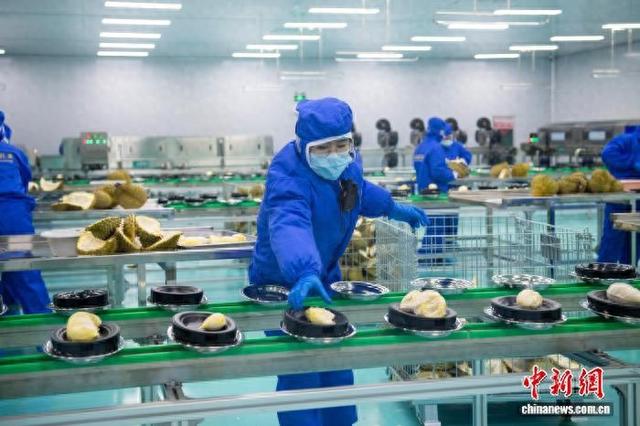
Group 1 - The first shipment of frozen durians from Indonesia to China was received in Qinzhou, Guangxi on January 6 [2][4][5] - This shipment consists of 23 tons of frozen durian flesh and puree, which will undergo deep processing in the Qinzhou Comprehensive Bonded Zone [2][4][5] - The processed products will include whole sliced durians, frozen durian flesh, freeze-dried durians, and durian puree, entering the Chinese market in various forms [2][4][5]
陕西富平小柿子“链”出大产业
Zhong Guo Xin Wen Wang· 2025-12-29 04:00
Core Viewpoint - The article highlights the significance of the persimmon industry in Fuping, Shaanxi Province, emphasizing the transformation of fresh persimmons into high-quality dried persimmons, known for their unique sugar frost, which is a natural indicator of quality and a product of traditional farming practices [2][4][6]. Group 1: Quality and Production Challenges - The sugar frost on dried persimmons is often misunderstood as an additive, but it is a natural byproduct of the drying process, representing the essence of quality [2][4]. - Achieving the ideal sugar frost requires optimal weather conditions, making the production process highly dependent on nature, which poses risks for farmers [4][6]. - Farmers like Tian Yanfeng face challenges such as unstable quality and hygiene issues due to traditional drying methods, which can lead to significant financial losses during adverse weather [4][6]. Group 2: Modernization and Financial Support - To overcome reliance on weather, farmers are seeking modern solutions like standardized drying facilities, but financial constraints pose a significant barrier [6][9]. - Financial institutions, such as the Bank of China, have stepped in to provide crucial funding, enabling farmers to build modern drying facilities that enhance product quality and consistency [6][9]. - The introduction of standardized production environments has led to improved quality and marketability of dried persimmons, transforming them from local specialties to premium products sought after by urban markets [7][10]. Group 3: Industry Stability and Economic Impact - The persimmon industry relies heavily on timely cash flow during the harvest season, with companies needing to ensure they can pay farmers promptly to maintain trust and operational stability [7][9]. - Financial support from banks has stabilized the supply chain, ensuring that farmers receive their earnings and contributing to the overall health of the persimmon industry [9][10]. - The cumulative financial assistance provided to local farmers and processing enterprises has exceeded 20 million yuan, fostering a sustainable and prosperous industry [9][10].