
煤炭发电

Search documents
AI时代美国年轻人就业骤变
3 6 Ke· 2025-11-17 00:24
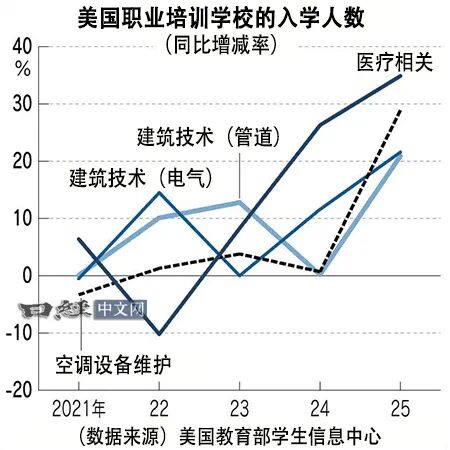
Core Insights - The integration of AI into daily life is leading to significant changes in employment dynamics, particularly affecting college graduates, while also driving up electricity costs in areas near data centers [1][4][5] Employment Trends - Enrollment in vocational training schools for trades like plumbing and carpentry is increasing, with a 12% year-over-year rise expected by spring 2025, compared to a 4% increase in college enrollment [1] - The unemployment rate for the 20-24 age group is projected to rise from 7.5% in December 2024 to 9.2% in August 2025, indicating a growing challenge for young graduates [4] - A study from Stanford University estimates that employment in software development for the 22-25 age group could decrease by approximately 20% from mid-2022 to July 2025 due to AI advancements [4] Economic Impact - Despite a reduction in job opportunities, the overall U.S. economy remains robust, partly due to significant investments in data centers, which are expected to reach $7 trillion globally by 2030, with the U.S. accounting for 40% of this investment [5] - The manufacturing sector is projected to face a labor shortage of 1.9 million workers by 2033, raising concerns about economic and national security [5] Electricity Demand and Pricing - The U.S. is experiencing a surge in electricity demand, primarily driven by data centers, with predictions indicating record-high electricity consumption in 2024 and 2025 [5][6] - Electricity prices are expected to rise by 5% year-over-year by 2025, with some regions near data centers seeing prices double over the past five years [6] - The Northeast, particularly Virginia, is projected to face electricity shortages due to data center consumption exceeding available supply, potentially increasing monthly household electricity bills by approximately $70 by 2028 [6] AI Development and Competition - The U.S. continues to lead in AI research, but a Stanford survey indicates that the gap between U.S. and Chinese AI models is narrowing, with only a 1.7% difference as of February [7] - The U.S. government is expected to tighten export controls on advanced semiconductors while promoting domestic innovation and infrastructure development [7] - Concerns are raised about the potential risks to public and national security due to intense competition in AI development, which may compromise safety standards [7]

首台、最大、突破!本周,大国重器交出亮眼成绩单
Yang Shi Xin Wen Ke Hu Duan· 2025-11-14 00:21
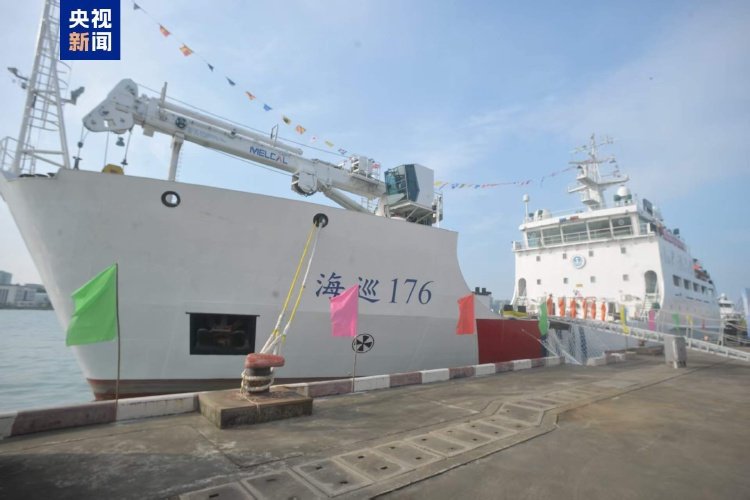
Group 1 - China's self-developed 3D printed engine successfully completed its first flight test, marking a significant breakthrough in engineering applications [1][3] - The flight lasted 30 minutes, reached an altitude of 6000 meters, and achieved a maximum speed of 0.75 Mach, with all operational parameters functioning normally [1][3] - The engine's design incorporates over 75% of its components manufactured through 3D printing, significantly reducing the number of parts and achieving lightweight, high-performance goals [3] Group 2 - The world's largest high-altitude wind energy capturing kite, measuring 5000 square meters, successfully completed its test in Inner Mongolia, indicating progress in high-altitude wind power technology [4][5] - This kite can capture wind energy at altitudes above 300 meters and is designed to pull ground-based generators for electricity production [5] - High-altitude wind energy is seen as a new energy frontier with significant potential due to its high wind speeds and stable wind directions [5] Group 3 - The "Haixun 176," China's largest and most advanced buoy tender, has officially joined the South China Sea Navigation Guarantee Center [6][8] - The vessel measures 75.2 meters in length, has a displacement of 2360 tons, and can operate safely in sea conditions up to level 6 [6][8] - It will enhance navigation support services in the South China Sea, focusing on buoy deployment and maintenance [8] Group 4 - The world's first 650°C high-efficiency ultra-supercritical coal-fired boiler has entered the construction phase at Huaneng Yuhuan Power Plant [9][11] - This boiler represents a breakthrough in high-temperature alloy materials, achieving the highest steam temperature globally for coal-fired power generation [11] - Upon completion, it is expected to set new records for the highest operational parameters and lowest coal consumption in coal-fired power generation [11]
尽显“重器”“前沿”“开放”!上周,我国实现多领域新突破
Yang Shi Xin Wen· 2025-11-11 07:41
Group 1: National Defense and Technology - China's first electromagnetic aircraft carrier, Fujian, has officially entered service, marking the beginning of the "three aircraft carrier era" [2] - Fujian is the largest active vessel in the navy, with its home port located in Sanya, Hainan [2] - The development of carrier-based aircraft such as the J-35 and KJ-600 is progressing as planned, with expectations for operational capability not far off [2] Group 2: Antarctic Research - The "Snow Dragon" and "Snow Dragon 2" have crossed the equator as part of China's 42nd Antarctic expedition [3] - The expedition will focus on national needs and global scientific frontiers, including the construction of supporting facilities at the Qinling Station [3] - Key tasks include monitoring important Antarctic sea areas and applying domestic technology in new ways [3] Group 3: Energy Sector - The world's first 650°C ultra-supercritical coal-fired power unit has begun construction in Zhejiang, aiming to set records for the highest parameters and lowest coal consumption [4] Group 4: China International Import Expo (CIIE) - The CIIE showcased over 461 new products, technologies, and services, with participation from 155 countries and regions [5] - The exhibition area exceeded 367,000 square meters, featuring 290 Fortune 500 and industry-leading companies [6] - The event included a focus on the "silver economy" and introduced a pet-themed display area [6][7] - A total of 83 supporting activities were held, resulting in over 300 cooperation intentions and an estimated cooperation amount exceeding $10.3 billion [7]
财经观察:“核能时代落幕”,德国电力靠什么保障
Huan Qiu Shi Bao· 2025-10-30 22:44
Core Viewpoint - Germany has officially abandoned nuclear power, marking the end of an era that has provided electricity for approximately 60 years, raising concerns about rising electricity costs for consumers and the impact on energy-intensive industries [1][2]. Group 1: Germany's Nuclear Phase-Out - Germany is the first major industrial nation to completely phase out nuclear power, which has been a significant source of electricity since the 1960s [1]. - The decision to abandon nuclear energy was solidified after the Fukushima disaster in 2011, leading to the closure of the last three nuclear plants in April 2023 [2]. - The closure of nuclear plants has resulted in increased carbon emissions, as Germany has had to rely more on coal to meet electricity demands, creating a conflict between environmental goals and energy policy [2][3]. Group 2: Public Sentiment and Economic Impact - A significant portion of the German public opposes the nuclear phase-out, with surveys indicating that nearly two-thirds of Germans are against closing the remaining nuclear plants [4]. - Since 2011, German consumers have incurred an additional cost of €57 billion due to the transition away from nuclear energy [4]. - The high electricity prices are prompting energy-intensive companies to relocate production to Eastern Europe or Asia, contributing to a decline in Germany's industrial competitiveness [5]. Group 3: Energy Transition Challenges - Germany aims for 80% of its electricity to come from renewable sources by 2030, but currently, renewables only account for about 57% of the energy supply, leading to instability [6]. - The country has become a net importer of electricity, with significant imports recorded in the second quarter of 2023, highlighting the challenges of domestic energy production [6]. - The reliance on gas-fired power plants is increasing, with plans to invest €20 billion in new gas plants to ensure energy security, but this may not lower electricity costs significantly [7]. Group 4: Future of Nuclear Energy in Europe - The EU plans to increase nuclear capacity from 98 GW to 109 GW by 2050, requiring an investment of €205 billion for new plants and €36 billion for extending existing reactors [3]. - Countries like Poland are moving forward with nuclear projects, contrasting Germany's phase-out, as the EU seeks to reduce dependence on foreign energy and achieve climate goals [2][3].
时报数说 新能源成中国传统煤电大省第一大电源
Zheng Quan Shi Bao· 2025-08-29 20:04
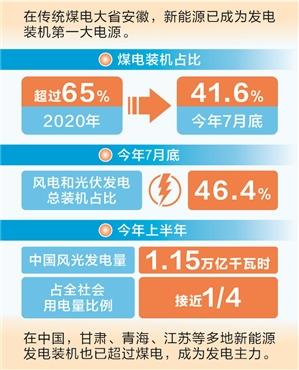
Core Viewpoint - The article discusses significant developments in the financial market, highlighting trends and potential investment opportunities in various sectors [2]. Group 1: Financial Market Trends - The financial market is experiencing notable fluctuations, with specific sectors showing resilience amidst broader economic challenges [2]. - Investment strategies are being adjusted in response to changing market conditions, emphasizing the importance of sector analysis [2]. Group 2: Sector Analysis - Certain industries are outperforming others, indicating potential areas for investment [2]. - The article suggests that investors should focus on sectors that demonstrate strong fundamentals and growth potential [2].
低压吸附+真空再生+快速循环烟气变压吸附碳捕集技术通过鉴定
Zhong Guo Hua Gong Bao· 2025-08-08 03:38
Core Insights - The coal-fired flue gas pressure swing adsorption carbon capture technology developed by the Beijing Low Carbon Clean Energy Research Institute and Zhejiang Electric Power Company has been recognized as internationally leading by the China Coal Industry Association [1] - This technology utilizes solid adsorbent materials to selectively adsorb and efficiently concentrate carbon dioxide from flue gas, featuring low energy consumption, quick start-stop capabilities, stable operation, no secondary pollution, and full electric drive [1] Group 1 - The technology was initiated in October 2021, focusing on the development and demonstration of key carbon capture technologies tailored for coal-fired flue gas characteristics [1] - A comprehensive research approach was adopted, including the development of high-performance adsorbents and low-energy capture processes, culminating in a complete technology demonstration at a scale of 10,000 tons [1] Group 2 - In December 2024, the first industrial demonstration unit for low-pressure adsorption carbon capture was completed, marking a significant milestone in the industry [2] - The demonstration unit achieved a capture energy consumption of 331 kWh per ton of carbon dioxide under non-optimal conditions, laying the groundwork for future 100,000-ton scale projects [2] - The Low Carbon Institute's CCUS center is focusing on cutting-edge technologies in carbon capture and utilization, with plans for further scaling and demonstration of adsorption carbon capture technology in the Zhejiang region [2]
美国白宫:公告涵盖煤炭发电厂、塔科奈铁矿石加工设施以及部分生产与半导体、医疗设备灭菌和国家防御系统相关化学品的化工制造商。
news flash· 2025-07-17 22:10
Group 1 - The announcement from the White House covers coal-fired power plants, Tacony iron ore processing facilities, and certain chemical manufacturers related to semiconductor production, medical device sterilization, and national defense systems [1]
美国总统特朗普:指示能源部长拯救亚利桑那州的煤电厂,防止其关闭。
news flash· 2025-04-08 20:37
Core Viewpoint - President Trump has directed the Energy Secretary to take action to save coal power plants in Arizona from closure [1] Group 1 - The directive aims to prevent the shutdown of coal power facilities in Arizona, highlighting the administration's support for the coal industry [1] - This move reflects ongoing efforts to bolster traditional energy sources amid a broader shift towards renewable energy [1] - The decision may have implications for energy policy and the future of coal in the United States [1]
美国能源部长:美国需要停止关闭煤电厂。
news flash· 2025-04-08 15:23
Core Viewpoint - The U.S. Energy Secretary emphasizes the need for the country to halt the closure of coal power plants, indicating a shift in energy policy focus towards maintaining coal energy production [1] Group 1 - The U.S. government is advocating for the retention of coal power facilities to ensure energy security and stability [1] - The statement reflects a broader concern regarding the reliability of energy sources amid increasing demand and potential supply chain disruptions [1] - The Energy Secretary's remarks suggest a potential policy reversal or adjustment in the current energy transition strategy [1]