
电子政务

Search documents
报告显示:我国政务数据资源体系实现系统性重构
Xin Lang Cai Jing· 2025-12-27 12:30
Core Insights - The report highlights a systematic reconstruction of China's government data resource system over the past decade, leading to the formation of a national integrated government big data system [1] - The establishment of a national integrated government data sharing hub has resulted in the release of 32,000 types of data resources, supporting 540 billion instances of data sharing and utilization across various regions and departments [1] - Electronic governance has significantly enhanced efficiency in public service delivery, with 92.5% of provincial administrative licensing matters now processed online, and services like "cross-province handling" and "certificate-free processing" becoming the norm [1] Group 1 - The report indicates that cross-regional and cross-departmental information sharing and business collaboration have shown significant results, with ongoing deepening of information technology applications in economic regulation, market supervision, social governance, and ecological environment protection [1] - The international influence of China's electronic governance has steadily increased, with the country's e-government development index rising from 70th in 2014 to 35th in 2024 in the United Nations e-government survey, and an online service index ranking of 11th globally [1]
“十四五”时期我国信息化应用水平大幅提升 互联网普及率从70.4%提升至79.7%
Ren Min Ri Bao· 2025-12-25 22:19
Core Insights - During the "14th Five-Year Plan" period, China's level of information application has significantly improved, with internet penetration increasing from 70.4% to 79.7% [1] - The added value of the core digital economy industries as a percentage of GDP rose from 7.8% to 10.4%, maintaining China's position as the second-largest digital economy globally [1] - A nationwide government service "one network" has been established, with 92.5% of provincial administrative licensing matters processed online and achieving "one visit at most" [1] Technological Advancements - Breakthroughs in key core technologies have accelerated, with new achievements in integrated circuits, artificial intelligence, and basic software, including over 700 generative AI large model products registered [1] - The research and standardization of 6G technology is progressing steadily, with the first phase of technical testing completed [1] Network Infrastructure - The number of mobile IoT users increased from 1.136 billion to 2.9 billion [1] - The number of active IPv6 users rose from 462 million to 869 million [1] Rural Digital Development - The gap in internet penetration between urban and rural areas has narrowed by 8.2 percentage points compared to the end of the "13th Five-Year Plan" [1] - The rate of informationization in agricultural production increased from 22.5% to over 30% [1]
“十四五”时期信息化发展取得显著成就
Xin Lang Cai Jing· 2025-12-25 20:25
Group 1 - The core viewpoint of the article highlights significant achievements in China's information technology development during the "14th Five-Year Plan" period, emphasizing breakthroughs in network information technology and advancements in electronic governance [1][2] - The Central Cyberspace Administration of China reported that over the past five years, the innovation capability in information technology has significantly improved, with notable advancements in integrated circuits, artificial intelligence, and foundational software [1] - The total number of products equipped with the open-source Harmony operating system has exceeded 1.19 billion units, and over 700 generative artificial intelligence models have been registered, showcasing China's leadership in AI technology [1] Group 2 - The number of internet users in China increased from 989 million to 1.123 billion during the "14th Five-Year Plan," with the internet penetration rate rising from 70.4% to 79.7% [2] - The digital literacy rate among citizens has improved, with over 60% possessing basic digital skills, contributing to the dissemination of quality resources in education, healthcare, and culture [2] - The gap in internet penetration between urban and rural areas has narrowed by 8.2 percentage points compared to the end of the "13th Five-Year Plan," with the rural e-commerce market exceeding 2.5 trillion yuan, a 43% increase from the previous period [2]
“十四五”时期我国信息化应用水平大幅提升
Xin Hua She· 2025-12-25 14:09
Core Viewpoint - During the "14th Five-Year Plan" period, China's information technology application level has significantly improved, with a notable increase in internet penetration and advancements in digital governance [1] Group 1: Information Technology Development - Internet penetration rate increased from 70.4% to 79.7% [1] - The gap in internet penetration between urban and rural areas has narrowed by 8.2 percentage points compared to the end of the "13th Five-Year Plan" [1] - The rate of informationization in agricultural production rose from 22.5% to over 30% [1] Group 2: E-Government Development - Steady progress in e-government development, establishing a national government service "one network" [1] - 92.5% of provincial administrative licensing matters can be processed online, transitioning from "can be handled" to "efficiently completed" [1] - Strengthened planning and policy guidance, with over 160 legislative documents in the network field and more than 900 national standards established [1]
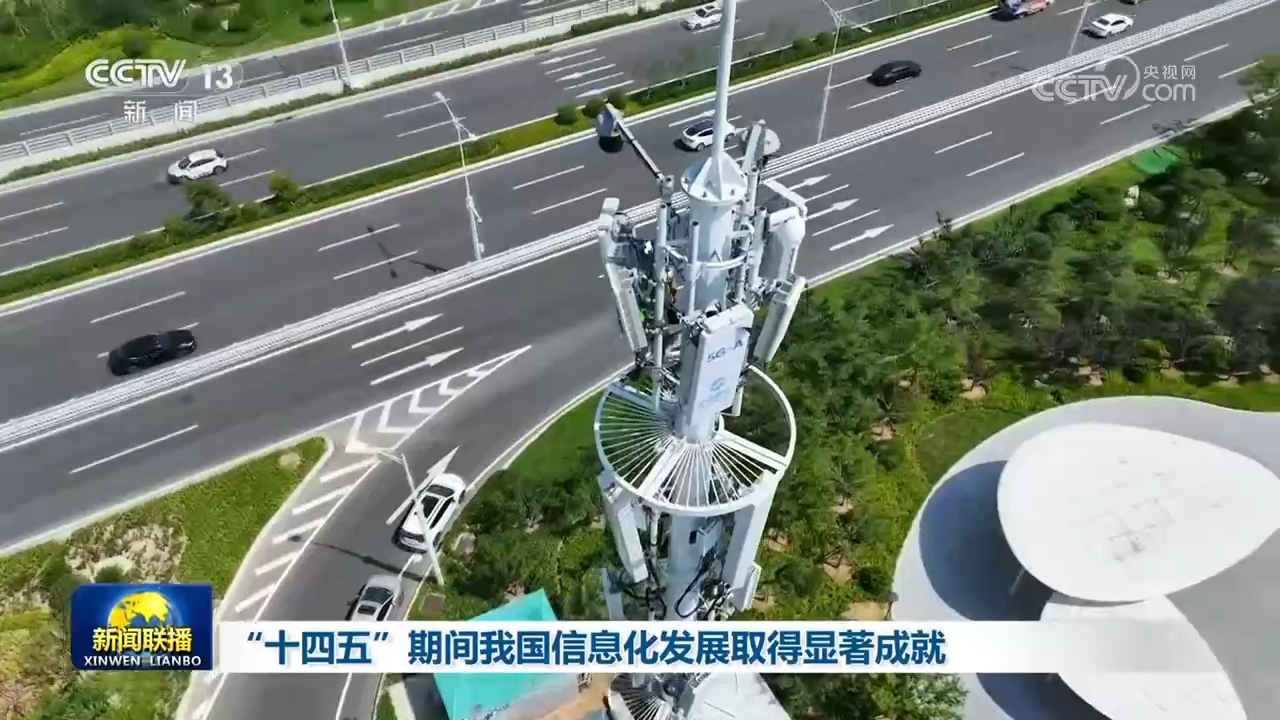
“十四五”期间我国信息化发展取得显著成就
Yang Shi Wang· 2025-12-25 12:19
Core Insights - During the "14th Five-Year Plan" period, China has made significant achievements in information technology development, transitioning from breakthroughs in key areas to comprehensive empowerment across various sectors [1]. Group 1: Information Infrastructure - The penetration rate of 5G users in China increased from 15% to 83.9% [3]. - The number of gigabit broadband users rose from 6.4 million to 239 million [3]. - Mobile IoT users expanded from 1.136 billion to 2.9 billion [3]. Group 2: Digital Economy - The value added by the core industries of the digital economy increased from 7.8% to 10.4% of GDP, maintaining China's position as the second-largest digital economy globally [5]. - Key technologies such as integrated circuits, artificial intelligence, and foundational software have seen accelerated breakthroughs, with over 1.19 billion products equipped with the open-source Harmony operating system [5]. - Research and standardization of 6G technology are progressing steadily, with the first phase of technical testing completed and over 300 key technology reserves established [5]. Group 3: E-Government Development - A national government service "one network" has been established, with 92.5% of provincial administrative licensing matters processed online and under the "one trip at most" policy [7]. - The informatization rate of agricultural production increased from 22.5% to over 30% [7]. - By 2024, the national rural online retail sales are expected to exceed 2.5 trillion yuan, representing a 43% increase compared to the end of the "13th Five-Year Plan" [7]. - Telemedicine service networks now cover all cities and counties, accelerating the bridging of the urban-rural digital divide [7].

我省新一代电子政务外网主体工程启用
Xin Hua Ri Bao· 2025-12-03 00:00
Core Insights - The new "One Network" for Jiangsu Province's electronic government has been officially launched, serving as a major infrastructure to support digital government initiatives and enhance operational efficiency [1] Group 1: Infrastructure Development - The new electronic government external network is a significant project categorized under digital government construction by the provincial data bureau [1] - A project construction task force has been established to ensure uniform standards and implementation across the province [1] - The core construction goals and main functions of the new network have been achieved, establishing a new network control system for unified scheduling, comprehensive perception, and agile response [2] Group 2: Network Capabilities - The network's carrying capacity has significantly improved, with core interconnection bandwidth reaching 100,000 Mbps, and access bandwidth for cities and provincial departments reaching 10,000 Mbps [2] - The network features cross-domain orchestration capabilities, allowing for unified status perception, operational analysis, and network control across different vendors and levels [2] - The solid and mobile integration capability supports simultaneous use by 10,000 mobile terminals, with the potential to expand to 40,000 terminals, ensuring flexible and secure access [2] Group 3: Management Efficiency - A unified management platform and security management platform have been established, transitioning from a tiered management model to an integrated intelligent linkage management model [2] - Network configuration time has been reduced from several days to under 5 minutes, fault detection time from several tens of minutes to 10 seconds, and high-frequency security incident response time from several hours to 10 minutes [2]
世界银行将提供2.5亿美元贷款助力摩洛哥数字化转型
Shang Wu Bu Wang Zhan· 2025-11-28 07:26
Core Insights - The World Bank will provide a $250 million loan to support Morocco's "2030 Digital Strategy" aimed at enhancing digital infrastructure and services [1] Group 1: Funding and Investment - The funding will focus on two main areas: modernizing e-government services and enhancing digital industry competitiveness [1] - The loan will help improve system interoperability, promote a "cloud-first" approach, and expand broadband coverage in underdeveloped regions [1] Group 2: Strategic Goals - Morocco's national digital strategy, set to launch in September 2024, aims to address structural issues such as regional development imbalance and the mismatch between talent training and market demand [1] - The strategy is expected to create 240,000 direct jobs and contribute an additional $10 billion to the GDP by 2030 [1] Group 3: Current Economic Context - Currently, the digital economy accounts for only 4.5% of Morocco's GDP, indicating significant untapped potential [1]
飞利信股价涨5.22%,华宝基金旗下1只基金位居十大流通股东,持有424.47万股浮盈赚取114.61万元
Xin Lang Cai Jing· 2025-11-24 06:32
Group 1 - The core viewpoint of the news is that Feilixin's stock has seen a significant increase of 5.22%, reaching a price of 5.44 CNY per share, with a trading volume of 201 million CNY and a turnover rate of 2.90%, resulting in a total market capitalization of 7.808 billion CNY [1] - Feilixin Technology Co., Ltd. is based in Haidian District, Beijing, and was established on October 16, 2002, with its listing date on February 1, 2012. The company specializes in providing intelligent meeting system solutions and related services, which can be categorized into several business segments [1] - The main revenue composition of Feilixin includes: 50.80% from IoT and intelligent systems, 22.22% from data, software, and services, 21.97% from audio-visual and control, and 5.01% from real estate, data center leasing, and other services [1] Group 2 - Among Feilixin's top ten circulating shareholders, Huabao Fund holds a significant position with its Huabao ChiNext AI ETF (159363) increasing its holdings by 1.8477 million shares, totaling 4.2447 million shares, which represents 0.32% of the circulating shares [2] - The Huabao ChiNext AI ETF (159363) was established on December 6, 2024, with a current scale of 4.352 billion CNY and has achieved a year-to-date return of 68.36%, ranking 65th out of 4209 in its category [2]

驻苏使馆贾金易参赞会见苏里南新任电子政务局局长
Shang Wu Bu Wang Zhan· 2025-10-23 06:23
Core Viewpoint - The meeting between the Chinese embassy's counselor and the new head of Suriname's e-Government Bureau focuses on advancing the road monitoring project in Suriname [1] Group 1 - The meeting took place on October 21, highlighting diplomatic engagement between China and Suriname [1] - The discussion centered on the collaboration for the road monitoring project, indicating a commitment to infrastructure development in Suriname [1]
武进:“一镇一品”结硕果 特色产业“齐发力”
Xin Hua Ri Bao· 2025-08-28 21:12
Core Viewpoint - The article highlights the continuous efforts of Wujin District in Changzhou to optimize the business environment and stimulate market vitality through innovative reforms and initiatives aimed at high-quality development [1][5]. Group 1: Business Environment Initiatives - The establishment of the "Business Environment Experience Officer" system, which involves 14 professionals from various sectors to provide feedback on government services and policies, aims to create a collaborative business environment [1]. - The "One Town, One Product" initiative encourages towns to leverage their industrial characteristics for targeted development, addressing regional disparities and diverse business needs [2]. Group 2: Service Improvement Measures - The transition from "waiting for approval" to "proactive problem-solving" in government services is exemplified by the upgraded "Land Clearance List System," which has benefited companies like Jianshibo [3]. - The integration of resources for enterprises, including approvals, finance, and talent, provides a "one-stop" service for innovative companies [4]. Group 3: Technological Empowerment - The trial operation of intelligent customer service applications aims to enhance the level of service automation and efficiency [5]. - Continuous reforms and improvements in the business environment have led to high satisfaction rates among private enterprises, positioning Wujin as a leader in creating a market-oriented, law-based, and international business environment [5].