白银等贵金属

Search documents
银价3天累计跌幅达40%,金价累计跌幅约20%
Shen Zhen Shang Bao· 2026-02-02 21:07
Group 1: Market Trends - International gold and silver prices experienced a significant drop, with gold futures falling below $4500 per ounce and silver futures dropping to $72.35 per ounce on February 2 [2] - In January, gold and silver prices surged, reaching historical highs of $5626.80 per ounce and $120.57 per ounce respectively, with monthly increases of approximately 29.89% and 72% [2] - Following the peak, gold and silver prices faced volatility, with gold prices declining by about 20% and silver by 40% over three days, erasing January's gains [2] Group 2: Stock Market Impact - The decline in gold and silver prices negatively impacted the stock market, with the Shanghai Composite Index closing down 2.48% on February 2 [4] - Precious metal stocks were heavily affected, with companies like Xiaocheng Technology (down 18.96%) and others experiencing significant losses, including 29 stocks hitting the daily limit down [4] - In the Hong Kong market, the Hang Seng Index fell by 2.23%, with notable declines in gold-related stocks [4] Group 3: Commodity Valuation Concerns - Citigroup's research indicated that gold valuations have reached extreme levels, with global gold expenditure as a percentage of GDP rising to 0.7%, the highest in 55 years [3] - A potential return to historical gold allocation ratios could lead to a significant price drop, with estimates suggesting a "halving" risk for gold prices [3] - The price of gold jewelry also saw a decline, with prices dropping to 1339 yuan per gram, a decrease of over 100 yuan from the previous day [3] Group 4: Regulatory Adjustments - The Shanghai Gold Exchange announced adjustments to the margin levels and price limits for silver contracts due to high volatility, increasing the margin from 20% to 26% [5] - The adjustments aim to mitigate market risks amid significant price fluctuations in silver [5] Group 5: Future Outlook - Some institutions believe the recent price corrections in gold and silver are temporary, with predictions of strong demand from central banks and expected net inflows into gold ETFs [5] - UBS forecasts a net purchase of 950 tons of gold by global central banks in 2026, indicating a strong appetite for gold reserves [5] - Analysts suggest that the recent price declines can be viewed as a market cooling phase rather than panic selling, which may help to stabilize the market for future growth [5]
地缘局势推升避险需求,贵金属上行动能充足 | 投研报告
Sou Hu Cai Jing· 2026-01-19 02:23
Core Viewpoint - The precious metals sector, particularly gold and silver, has experienced significant price increases, driven by various economic factors and geopolitical events [1][2][4]. Group 1: Precious Metals Price Movements - London spot gold rose by 5.93% to $4,611.05 per ounce, while the Shanghai Futures Exchange gold increased by 5.60% to ¥1,032.32 per gram, with holdings up by 10.39% to 347,100 contracts [1]. - London spot silver surged by 22.35% to $90.80 per ounce, and the Shanghai Futures Exchange silver climbed by 31.68% to ¥22,483 per kilogram, with holdings increasing by 12.21% to 719,100 contracts [1]. - Other precious metals also saw gains, with London spot palladium up by 6.95% to $1,755 per ounce and platinum up by 7.93% to $2,301 per ounce [1]. Group 2: Economic Indicators Impacting Precious Metals - The U.S. non-farm payrolls added 50,000 jobs in December, below the expected 60,000, with an unemployment rate of 4.4%, slightly better than the anticipated 4.5% [1]. - The annual increase in non-farm employment for 2025 was 584,000, significantly lower than the 2 million increase in 2024, marking the weakest growth since 2010-2019, excluding pandemic years [1]. Group 3: Market Dynamics and Future Outlook - The CME has adjusted the margin requirements for precious metals contracts, which may lead to increased market volatility and liquidity pressures [2]. - Geopolitical tensions, such as the U.S. military actions in Venezuela, could further influence market dynamics and investor sentiment towards precious metals [2]. - The "Trump 2.0" and "rate cut trade" themes are expected to provide strong momentum for gold prices in the medium term, with key upcoming economic indicators to watch [3][4]. - Central banks are expected to continue increasing gold reserves, with China's reserves reaching 74.15 million ounces by the end of December 2025, reflecting a strategic shift towards gold accumulation [4].
贵金属板块11月7日跌0.04%,招金黄金领跌,主力资金净流出2.21亿元
Zheng Xing Xing Ye Ri Bao· 2025-11-07 08:30
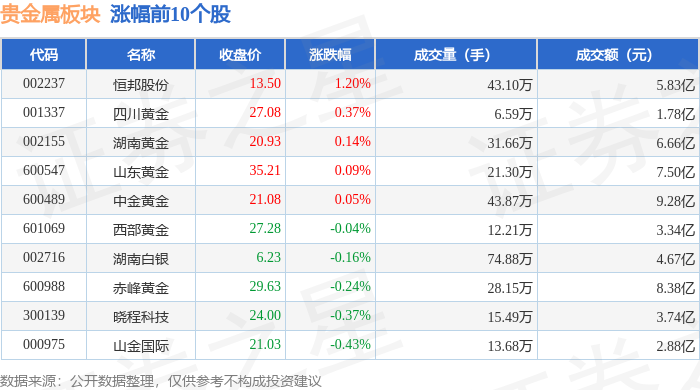
Core Viewpoint - The precious metals sector experienced a slight decline of 0.04% on November 7, with Zhaojin Gold leading the drop [1] Group 1: Market Performance - The Shanghai Composite Index closed at 3997.56, down 0.25% [1] - The Shenzhen Component Index closed at 13404.06, down 0.36% [1] Group 2: Individual Stock Performance - Zhaojin Gold (code: 000506) closed at 12.38, down 1.59% with a trading volume of 305,500 shares and a transaction value of 383 million [2] - Shandong Gold (code: 600547) closed at 35.21, up 0.09% with a trading volume of 213,000 shares and a transaction value of 750 million [2] - Hunan Gold (code: 002155) closed at 20.93, up 0.14% with a trading volume of 316,600 shares and a transaction value of 666 million [2] Group 3: Capital Flow - The precious metals sector saw a net outflow of 221 million from institutional investors, while retail investors had a net inflow of 140 million [2][3] - The main capital inflow and outflow for Zhaojin Gold showed a net inflow of 6.26 million from retail investors, but a net outflow of 1,117.36 million from institutional investors [3]