租赁商务服务

Search documents
兼评2月经济数据:经济开门红好于预期
KAIYUAN SECURITIES· 2026-03-17 01:12
Group 1: Economic Performance - Industrial added value for January-February increased by 6.3% year-on-year, surpassing expectations by 1.1 percentage points[3] - Fixed asset investment (FAI) showed a cumulative year-on-year increase of 1.8%, against an expected decline of 2.7%[14] - Service sector production rose to 5.2% year-on-year, up 0.2 percentage points from the previous value[3] Group 2: Investment Trends - Infrastructure investment rebounded significantly, with broad infrastructure up 25.8% year-on-year and narrow infrastructure up 23.6%[4] - Manufacturing investment growth improved by 2.5 percentage points to 3.1%, with notable increases in electrical machinery and textiles[4] - Real estate investment saw a reduction in decline, improving by 6.1 percentage points to -11.1%[5] Group 3: Consumer Behavior - Retail sales (social retail) increased by 1.9 percentage points to 2.8% year-on-year, although cumulative growth declined by 0.9 percentage points[6] - Service retail continued to outperform goods retail, with a widening growth gap of 3.1 percentage points[6] - Key contributors to retail growth included home appliances and food, while automotive sales lagged[6] Group 4: Market Outlook - Economic performance in early 2026 exceeded expectations, suggesting a potential moderate recovery in equity markets[7] - The need for additional policies to support domestic recovery remains, particularly in light of geopolitical uncertainties and consumer demand fluctuations[7] - Risks include potential policy changes and unexpected economic downturns in the U.S.[8]
国泰海通|宏观:哪些服务业:空间较大
国泰海通证券研究· 2026-02-12 14:02
Core Viewpoint - The report analyzes the service industry in China from three dimensions: development trends, demand potential, and productivity changes, identifying significant growth opportunities in sectors such as retail, catering, publishing, healthcare, internet services, leasing business services, railway transportation, and banking [1][7]. Service Industry Definition and Accounting - The service industry, defined as the tertiary sector, includes various sectors excluding primary and secondary industries, covering 15 categories from wholesale and retail to specialized auxiliary activities [2][7]. - Current statistical accounting for the service industry in China is less developed compared to the industrial sector, with issues such as data lag, missing data, and incomplete coverage of sub-sectors [7]. Analysis of Development Potential - The potential for service industry growth is significant, with China's GDP per capita nearing high-income thresholds, yet the value added and employment share in the service sector remain at the lower end compared to similar income countries [3][7]. - The report suggests that there is approximately a 7.7 percentage point potential increase in the service industry's value added share, projected to reach 56.7% by 2024, compared to the average of 64.5% in high-income countries [7]. Supply and Demand Perspective - The enhancement of service industry levels is driven by both supply-side productivity changes and demand-side consumption structure upgrades, with life services expanding due to dual effects of demand pull and cost push [7]. - The report highlights that while the share of productive services in China is narrowing the gap with developed economies, the life services sector remains relatively stable, indicating a need for effective labor mobility to transmit productivity gains across sectors [7]. Industry Chain Perspective - The report identifies two main lines for enhancing and upgrading the service industry: the integration of productive services with manufacturing to avoid de-industrialization and the strong consumer pull on life services such as retail, accommodation, and transportation [7]. - By 2025, the service industry in China is expected to show stable overall performance, with weak demand for life services and rising prices lacking sufficient internal support [7]. Sector-Specific Growth Opportunities - The analysis indicates that within the life services sector, areas such as retail, catering, publishing, and healthcare, as well as productive services like internet services, leasing business services, railway transportation, and banking, have substantial growth potential [1][7].


哪些服务业:空间较大
GUOTAI HAITONG SECURITIES· 2026-02-11 11:10
Service Industry Overview - The service industry in China is defined as the tertiary sector, which includes various sectors excluding primary and secondary industries, covering 15 categories from wholesale and retail to auxiliary activities in agriculture, forestry, animal husbandry, and fishing[8] - The current service industry statistics in China show that the quarterly value added, retail sales, and price calculations are still lagging behind industrial statistics, indicating issues such as data updates and coverage[9] Development Potential - China's GDP per capita is approaching the threshold of high-income countries, yet the value added and employment share of the service industry remain at the lower end compared to similar income countries, suggesting significant room for improvement[12] - The service industry value added is projected to reach 56.7% by 2024, indicating a potential increase of approximately 7.7 percentage points compared to the average of 64.5% in high-income countries[20] Sector Analysis - Key sectors with substantial growth potential include retail, catering, publishing, healthcare, internet services, leasing and business services, railway transportation, and banking[39] - The productivity growth in the service sector has been higher than that in the industrial sector since 2016, suggesting that service sector productivity improvements can mitigate structural economic slowdowns[20] Demand and Supply Dynamics - The expansion of the service industry is driven by both supply-side productivity changes and demand-side consumption structure upgrades, with life services showing strong demand elasticity[25] - The average annual growth rate of labor compensation in the service industry from 2018 to 2023 was 2.6%, significantly lower than the 8.1% growth in the manufacturing sector, indicating a disparity in wage growth across sectors[28] Risks and Challenges - There are risks associated with incomplete or lagging service industry statistics, discrepancies in international comparisons, and potential underperformance in income growth and service efficiency improvements[41]
2025年安徽省产业结构持续向新向优
Sou Hu Cai Jing· 2026-02-02 08:44
Group 1: Economic Growth and Structure - The core viewpoint indicates that by 2025, Anhui Province's industrial structure will continue to improve, with advanced manufacturing as the main engine for economic growth, leading to a significant rise in modern service industries [1] - Advanced manufacturing sectors such as automotive, electronic information, and electrical equipment are showing strong performance, with automotive industry growth at 19.5%, electronic information at 42.2%, and electrical equipment at 4.2%, reflecting a systemic leap in emerging industries [1] Group 2: Integration of Manufacturing and Services - The new emerging service industries closely related to advanced manufacturing are experiencing robust growth, with sales revenue increasing by 8.1% year-on-year, contributing 47.7% to the overall provincial growth, highlighting the synergy between manufacturing and services [2] - Specific sectors such as scientific and technical services, leasing and business services, and software information technology services have seen sales growth of 13.2%, 6.8%, and 4.2% respectively, providing strong support for the upgrading of advanced manufacturing [2] Group 3: Innovation and Digital Economy - Innovation-driven development is identified as a core engine for high-quality economic growth, with sales revenue from knowledge-intensive industries increasing by 12.3%, indicating enhanced application of technological achievements [3] - The core digital economy sectors have seen a sales revenue growth of 7.6%, with digital product services and manufacturing growing by 36.4% and 16% respectively, showcasing a positive trend in the integration of digital and traditional industries [3] - The Anhui Provincial Taxation Bureau emphasizes its role in supporting innovation-driven strategies and optimizing tax services to empower industrial collaboration [3]
增长5.5%!深圳,最新公布→
Zheng Quan Shi Bao· 2025-10-30 11:53
Economic Growth - Shenzhen's GDP for the first three quarters of 2025 reached 27,896.44 billion yuan, with a year-on-year growth of 5.5% at constant prices [1] - The primary industry added value was 17.45 billion yuan, showing no growth; the secondary industry increased by 9,946.06 billion yuan, growing by 3.5%; the tertiary industry added 17,932.93 billion yuan, with a growth of 6.6% [1] Industrial Performance - The industrial added value in Shenzhen increased by 5.0% year-on-year, with a growth acceleration of 0.7 percentage points compared to the first half of the year [1] - Key sectors such as general equipment manufacturing grew by 16.6%, instrument manufacturing by 7.5%, and computer, communication, and other electronic equipment manufacturing by 6.0% [1] - High-tech product output saw rapid growth, with civil drones, industrial robots, and 3D printing equipment increasing by 46.9%, 38.2%, and 33.6% respectively [1] Service Sector - The added value of the service industry in Shenzhen was 17,932.93 billion yuan, with a year-on-year growth of 6.6%, accelerating by 0.5 percentage points from the first half of the year [1] - Financial services, information transmission, software and IT services, and leasing and business services grew by 14.5%, 9.7%, and 5.6% respectively [1] Consumer Market - The total retail sales of consumer goods in Shenzhen reached 7,560.81 billion yuan, with a year-on-year growth of 3.6%, slightly up by 0.1 percentage points from the first half of the year [2] - Retail sales of essential goods showed strong growth, with food and daily necessities increasing by 8.4% and 7.5% respectively [2] - The policy for replacing old consumer goods continued to show effects, with retail sales of home appliances and audio-visual equipment increasing by 41.5% [2] Foreign Trade - Shenzhen's total import and export volume for the first three quarters was 33,643.29 billion yuan, with a slight year-on-year increase of 0.1% [2] - Exports amounted to 20,382.04 billion yuan, down by 4.7%, while imports reached 13,261.25 billion yuan, growing by 8.4% [2] - High-tech product exports increased by 9.7% [2] Investment Trends - Fixed asset investment in Shenzhen decreased by 17.4% year-on-year [3] - Real estate development investment fell by 24.8%, while infrastructure investment grew by 6.8% and industrial technological transformation investment surged by 42.7% [3] Financial Sector - As of the end of September, the balance of deposits in Shenzhen's financial institutions (including foreign capital) was 143,649.54 billion yuan, with a year-on-year growth of 5.6% [3] - The balance of loans in financial institutions (including foreign capital) was 99,404.44 billion yuan, growing by 5.0% year-on-year [3]

兼评Q3经济数据:Q3经济放缓符合预期,关注政策性金融工具效果
KAIYUAN SECURITIES· 2025-10-20 13:42
Economic Overview - Q3 2025 GDP grew by 4.8% year-on-year, aligning with expectations, while quarter-on-quarter growth was 1.1%, an increase of 0.1 percentage points from the previous value[3] - The nominal GDP growth rate narrowed the gap with real GDP growth by 0.2 percentage points, indicating a mild recovery in price levels[3] Industrial and Service Sector Performance - Industrial added value in September increased by 6.5% year-on-year, up 1.3 percentage points from the previous value, driven by sectors like automotive and food manufacturing[3][15] - The service sector maintained resilience with a production growth rate of 5.6% year-on-year, consistent with previous values[3][15] Consumer Behavior - Disposable income growth slowed slightly to 5.1%, down 0.2 percentage points, with a consumption rate of 68.1% in Q3 2025, lower than the levels in 2023-2024[20] - Retail sales in September saw a cumulative year-on-year decline of 0.1 percentage points to 4.5%, with a monthly decline of 0.4 percentage points to 3.0%[4][23] Investment Trends - Fixed asset investment showed a cumulative year-on-year decline of 0.5%, with real estate investment down 13.9%[14][27] - Infrastructure investment saw a significant drop, with broad infrastructure down 8.0% year-on-year, while narrow infrastructure improved to -4.7%[6][33] Future Economic Outlook - To achieve an annual growth target of approximately 5.0%, Q4 2025 GDP needs to reach 4.6%[7][35] - The government is focusing on policy financial tools, including a 500 billion yuan initiative to stimulate investment and consumption[7][35] Risk Factors - Potential risks include policy changes that may fall short of expectations and an unexpected recession in the U.S. economy[8][36]
兼评7月经济数据和个人消费贷贴息:内需放缓,个人消费贷贴息或提振社零0.2个百分点
KAIYUAN SECURITIES· 2025-08-16 07:49
Consumption - The contribution of trade-in programs to retail sales has weakened, with July retail sales growth declining by 1.1 percentage points to 3.7% year-on-year[3] - The personal consumption loan interest subsidy is expected to boost retail sales by approximately 0.2 percentage points, with a historical context showing a 1% subsidy could lead to a greater impact than previous years[4] - The consumer loan consumption rate has remained low, averaging around 2.5% since 2024, indicating a shift towards cash purchases rather than credit expansion[3] Production - Industrial production growth in July was 5.7%, down 1.1 percentage points from the previous value, with a month-on-month increase of only 0.38%[5] - Service sector production also saw a slight decline of 0.2 percentage points to 5.8% year-on-year, with mixed performance across various industries[5] Fixed Investment - Real estate investment has further declined, with July showing a year-on-year drop of 12.0%, and new housing sales showing signs of weakness[6] - Manufacturing investment has decreased by 1.3 percentage points to 6.2%, with significant declines in sectors such as non-ferrous metallurgy and chemical products[6] - Infrastructure investment turned negative for the first time since 2021, with broad infrastructure showing a decline of 1.9% year-on-year in July[6] Economic Outlook - The data from July indicates a further weakening of domestic demand, suggesting increased downward pressure on economic growth in Q4, which may prompt policy adjustments[7] - Risks include potential underperformance of policy measures and unexpected downturns in the U.S. economy[7]
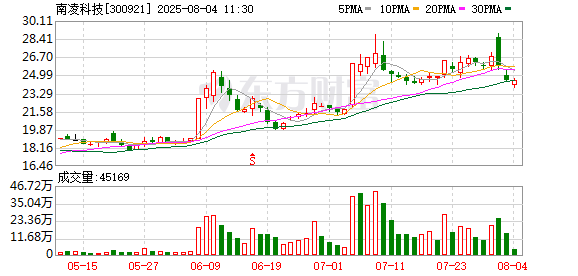
南凌科技:接受长盛基金调研
Mei Ri Jing Ji Xin Wen· 2025-08-04 04:53
Group 1 - The core point of the article is that Nanling Technology (SZ 300921) announced a scheduled investor research meeting with Changsheng Fund on July 28, 2025, where the company's board secretary, Yu Li, will participate and address investor inquiries [2] Group 2 - For the year 2024, the revenue composition of Nanling Technology is as follows: Other sectors account for 24.15%, Manufacturing accounts for 23.45%, Information Transmission, Software, and IT Services account for 20.75%, Wholesale and Retail account for 17.96%, Financial Services account for 7.47%, and Leasing and Business Services account for 6.22% [2]