稀土磁铁

Search documents
中国贸促会:今年链博会将创新设置人工智能专区
Mei Ri Jing Ji Xin Wen· 2026-01-28 13:25
Group 1: Trade Friction and Discrimination - The trade friction index related to China from 19 countries/regions is at a high level of 101 as of November 2025, with the EU having the highest index, particularly in sectors like semiconductor materials, rare earth magnets, and LCD products [1] - In January 2023, the EU has increased discriminatory measures against Chinese companies, including the introduction of the Carbon Border Adjustment Mechanism (CBAM) which sets high default values for carbon emissions from Chinese products [2] - The EU has also mandated member states to exclude "high-risk suppliers" in 18 key industries, unjustly labeling some Chinese companies as high-risk, thereby limiting their participation in 5G infrastructure [2] Group 2: Future Plans and Initiatives - The China Council for the Promotion of International Trade (CCPIT) plans to enhance its services for foreign enterprises and support Chinese companies in international exhibitions, with a focus on the 2027 World Expo in Belgrade, Serbia [3] - The CCPIT aims to organize high-quality economic and trade activities in 2026, including the Global Trade and Investment Promotion Summit and the 19th China-Latin America Entrepreneurs Summit, to deepen cooperation along the Belt and Road Initiative [3] - The CCPIT will innovate the Chain Expo to facilitate exchanges and cooperation between Chinese and foreign enterprises, focusing on emerging industries such as artificial intelligence and renewable energy [4] Group 3: Legal and Intellectual Property Services - The CCPIT is committed to building a world-class mediation and arbitration institution to enhance the international commercial dispute resolution framework [5] - The organization will expand its services in intellectual property disputes and overseas rights protection, aiming to strengthen the knowledge of intellectual property services [5] - The CCPIT plans to enhance its legal services, including compliance management and risk prevention, to assist enterprises in navigating trade friction [5]
2025年11月欧盟涉华经贸摩擦指数最高
Zhong Guo Xin Wen Wang· 2026-01-28 09:09
Group 1 - The core viewpoint of the article highlights that the EU has the highest trade friction index with China in November 2025, particularly in sectors like semiconductor materials, rare earth magnets, and LCD products [1] - In November 2025, the trade friction measures involving 19 countries (regions) decreased by 12.4% year-on-year and 2.4% month-on-month, while the global trade friction index remained high at 101 [1] - The EU, the US, and South Korea rank as the top three countries in terms of global trade friction index, with the EU initiating multiple anti-subsidy and anti-dumping investigations, surpassing the US for the first time in 16 months in terms of trade friction measures [1] Group 2 - A total of 30 import and export tariff measures were announced by the 20 monitored countries (regions), along with 19 trade remedy investigations, 152 notifications to the WTO regarding technical barriers to trade (TBT) and sanitary and phytosanitary measures (SPS), 12 import and export restrictions, and 212 other restrictive measures [2] - The trade remedy measures index is the highest among the five categories of sub-index measures [2]
贸促会发布新一期全球经贸摩擦指数,欧盟升至榜首
Di Yi Cai Jing· 2026-01-28 08:19
Core Viewpoint - The European Union (EU) has increased unreasonable discriminatory measures against Chinese enterprises, exacerbating global trade frictions in a complex international trade environment [1][3]. Group 1: EU Measures Against Chinese Enterprises - The EU has intensified its anti-subsidy and anti-dumping investigations, surpassing the US in the amount of trade friction measures, which now exceed the latter's for the first time in 16 months [1]. - The trade friction index related to China reached 101 in January, indicating a high level of tension, with the EU having the highest index among 19 countries [1]. - The EU's carbon border adjustment mechanism (CBAM) has set significantly high default values for carbon emissions from Chinese products, disregarding China's achievements in green and low-carbon development [3]. Group 2: Chinese Response and Investment Outlook - The Chinese Ministry of Commerce criticized the EU's use of non-technical standards to restrict Chinese enterprises, claiming it distorts the market and threatens supply chain security [3][4]. - Chinese enterprises are optimistic about "going global," with a projected 7.1% increase in foreign direct investment by 2025, maintaining a top-three position globally for nine consecutive years [5]. - A survey indicates that nearly 80% of Chinese enterprises intend to expand or maintain their foreign investment, with 90% showing an increased willingness to use RMB for overseas investments [5][6]. Group 3: Support for Chinese Enterprises - The China Council for the Promotion of International Trade (CCPIT) is enhancing services for enterprises going abroad, including organizing business negotiations and improving the overseas service system [5][6]. - The CCPIT aims to create a comprehensive digital service ecosystem for enterprises, leveraging big data and artificial intelligence to support their international expansion [6].

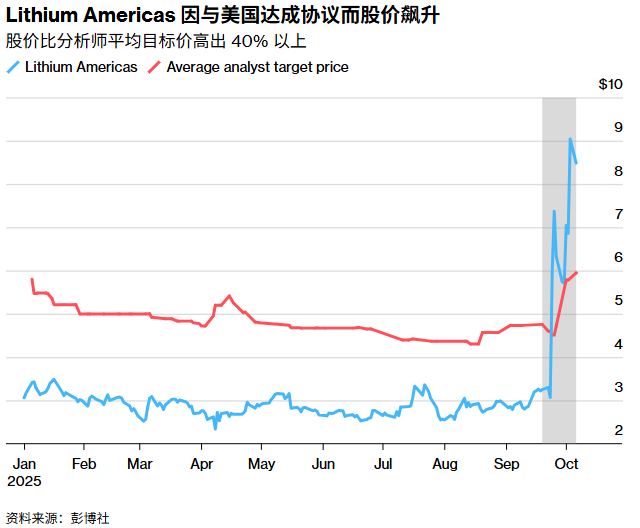
获美政府持股后Lithium Americas(LAC.US)狂飙175%,分析师警告高估值与股权稀释风险
Zhi Tong Cai Jing· 2025-10-07 14:07
Core Viewpoint - The market has reacted strongly to the agreement between Lithium Americas and the U.S. government, leading to a 175% increase in the company's stock price, but analysts are now questioning the sustainability of this valuation and the potential dilution of shareholder equity [1][4]. Group 1: Stock Performance and Analyst Ratings - Following the announcement of the agreement, four analysts have downgraded their ratings on Lithium Americas, reflecting concerns over the stock's high valuation amidst market enthusiasm [1]. - The stock price of Lithium Americas has seen a significant increase, reaching near a two-year high, and is currently over 40% above the average target price set by analysts [1][4]. - Analysts from various firms, including Jefferies and Cormark Securities, have suggested that investors should consider taking profits and waiting for a market correction before re-entering [4][5]. Group 2: Agreement Details and Implications - Under the terms of the agreement, the U.S. government will acquire a 5% stake in Lithium Americas and its Thacker Pass mining project, along with a $435 million loan from the Department of Energy [4]. - The potential dilution of existing shareholder equity could be around 40% if similar concessions are required for future loan disbursements [4]. - The agreement is part of a broader trend where the U.S. government is investing in mining companies, as seen with previous investments in MP Materials and Intel, which have also experienced significant stock price increases [4].