
羽绒加工

Search documents
春节错月致1月CPI同比涨幅回落,反内卷带动相关领域价格改善
第一财经· 2026-02-11 06:23
Core Viewpoint - The article discusses the recent trends in China's Consumer Price Index (CPI) and Producer Price Index (PPI), highlighting a decline in CPI and an improvement in PPI due to various factors including seasonal effects and policy implementations [3][5]. CPI Analysis - In January, the CPI increased by 0.2% month-on-month and year-on-year, with a notable decrease of 0.6 percentage points compared to December [3][5]. - The decline in CPI is attributed to the high base effect from the previous year's Spring Festival and a significant drop in energy prices, which fell by 5.0%, contributing approximately 0.34 percentage points to the CPI decrease [5][7]. - Core CPI, excluding food and energy, rose by 0.8% year-on-year and 0.3% month-on-month, marking the highest increase in six months, indicating a steady recovery in consumer demand [5][7]. PPI Analysis - The PPI rose by 0.4% month-on-month in January, marking the fourth consecutive month of increase, with the growth rate expanding by 0.2 percentage points from the previous month [7][8]. - Key factors driving PPI growth include the ongoing construction of a unified national market and increased demand in certain industries, leading to price increases in sectors such as photovoltaic, power batteries, cement, and steel [7][8]. - Specific price changes include a 0.1% increase in cement and lithium-ion battery manufacturing, a 1.9% increase in photovoltaic equipment manufacturing, and a 0.5% increase in computer and communication equipment manufacturing due to rising demand for digital technologies [7][8]. Future Price Trends - The National Bureau of Statistics indicates that favorable factors for moderate price recovery are accumulating, with expectations for expanded consumer demand supported by fiscal and financial policies [8]. - The emphasis on industry self-discipline and capacity management is expected to continue, contributing to price stabilization and recovery [8].

(走进中国乡村)小鹅绒撑起中国东北乡村“温暖产业”
Zhong Guo Xin Wen Wang· 2026-02-04 06:26
Core Insights - The article highlights the growth of the down industry in Wanjintai Township, Jilin Province, which has become a significant contributor to the local economy, particularly in the high-end down market, accounting for approximately 50% of China's market share [1][2]. Industry Overview - The down industry in Wanjintai Township has evolved since the 1980s, with a formalized trading market established by 1995, and has seen a surge in production enterprises in recent years, replacing informal trading [1]. - The region's cold climate contributes to the high density and strong insulation properties of the local goose down, which is comparable in quality to that from other regions [1]. Production Capacity and Employment - Currently, there are 16 large-scale down processing enterprises in the township, generating an annual total output value of approximately 600 million yuan, with three companies exceeding 100 million yuan in output [2]. - The industry supports over 5,000 jobs, with a significant number of vehicles involved in the supply chain, indicating robust local economic activity [2]. Future Development Plans - Local government initiatives include the establishment of a down industry association aimed at enhancing quality and efficiency through training and financial support, with the down industry included in the local "14th Five-Year Plan" [5]. - Companies are actively seeking to expand their operations, with plans for deeper processing to increase product value, reflecting a commitment to long-term growth and community income enhancement [5].
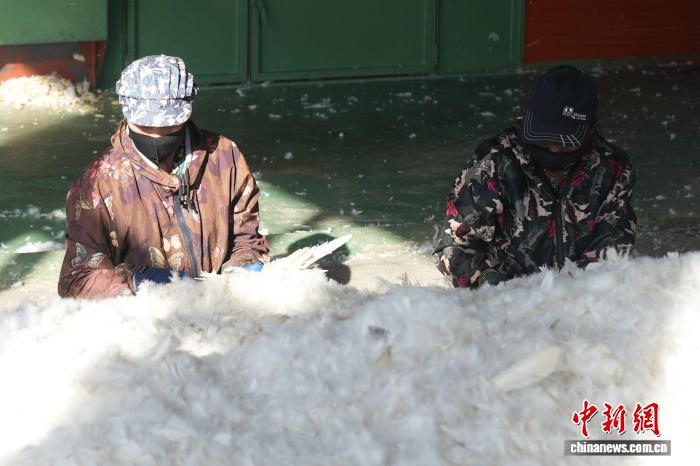
(乡村行·看振兴)一羽鹅绒看振兴:吉林农安绘就“温暖产业”新图景
Xin Lang Cai Jing· 2026-02-04 05:06
Core Insights - The feather processing industry in Wanjinta Township, Jilin Province, has become a significant source of employment and income for local residents, with workers earning a stable income of 6,000 yuan per month [1][3] - The region's cold climate contributes to the high density and quality of its goose down, which holds about 50% of the national high-end goose down market share [3] - The local industry has expanded significantly, with 16 large-scale feather processing enterprises generating an annual total output value of approximately 600 million yuan [3][4] Industry Development - The Wanjinta Township has a long history with the feather industry, evolving from informal trading in the 1980s to a structured market with established enterprises since the 2000s [1][3] - The local company, Jilin Wanjin Feather Co., Ltd., has increased its production capacity to 150 million jin annually, a fivefold increase over the past decade, with a projected output value exceeding 50 million yuan by 2025 [3][5] - The township's government is actively promoting the feather industry as part of its "14th Five-Year Plan," focusing on policy support and service optimization to attract feather product processing projects [4][5] Employment and Community Impact - The feather industry provides flexible employment opportunities for local residents, including elderly individuals, significantly improving their quality of life [3][4] - The industry supports over 5,000 vehicles involved in the collection and transportation of feathers, with more than 5,000 workers engaged in related activities [3] - The establishment of a feather industry association aims to enhance quality and efficiency through training and collaboration among enterprises [4]
巨野农商银行:深耕普惠金融,赋能养殖鹅产业链发展
Qi Lu Wan Bao· 2026-01-30 05:17
Core Viewpoint - The goose farming industry in Jiuye County is transitioning from traditional small-scale farming to a modern agricultural model characterized by scale, chain integration, and high value-added processes, supported by Jiuye Rural Commercial Bank's financial services [1] Group 1: Financial Support for Farmers - Jiuye Rural Commercial Bank addresses the financial challenges faced by farmers, such as insufficient startup capital and high pressure during the breeding cycle, by implementing a "grid-based" approach for direct engagement and ensuring timely financial support [2] - A local farmer, referred to as "Old Zhang," received a loan of 300,000 yuan, enabling him to expand his goose farming operations and double his annual output, resulting in an additional income of over 150,000 yuan [2] Group 2: Enhancing Value through Processing - The bank focuses on enhancing the processing segment of the industry, particularly in developing high-value by-products like goose down, by providing loans for technology upgrades and capacity expansion to processing enterprises [2] - A down products company received a loan of 5 million yuan for equipment upgrades, leading to improved product quality and pricing, which in turn increased the overall purchase price of goose down for local farmers [3] Group 3: Supporting Supply Chain Stability - Jiuye Rural Commercial Bank also supports upstream supply chains, such as feed production, to ensure a stable supply for farmers, thereby maintaining a continuous flow of resources [4] - A local feed production company received financial support for facility expansion, resulting in a 40% increase in production capacity, which stabilized local supply and benefited farmers through reduced costs [4]
河南小县,承包了中国羽绒服
投资界· 2026-01-03 08:57
Core Viewpoint - The article highlights the significance of Taiqian County in China's down industry, emphasizing its dominance in high-quality down production and its potential to become a global hub for down processing and trading [4][5][14]. Industry Overview - China accounts for 85% of the global down processing supply, with Taiqian County supplying one-third of the national down processing and over 50% of high-end down production [5][6]. - Taiqian County is recognized as one of the "China Down Hometowns," alongside Guangdong, Guangxi, and Zhejiang [7]. Taiqian County's Down Industry Characteristics - Taiqian County hosts over 200 down enterprises, with an annual deep processing capacity of 89,000 tons of down and production of 35 million down garments, generating over 4 billion yuan in annual output value [9][10]. - The county produces nearly 40,000 tons of high-quality down annually, with over 50% of the national share in high-end pure white duck down [9][10]. Historical Context and Development - The down industry in Taiqian County emerged from a historical context of poverty and geographical disadvantages, transforming into a significant economic driver for the region [15][18]. - The local population initially engaged in collecting down from slaughterhouses in Northeast China, leading to the establishment of processing facilities as the industry grew [18][19]. Future Development Plans - Taiqian County aims to enhance its down and garment processing industry to exceed 10 billion yuan by 2025, aspiring to become the largest global hub for high-quality down and down products [14][20]. - Recent initiatives, such as the "Luyu Cooperation Development Implementation Plan," aim to strengthen regional collaboration and improve Taiqian's logistical advantages [21][23]. Strategic Advantages - The county's geographical location allows it to connect with major transportation networks, enhancing its potential for industrial growth and attracting investment [23][25]. - Taiqian's established supply chain and processing capabilities position it well to attract enterprises from regions like Jiangsu and Zhejiang, facilitating industry transfer and expansion [25].

宝藏之城丨这座小城温暖冬天
Xin Hua She· 2025-12-28 02:09
Core Viewpoint - The article highlights the development of the down industry in Guangxi's Gangnan District, known as "China's Down Town," which has established a complete industrial chain over 40 years of growth [1] Industry Overview - The down industry in Gangnan District began in the 1980s and is primarily concentrated in Qiaoxu Town [1] - There are currently 170 down processing enterprises in Gangnan District, processing approximately 90,000 tons of down annually [1]
价格暴涨!“羽绒价格一天一个价”
新华网财经· 2025-11-20 14:03
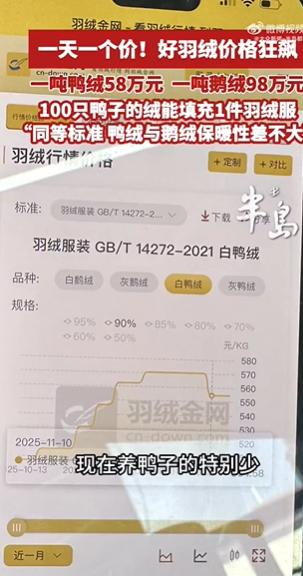
Core Insights - The article discusses the significant price increase of down jackets due to rising raw material costs, particularly duck down and goose down, which have surged since October [2][4][6]. Price Trends - Duck down prices have skyrocketed, with 90% white duck down reaching approximately 580,000 yuan per ton, up from 170,000 yuan [4]. - Goose down prices are now around 980,000 yuan per ton [4]. - As of November 19, the price for 90% white duck down was 559.32 yuan per kilogram, a year-on-year increase of 7.6%, while 90% gray duck down was priced at 541.94 yuan per kilogram, up 9.58% year-on-year [4]. Market Dynamics - The down processing industry typically experiences a seasonal price increase during autumn, known as "golden September and silver October" [6]. - The decline in pork prices has led to reduced duck and goose production, contributing to the scarcity of down and subsequent price hikes [6]. - Extreme cold weather this winter could further exacerbate the price increases in down products [6]. Cost Structure - The cost of raw materials for a down jacket filled with 90% white duck down and 150 grams of filling ranges from 63 to 82.5 yuan, leading to a core cost of 126 to 247.5 yuan [8]. - The reasonable selling price of such a jacket is unlikely to be below 300 yuan when considering additional costs [8]. Consumer Guidance - The article emphasizes the importance of understanding key indicators when purchasing down jackets, such as down content, filling amount, and compliance with the new national standard (GB/T 14272-2021) [12][13]. - Consumers are advised to check for the down content percentage, with higher percentages indicating better warmth [17]. - The filling amount (in grams) is crucial for determining the jacket's insulation effectiveness [18].
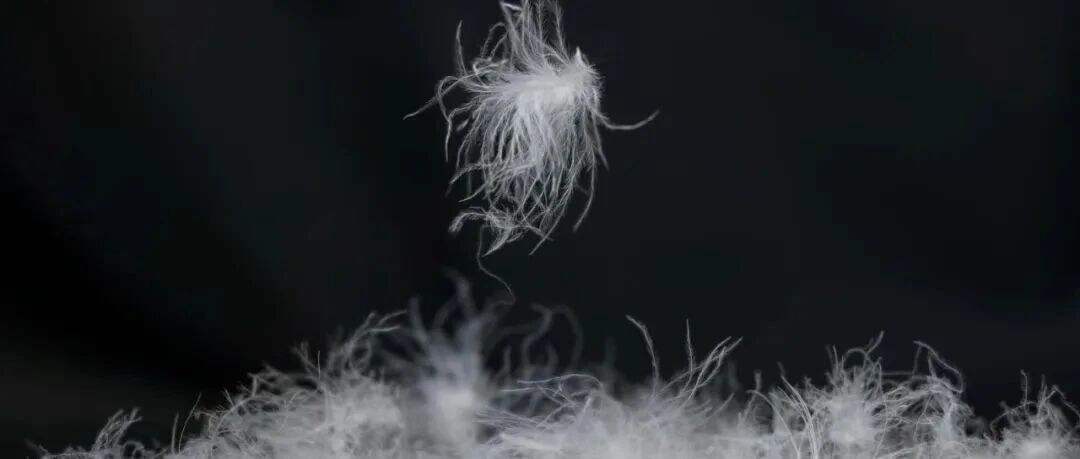
各地气温骤降,羽绒价格一天一个价
Jing Ji Ri Bao· 2025-11-20 01:17
Price Trends - Downstream demand for down products has surged, with prices increasing since October. As of November 19, the price for 90% white duck down reached 559.32 RMB per kilogram, a year-on-year increase of 7.6%, while 90% grey duck down was priced at 541.94 RMB per kilogram, up 9.58% year-on-year [1] - The price of 90% white duck down has escalated from 170,000 RMB per ton to approximately 580,000 RMB, while goose down is now priced at 980,000 RMB per ton. The cost of producing a short adult down jacket has risen significantly, requiring down from about 100 ducks, pushing factory prices close to 1,000 RMB [1] Market Dynamics - The down processing industry experiences a seasonal peak in demand during autumn, leading to continuous price increases. This year's price surge is attributed not only to seasonal demand but also to the decline in pork prices, which affects the profitability of duck and goose farmers, leading to reduced production and consequently higher down prices [1] - If extreme cold weather occurs this winter, it is likely that down prices will continue to rise [1] Consumer Insights - A recent discussion highlighted that consumers are struggling to find genuine down jackets priced below 300 RMB, with some retailers claiming that such low-priced items are not made from real down [5] - According to the China Down Industry Association, the price for standard 90% white duck down ranges from 420 RMB to 550 RMB per kilogram, while white goose down is priced between 840 RMB and 1,200 RMB per kilogram. The core cost of a down jacket filled with 150 grams of 90% white duck down is estimated to be between 126 RMB and 247.5 RMB, indicating that a reasonable selling price for such products cannot be below 300 RMB [5]
羽绒价格飞涨 都是猪肉惹的祸
Xin Lang Cai Jing· 2025-11-07 09:17
Group 1 - The price of down feathers has reached last year's peak levels, with 90% down priced at 550,000 yuan per ton [1] - The increase in down prices is attributed not only to seasonal demand but also to the decline in pork prices, which affects the overall meat market [1] - Farmers raising ducks and geese are sensitive to pork price fluctuations; reduced profitability may lead to decreased production, resulting in lower supply of duck and goose feathers, thus driving up prices [1] Group 2 - If extreme cold weather occurs this winter, it is expected that down prices may rise further [1]
广西自贸试验区创新监管模式 助力国际羽绒加贸中心建设
Zhong Guo Xin Wen Wang· 2025-07-12 11:36
Core Insights - The Guangxi Zhuang Autonomous Region is enhancing its status as an international down processing trade center by introducing a new rapid customs clearance model for imported washed feathers and down, which is the first of its kind in China [1][2] Group 1: Industry Development - The down industry is a traditional advantage for Guangxi, with local enterprises requiring significant imports of raw materials from countries like Thailand [1] - The new customs model allows imported washed feathers and down to be cleared directly at Qinzhou Port, reducing logistics distance by approximately 1500 kilometers and cutting overall clearance time by 70% [1] - The first batch of 18.5 tons of imported washed feathers and down from Thailand achieved seamless "port to factory" delivery in just 8 days [1] Group 2: Economic Impact - Since the implementation of the reform, Qinzhou Port has imported over 44 batches and 1068.2 tons of washed feathers and down, valued at over 40 million yuan [2] - The new model is expected to reduce logistics costs for enterprises by approximately 10 million yuan annually and increase the annual import volume of non-epidemic area washed feathers and down from 10,000 tons to between 30,000 and 60,000 tons [2] Group 3: Future Plans - The Guangxi Free Trade Zone plans to deepen reforms, expand the range of pilot enterprises, and optimize the cross-border trade ecosystem [2] - There are intentions to upgrade the down testing center to a regional international certification platform, further enhancing Qinzhou Port's role as a core channel for raw material imports from ASEAN [2]