
羽绒

Search documents
2026年1月物价数据点评:“反内卷”与新质生产力发展并进
BOHAI SECURITIES· 2026-02-12 10:11
Group 1: CPI Analysis - In January 2026, the CPI increased by 0.2% year-on-year, a decrease from the previous value of 0.8%[11] - Core CPI's month-on-month growth reached its highest level in six months, driven by increased travel demand and rising international gold prices[4] - Food prices remained stable month-on-month, with fresh vegetable prices decreasing by 4.8%[14] Group 2: PPI Analysis - In January 2026, the PPI's year-on-year decline narrowed, while the month-on-month increase expanded[5] - Prices in the upstream raw materials sector turned from decline to increase due to the "anti-involution" effect, with basic chemical raw materials rising by 0.7%[25] - The month-on-month increase in production materials prices expanded, while living materials prices shifted from stable to rising[25] Group 3: Future Outlook - The CPI is expected to increase in February 2026, influenced by sufficient pig supply and potential price rises in fresh vegetables before the Spring Festival[16] - The PPI is projected to maintain a similar month-on-month increase in February, with a further narrowing of the year-on-year decline to around -1.0%[5] - Input inflation may rise in February, driven by ongoing "anti-involution" and the rapid development of new productive forces[26]
1月核心CPI温和上涨 节前重要民生商品量足价稳
Bei Jing Shang Bao· 2026-02-11 11:01
Group 1 - In January, the national consumer price index (CPI) increased by 0.2% year-on-year, with core CPI (excluding food and energy) rising by 0.8% [1][3] - The CPI increase was influenced by the Spring Festival timing and a significant drop in energy prices due to international oil price fluctuations [1][3] - The new base year for CPI and producer price index (PPI) is set to 2025, with the impact of this base year change on CPI and PPI monthly year-on-year indices averaging approximately 0.06 and 0.08 percentage points, respectively [1][8] Group 2 - Food prices decreased by 0.7%, contributing to a 0.11 percentage point decline in the year-on-year CPI, while non-food prices increased by 0.4% [4][5] - Core CPI showed a moderate increase, with a 0.3% month-on-month rise, marking the highest level in six months, driven by rising prices in travel and household services [5] - The PPI decreased by 1.4% year-on-year but increased by 0.4% month-on-month, marking four consecutive months of month-on-month increases [6][7] Group 3 - The new base year CPI classification includes adjustments to better reflect changes in consumer spending, with new categories added such as home security devices and internet medical services [8][9] - The overall weight changes in the CPI categories are minimal compared to the 2020 base year, with an increase in service weights and a decrease in consumer goods weights [9]


春节错月致1月CPI同比涨幅回落,反内卷带动相关领域价格改善
Di Yi Cai Jing· 2026-02-11 04:17
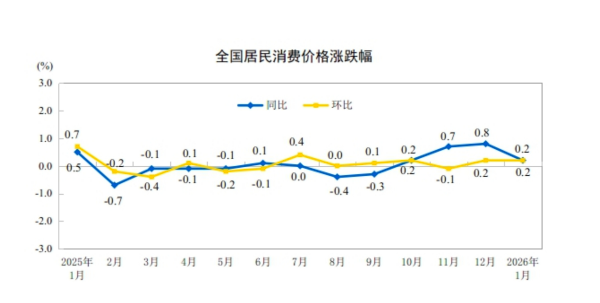
Group 1: Consumer Price Index (CPI) - In January, the CPI increased by 0.2% month-on-month and year-on-year, reflecting a decrease of 0.6 percentage points compared to December [1] - The decline in CPI is attributed to the Spring Festival timing and a significant drop in energy prices, which decreased by 5.0%, impacting CPI by approximately 0.34 percentage points [3] - Core CPI, excluding food and energy, rose by 0.8% year-on-year and 0.3% month-on-month, marking the highest increase in six months, indicating a steady recovery in consumer demand [3] Group 2: Producer Price Index (PPI) - The PPI rose by 0.4% month-on-month in January, marking the fourth consecutive month of increase, with an expansion of 0.2 percentage points from the previous month [5] - Factors contributing to the PPI increase include the ongoing construction of a unified national market and rising demand in certain industries [5] - Prices in sectors such as photovoltaic, battery, cement, and steel have shown positive improvements due to the "anti-involution" policies implemented last year [5] Group 3: Industry-Specific Price Changes - In January, prices for cement manufacturing and lithium-ion battery manufacturing increased by 0.1%, continuing a four-month upward trend [5] - The price of photovoltaic equipment and components shifted from a 0.2% decrease to a 1.9% increase, while basic chemical raw materials saw a 0.7% increase [5] - The prices of non-ferrous metal mining and smelting industries rose significantly, with silver smelting prices increasing by 38.2% and copper smelting by 8.4% [6] Group 4: Future Price Trends - The National Bureau of Statistics indicates that favorable factors for moderate price recovery are accumulating, supported by policies aimed at boosting consumption and stabilizing market expectations [6] - The implementation of coordinated fiscal and financial policies is expected to gradually expand consumer demand, providing a foundation for stable price operations [6] - Emphasis on industry self-regulation and capacity management is anticipated to further enhance price recovery in key sectors [6]
国家统计局解读2026年1月份CPI和PPI数据
Guo Jia Tong Ji Ju· 2026-02-11 01:43
Group 1 - The Consumer Price Index (CPI) increased by 0.2% month-on-month and year-on-year, while the core CPI, excluding food and energy, rose by 0.8% year-on-year [1][2] - The decline in food prices, particularly fresh vegetables and pork, contributed to a decrease in the CPI's year-on-year growth rate, with fresh vegetable prices rising by 6.9% and pork prices falling by 13.7% [1][2] - Energy prices decreased by 5.0% in January, impacting the CPI negatively by approximately 0.34 percentage points, with gasoline prices down by 11.4% year-on-year [1][2] Group 2 - The Producer Price Index (PPI) rose by 0.4% month-on-month, marking the fourth consecutive month of increase, with a narrowing year-on-year decline of 1.4% [2][3] - The increase in PPI was driven by the ongoing development of a unified national market, leading to price rises in sectors such as cement manufacturing and lithium-ion battery production [2][3] - Input factors influenced the price trends in domestic non-ferrous metals and petroleum-related industries, with non-ferrous metal mining prices increasing by 22.7% year-on-year [3][4]
益客食品:公司始终致力于通过补链强链提升全产业链整体价值
Zheng Quan Ri Bao Wang· 2026-01-13 11:12
Core Viewpoint - Yike Foods (301116) is committed to enhancing the overall value of its supply chain as a leading enterprise in the white feather poultry industry, with a focus on expanding its down feather segment [1] Group 1: Business Expansion - The company is expanding its down feather business scale, particularly with ongoing capacity construction in Shandong and planned projects in Guangdong [1] - The increase in product prices is generally beneficial for the company's operational performance [1] Group 2: Operational Factors - The company's operating profit is influenced not only by product prices but also by various factors including raw material costs [1] - Investors are advised to monitor the company's future periodic reports for updates on the operational status of the down feather segment [1]

逛烟火市集,探冬衣产业,多元体验点亮嘉兴暖冬
Xin Lang Cai Jing· 2026-01-12 23:09
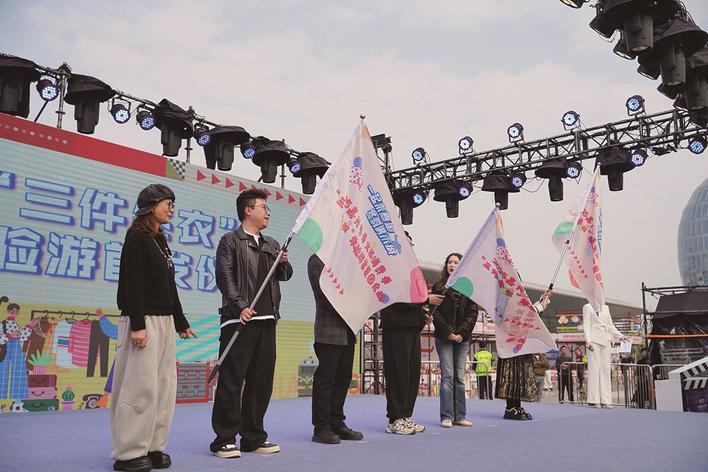
Core Viewpoint - The 2025 Jiaxing Winter Cultural and Tourism Consumption Season aims to enhance local tourism and consumption through a series of events centered around traditional food and winter clothing, promoting Jiaxing as a vibrant winter destination [8][9][12]. Group 1: Event Overview - The event features the theme "Come to Jiaxing for Winter Fun," integrating "intangible cultural heritage food" and "three winter clothing items" as its main focus, supported by a winter market and various activities to stimulate consumer enthusiasm [8][9]. - The event is organized by multiple local government bodies and supported by financial institutions, showcasing a collaborative effort to boost local tourism [8]. Group 2: Winter Market Highlights - The winter market, held at Jiaxing South Square, includes three main sections: intangible cultural heritage food, winter clothing, and creative cultural products, catering to winter consumer preferences [9][10]. - Local brands showcase traditional foods, such as non-heritage dumplings and various snacks, providing a one-stop experience for visitors to taste Jiaxing's local flavors [9][10]. Group 3: Interactive Activities - The market features an interactive voting activity for local foods, enhancing visitor engagement and promoting local culinary culture [10][11]. - Various creative DIY activities are available, allowing visitors to experience traditional crafts and engage with the local culture [11]. Group 4: Winter Clothing Focus - The event emphasizes the "three winter clothing items" (woolen sweaters, leather, and down jackets), leveraging Jiaxing's established clothing industry to attract consumers [13][14]. - Guided tours to local clothing production centers are organized, providing participants with firsthand experience of the clothing industry and promoting local products [13][14]. Group 5: Visitor Experience - The strategic location of the event at Jiaxing South Square enhances accessibility for visitors, particularly those traveling from nearby regions, promoting a convenient cultural tourism experience [12]. - Positive feedback from participants highlights the quality and affordability of Jiaxing's winter clothing, contributing to the city's reputation as a winter shopping destination [14].
河南小县,承包了中国羽绒服
投资界· 2026-01-03 08:57
Core Viewpoint - The article highlights the significance of Taiqian County in China's down industry, emphasizing its dominance in high-quality down production and its potential to become a global hub for down processing and trading [4][5][14]. Industry Overview - China accounts for 85% of the global down processing supply, with Taiqian County supplying one-third of the national down processing and over 50% of high-end down production [5][6]. - Taiqian County is recognized as one of the "China Down Hometowns," alongside Guangdong, Guangxi, and Zhejiang [7]. Taiqian County's Down Industry Characteristics - Taiqian County hosts over 200 down enterprises, with an annual deep processing capacity of 89,000 tons of down and production of 35 million down garments, generating over 4 billion yuan in annual output value [9][10]. - The county produces nearly 40,000 tons of high-quality down annually, with over 50% of the national share in high-end pure white duck down [9][10]. Historical Context and Development - The down industry in Taiqian County emerged from a historical context of poverty and geographical disadvantages, transforming into a significant economic driver for the region [15][18]. - The local population initially engaged in collecting down from slaughterhouses in Northeast China, leading to the establishment of processing facilities as the industry grew [18][19]. Future Development Plans - Taiqian County aims to enhance its down and garment processing industry to exceed 10 billion yuan by 2025, aspiring to become the largest global hub for high-quality down and down products [14][20]. - Recent initiatives, such as the "Luyu Cooperation Development Implementation Plan," aim to strengthen regional collaboration and improve Taiqian's logistical advantages [21][23]. Strategic Advantages - The county's geographical location allows it to connect with major transportation networks, enhancing its potential for industrial growth and attracting investment [23][25]. - Taiqian's established supply chain and processing capabilities position it well to attract enterprises from regions like Jiangsu and Zhejiang, facilitating industry transfer and expansion [25].

行情周报 | 羽绒消费热度降温,市场行情短暂回落;成品绒仍处销售期,刚需采购继续维持
Sou Hu Cai Jing· 2025-11-15 07:42
Core Insights - The market confidence in terminal sales has been renewed due to the brewing cold wave, despite a recent decline in down product prices influenced by the end of the "Double Eleven" shopping festival and warmer temperatures [2] Industry Summary - The down market experienced a downturn in the 46th week of 2025, with white goose down, gray goose down, and white duck down prices falling. The short-term consumption heat for down products has cooled rapidly, but the upcoming cold wave has restored market confidence in terminal sales [2] - Raw material prices have stabilized after high-level adjustments, but tight supply and strong price-holding intentions from stockholders have hindered effective transaction volumes [2] - The Chinese apparel category's exports to the U.S. continue to decline, with multiple pressures such as weak terminal consumption and low brand replenishment willingness affecting recovery [2] - In Zhejiang Pinghu, the down jacket production has entered a peak season, with companies ramping up production to meet high order volumes, producing 100,000 down jackets in a month [3][5] - The down jacket refurbishment market has also seen an early peak season, with increased processing and sales activity due to nationwide low-temperature weather [3][7] - In South Korea, down jacket sales have significantly increased, with some styles selling out and restarting production due to the drop in morning temperatures [8][10] Recent Positive Developments - The down jacket production in Pinghu has surged, with companies hiring additional workers to meet the demand, reflecting a mature down jacket industry in the region [3][5] - The refurbishment of down jackets has become a popular topic on social media, with many consumers sharing their experiences and driving demand for related services [7] - In Jilin, the down production season is in full swing, with orders extending into the next year, indicating strong demand for down products [10][12] Recent Negative Developments - China's apparel exports to the U.S. have seen a significant decline, with a 15.7% drop in clothing exports in October 2025 compared to the previous year [15] - The overall container import volume in the U.S. has decreased, indicating a potential slowdown in trade activity [15] - The duck feather and down prices have surged, but as supply increases, prices may face downward pressure due to weak consumer demand [16][19]
华英农业涨停,成交额1.06亿元,主力资金净流入133.06万元
Xin Lang Cai Jing· 2025-11-11 02:01
Core Points - The stock price of Huaying Agriculture reached a limit up on November 11, trading at 3.45 CNY per share with a total market capitalization of 7.358 billion CNY [1] - Year-to-date, Huaying Agriculture's stock price has increased by 44.35%, with a 14.62% rise in the last five trading days [2] Financial Performance - For the period from January to September 2025, Huaying Agriculture reported a revenue of 3.79 billion CNY, reflecting a year-on-year growth of 0.89%. However, the net profit attributable to shareholders was -32.23 million CNY, a decrease of 198.26% compared to the previous year [3] - The company has distributed a total of 85.51 million CNY in dividends since its A-share listing, with no dividends paid in the last three years [4] Shareholder Information - As of October 31, Huaying Agriculture had 37,200 shareholders, a decrease of 0.42% from the previous period, while the average number of circulating shares per shareholder increased by 0.42% to 57,176 shares [3]

羽绒价格飞涨 都是猪肉惹的祸
Xin Lang Cai Jing· 2025-11-07 09:17
Group 1 - The price of down feathers has reached last year's peak levels, with 90% down priced at 550,000 yuan per ton [1] - The increase in down prices is attributed not only to seasonal demand but also to the decline in pork prices, which affects the overall meat market [1] - Farmers raising ducks and geese are sensitive to pork price fluctuations; reduced profitability may lead to decreased production, resulting in lower supply of duck and goose feathers, thus driving up prices [1] Group 2 - If extreme cold weather occurs this winter, it is expected that down prices may rise further [1]