
计算机服务业

Search documents
热点思考 | 设备投资,能否“持续高增”?(申万宏观·赵伟团队)
Xin Lang Cai Jing· 2026-01-06 16:25
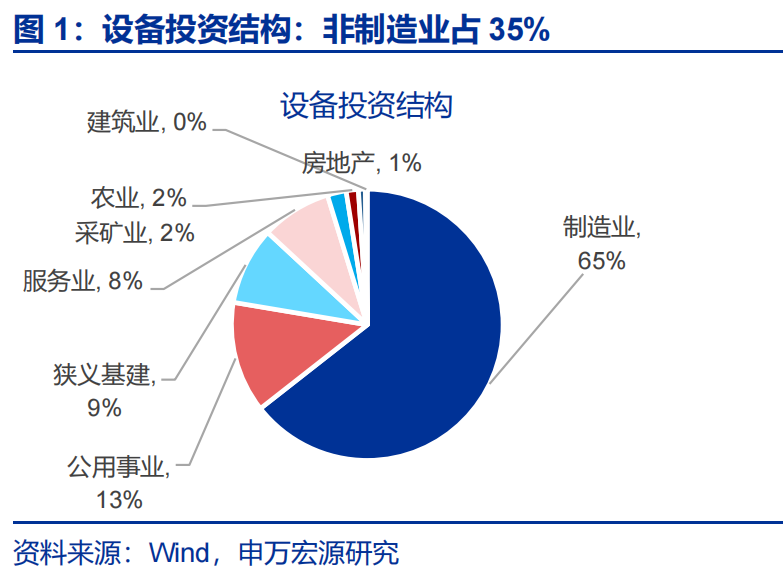
Group 1 - The core argument is that the high growth in equipment investment is not primarily driven by the "Two New" policies or the manufacturing Juglar cycle, but rather by strong investment in broad infrastructure and the service sector [1][8][69] - Equipment investment growth is significantly higher in sectors such as construction (65.5%), narrow infrastructure (46.1%), public utilities (16.5%), and services (13.9%) compared to manufacturing (6.5%), contributing an additional 8.1 percentage points to overall equipment investment [1][8][69] - In 2025, manufacturing investment growth is expected to decline to 1.9%, while equipment investment is projected to maintain high growth at 12.2%, driven by digital infrastructure and energy infrastructure [1][8][69] Group 2 - The strong growth in equipment investment is fueled by the establishment of a modern industrial system, which enhances digital infrastructure, alongside natural renewal cycles and recovering travel demand, thus boosting narrow infrastructure and construction equipment investment [3][24][69] - Key sectors such as software and computer services are experiencing growth rates of 53%, while aviation and road transport equipment investments are also high, correlating with a 17.9% year-on-year increase in civil aviation passenger transport [3][24][69] - The acceleration of energy transition and infrastructure investment in central and western regions, particularly since the intensification of the "dual carbon" policy in 2021, has led to a significant increase in public utility equipment investment [3][31][69] Group 3 - Fiscal policies have increased research spending and improved travel chain demand, leading to a notable rise in service sector equipment investment, which has outpaced construction investment since 2023 [4][40][69] - The growth rate for service sector equipment investment reached 13.9% in 2024, while construction investment only grew by 2.8% [4][40][69] - The recovery gap in service sector investment is estimated to be around 2-3 trillion yuan, indicating a strong potential for future growth in this area [4][56][69] Group 4 - Equipment investment is expected to continue its high growth into 2026, supported by both domestic and external demand chains [5][69] - Narrow infrastructure investment is anticipated to rebound significantly, particularly in digital infrastructure and hub-related investments [5][46][69] - The "dual carbon" policy is expected to further drive investment in equipment for carbon reduction, including modifications in high-energy-consuming industries and investments in renewable energy [5][51][69]

热点思考 | 设备投资,能否“持续高增”?(申万宏观·赵伟团队)
赵伟宏观探索· 2026-01-06 16:03
Core Viewpoint - The article argues that the high growth in equipment investment is not primarily driven by the "Two New" policies or the manufacturing Juglar cycle, but rather by strong investment in broad infrastructure and the service sector [2][9][71]. Group 1: Misconceptions about Equipment Investment Growth - Misconception 1: The strong equipment investment is attributed to the "Juglar cycle"; however, it is actually driven by robust growth in broad infrastructure and service sector investments. In 2024, the growth rates for equipment purchases in construction (65.5%), narrow infrastructure (46.1%), public utilities (16.5%), and services (13.9%) significantly outpaced manufacturing (6.5%), contributing an additional 8.1 percentage points to overall equipment investment [2][9][71]. - Misconception 2: The strong equipment investment is influenced by the "Two New" policies; however, the investment rhythm and structure contradict this view. Special government bonds supporting the "Two New" policies will intensify in the second half of 2024, but by February 2024, manufacturing investment and equipment purchase investment had already surged significantly [2][9][71]. - Misconception 3: The strong manufacturing investment is a result of strong equipment investment; in reality, it stems from construction and installation investments (expansion investments). Since 2024, while manufacturing and equipment purchase investments have grown simultaneously, the growth in equipment investment is not solely derived from manufacturing [3][21][71]. Group 2: Drivers of High Equipment Investment Growth - Reason 1: The establishment of a modern industrial system has driven strong digital infrastructure growth, combined with natural renewal cycles and recovery in travel demand, boosting narrow infrastructure and construction equipment investments. In 2024, narrow infrastructure equipment purchases contributed 4.3 percentage points to total equipment investment, exceeding manufacturing's contribution [4][25][77]. - Reason 2: The acceleration of energy transition and thermal power renovation investments in the central and western regions has strengthened public utility equipment investments, particularly since the intensification of the "dual carbon" policy in 2021. Public utility equipment investment has consistently outpaced construction investment by nearly 10 percentage points since 2021 [4][32][77]. - Reason 3: Increased fiscal spending on research and improvement in travel chain demand have boosted service sector equipment investments. Since 2023, service sector equipment investments have shown a trend of being stronger than construction investments, with significant growth in sectors like leasing and scientific research [5][42][77]. Group 3: Sustainability of High Equipment Investment Growth - Main Line 1: Narrow infrastructure is expected to rebound significantly, especially in digital infrastructure and hub-type investment construction. Recent policy measures, including the issuance of special bonds and financial tools, are set to support new infrastructure investments [6][48][79]. - Main Line 2: The "dual carbon" policy is expected to enhance investments in equipment for carbon reduction, including renovations in high-energy-consuming industries and investments in renewable energy [6][53][79]. - Main Line 3: Policies related to "investment in people" are likely to be significantly intensified, with service sector equipment investments related to consumer infrastructure expected to recover actively [6][58][79]. - Main Line 4: Equipment investments related to external demand are expected to remain resilient, particularly in sectors supporting the industrialization of emerging economies [6][63][79].

热点思考 | 设备投资,能否“持续高增”?(申万宏观·赵伟团队)
申万宏源宏观· 2026-01-06 11:19
Core Viewpoint - The article argues that the high growth in equipment investment is not primarily driven by the "Two New" policies or the manufacturing Juglar cycle, but rather by strong investment in broad infrastructure and the service sector [2][9][71]. Group 1: Misconceptions about Equipment Investment Growth - Misconception 1: The strong equipment investment is attributed to the Juglar cycle; however, it is actually driven by robust growth in broad infrastructure and service sector investments. In 2024, the growth rates for equipment purchases in construction (65.5%), narrow infrastructure (46.1%), public utilities (16.5%), and services (13.9%) significantly outpaced manufacturing (6.5%), contributing an additional 8.1 percentage points to overall equipment investment [2][9][71]. - Misconception 2: The strong equipment investment is influenced by the "Two New" policies; however, the investment rhythm and structure contradict this view. The special government bonds supporting "Two New" policies will only ramp up in the second half of 2024, while manufacturing and equipment purchase investments had already surged in February 2024 [2][9][71]. - Misconception 3: The strong manufacturing investment is a result of strong equipment investment; in reality, it stems from construction and installation investments (expansion investments). Since 2024, while manufacturing and equipment purchase investments have grown simultaneously, the growth in equipment investment is not solely derived from manufacturing [3][21][71]. Group 2: Drivers of High Equipment Investment Growth - Reason 1: The establishment of a modern industrial system has boosted digital infrastructure, combined with natural renewal cycles and recovering travel demand, driving equipment investment in narrow infrastructure and construction. In 2024, narrow infrastructure equipment purchases contributed 4.3 percentage points to total equipment investment, exceeding manufacturing's contribution [4][25][77]. - Reason 2: The acceleration of energy transition and thermal power renovation investments in central and western regions has strengthened public utility equipment investments, particularly since the intensification of the "dual carbon" policy in 2021 [4][32][77]. - Reason 3: Increased fiscal spending on research and improvements in travel chain demand have driven strong service sector equipment investments. Since 2023, service sector equipment investments have shown a trend of outpacing construction investments [5][42][77]. Group 3: Sustainability of High Equipment Investment Growth - Main Line 1: Narrow infrastructure is expected to rebound significantly, especially in digital infrastructure and hub-related investments. Recent policy measures, including a reduction in the proportion of special refinancing bonds, are anticipated to support a rebound in infrastructure investment in 2026 [6][48][79]. - Main Line 2: The "dual carbon" policy is expected to enhance investments in equipment for carbon reduction, including renovations in high-energy-consuming industries and investments in renewable energy [6][53][79]. - Main Line 3: Policies related to "investment in people" are likely to be significantly strengthened, with service sector equipment investments related to consumer infrastructure expected to recover actively [6][58][79]. - Main Line 4: Equipment investments related to external demand are expected to remain resilient, particularly in sectors supporting the industrialization of emerging economies [6][63][79].

宏观专题报告:设备投资,能否“持续高增”?
Shenwan Hongyuan Securities· 2026-01-06 03:41
Group 1: Misconceptions about Equipment Investment Growth - Equipment investment growth is not primarily driven by the "Juga Cycle" but rather by strong infrastructure and service sector investments, with construction industry growth at 65.5% and narrow infrastructure at 46.1% in 2024, contributing an additional 8.2 percentage points to overall equipment investment[2] - The notion that equipment investment strength is influenced by the "Two New" policies is misleading; significant increases in manufacturing investment and equipment purchases occurred as early as February 2024, with equipment purchase investment growth reaching 17%[2] - Manufacturing equipment purchase investment growth was only 6.5% in 2024, significantly lower than the overall equipment investment growth of 15.7%[3] Group 2: Drivers of Equipment Investment Growth - The establishment of a modern industrial system has driven strong digital infrastructure investments, with software industry growth at 53% and computer services at 35%, contributing to overall equipment investment[4] - Public utility equipment investment has surged since the "dual carbon" policy was intensified in 2021, with electricity and heat equipment investment growth at 17.6%[4] - Service sector equipment investment has outpaced construction investment since 2023, with growth rates of 13.9% compared to 2.8% for construction investment in 2024[5] Group 3: Sustainability of Equipment Investment Growth - Equipment investment is expected to continue high growth in 2026, supported by a rebound in narrow infrastructure, particularly in digital infrastructure and hub-related investments[6] - The "dual carbon" policy is anticipated to further enhance investment in carbon reduction technologies, including high-energy-consuming industry upgrades and renewable energy investments[6] - Policies focused on "investing in people" are likely to increase service sector equipment investment, with a projected growth rate of around 6% in 2026, surpassing the overall fixed asset investment growth of 3%[7]
东华软件:投资设立“东华软件(塔城市)有限公司”
Sou Hu Cai Jing· 2025-12-05 16:26
Group 1 - Donghua Software announced the establishment of "Donghua Software (Tacheng City) Co., Ltd." with a total investment of 50 million RMB, where Donghua Software contributes 49.5 million RMB (99% of registered capital) and its subsidiary Donghua Cloud contributes 500,000 RMB (1% of registered capital) [1] - For the first half of 2025, Donghua Software's revenue composition is as follows: Financial Health Industry 61.15%, Government and Public Sector 21.98%, Telecommunications Industry 7.08%, Other Industries 6.13%, and Computer Services 3.61% [1] - As of the report date, Donghua Software's market capitalization is 32.6 billion RMB [1]

东华软件:公司及子公司的担保总额为人民币32.75亿元
Mei Ri Jing Ji Xin Wen· 2025-12-05 16:09
Group 1 - The total guarantee amount provided by Donghua Software and its subsidiaries is RMB 3.275 billion, which accounts for 26.31% of the company's audited net assets as of the end of 2024 [1] - For the first half of 2025, the revenue composition of Donghua Software is as follows: Financial health industry 61.15%, Government and public sector 21.98%, Telecommunications 7.08%, Other industries 6.13%, and Computer services 3.61% [1] - As of the report date, Donghua Software has a market capitalization of RMB 32.6 billion [1]
东华软件:11月25日召开董事会会议
Mei Ri Jing Ji Xin Wen· 2025-11-25 09:50
Group 1 - Donghua Software (SZ 002065) announced on November 25 that its 44th meeting of the 8th board of directors was held to review the proposal for the reappointment of the accounting firm [1] - For the first half of 2025, Donghua Software's revenue composition was as follows: Financial health industry accounted for 61.15%, government and public sector 21.98%, telecommunications 7.08%, other industries 6.13%, and computer services 3.61% [1] - As of the report date, Donghua Software's market capitalization was 33.9 billion yuan [1] Group 2 - A company recently listed faced regulatory scrutiny from the China Securities Regulatory Commission (CSRC) due to a significant loss exceeding 100 million yuan shortly after its IPO [1] - The company's core product was severely impacted as its largest client shifted to self-sourcing, reducing procurement [1]
东华软件:11月3日召开董事会会议
Mei Ri Jing Ji Xin Wen· 2025-11-03 12:47
Group 1 - The core point of the article is that Donghua Software announced the convening of its 43rd board meeting to discuss the proposal for external investment to establish a subsidiary [1] - For the first half of 2025, Donghua Software's revenue composition is as follows: 61.15% from the financial health industry, 21.98% from government and public sectors, 7.08% from the telecommunications industry, 6.13% from other industries, and 3.61% from computer services [1] - As of the time of reporting, Donghua Software has a market capitalization of 33.4 billion yuan [1]
东华软件:董事兼总经理吕波拟减持不超过约152万股
Mei Ri Jing Ji Xin Wen· 2025-10-16 09:39
Company Overview - Donghua Software (SZ 002065) announced on October 16 that its board member and general manager, Lv Bo, plans to reduce his shareholding by up to approximately 1.52 million shares, which represents no more than 0.0474% of the company's total share capital, within three months starting from November 10, 2025 [1][1][1] Financial Performance - For the first half of 2025, Donghua Software's revenue composition is as follows: Financial Health Industry accounted for 61.15%, Government and Public Sector for 21.98%, Telecommunications for 7.08%, Other Industries for 6.13%, and Computer Services for 3.61% [1][1][1] Market Capitalization - As of the report date, Donghua Software's market capitalization stands at 33.8 billion yuan [1][1][1]
东华软件:控股股东、实控人薛向东拟减持不超过约4488万股
Mei Ri Jing Ji Xin Wen· 2025-09-12 12:08
Core Viewpoint - Donghua Software plans to reduce its shareholding by up to approximately 44.88 million shares, representing no more than 1.4% of the total share capital, due to personal financial needs of its controlling shareholder, Xue Xiangdong [1] Company Summary - Donghua Software's revenue composition for the first half of 2025 is as follows: Financial Health Industry 61.15%, Government and Public Sector 21.98%, Telecommunications Industry 7.08%, Other Industries 6.13%, and Computer Services Industry 3.61% [1] - As of the report date, Donghua Software has a market capitalization of 33.6 billion yuan [1]