餐饮住宿服务

Search documents
春节假期长三角接收消费投诉5万余件
Xin Lang Cai Jing· 2026-02-26 17:41
Core Insights - The article reports on the consumer complaint and inquiry statistics during the Spring Festival holiday in the Yangtze River Delta region, highlighting the efforts of market regulatory authorities to address consumer issues and promote consumption [1] Group 1: Complaint and Inquiry Statistics - A total of 54,991 complaints and 11,724 reports were received, along with 90,020 inquiries during the holiday period [1] - Shanghai received 16,863 complaints, 4,978 reports, and answered 69,462 inquiries; Jiangsu received 12,566 complaints, 2,522 reports, and answered 8,406 inquiries; Zhejiang received 19,715 complaints, 3,154 reports, and answered 2,985 inquiries; Anhui received 5,847 complaints, 1,070 reports, and answered 9,167 inquiries [1] Group 2: Consumer Behavior Insights - Online consumption complaints accounted for 77% of total complaints, while offline consumption complaints made up 23% [1] - The main sectors involved in complaints included clothing and footwear, food, household goods, sales services, catering and accommodation services, and internet services [1] Group 3: Issues Highlighted - The primary issues reported were related to after-sales service, product quality, contract fulfillment, and unfair competition [1]
长三角地区受理投诉5.4万余件
Xin Lang Cai Jing· 2026-02-25 22:05
Core Insights - The consumer complaint and reporting system in the Yangtze River Delta region received a total of 54,991 complaints and 11,724 reports during the Spring Festival holiday, indicating a well-functioning consumer rights protection mechanism [1] - Online consumption complaints accounted for 77% of total complaints, highlighting a significant shift towards digital shopping [1] - The main issues reported were related to after-sales service, product quality, contract fulfillment, and unfair competition [1] Group 1: Complaint Statistics - Shanghai received 16,863 complaints and 4,978 reports, with 69,462 consultations answered [1] - Jiangsu received 12,566 complaints and 2,522 reports, with 8,406 consultations answered [1] - Zhejiang received 19,715 complaints and 3,154 reports, with 2,985 consultations answered [1] - Anhui received 5,847 complaints and 1,070 reports, with 9,167 consultations answered [1] Group 2: Consumer Behavior - Online consumption complaints made up 89.8% of total complaints in Shanghai, with significant issues in e-commerce and live-streaming sales [2] - Common complaints included product quality issues, discrepancies between advertising and actual products, order cancellations, unfulfilled promotional promises, delivery delays, and inadequate after-sales service [2] - There were 36 complaints related to New Year's Eve dinner services, primarily concerning order disputes, delivery delays, business closures, and poor food quality [2] Group 3: Emerging Trends - There was an increase in green consumption requests, with 488 related complaints, focusing on shared consumption, eco-friendly promotions, and compliance with plastic restrictions [3] - Smart consumption requests also rose, with 163 complaints regarding smart home and wearable devices, mainly concerning product quality, advertising, and after-sales service [3]
马年春节长三角假日消费维权畅通有序 良好消费环境持续营造
Xin Lang Cai Jing· 2026-02-24 13:11
Core Viewpoint - The Shanghai Municipal Market Supervision Administration reported a total of 66,715 complaints during the 2026 Spring Festival holiday, with a significant focus on online consumption and various consumer issues [1][2]. Group 1: Complaint Statistics - A total of 66,715 complaints were received across the Yangtze River Delta region during the holiday, with online consumption complaints accounting for 77% and offline for 23% [1]. - In Shanghai alone, there were 16,863 consumer complaints, 4,978 reports, and 69,462 inquiries answered [1]. Group 2: Consumer Demand Characteristics - Overall consumer demand remained stable, with a focus on source governance and multi-channel resolution of disputes [2]. - Online consumption complaints made up 89.8% of the total, primarily related to e-commerce and live-streaming sales, with issues such as quality defects and delivery delays [2]. - Complaints related to traditional New Year's Eve dinner services remained stable at 36 cases, focusing on delivery delays and product quality [2]. - There was an increase in complaints related to green consumption, totaling 488, with a significant portion concerning shared consumption [2]. - Complaints regarding smart consumer products rose to 163, highlighting issues with product quality and after-sales service [2].
长三角假期消费维权报告出炉 线上消费是“重灾区”
Sou Hu Cai Jing· 2025-10-11 00:11
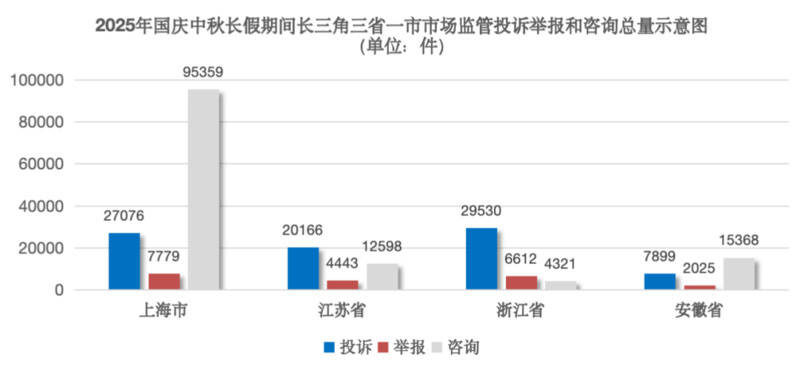
Core Insights - The report highlights that during the 2025 National Day and Mid-Autumn Festival holiday, the Yangtze River Delta region's market supervision departments enhanced complaint handling and consumer protection efforts, resulting in a significant number of complaints and inquiries [1][3] Group 1: Complaint Statistics - A total of 84,671 complaints were received, 20,859 reports were registered, and 127,646 inquiries were answered across the three provinces and one city during the holiday [1][3] - Shanghai received 27,076 complaints, 7,779 reports, and answered 95,359 inquiries; Jiangsu received 20,166 complaints, 4,443 reports, and answered 12,598 inquiries; Zhejiang received 29,530 complaints, 6,612 reports, and answered 4,321 inquiries; Anhui received 7,899 complaints, 2,025 reports, and answered 15,368 inquiries [3] Group 2: Consumer Behavior Insights - Online consumption complaints accounted for 78% of total complaints, while offline consumption complaints made up 22% [3] - The main industries involved in complaints included clothing and footwear, food, household goods, catering and accommodation services, and sales services [3] Group 3: Issues Identified - The primary issues reported were related to after-sales service, product quality, contract fulfillment, and unfair competition [3] - The market supervision departments are implementing measures to optimize the consumption environment, enhance consumer rights protection, and improve consumption order [3]