个人大额存单

Search documents
抢滩“开门红”揽储 中小行限时上调利率,大行调整存款起存门槛
2 1 Shi Ji Jing Ji Bao Dao· 2026-01-21 06:00
Core Viewpoint - The current deposit-taking competition among banks, particularly small and medium-sized banks, is intensifying as they adjust deposit rates to attract funds, despite a general decline in the enthusiasm for such actions compared to previous years [2][5]. Group 1: Deposit Rate Adjustments - Several small and medium-sized banks have recently raised their fixed deposit rates, albeit by limited margins compared to previous years, reflecting a balance between managing funding costs and maintaining market competitiveness [2][3]. - Specific examples include the increase of the one-year and three-year fixed deposit rates by the DeShang Village Bank in Henan and the adjustment of rates by other banks such as the Jiangsu Bank and Shenyang Bank [3][4]. - The overall trend shows that most banks adjusting rates are smaller institutions, with some offering promotional incentives like shopping cards for depositors [4]. Group 2: Market Dynamics and Strategies - The current market for deposits is generally ample, but small regional banks face significant pressure to attract deposits, leading to temporary rate increases as a marketing strategy rather than a long-term trend [5][8]. - Large state-owned banks are not following suit with rate increases but are instead adjusting the minimum deposit thresholds for their products, indicating a strategic shift towards customer relationship management [6][8]. - The dual pressures of maintaining profitability while complying with regulatory standards are influencing banks' strategies, with many seeking sustainable ways to optimize their funding structures [7][8]. Group 3: Future Outlook - Analysts predict that banks will continue to lower funding costs, with potential downward adjustments in deposit rates as net interest margins remain under pressure [8][9]. - The average cost of deposits may decrease by approximately 35 basis points due to the maturity of high-interest deposits, which could improve net interest margins by 10 to 15 basis points [9].
多家中小银行密集上调存款利率,各家银行为揽储开启“花式”营销
Zhong Guo Ji Jin Bao· 2026-01-15 23:33
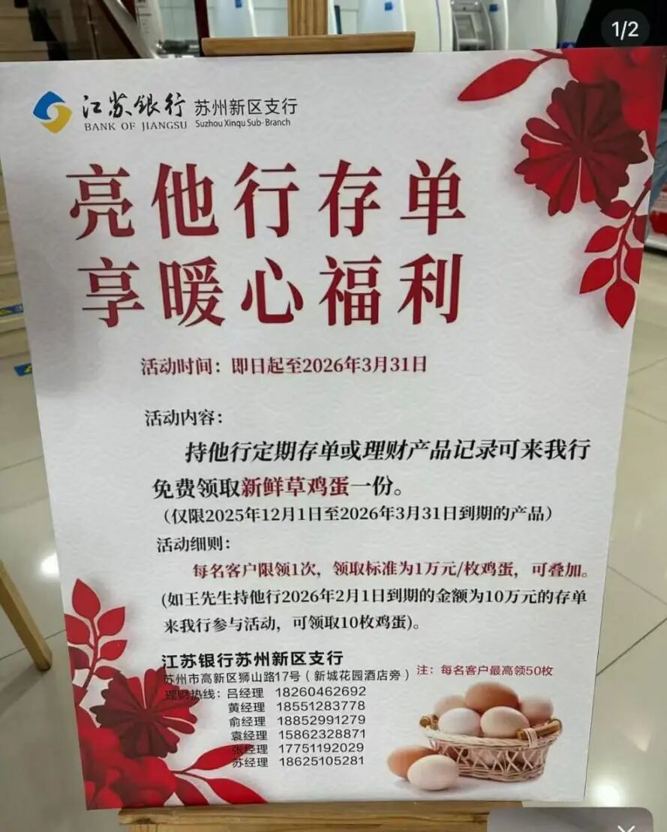
Group 1 - The core viewpoint of the articles highlights that many small and medium-sized banks are increasing their fixed deposit rates and offering promotional gifts to attract depositors, although the rate increases are more restrained compared to previous years [1][2][6] - Several small banks have announced specific rate increases, such as Shanxi Zuoyun Rural Commercial Bank raising its three-year and five-year fixed deposit rates from 1.45% and 1.50% to 1.65% [2] - Jiangsu Bank has introduced a unique promotional activity where customers can receive fresh eggs based on their deposits, indicating a creative approach to customer retention [3] Group 2 - The increase in deposit rates this year is generally modest, with most banks raising rates by only 10 to 20 basis points, reflecting a more cautious strategy compared to previous years [6] - Analysts suggest that the current trend of small banks raising short-term deposit rates is a temporary marketing strategy rather than a long-term trend, as overall deposit rates are expected to continue declining [6][7] - Larger banks appear less aggressive in their deposit strategies, with fewer promotional activities and rate increases observed, indicating a divergence in approach between small and large banks [6]

抢滩“开门红”揽储 中小行限时上调利率,大行分层经营稳成本
2 1 Shi Ji Jing Ji Bao Dao· 2026-01-15 23:22
Core Viewpoint - The banking sector is experiencing a "New Year" deposit rush, with small and medium-sized banks facing pressure to attract deposits despite a decrease in the overall enthusiasm compared to previous years [2][5]. Group 1: Deposit Rate Adjustments - Several small and medium-sized banks have recently raised their fixed deposit rates, albeit by limited margins compared to previous years, reflecting a balance between managing funding costs and maintaining market competitiveness [2][4]. - For instance, the DeShang Village Bank in Henan increased its one-year and three-year fixed deposit rates from 1.50% and 1.70% to 1.55% and 1.73%, respectively [3]. - Other banks, such as the Jiangsu Bank and Shenyang Bank, have also introduced higher interest rate products, with some three-year fixed deposits offering rates as high as 1.90% [3][4]. Group 2: Marketing Strategies and Competitive Pressures - To attract deposits, some banks are employing promotional strategies, such as offering shopping vouchers for depositors, indicating a competitive environment among small banks [4]. - Analysts suggest that the recent rate increases by small banks are primarily short-term marketing tactics to meet year-end deposit targets, rather than indicative of a long-term trend [5]. Group 3: Large Banks' Strategies - Major state-owned banks have not followed suit in raising deposit rates but have adjusted the minimum deposit thresholds for their products, indicating a strategic shift towards customer relationship management [6][7]. - For example, the Industrial and Commercial Bank of China has set a minimum deposit of 1 million for certain high-yield products, while the Agricultural Bank of China has varied its minimum deposit requirements significantly across different products [6]. Group 4: Future Outlook - Industry experts predict that banks may continue to lower funding costs, with potential downward adjustments in deposit rates as net interest margins remain under pressure [8]. - The average cost of deposits may decrease by approximately 35 basis points in 2026, potentially improving net interest margins by 10 to 15 basis points, which could provide more room for future interest rate cuts by the central bank [8].


“花式”揽储:有银行送鸡蛋吸引他行储户,多家中小银行上调存款利率……
Sou Hu Cai Jing· 2026-01-15 21:31
Core Viewpoint - Several small and medium-sized banks in China have recently raised their deposit rates and launched various promotional activities to attract depositors, although the increase in rates is more restrained compared to previous years, indicating a cautious approach in the current market environment [1][11]. Group 1: Deposit Rate Adjustments - Multiple small and medium-sized banks have increased their fixed deposit rates, with Shanxi Zuoyun Rural Commercial Bank raising its three-year and five-year deposit rates from 1.45% and 1.50% to 1.65% [3]. - Baoying Rural Commercial Bank has also announced an increase in its three-year fixed deposit rate from 1.7% to 1.8%, reflecting a rise of 10 basis points [4]. - Shengjing Bank and Jilin Bank have also adjusted their deposit rates, with Jilin Bank raising its three-year fixed deposit annualized rate from 1.75% to 2% [5]. Group 2: Promotional Activities - To meet their deposit targets, many small and medium-sized banks have introduced various promotional activities, such as Beijing Shunyi Yinzuo Village Bank's lottery for new customers, where deposits can earn chances to win household items [6]. - Jiangsu Bank has launched a unique promotion where customers can receive free fresh eggs based on their existing deposits with other banks, allowing for multiple claims [8]. - Some bank staff have resorted to personal incentives, such as offering gift cards or small gifts to attract depositors, indicating a competitive environment for customer acquisition [10]. Group 3: Market Trends and Strategies - The increase in deposit rates this year is generally modest, with most adjustments ranging from 10 to 20 basis points, reflecting a more cautious strategy compared to previous years when increases were often larger [12]. - Analysts suggest that the current strategy of small increases in deposit rates and setting minimum deposit thresholds is aimed at precise customer acquisition without significantly raising costs, indicating a short-term marketing tactic rather than a long-term trend [12]. - Larger banks appear less affected by the need for aggressive deposit acquisition strategies, with fewer promotional activities observed compared to smaller banks [12].

“花式”揽储:有银行送鸡蛋吸引他行储户,多家中小银行上调存款利率……
中国基金报· 2026-01-15 16:18
Core Viewpoint - Multiple small and medium-sized banks in China have recently raised their deposit rates and launched various promotional activities to attract depositors, although the increase in rates is more restrained compared to previous years, indicating a short-term strategy rather than a long-term trend [2][11]. Group 1: Deposit Rate Adjustments - Several small and medium-sized banks have increased their fixed deposit rates, such as Shanxi Zuoyun Rural Commercial Bank raising its three-year and five-year rates from 1.45% and 1.50% to 1.65% [4] - Baoying Rural Commercial Bank has also adjusted its three-year fixed deposit rate from 1.7% to 1.8%, an increase of 10 basis points [4] - Jilin Bank has raised its three-year fixed deposit annualized rate from 1.75% to 2% [4] Group 2: Promotional Activities - To meet their deposit targets, many small and medium-sized banks have launched creative promotional activities, such as Beijing Shunyi Yinzou Village Bank offering a lottery for new customers with various household items as prizes [5] - Jiangsu Bank has introduced a unique promotion where customers can receive fresh eggs based on their deposits, allowing for multiple claims [7] - Some bank employees have resorted to personal incentives, such as offering gift cards or small gifts to attract depositors [9] Group 3: Market Trends and Strategies - The increase in deposit rates this year is generally more conservative, with most adjustments ranging from 10 to 20 basis points, reflecting a cautious approach compared to previous years [11] - Analysts suggest that the recent rate increases are part of a short-term marketing strategy aimed at precise customer acquisition, rather than a shift in the overall downward trend of deposit rates [11][12] - Larger banks appear less affected by the need for aggressive deposit strategies, focusing instead on adjusting minimum deposit thresholds while maintaining rates [12]

部分银行上调存款利率,最高涨20BP
2 1 Shi Ji Jing Ji Bao Dao· 2026-01-14 06:13
Core Viewpoint - The recent surge in deposit rates among small and medium-sized banks reflects a competitive landscape and the pressures of market dynamics, despite a general trend of declining interest rates in the banking sector [2][12]. Group 1: Deposit Rate Adjustments - Several small and medium-sized banks have recently raised their fixed deposit rates, albeit by limited margins compared to previous years, indicating a cautious approach to managing funding costs and market competitiveness [2][4]. - Specific examples include: - DeShang Village Bank in Henan raised its 1-year and 3-year fixed deposit rates from 1.50% and 1.70% to 1.55% and 1.73% respectively [4]. - Jiangsu Bank's new 3-year fixed deposit products offer rates of 1.85% and 1.90%, reflecting a competitive strategy to attract deposits [6]. - The overall trend shows that most banks increasing rates are smaller institutions, which are actively using promotional strategies to attract deposits [7]. Group 2: Market Dynamics and Strategies - Analysts suggest that the recent rate hikes by small banks are a response to year-end deposit targets and the need for liquidity, but these adjustments are seen as temporary marketing tactics rather than a long-term trend [8][12]. - Larger state-owned banks, while not increasing rates, are adjusting minimum deposit thresholds, indicating a shift towards maintaining customer relationships rather than competing on interest rates [10][12]. - The banking sector is facing dual pressures: the need to attract deposits while managing costs, leading to a potential future decrease in deposit rates as banks seek to stabilize their net interest margins [11][12]. Group 3: Regulatory and Compliance Considerations - Recent regulatory actions highlight the challenges faced by some banks in balancing growth and compliance, with penalties imposed for practices that violate operational standards [11]. - The trend of increasing deposit rates among smaller banks may be short-lived, as the overall market is expected to continue moving towards lower deposit rates in response to economic conditions [12][13].

部分银行上调存款利率,最高涨20BP
21世纪经济报道· 2026-01-14 05:54
Core Viewpoint - The article discusses the recent trend of small and medium-sized banks in China raising deposit interest rates amid a competitive environment for attracting deposits, although the overall enthusiasm for deposit collection has decreased compared to previous years [1][8]. Group 1: Deposit Rate Adjustments - Several small and medium-sized banks have recently raised their deposit interest rates, albeit by limited margins compared to previous years, indicating a more cautious approach to managing funding costs and market competitiveness [1][8]. - For instance, the De商村镇银行 increased its one-year and three-year deposit rates from 1.50% and 1.70% to 1.55% and 1.73% respectively, while the 湖北麻城农村商业银行 raised its rates by up to 20 basis points for certain products [3][5]. - The overall trend shows that most banks adjusting rates are smaller institutions, which are under pressure to attract deposits as they face significant competition at the beginning of the year [7][8]. Group 2: Strategies of Large Banks - Large state-owned banks have not followed suit in raising deposit rates but have instead adjusted the minimum deposit thresholds for their products, reflecting a strategic shift towards maintaining customer relationships [10][12]. - For example, the Industrial and Commercial Bank of China has set a minimum deposit of 1 million for certain three-year products, while the Agricultural Bank of China has varied its minimum deposit requirements significantly across different products [10][11]. - This approach indicates a broader industry trend where large banks are focusing on optimizing their liability structures rather than competing solely on interest rates [12]. Group 3: Market Dynamics and Future Outlook - Analysts suggest that the recent increases in deposit rates by small banks are likely short-term marketing strategies to meet year-end deposit targets, with a general expectation that deposit rates will trend downward in the long term [7][8][12]. - The current market conditions show a disparity in the operational situations of different banks, with small regional banks facing more acute pressures to attract deposits compared to larger institutions [8][11]. - Looking ahead, it is anticipated that banks will continue to lower funding costs, with deposit rates expected to decrease further, although the pace of such adjustments may slow down as rates are already at low levels [12][13].

建信期货国债日报-20260113
Jian Xin Qi Huo· 2026-01-13 02:04
Industry Investment Rating - No relevant content provided Core Viewpoints - In December 2025, the bond market was weakly volatile. In January 2026, as negative factors gradually materialized, the bond market's yield may first rise and then fall. With the easing of the supply - demand mismatch at the beginning of the year and the central bank's possible support before the Spring Festival, the bond market may see a low - level recovery. Currently, the suppression of the stock market on the bond market is being digested, and the current price level may attract early - year allocation forces, so Treasury bond futures may stabilize at a low level [11][12] Summary by Section 1. Market Review and Operation Suggestions - **Market Situation**: The weakening suppression from the stock market and the support from allocation forces kept the bond market stable. The yields of major term interest - rate bonds in the inter - bank market declined across the board. The inter - bank funding market was stable, with a net reverse - repo injection of 361 billion yuan in the open market today [8][9][10] - **Conclusion**: In December, the bond market was weakly volatile due to market speculation on interest - rate cuts and long - bond supply expectations, as well as pressure from the stock market's Spring Festival rally. In January, as negative factors are gradually materializing, after the initial high - pressure period of supply - demand mismatch, and with the central bank's possible support before the Spring Festival, Treasury bond futures may have a low - level recovery opportunity. The bond market's yield may first rise and then fall this month. With the release of economic data this week, the market should focus on fundamental information. Currently, the bond market may stabilize at a low level [11][12] 2. Industry News - **Policy**: The State Council Executive Meeting deployed a package of fiscal and financial policies to boost domestic demand, including optimizing loan discount policies for service providers, individual consumers, and small and medium - sized enterprises, and establishing a guarantee plan for private investment and a risk - sharing mechanism for private enterprise bonds [13] - **Interest Rates**: Most bank large - denomination certificates of deposit (CDs) have interest rates below 2%, and some small and medium - sized banks' products have rates below 1%. The term structure of large - denomination CDs shows a short - term trend [14] - **Real Estate**: In 2025, the transaction planned construction area of residential land in 300 cities decreased by 13.5% year - on - year, and the transfer fees decreased by 10.6% year - on - year. However, high - value land parcels in some cities continued to break records [14] - **Overseas**: The market's expectation of a Fed rate cut in January 2026 has completely disappeared. The US non - farm payrolls in December 2025 were lower than expected, and the unemployment rate decreased [14] 3. Data Overview - **Treasury Bond Futures**: Information on Treasury bond futures includes trading data of various contracts, cross - term spreads of main contracts, cross - variety spreads, and price trends [6][15][16] - **Money Market**: No specific data content is provided, only the source of data is mentioned [23] - **Derivatives Market**: Information on Shibor3M and FR007 interest - rate swap fixed - rate curves is provided [34]
广发银行将在12月7日起调整个人大额存单行内转让交易规则
Jin Tou Wang· 2025-12-04 03:27
Group 1 - The core announcement from Guangfa Bank is the adjustment of the internal transfer rules for personal large-denomination certificates of deposit (CDs) effective from December 7, 2025, to enhance customer experience [1] - After the specified date, any large-denomination CDs purchased cannot be transferred externally on the same day of purchase, regardless of the purchase method [1] - The adjustment applies to all currently available or ongoing transferable large-denomination CDs issued by Guangfa Bank, including those with pre-established transfer restrictions [1] Group 2 - For CDs with a pre-agreed transfer restriction period greater than one day, the original transfer restriction rules will still apply, such as a 30-day restriction from the purchase date [1] - Customers seeking further details can contact Guangfa Bank's customer service hotline or visit local branches for assistance [1]
工商银行这一大额存单产品起售门槛提至100万元!行业门槛基本为20万元
Mei Ri Jing Ji Xin Wen· 2025-12-03 01:27
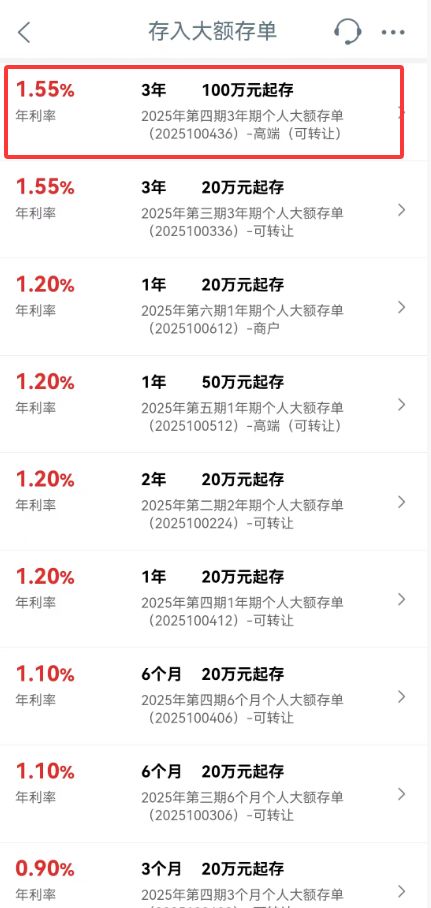
Core Viewpoint - The current trend in the banking sector shows a significant reduction in the availability of long-term large-denomination certificates of deposit (CDs), with major banks like ICBC, ABC, and BOC ceasing to offer 5-year products, indicating a shift towards shorter-term offerings and potential impacts on market liquidity and investment strategies [9][10]. Group 1: Current Offerings - ICBC is currently offering a 3-year large-denomination CD with a minimum deposit of 1 million yuan and an interest rate of 1.55% [1][2]. - The latest 3-year fixed deposit products from ICBC have an interest rate of up to 1.55%, with a minimum deposit requirement of only 50 yuan [1]. - Other banks have similar offerings, with 3-year CDs at 1.55% and 1-year and 2-year products at 1.20% [9]. Group 2: Market Trends - Major state-owned banks have completely stopped offering 5-year large-denomination CDs, with a noticeable trend towards shorter-term products across the banking sector [9]. - The exit of 5-year CDs is seen as a response to pressure on banks' interest margins, which may influence future loan rate adjustments and redirect funds towards capital markets [10]. - Analysts suggest that the reduction in deposit rates could lead to a "deposit migration" effect, where funds move from banks to higher-yielding investments in stocks, bonds, and funds, potentially benefiting the direct financing market [10].