负债成本管控

Search documents
中小银行集体降息,最高降30个基点
21世纪经济报道· 2026-03-12 12:44
Core Viewpoint - The article discusses the recent trend of deposit interest rates among small and medium-sized banks in China, highlighting a pattern of initial increases followed by subsequent decreases, particularly in the context of market competition and changing economic conditions [1][3]. Group 1: Deposit Rate Trends - In early 2026, many small and medium-sized banks raised their fixed deposit rates to capture market share during the "opening red" period, with increases of 10 to 20 basis points (0.1% to 0.2%) noted [3][6]. - By March 2026, these banks began to lower their deposit rates, with five-year fixed deposit rates dropping to the "1" digit range, while only a few banks maintained rates above 2% [1][6]. - The adjustment in deposit rates has led to a phenomenon of interest rate inversion, where five-year deposit rates are equal to or lower than three-year rates, as seen in banks like Heilongjiang Friendship Rural Commercial Bank [8][11]. Group 2: Large Time Deposits - Large time deposits have shown strong resistance to rate declines, with rates remaining stable compared to the beginning of the year, typically ranging from 1.4% to 1.45% for one-year products and around 1.8% for three-year products [13][15]. - The issuance of large time deposits has become more short-term focused, with fewer five-year products available, indicating a shift in bank strategies to manage costs and attract stable funding [13][15]. - The stability of large time deposit rates is attributed to their higher minimum investment requirements, which attract more stable customers, and banks' willingness to maintain competitive rates to secure these funds [15][17]. Group 3: Market Expectations and Future Outlook - The recent rate adjustments are seen as a market-driven response to pressures on net interest margins, with banks actively managing their liabilities by encouraging shorter-term deposits [12][18]. - Analysts suggest that the current trend of interest rate inversion may become a more common occurrence as banks adjust their strategies in anticipation of further rate declines [11][12]. - The overall impact of these changes is expected to influence both consumer behavior and banks' liability structures, with a shift towards shorter-term deposit products becoming more prevalent [12][18].


抢滩“开门红”揽储 中小行限时上调利率,大行分层经营稳成本
2 1 Shi Ji Jing Ji Bao Dao· 2026-01-15 23:22
Core Viewpoint - The banking sector is experiencing a "New Year" deposit rush, with small and medium-sized banks facing pressure to attract deposits despite a decrease in the overall enthusiasm compared to previous years [2][5]. Group 1: Deposit Rate Adjustments - Several small and medium-sized banks have recently raised their fixed deposit rates, albeit by limited margins compared to previous years, reflecting a balance between managing funding costs and maintaining market competitiveness [2][4]. - For instance, the DeShang Village Bank in Henan increased its one-year and three-year fixed deposit rates from 1.50% and 1.70% to 1.55% and 1.73%, respectively [3]. - Other banks, such as the Jiangsu Bank and Shenyang Bank, have also introduced higher interest rate products, with some three-year fixed deposits offering rates as high as 1.90% [3][4]. Group 2: Marketing Strategies and Competitive Pressures - To attract deposits, some banks are employing promotional strategies, such as offering shopping vouchers for depositors, indicating a competitive environment among small banks [4]. - Analysts suggest that the recent rate increases by small banks are primarily short-term marketing tactics to meet year-end deposit targets, rather than indicative of a long-term trend [5]. Group 3: Large Banks' Strategies - Major state-owned banks have not followed suit in raising deposit rates but have adjusted the minimum deposit thresholds for their products, indicating a strategic shift towards customer relationship management [6][7]. - For example, the Industrial and Commercial Bank of China has set a minimum deposit of 1 million for certain high-yield products, while the Agricultural Bank of China has varied its minimum deposit requirements significantly across different products [6]. Group 4: Future Outlook - Industry experts predict that banks may continue to lower funding costs, with potential downward adjustments in deposit rates as net interest margins remain under pressure [8]. - The average cost of deposits may decrease by approximately 35 basis points in 2026, potentially improving net interest margins by 10 to 15 basis points, which could provide more room for future interest rate cuts by the central bank [8].


抢滩“开门红”揽储:中小行限时上调利率,大行分层经营稳成本
2 1 Shi Ji Jing Ji Bao Dao· 2026-01-14 05:41
Core Viewpoint - The current trend in the banking sector shows that while small and medium-sized banks are raising deposit rates to attract funds, the overall enthusiasm for deposit collection has decreased compared to previous years, reflecting a balance between managing funding costs and maintaining market competitiveness in the context of deepening interest rate marketization [1][8]. Group 1: Deposit Rate Adjustments - Several small and medium-sized banks have recently raised their fixed deposit rates, albeit by limited margins compared to previous years, indicating a cautious approach to managing funding costs [3][4]. - For instance, the DeShang Village Bank in Henan raised its one-year and three-year fixed deposit rates from 1.50% and 1.70% to 1.55% and 1.73%, respectively [3]. - The Yangling Rural Commercial Bank has unified its personal fixed deposit rates to a range of 1.1% to 1.6%, with three-year and five-year rates set at 1.6% [4]. Group 2: Competitive Landscape - The competitive landscape among banks is intensifying, particularly for small and medium-sized banks, which are under pressure to stabilize liabilities and attract deposits, leading to temporary increases in deposit rates [5][7]. - Major state-owned banks, while not increasing deposit rates, are adjusting the minimum deposit thresholds for their products, indicating a strategic shift towards customer relationship management [6][8]. - The Agricultural Bank of China has raised the minimum deposit for a three-year certificate to 5 million yuan, while still offering products with a lower threshold of 200,000 yuan [6]. Group 3: Future Trends - Analysts predict that banks will continue to lower funding costs due to pressure on net interest margins, suggesting that deposit rates may further decline in the future [8][9]. - The net interest margin for commercial banks has narrowed to 1.42%, with expectations that the average cost of deposits may decrease by approximately 35 basis points as high-interest deposits mature [9]. - The overall trend indicates that banks may adopt varied pricing strategies for deposits, balancing between lowering rates and adjusting minimum deposit requirements [8][9].

取消、下架!多家银行停售5年定期存款
Huan Qiu Wang· 2025-11-13 01:32
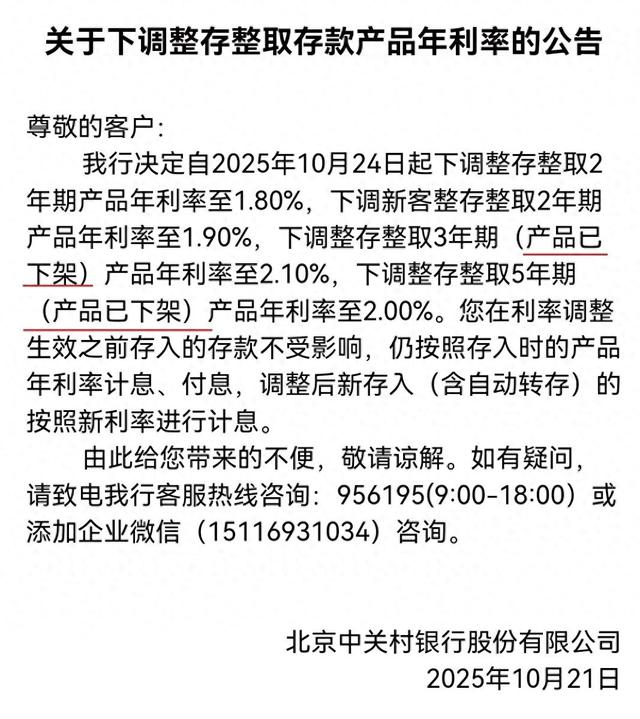
Core Viewpoint - The long-term fixed deposit products are being phased out by several banks, with the Tongyu County Mengyin Village Bank being the first to officially announce the cancellation of the 5-year fixed deposit product, indicating a trend in the banking industry towards reducing long-term deposit offerings due to narrowing net interest margins [1][2][7]. Group 1: Bank Actions - The Tongyu County Mengyin Village Bank announced a reduction in deposit rates and the cancellation of the 5-year fixed deposit product effective November 5, 2025, marking it as the first commercial bank to do so [2]. - Other banks, such as the Kundu Lun Mengyin Village Bank and Hubei Jingmen Rural Commercial Bank, have also reduced their deposit rates and removed the 5-year fixed deposit from their offerings, although they did not issue formal announcements [2][6]. - A total of seven private banks have removed the 5-year fixed deposit from their deposit pages, including Keshang Bank and Wanzhang Bank, with some also removing 3-year fixed deposits [2][6]. Group 2: Market Trends - The disappearance of the 5-year fixed deposit is not limited to small banks; major national banks have also stopped offering 5-year large denomination certificates of deposit, with some city commercial banks restricting them to special customer categories [6][8]. - The trend of phasing out long-term deposits is attributed to the ongoing pressure of narrowing net interest margins, prompting banks to optimize their liability structures and manage costs more effectively [7][8]. - Analysts suggest that the reluctance of customers to invest in 5-year deposits, which often offer lower interest rates compared to 3-year deposits, is also influencing banks' decisions to withdraw these products [8].
银行负债结构往深了调五年期存款产品首见“下架”
Zheng Quan Shi Bao· 2025-11-10 18:34
Core Viewpoint - The recent decision by the Tongyu County Mengyin Village Bank to cancel its five-year fixed deposit product reflects the broader trend among small and medium-sized banks in response to declining interest margins and the need to adjust their liability structures [1][2][5]. Group 1: Changes in Deposit Products - The Tongyu County Mengyin Village Bank is the first commercial bank to eliminate the five-year fixed deposit product, indicating direct transmission of pressure from declining interest margins [2]. - The bank has also reduced interest rates for other fixed deposit terms, with the one-year rate decreasing from 1.50% to 1.45%, the two-year rate from 1.60% to 1.55%, and the three-year rate from 1.95% to 1.85% [2]. - Other small and medium-sized banks have similarly announced reductions in deposit rates, with some experiencing cuts of up to 80 basis points [2]. Group 2: Industry Trends - The adjustments made by small and medium-sized banks are indicative of a larger industry trend, where banks are reluctant to accept longer-term deposits due to pressure on interest margins [3]. - The five-year large denomination certificates of deposit (CDs) have also seen a decline, with many banks no longer offering them, and new issuances reflecting lower interest rates compared to previous offerings [4]. - The overall trend shows that banks are focusing on managing their liability costs and are likely to continue adjusting long-term deposit products in the future [5][6]. Group 3: Future Outlook - Industry experts suggest that more banks may follow suit in adjusting long-term deposit products due to ongoing pressure on net interest margins [5][6]. - The continuous decline in loan market quoted rates (LPR) is contributing to lower loan yields, prompting banks to reduce deposit rates to manage costs effectively [6]. - The limited availability of long-term deposit products may lead depositors to reassess their risk tolerance and consider diversifying their asset allocations [6].
个别银行"抢跑"年末揽储 负债成本管控更趋精细化
Zheng Quan Shi Bao· 2025-10-27 01:09
Core Viewpoint - In the context of sustained pressure on net interest margins, many small and medium-sized banks are initiating a new round of interest rate cuts, actively lowering the upper limit of deposit rates to create space for profit growth [1][5]. Group 1: Deposit Rate Adjustments - Some banks have begun to quietly ramp up deposit acquisition efforts as the year-end approaches, combining this with refined and tiered customer management to stabilize general deposits while effectively controlling liability costs [1][3]. - Recent interest rate cuts have led to most deposit products entering the "1.x" range, with major state-owned banks adjusting their deposit rates in May, resulting in rates of 1.05% for two-year deposits and 0.98% for one-year deposits at Postal Savings Bank [3][4]. Group 2: Marketing Strategies - Certain banks, like China Merchants Bank, are launching promotional activities to attract deposits, such as cash rewards for customers who meet asset thresholds [2][3]. - The marketing rhythm for year-end and new year strategies remains consistent across banks, with many emphasizing the importance of both year-end performance and the start of the new year [3][6]. Group 3: Liability Cost Management - The continuous narrowing of net interest margins has made liability cost management a key focus for banks, with regulatory guidance pushing for lower overall funding costs [4][5]. - Some banks are experiencing a phenomenon of interest rate inversion, where shorter-term deposits offer higher rates than longer-term ones, indicating a strategic response to anticipated future cost pressures [6][7]. Group 4: Targeted Deposit Strategies - Banks are increasingly adopting differentiated deposit strategies for specific customer segments, particularly targeting older clients with higher interest rates and lower minimum deposit thresholds [7]. - This approach not only optimizes the liability structure but also helps in acquiring stable long-term funding while fulfilling social responsibilities [7].
个别银行“抢跑”年末揽储 负债成本管控精细化
Zheng Quan Shi Bao· 2025-10-27 00:22
Core Viewpoint - In the context of sustained pressure on net interest margins, many small and medium-sized banks are initiating a new round of interest rate cuts, actively lowering the upper limit of deposit rates to create space for profit growth [1][5]. Group 1: Deposit Rate Adjustments - Some banks have quietly started aggressive deposit collection efforts as the year-end approaches, combining this with refined and tiered customer management to stabilize general deposits while effectively controlling liability costs [1][2]. - Since early October, several small and medium-sized banks have held fourth-quarter operational meetings, emphasizing the importance of achieving a successful year-end while preparing for a strong start in the first quarter of the following year [2][3]. - The recent adjustment of deposit rates has led to most market deposit products entering the "1" range, with major state-owned banks' two-year, three-year, and five-year fixed deposit rates set at 1.05%, 1.25%, and 1.3% respectively [3][4]. Group 2: Competitive Strategies - Some banks are offering cash rewards for customers who meet core asset thresholds, with activities designed to encourage customers to keep their deposits [2][3]. - The actual execution rates for certain term deposits have seen some upward adjustments compared to the listed rates, indicating a competitive landscape among banks [4][6]. - Banks are increasingly adopting differentiated deposit strategies targeting specific customer segments, particularly offering higher rates and lower minimum deposit thresholds for older customers [7]. Group 3: Market Trends and Challenges - The continuous narrowing of net interest margins is a common challenge faced by the banking industry, prompting a focus on managing liability costs more effectively [4][5]. - The People's Bank of China has emphasized the need to lower overall bank liability costs to alleviate pressure on net interest margins, which has led to recent adjustments in deposit rates [5][6]. - The phenomenon of interest rate inversion, where shorter-term deposits offer higher rates than longer-term ones, is emerging as banks anticipate future cost pressures on long-term liabilities [6][7].

个别银行“抢跑”年末揽储 负债成本管控更趋精细化
Zheng Quan Shi Bao· 2025-10-26 22:24
Core Viewpoint - In the context of sustained pressure on net interest margins, many small and medium-sized banks are initiating a new round of interest rate cuts, actively lowering the upper limit of deposit rates to create space for profit growth [1][5]. Group 1: Deposit Rate Adjustments - Some banks have begun to quietly ramp up deposit acquisition efforts as the year-end approaches, combining this with refined and tiered customer management to stabilize general deposits while effectively controlling liability costs [1][2]. - Since early October, several small and medium-sized banks have held fourth-quarter operational meetings, emphasizing the importance of achieving a successful year-end while preparing for a strong start to the new year [2][3]. - The recent downward adjustments in deposit rates have led to most market deposit products now having rates in the "1" range, with major state-owned banks last adjusting their deposit rates on May 20, resulting in rates of 1.05% to 1.3% for various terms [3][4]. Group 2: Liability Cost Management - The continuous decline in deposit rates has made it challenging for risk-averse savers to find alternative investment options, leading to a sustained popularity of large-denomination certificates of deposit [4][6]. - The People's Bank of China has emphasized the need to further reduce the overall liability costs of banks to alleviate net interest margin pressures, with recent rate cuts providing banks with more room to improve their liability costs [5][6]. - Banks are increasingly adopting refined and tiered strategies for managing liability costs, with some banks experiencing interest rate inversion, breaking the traditional expectation that longer terms yield higher rates [6][7]. Group 3: Targeted Deposit Strategies - Banks are implementing differentiated deposit strategies for various customer segments, particularly offering higher rates and lower minimum deposit thresholds for older customers [7]. - This approach not only optimizes the liability structure and locks in stable long-term funds but also reduces liquidity management pressures and enhances customer acquisition efficiency [7].
个别银行“抢跑”年末揽储负债成本管控更趋精细化
Zheng Quan Shi Bao· 2025-10-26 17:38
Core Viewpoint - In the context of sustained pressure on net interest margins, many small and medium-sized banks are initiating a new round of interest rate cuts, actively lowering the upper limit of deposit rates to create space for profit growth [1][5]. Group 1: Deposit Rate Adjustments - Some banks have begun to quietly ramp up deposit acquisition efforts as the year-end approaches, combining this with refined and tiered customer management to stabilize general deposits while effectively controlling liability costs [1][3]. - Recent adjustments in deposit rates have seen most market deposit products enter the "1" range, with major state-owned banks' two-year, three-year, and five-year fixed deposit rates set at 1.05%, 1.25%, and 1.3% respectively [3][4]. - Some banks have implemented actual execution rates above the listed rates, with examples including Postal Savings Bank offering a one-year fixed deposit rate of 1.15% and large certificates of deposit at 1.25% [4]. Group 2: Marketing Strategies - Banks are employing various marketing strategies to attract deposits, such as cash rewards for customers who meet certain asset thresholds, as seen in activities launched by China Merchants Bank [2][3]. - The year-end "closing battle" and the beginning of the new year "opening red" strategy are emphasized by many banks, particularly in rural commercial banks in regions like Shanxi, Jiangsu, and Jiangxi [3][5]. Group 3: Liability Cost Management - The continuous narrowing of net interest margins has become a common challenge for the banking industry, leading to a focus on managing liability costs more effectively [4][6]. - The People's Bank of China has called for further reductions in overall bank liability costs to alleviate pressure on net interest margins, which has led to recent adjustments in deposit rates [5][6]. Group 4: Targeted Deposit Strategies - Banks are increasingly adopting differentiated deposit strategies for specific customer segments, particularly for older clients, offering higher interest rates and lower minimum deposit thresholds [7]. - This approach not only optimizes the liability structure but also helps in acquiring stable long-term funds while reducing liquidity management pressure [7].
多家互联网银行上线大额存单排队功能
21世纪经济报道· 2025-09-12 16:06
Core Viewpoint - The interest rates for large time deposits in state-owned and joint-stock banks have dropped to the "1" range after multiple rounds of interest rate cuts, with some banks removing large time deposits with terms longer than three years [1][2] Group 1: Current Market Conditions - Large time deposits with interest rates above 2% are rarely found, primarily in regional and internet banks [1] - Internet banks are offering higher interest rates on large time deposits, but these products often have limited availability and require reservations, leading to waiting times of one week to several months [1][5] - The starting amount for large time deposits is generally 200,000 yuan, with rates slightly higher than regular fixed deposits, and they are included in the deposit insurance scheme [1] Group 2: Specific Bank Offerings - WeBank offers two types of "large time deposit+" products with interest rates of 3% and 2.1%, respectively, but the former is currently unavailable for reservations [1][2] - MyBank has a two-year large time deposit with a listed interest rate of 1.6% and a dedicated transfer area for high-interest deposits [2] - Citic Baixin Bank limits the issuance of high-interest large time deposits to new customer benefits, with a current rate of 2.1% for two-year deposits [2] Group 3: Financial Performance and Strategies - Internet banks are experiencing a narrowing net interest margin, with private banks' net interest margin decreasing from 4.11% at the end of last year to 3.91% by mid-year, although still higher than most traditional banks [5] - WeBank's net interest margin is projected to decline from 6.04% at the end of 2023 to 5.71% by mid-2024, while MyBank's is expected to rise slightly from 3.34% to 3.48% in the same period [5] - Internet banks are implementing various measures to control funding costs, including promoting the transfer of maturing fixed deposits to bank wealth management products and reducing fixed deposit rates [5][6]