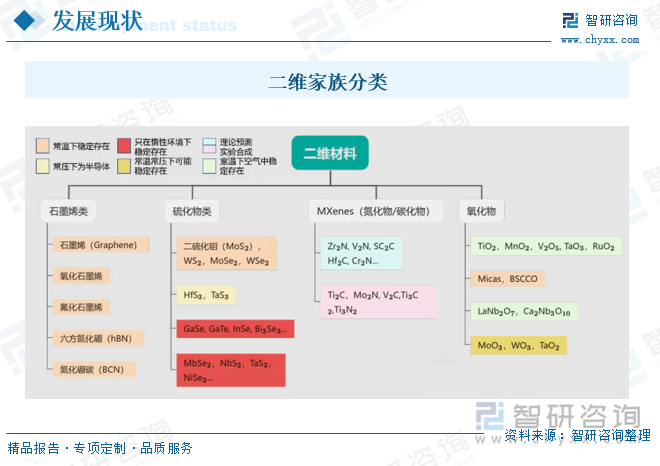
二维半导体材料

Search documents
未来10年中国战略必争领域与新材料发展的重点任务
材料汇· 2026-02-19 13:19
点击 最 下方 关注《材料汇》 , 点击"❤"和" "并分享 添加 小编微信 ,寻 志同道合 的你 (请添加小编微信,后续会组建 相关行业微信群 ) (欢迎 一级市场投资朋友 加入) 正文 全球科技和产业竞争格局加速重塑,前瞻预判前沿技术和颠覆性技术,谋划布局新兴产业和未来产业发 展成为打造国家竞争新优势的关键。 新材料是高新技术产业发展的基石和先导,新材料的突破将加速新兴和未来产业变革!中国未来产业崛 起引领全球新材料创新发展! 新一代信息技术、新能源、重大工程与高端装备、生命健康等是中国实现科技强国、制造强国的战略必 争领域 ,也是对新材料有重大需求的重点领域。支撑和满足以上重点领域应用需求,也是未来 10 年中 国新材料发展的重点任务。 一、人工智能发展和数字中国建设对高性能计算与存储、高速及大容量网络通信和智能化人机交互系统 提出更高要求,亟待发展一批新型信息材料 ( 1 )先进计算与存储关键材料 随着人工智能、超算、云等计算场景的快速发展,未来将会出现百万级的数据中心。传统硅基材料及与 其相配合的周边材料性能,无论在 AI 计算方面还是电能功率方面都接近极限。 异质异构集成 将不同 材料体系、器件结 ...


中国研究团队再登《Science》:二维半导体量产技术实现关键跨越
Huan Qiu Wang Zi Xun· 2026-02-05 03:30
此次突破聚焦产业化工艺核心难题,研发团队创新性地推出定制化Oxy-MOCVD 200 ultra设备,构 建"氧辅助预反应动力学调控"与"无氢低碳硫源输运"双系统,从源头重构生长环境,彻底破解了二维半 导体晶畴尺寸小、生长速率低、碳污染等量产关键瓶颈。这一技术升级实现了从"实现生长"到"优化生 长"的战略升维,此前双方已于2025年10月突破衬底工程,成功实现6英寸单晶普适制备。 来源:环球网 两项核心突破共同构建起自主可控的完整产业化技术闭环,形成驱动二维半导体产业化的"双引擎"。在 装备自主化方面,此次采用的Oxy-MOCVD设备实现100%国产化,验证了我国高端半导体装备从"自主 可用"向"引领定制"的跨越式发展;在技术应用方面,经调控后的二维半导体材料在均匀性、纯度及电 学性能上实现质的提升,可无缝对接下一代埃米级芯片、柔性显示等高需求场景,将大幅缩短材料到芯 片的产业化进程。 【环球网科技综合报道】2月5日消息,由极钼芯科技联合南京大学在二维半导体领域近日取得重大技术 突破,相关成果再度登上国际顶级学术期刊《Science》。这是双方三个月内第二次斩获该领域顶尖学 术认可,标志着我国成功攻克二维半导 ...

突破“后摩尔”极限:国内首条二维半导体工程化示范线在沪“点亮”
Xin Hua Cai Jing· 2026-01-07 03:31
Group 1 - The core point of the article highlights the launch of China's first engineering demonstration line for two-dimensional semiconductors by Yuanjiwei Technology in Shanghai, marking a significant step in the transition from laboratory research to industrialization in the field of non-silicon heterogeneous integration technology [1][2] - The semiconductor industry is entering a "post-Moore era" with advanced processes of 2 nanometers and below, where the physical limits of silicon materials are becoming a bottleneck for further computational power advancements [1] - Two-dimensional semiconductors are recognized as revolutionary materials for the next generation of integrated circuits, offering unique physical properties such as atomic-level thickness and ultra-high carrier mobility, with important applications in high-frequency communication, flexible electronics, quantum computing, and edge intelligence [1] Group 2 - The engineering demonstration line aims to achieve the industrialization of two-dimensional semiconductor materials by integrating mainstream semiconductor manufacturing equipment, thereby shortening the cycle from research results to industrial application [2] - The production line is expected to officially "go live" by June 2026, completing all equipment linkage debugging and process optimization, and running the wafer process [2] - Shanghai is positioning two-dimensional semiconductors as a key focus for future industrial development, with systematic deployment around critical areas such as material production, manufacturing processes, device design, and equipment [2]
院士报告:面向2035的新材料研发与应用重点任务
材料汇· 2026-01-05 16:02
Core Viewpoint - The article emphasizes the critical need for new materials in various strategic sectors such as information technology, energy, advanced manufacturing, and healthcare to support China's goal of becoming a technology and manufacturing powerhouse by 2035 [2][4]. Group 1: New Generation Information Technology - The rapid development of AI, supercomputing, and cloud computing necessitates new information materials, particularly in advanced computing and storage [4]. - Traditional silicon-based materials are nearing their performance limits, prompting the exploration of two-dimensional semiconductor materials like graphene and transition metal dichalcogenides for next-generation chips [4][5]. - Quantum computing materials, including superconductors and topological materials, are emerging as pivotal technologies in the computing sector [5]. Group 2: Communication and Networking - The next decade will see the evolution of communication networks, requiring new devices and materials such as wide bandgap semiconductors and high-performance optical components [6]. - The development of high-performance laser and electro-optic modulators is essential for F6G optical communication systems [6][7]. - Chip output and all-optical interconnect technologies are crucial for enhancing computing power and energy efficiency in data centers [7]. Group 3: New Energy Materials - The photovoltaic industry is a competitive sector for China, with N-type monocrystalline silicon battery technologies becoming mainstream [9]. - There is a need for advancements in thin-film solar cells and new stacked solar cell materials to maintain global leadership in solar energy [9][10]. - The development of high-performance energy storage materials, including solid-state and sodium-ion batteries, is critical for the electrification of transportation and energy sustainability [10]. Group 4: Advanced Manufacturing and Equipment - High-performance materials are essential for aerospace, robotics, and marine engineering, with a focus on lightweight and durable materials [17][19]. - The development of advanced structural materials for high-speed trains and aerospace applications is necessary to meet stringent performance requirements [21][19]. - The military sector requires lightweight materials that can withstand extreme conditions, with a focus on new composite materials and wide bandgap semiconductors [23][22]. Group 5: Healthcare and Biomanufacturing - There is a growing demand for regenerative biomaterials that can facilitate tissue and organ repair, addressing clinical needs [25]. - Minimally invasive repair materials and devices are becoming a significant focus in high-end medical equipment development [26]. - The push for biomanufacturing materials, including bioplastics and bio-based chemicals, is crucial for reducing reliance on fossil resources and achieving sustainability goals [27].

芯片产业的下一个颠覆性突破!
半导体芯闻· 2025-07-07 09:49
Core Viewpoint - The article discusses the future of semiconductor technology, emphasizing the transition from traditional silicon-based materials to two-dimensional (2D) semiconductor materials as a key focus for innovation and development in the industry [2][12][53]. Group 1: Industry Trends and Predictions - IMEC predicts that by 2039, the second generation of 2D Field Effect Transistors (2DFET) will become mainstream, highlighting the growing importance of 2D materials in semiconductor technology [4][53]. - The global market for 2D semiconductor materials is expected to reach $1.8 billion in 2024, with graphene being the largest segment, accounting for 45% of the market share [16]. - The market is projected to grow at a compound annual growth rate (CAGR) of 24%-26.5% from 2025 to 2030, driven by demand in 5G communication, AIoT, and high-performance computing [16]. Group 2: Material Innovations - The transition to 2D semiconductor materials is seen as a solution to the challenges posed by traditional silicon-based devices, which face physical limitations such as quantum tunneling and short-channel effects [5][12]. - 2D materials, such as graphene and transition metal dichalcogenides (TMDs), offer unique electrical properties and the potential for higher integration densities, with vertical field-effect transistors (VFETs) achieving densities ten times that of FinFETs [6][14]. - Research has shown that 2D materials can be engineered to exhibit a wide range of electronic properties, making them suitable for various applications, including neuromorphic devices and quantum computing [9][12]. Group 3: Industrial Applications and Developments - Companies like TSMC, Intel, and Samsung are investing heavily in the research and integration of 2D semiconductor materials, pushing the industry from laboratory experiments to large-scale production [16]. - The first domestic engineering demonstration line for 2D semiconductors has been launched, aiming to develop commercial production lines within three years [17]. - Significant advancements have been made in the development of flexible integrated circuits based on 2D materials, with successful demonstrations of medium-scale circuits that integrate over 100 transistors [45][50]. Group 4: Challenges and Solutions - The integration of 2D materials into existing semiconductor processes presents challenges, including the need for compatible substrates and the management of high-temperature growth processes [54][57]. - Researchers are exploring various methods to overcome these challenges, such as using low-resistance source/drain contacts and alternative doping techniques to enhance the performance of 2D devices [58][59]. - The industry is also focusing on developing heterogeneously integrated chip technologies that leverage existing silicon ecosystems while incorporating 2D materials [59].


芯片新时代,将开启
半导体行业观察· 2025-07-07 00:54
Core Viewpoint - The article discusses the future of semiconductor technology, emphasizing the transition from traditional silicon-based materials to two-dimensional (2D) semiconductor materials as a key focus for innovation and development in the industry [2][11][63]. Group 1: Semiconductor Industry Trends - The evolution of advanced process nodes and transistor architectures is leading to a growing interest in 2D semiconductor materials, as traditional silicon-based technologies face physical limitations and increasing costs [2][4][11]. - IMEC predicts that by 2039, 2D materials will become mainstream in semiconductor applications, particularly in the development of the second generation of 2D field-effect transistors (2DFETs) [3][52]. Group 2: Advantages of 2D Materials - 2D materials, such as graphene and transition metal dichalcogenides (TMDs), offer unique electrical properties and the potential for significantly higher transistor densities compared to traditional silicon [5][13]. - The introduction of 2D materials can address challenges related to size scaling and energy efficiency, making them ideal candidates for next-generation integrated circuits [11][12]. Group 3: Market Potential and Growth - The global market for 2D semiconductor materials is projected to reach $1.8 billion by 2024, with graphene accounting for 45% of this market due to its superior conductivity and mechanical strength [15]. - The market is expected to grow at a compound annual growth rate (CAGR) of 24%-26.5% from 2025 to 2030, driven by demand in sectors such as 5G communication, AIoT, and high-performance computing [15]. Group 4: Research and Development Initiatives - Major companies like TSMC, Intel, and Samsung are investing heavily in 2D semiconductor research and development, aiming to transition from laboratory experiments to large-scale production [15][16]. - Research teams are making significant breakthroughs in the fabrication and application of 2D materials, including the development of the first domestically produced 2D semiconductor integrated circuit demonstration line in China [16][19]. Group 5: Challenges in Industrialization - The transition to 2D materials presents several challenges, including the need for compatible substrates, high-temperature growth processes, and maintaining device reliability and consistency [52][58]. - The industry faces hurdles in integrating 2D materials with existing CMOS technology, particularly in achieving low-resistance contacts and effective doping methods [59][60]. Group 6: Future Outlook - The rise of 2D semiconductor materials is not just a technological advancement but also a restructuring of the semiconductor supply chain, with China positioned to leverage its policy support and technological capabilities [63]. - The integration of 2D materials is expected to lead to a new era of electronic systems characterized by high heterogeneity, impacting various fields including information processing and energy conversion [63].
研判!2025年中国二维半导体材料行业发展背景、相关政策、市场规模及未来趋势分析:二维半导体材料产业应用逐步推进[图]
Chan Ye Xin Xi Wang· 2025-05-19 01:07
Core Viewpoint - The development of two-dimensional (2D) materials, particularly graphene, has gained significant attention due to their unique electrical properties and potential applications in various fields, including semiconductors, photonics, and quantum computing [1][2][9]. Industry Overview - Two-dimensional materials are defined as materials with atomic layer thickness in one dimension while maintaining larger dimensions in the other two. Graphene is the most well-known example, first isolated in 2004, showcasing exceptional electrical properties [1][2]. - The global market for 2D semiconductor materials is projected to reach $1.8 billion by 2024, with graphene accounting for 45% of this market due to its superior conductivity and mechanical strength [14]. Market Status - The semiconductor materials market is expected to generate $67.5 billion in revenue in 2024, with a year-on-year growth of 3.8%. This growth is driven by the recovery of the semiconductor industry and the increasing demand for advanced materials in high-performance computing and high-bandwidth memory [5][7]. - Taiwan, mainland China, and South Korea are the top three markets for semiconductor materials, collectively accounting for 65% of the global market share. Taiwan leads with a market size of $20.09 billion, while mainland China is projected to reach $13.458 billion in 2024, growing by 5.3% [7]. Development Background - The evolution of semiconductor materials has transitioned from first-generation silicon and germanium to second-generation compound semiconductors and third-generation wide-bandgap semiconductors. 2D semiconductor materials have emerged as a key area of research since the discovery of graphene, addressing the limitations of traditional materials [9][20]. - The Chinese government has included 2D semiconductor materials in its list of frontier materials, providing substantial policy support to encourage development and commercialization [11][13]. Technological Advancements - Significant breakthroughs in 2D semiconductor technology have been achieved, including the successful batch production of transition metal dichalcogenides (TMDs) and the development of a 32-bit RISC-V architecture microprocessor based on 2D materials [16][18]. - The industry is witnessing advancements in channel engineering, contact engineering, gate stacking, and integration technology, which are crucial for the large-scale fabrication of 2D semiconductor devices [18][19]. Future Trends - The unique physical properties and broad application potential of 2D semiconductor materials position them as a critical technology direction in the post-Moore era. With ongoing support from policies and market demand, the industry is expected to overcome key technological bottlenecks and drive a new wave of industrial revolution in fields such as optoelectronics and flexible electronics [20].