光互联

Search documents
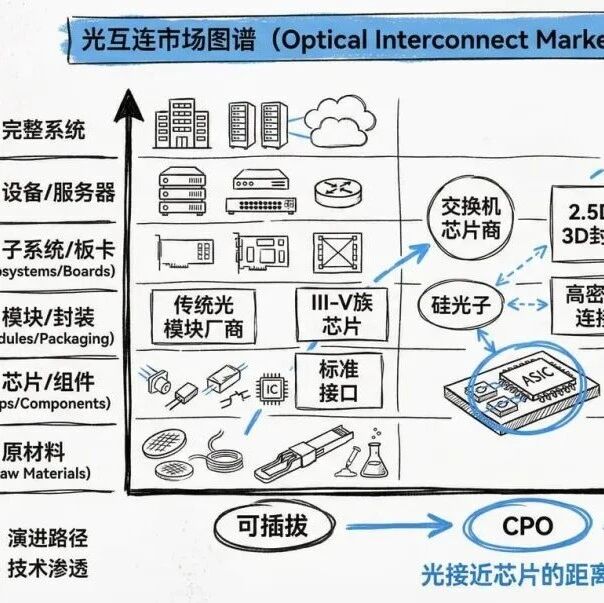
光互联的市场图谱
傅里叶的猫· 2026-02-21 14:13
Core Insights - The article discusses the evolution of optical interconnect technology, highlighting three key structural patterns in the market: vertical integration vs. specialization, the scarcity of light generation, and the rise of SiPho foundries [5][6][10]. Group 1: Market Structure - Vertical integration offers structural advantages during technological transitions, as companies that can design across multiple layers can optimize the entire tech stack [9]. - Companies like Broadcom exemplify vertical integration, appearing across multiple layers of the value chain, while most others focus on specific segments [8]. - The semiconductor industry has historically shown that such advantages may not be permanent, as standardization can lead to the emergence of fabless models [9]. Group 2: Scarcity of Light Generation - The difficulty of producing light sources (Layer 1 and Layer 0) is highlighted, with InP and GaAs materials requiring specialized technology and equipment [12][13]. - Companies capable of mass-producing high-performance InP lasers are few, creating a concentrated market [13][14]. Group 3: Rise of SiPho Foundries - Layer 2, which focuses on SiPho foundries, is gaining attention as traditional semiconductor manufacturers like TSMC and GlobalFoundries enter the photonics space [17]. - TSMC's potential to optimize both AI chips and optical interconnects within the same ecosystem could disrupt existing vertical integration advantages [17]. Group 4: Layer Analysis - Layer 0 involves substrate supply, with companies like AXT benefiting from increased demand for III-V substrates, although geopolitical risks exist due to production in China [21][22]. - Layer 1 is dominated by Coherent and Lumentum, both of which manufacture InP lasers and are expanding production amid high demand [24][25]. - Layer 2 focuses on SiPho foundries, with companies like GlobalFoundries and TSMC leading in manufacturing photonic integrated circuits [27][29]. - Layer 3, represented by DSPs, faces potential obsolescence as CPO technology advances, with companies like Broadcom and Marvell adapting to this shift [33][36]. - Layer 4 sees companies like Innolight and Eoptolink currently leading in the pluggable module market, but their positions may be challenged as the industry shifts towards CPO [40][42]. Group 5: Future Signals - Key indicators to watch include pJ/bit energy consumption metrics, which reflect technological advancements and efficiency [56]. - The ongoing standardization efforts, such as OIF and UCIe, will shape the future market landscape and influence competitive dynamics [57][59]. - Recent mergers and acquisitions signal strategic directions in the industry, with notable deals like Marvell's acquisition of Celestial AI [60][62]. - The choices made by major cloud service providers like Google and AWS regarding their technology partnerships will ultimately determine market trajectories [63][64].




通信行业周报:光纤行业涨价趋势明确,关注 cpo 和光互联投资机会-20260203
GUOTAI HAITONG SECURITIES· 2026-02-03 01:47
Investment Rating - The report assigns an "Overweight" rating for the optical fiber industry, indicating a projected increase of over 15% relative to the CSI 300 index [4][33]. Core Insights - The optical interconnection sector shows strong performance expectations, with a focus on the transition opportunities from CPO/OIO technology. The optical fiber industry is experiencing a clear price increase trend, driven by demand from telecom operators and pre-holiday inventory needs [2][9]. - LightCounting forecasts that CPO technology shipments will begin scaling from 800G and 1.6T ports between 2026 and 2027, primarily for large cloud service providers. By 2029, the penetration rates for 800G, 1.6T, and 3.2T CPOs are expected to be 2.9%, 9.5%, and 50.6% respectively [8][9]. - Recent price increases in fiber optics are anticipated to continue due to heightened demand from telecom operators and upcoming procurement activities [9]. Summary by Sections Industry Overview - The optical interconnection sector is expected to maintain strong performance, with individual company variations but overall manageable conditions anticipated for 2026 [7]. - The appreciation of the RMB is impacting the optical interconnection sector, particularly for companies focused on overseas exports, with potential profit impacts estimated at under 5% for most, while some may see significant effects [7]. Investment Highlights - The industry has seen an increase in holding ratios, with valuations at historically high levels, reflecting positive expectations driven by the AI industry chain [23]. - AI is driving network upgrades, with strong overseas demand benefiting domestic core enterprises amid a global infrastructure wave [24]. - A new cycle of domestic AI infrastructure is emerging, with significant opportunities for leading companies in various segments [25]. - New connectivity solutions are expected to emerge in 2026, presenting additional investment opportunities [26]. - The demand for communication capabilities is increasing due to AI model training and applications, leading to rapid advancements in network innovation and technology applications [27]. Key Industry News - Corning has signed a long-term supply agreement worth $6 billion with Meta to support its data center expansion, highlighting the trend of strengthening domestic manufacturing and supply chains [10][11]. - NVIDIA has invested $2 billion in CoreWeave to enhance AI computing capabilities, indicating a strong commitment to AI infrastructure development [12][13]. - Microsoft has launched its second-generation AI chip, Maia 200, aimed at optimizing AI inference costs and reducing reliance on NVIDIA [14][15]. - The personal AI assistant ClawdBot has gained significant traction, showcasing advancements in AI capabilities and user interaction [16][17]. - Microsoft and Meta reported substantial increases in capital expenditures, reflecting their commitment to expanding computing infrastructure [18][19].
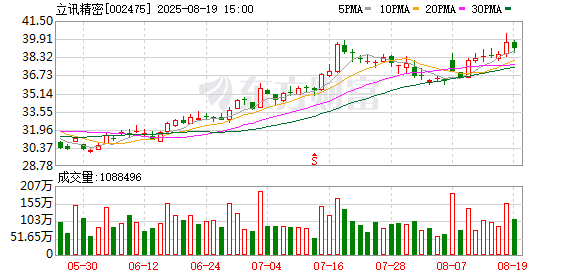
立讯精密赴港IPO:年入2688亿,七成营收依赖单一客户
Nan Fang Du Shi Bao· 2025-08-19 09:03
Core Viewpoint - Luxshare Precision has officially submitted its H-share listing application to the Hong Kong Stock Exchange, aiming to enhance its global presence and diversify its business through international capital [2][7] Financial Performance - Luxshare Precision has shown steady revenue growth, with projected revenues nearing 270 billion RMB in 2024, up from 214 billion RMB in 2022 and 231.9 billion RMB in 2023 [3] - Net profit has also increased consistently, reaching 146 billion RMB in 2024, compared to 105 billion RMB in 2022 and 122 billion RMB in 2023 [3] - In Q1 2025, revenue grew by 17.9% year-on-year to 61.8 billion RMB, while net profit surged by 31.3% to 3.4 billion RMB [3] Business Segments - The company’s revenue structure is divided into four main segments: consumer electronics, automotive electronics, communication and data centers, and others [3] - Consumer electronics remains the cornerstone of revenue, contributing 233 billion RMB in 2024, accounting for 86.7% of total revenue [3] - Automotive electronics revenue has seen a compound annual growth rate (CAGR) of 49.6% from 2022 to 2024, reaching 13.8 billion RMB in 2024, and Q1 2025 saw a remarkable 98.9% year-on-year growth [4] Client and Supplier Concentration Risks - The company faces significant risks due to high customer concentration, with revenue from its largest customer accounting for 73.3%, 75.2%, and 70.7% of total revenue in 2022, 2023, and 2024, respectively [5] - It is widely believed that the largest customer is Apple, which ties the company's performance closely to Apple's product cycles and supply chain strategies [6] - Supplier concentration is also a concern, with the top five suppliers accounting for 62.3% of total procurement, and the largest supplier also being the largest customer [6] Fundraising and Strategic Goals - The net proceeds from the listing will primarily be used for expanding and upgrading existing production bases, particularly in automotive and consumer electronics, investing in technology R&D, and enhancing smart manufacturing capabilities [7] - The funds will also be allocated for investments in quality targets along the supply chain, repayment of bank loans, and supplementing working capital [7]