全自动驾驶系统

Search documents
特斯拉AI6芯片,曝光
半导体芯闻· 2026-03-23 10:24
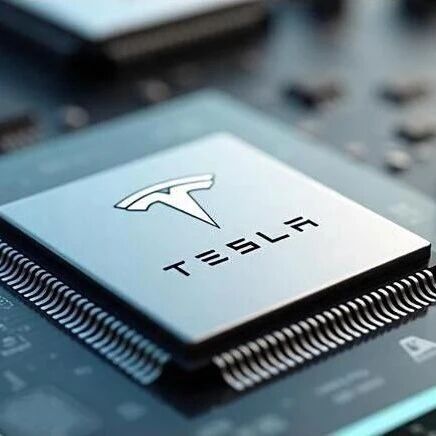
Core Insights - Tesla is optimistic about its chip tape-out timeline, indicating efforts to rapidly enhance its silicon chip manufacturing capabilities [1][3] - CEO Elon Musk is looking forward to the future of the AI6 autonomous driving chip, which is still two generations away from official release, but is already part of the company's ambitious AI hardware roadmap [1][3] - The AI6 chip aims to significantly improve Tesla's autonomous driving technology, humanoid robots, and data center operations [1][3] Group 1 - The AI5 chip has made progress, with Musk stating its design is "on track" and "nearly complete," describing it as a "critical" project requiring his personal involvement [3] - The performance of AI5 is comparable to Nvidia's Hopper level in a single system-on-chip (SoC) configuration and Blackwell level in a dual configuration, but with lower cost and power consumption [3] - AI5 is optimized for edge computing for Optimus robots and Robotaxi vehicles, while also capable of handling data center training tasks [3] Group 2 - The company plans to shorten future chip development cycles to nine months, enabling rapid iterations for AI7, AI8, and higher technologies [4] - Samsung is expected to produce the AI6 chip under a multi-billion dollar agreement, while AI5 will be jointly produced by TSMC and Samsung [4] - These chips will be central to Tesla's full self-driving system, enhancing safety and performance, while also providing efficient reasoning capabilities for expanding data centers [4] Group 3 - The advancement of the AI5 project has led Musk to restart the Dojo 3 supercomputer project, with long-term plans for internal production through the Terafab factory [4] - Tesla aims to accelerate chip development using AI tools to reduce reliance on third-party GPUs and provide high-performance, energy-efficient solutions tailored for its ecosystem [4] - The success of AI6 could mark a significant step for Tesla towards leadership in fully autonomous driving and robotics, although the timeline remains dependent on actual production circumstances [4]


帮主郑重:马斯克豪赌25万亿,特斯拉“忘掉造车”是神话还是陷阱?
Sou Hu Cai Jing· 2026-01-19 08:11
Core Viewpoint - Elon Musk's statement about Tesla potentially being remembered for its robots rather than cars signifies a strategic shift towards robotics, indicating a transformative vision for the company [1]. Group 1: Strategic Shift - Tesla's mission has evolved from "accelerating the world's transition to sustainable energy" to "accelerating the world's transition to sustainable abundance," with a focus on its humanoid robot, Optimus [3]. - Musk predicts that approximately 80% of Tesla's future value will come from Optimus, which is central to his ambitious compensation plan that includes delivering 1 million robots by 2035 and increasing the company's market value to $8.6 trillion [3]. Group 2: Technological Foundation - Tesla's confidence in achieving its ambitious goals stems from a decade of building a robust technological foundation in the smart electric vehicle sector [4]. - The company has accumulated over 45 billion miles of driving data, which supports the development of its AI systems necessary for robotics [4]. - Tesla aims to keep the cost of Optimus between $20,000 to $30,000, significantly lower than competitors, by leveraging its existing supply chain and engineering capabilities [4]. - A clear roadmap is in place, with the third-generation Optimus V3 expected to launch in Q1 2026, aiming for an annual production of 1 million units within five years [4]. Group 3: Challenges and Realities - Tesla faces significant challenges in achieving its production goals, with the initial target of 5,000 units by 2025 already deemed unattainable, as only a few hundred units have been produced for testing [5]. - Technical hurdles remain, particularly in developing a dexterous hand, understanding the environment with AI, and scaling production capabilities [5]. - The financial burden of extensive robot development may strain Tesla's core automotive business, especially as vehicle deliveries decline and profits are pressured [5]. Group 4: Industry and Investment Implications - Tesla's entry into the humanoid robot market is reshaping the industry landscape, accelerating commercialization and attracting significant capital and talent [6]. - If successful, Tesla's mass production of robots could revolutionize the entire supply chain, impacting components like motors and sensors, with related companies already seeing increased attention in the capital markets [6]. - Investors are encouraged to adopt a long-term perspective, focusing on technological milestones rather than immediate profitability [7]. - Caution is advised as Tesla's stock price reflects high expectations, and the transition from producing "hundreds" to "millions" of units presents substantial challenges [8]. Conclusion - Tesla's transformation represents a high-stakes test of its engineering capabilities and a challenge to achieve advanced AI in robotics, with 2026 being a critical year for evaluating progress [9].

美股异动丨特斯拉盘前跌2.5% 美国将调查公司近290万辆“全自动驾驶”汽车
Ge Long Hui· 2025-10-14 08:50
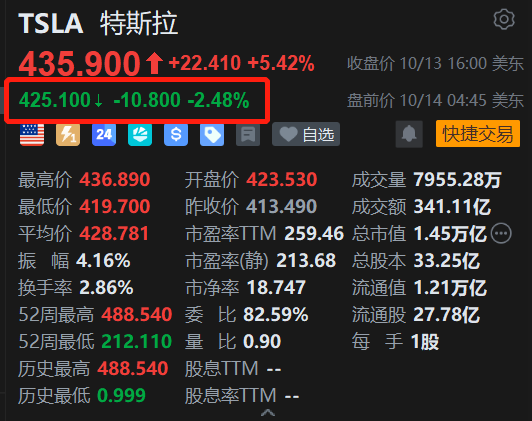
Core Viewpoint - Tesla's stock dropped 2.5% in pre-market trading following an announcement from the National Highway Traffic Safety Administration (NHTSA) that it will investigate approximately 2.88 million Tesla vehicles equipped with the "full self-driving" system due to over 50 reports of traffic safety violations and multiple accident notifications [1]. Group 1: Investigation Details - The NHTSA stated that Tesla's "full self-driving" vehicles have exhibited behaviors that violate traffic safety regulations, including running red lights and making illegal lane changes [1]. Group 2: Stock Performance - Tesla's closing price on October 13 was $435.90, reflecting an increase of 5.42% [1]. - The pre-market price on October 14 was $425.10, showing a decrease of 2.48% [1]. - The stock reached a high of $436.89 and a low of $419.70 during the trading session [1]. - The total trading volume was 79.55 million shares, with a market capitalization of $1.45 trillion [1].