关键矿产(锂

Search documents
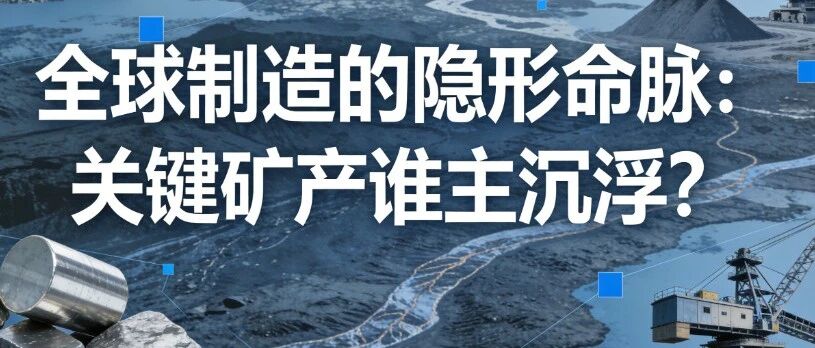
全球制造的隐形命脉:关键矿产谁主沉浮?
QYResearch· 2026-02-14 00:48
Group 1 - Critical minerals are essential for new energy, high-end manufacturing, and strategic industries, including lithium, cobalt, nickel, tungsten, and rare earth elements [1] - The global critical minerals market is projected to reach approximately $142 billion by 2025 and $213 billion by 2030, with a CAGR of about 8.5% from 2025 to 2030 [3] - Lithium, cobalt, and nickel account for 55% of the market, driven mainly by the demand from electric vehicle batteries and energy storage [3] Group 2 - China is the most complete supply chain country for critical minerals, with lithium production expected to reach 280,000 tons (lithium carbonate equivalent) by 2025, accounting for about 50% of global production [4] - The demand for critical minerals in downstream applications such as new energy vehicles, energy storage, and smart manufacturing is increasing, leading to higher material content per vehicle or component [4][6] - The global sales of new energy vehicles are expected to reach approximately 22 million units by 2025, with energy storage systems projected to have an installed capacity of 200 GWh [6] Group 3 - The critical minerals industry chain consists of three core segments: upstream (mining and initial beneficiation), midstream (refining and alloying), and downstream (applications) [5] - China holds about 35-50% of global critical mineral reserves and 85-90% of rare earth separation capacity, making it a key processing center [5] - The refining cost of high-nickel battery materials accounts for about 15-20% of the total cost of electric vehicle batteries [5] Group 4 - Major companies in the critical minerals sector include China Northern Rare Earth Group, Rongjie Resources, Tianqi Lithium, and others, with projected revenues for 2025 ranging from approximately 45-48 billion RMB for China Northern Rare Earth Group to 2-3 billion USD for MP Materials [7] - Global efforts are underway to localize critical mineral supply chains, with initiatives from the US, EU, and India to enhance midstream refining and downstream processing capabilities [7] Group 5 - Future industry trends include breakthroughs in high-purity material technology, scaling up critical mineral recycling, and increasing the value of mid-heavy rare earths and high-nickel materials [8] - The strategic importance of critical minerals in high-end manufacturing and new energy industries positions supply chain leaders for competitive advantages in the global market [9] - Companies should focus on enhancing midstream refining technology, developing high-value downstream applications, and exploring recycling and value extraction of mid-heavy minerals for sustainable supply chains [9]




若供应中断,各国关键矿产储备能撑多久?
Wen Hua Cai Jing· 2026-01-28 05:17
Group 1 - The global supply of critical minerals is highly concentrated in a few countries, making supply chains vulnerable to geopolitical shocks [1][2] - Most countries' strategic reserves are limited, with only a few able to sustain key industries for months during significant supply disruptions [1][2] - Japan and South Korea have established structured reserve systems, with Japan's reserves capable of covering several months of demand for cobalt and nickel, while South Korea has reserves for about two months [1][2] Group 2 - The vulnerability of the U.S. and Europe is greater than commonly perceived, with U.S. strategic reserves primarily serving defense needs and only supporting a few weeks of supply during disruptions [2] - Europe has just begun discussions on coordinated reserve establishment under the Critical Raw Materials Act, leaving industries at risk in the short term [2] - Australia is building strategic reserves based on domestically mined minerals, focusing on rare earths, antimony, and gallium to enhance resilience and support allies [2] Group 3 - The effectiveness of reserves depends on alignment with actual demand, trade flows, substitution possibilities, and price dynamics, indicating that a seemingly sufficient reserve may deplete quickly if not prioritized correctly [3] - Critical minerals are increasingly viewed as strategic assets, with their value shaped by resilience and geopolitical factors rather than just cost curves and demand growth [3]
100%关税,卡尼不忍了,公然叫嚣特朗普:加拿大从此不买美国货!
Sou Hu Cai Jing· 2026-01-27 05:08
Group 1 - Canada has taken a bold stance against the U.S., with Prime Minister Carney openly criticizing American hegemony and urging citizens to avoid buying American goods [1][2] - A significant five-year critical mineral supply agreement was signed, involving lithium, cobalt, and nickel, which are essential for industries in Detroit and Silicon Valley [1][2] - The second agreement allows for direct currency settlement between Canada and China, bypassing the U.S. dollar, which poses a challenge to U.S. financial dominance [2][10] Group 2 - Carney's repeated emphasis on Canada as a "middle power" during his speech at Davos signifies a strategic shift in Canada's foreign policy, positioning itself as an independent player rather than a subordinate ally [4][12] - The language used by Carney reflects a fracture in the narrative of Western leadership, suggesting that Canada is no longer bound to the U.S. and can choose its partners based on issues rather than ideology [6][12] - The potential for other nations, such as Japan and South Korea, to reassess their loyalty to the U.S. in light of Canada's actions indicates a broader shift in global alliances [8][10] Group 3 - The agreements signify a move towards a transactional relationship among nations, where loyalty is no longer guaranteed and can be negotiated [8][12] - Carney's actions and the growing anti-American sentiment in Canada, with 64% of the public expressing negative views towards the U.S., provide a strong foundation for this new approach [10][12] - The implications of these developments suggest that the era of unquestioned U.S. dominance may be coming to an end, as other nations explore alternatives to American influence [12][14]