功夫机器人

Search documents
巴西媒体热议中国“功夫机器人”:资本市场改革为科技跃升注入动能
Xin Hua Cai Jing· 2026-02-27 05:58
Core Viewpoint - The development of humanoid robots in China, exemplified by the "Kung Fu Robot" showcased during the Spring Festival Gala, reflects significant advancements in motion control, artificial intelligence, and precision manufacturing, highlighting the interconnectedness of capital market reforms, RMB internationalization, and technological innovation in China [1][2]. Group 1: Financial Structure and Support - Humanoid robots are capital-intensive and require long R&D cycles, making "patient capital" essential to navigate the innovation process [1]. - The growth of Chinese tech companies is closely linked to structural reforms in the capital market, which have improved direct financing and reduced reliance on traditional bank credit, creating a stable financing environment for high-tech industries [1][2]. - Strengthening the financing function of hard technology in the capital market provides institutional support for high-risk, long-term projects, with visible results like the robots on stage [2]. Group 2: Market Performance and Valuation - In the context of positive interaction between technological innovation and capital support, sectors related to robots, automation, and AI in the Chinese stock market are performing actively, with stock valuations expected to rise by approximately 30% to 70% by 2025 [2]. - The current round of financial reforms emphasizes "functional opening," supporting innovation while maintaining financial stability, leading to a shift in capital allocation towards robotics, automation, semiconductors, AI applications, and advanced materials [2]. Group 3: RMB Internationalization and Global Impact - RMB internationalization plays a crucial role in reducing transaction costs and enhancing exchange rate predictability, which benefits tech companies by internalizing financing risks and broadening the base of long-term investors [3]. - The leap in Chinese robotics technology is not just a technical event but also reflects the coordinated advancement of financial market reforms, RMB internationalization, and strategic investments in robotics, AI, and sustainable development [3]. - The trend has significant implications for Brazil, as China's growing technological strength may reshape global value chains and increase the use of RMB in bilateral trade, thereby reducing exchange rate costs [3].

小块头也有大能量!超774万家中小企业,在广东办大事
Nan Fang Du Shi Bao· 2025-07-04 04:22
Group 1 - The 20th China International Small and Medium Enterprises Expo was held in Guangzhou from June 27 to 30, attracting over 10,000 buyers and achieving intended transaction amounts exceeding 100 billion yuan [2] - Guangdong is home to 835.71 million enterprises, with small and medium enterprises (SMEs) accounting for over 90% of the total, indicating their significant role in the province's economic development [3] - SMEs in Guangdong are actively involved in both traditional and emerging industries, contributing to the continuous growth of various sectors [3] Group 2 - Innovative products showcased at the expo include a kung fu robot, an intelligent coffee machine capable of creating multiple designs in 90 seconds, and a running "robot dog," highlighting the technological advancements of SMEs [4] - As of the end of 2024, Guangdong aims to cultivate over 50,000 innovative SMEs and more than 27,000 specialized and innovative SMEs, with 2,089 "little giant" enterprises leading the nation [4] - The Guangdong Provincial Department of Industry and Information Technology announced the addition of 55 new provincial-level characteristic industrial clusters, bringing the total to 133, covering various industries such as drones, new energy, and biomedicine [5] Group 3 - In 2023, the total output value of characteristic industrial clusters in Guangdong reached 997.32 billion yuan, a year-on-year increase of 12.87%, with 42 clusters exceeding 10 billion yuan in output [5] - R&D expenditure for these clusters was approximately 50.38 billion yuan, reflecting a 12.99% increase, with a research intensity of 5.05% [5] - SMEs are increasingly recognized as a key support for the resilience of Guangdong's economy, despite their smaller size, they possess significant potential [5]

解锁科技与人文融合新体验,就来文博会深圳光明展区
Nan Fang Du Shi Bao· 2025-05-19 07:49
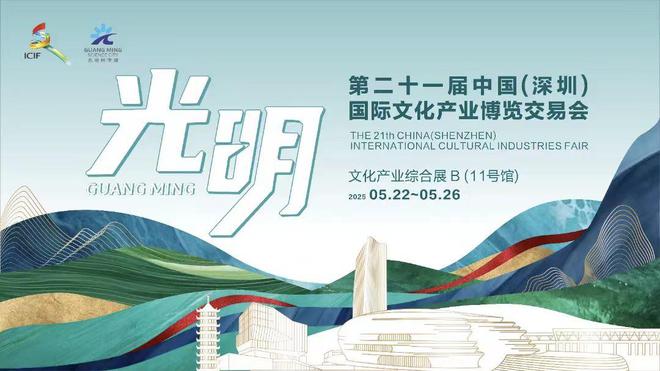
Core Viewpoint - The 21st China (Shenzhen) International Cultural Industries Fair (Cultural Fair) will be held from May 22 to 26 in Shenzhen, showcasing the integration of culture, technology, and tourism in the Guangming District [1][3]. Group 1: Event Overview - The Cultural Fair is recognized as China's only national-level, international, and comprehensive cultural industry expo, known as "China's First Cultural Industry Exhibition" [3]. - This year's fair continues the "comprehensive exhibition + professional exhibition" model, with the main venue at Shenzhen International Convention and Exhibition Center (Baoan), featuring eight exhibition halls, including three comprehensive halls and five professional halls [3]. Group 2: Guangming District's Participation - The Guangming District's exhibition area, located in the cultural industry comprehensive exhibition (Hall 11), focuses on local cultural showcases, gathering leading cultural enterprises and unique creations from various provinces and cities [3]. - The theme of the Guangming exhibition area is "Science is so Fun, Let's Head Towards Guangming," integrating the technological innovation of Guangming Science City with urban pastoral aesthetics, aiming to create an immersive exhibition space that combines technology and culture [3][5]. Group 3: Innovation and Technology - Participating enterprises will showcase a dual-core drive of "technology + culture," presenting an innovative ecosystem that spans various fields, from brain-machine interfaces to light and shadow art, and from intangible cultural heritage IPs to smart displays [5]. - In the technology sector, innovations include "human-machine integrated" control of kung fu robots, holographic invisible screens, and brain-machine intelligent products, demonstrating new achievements in technological innovation [5]. Group 4: Sub-venues and Activities - The Huaqiang Technology Ecological Park has been selected as a sub-venue for the Cultural Fair, featuring the theme "Micro Light as a Torch, Moving Towards Light" [6]. - This sub-venue will host a variety of activities, including film screenings, forums, light and shadow markets, and poster exhibitions, allowing audiences to explore the development of the film industry through classic films and interactive installations [8].
锚定“世界一流科学城” 深圳光明打造产学研用新范式丨解码光明科学城“蝶变”之路
证券时报· 2025-03-21 00:27
Core Viewpoint - The article highlights the rapid transformation of scientific research into marketable products within the Guangming Science City, emphasizing the integration of research and industry as a key driver for innovation and economic growth [2][12]. Group 1: Research and Development Environment - Guangming Science City is strategically located to facilitate the seamless transition from laboratory discoveries to commercial applications, with institutions like the Shenzhen Medical Academy and the "Bay Gravity" incubation platform situated just 50 meters apart [1]. - The establishment of major scientific facilities, such as the Synthetic Biology Research Facility and the Brain Analysis and Simulation Facility, supports large-scale, automated research processes, enhancing efficiency and reducing development cycles [5][6]. - The region has attracted high-level research institutions and universities, such as the Shenzhen Medical Academy and Shenzhen University of Technology, fostering a rich environment for innovation and talent development [6][12]. Group 2: Entrepreneurial Ecosystem - The unique collaboration between scientists and entrepreneurs in Guangming Science City allows for a dual identity where individuals can engage in both research and business, promoting a culture of innovation [9][11]. - Companies like Liying Biotechnology have successfully commercialized advanced biotechnological products, achieving significant revenue milestones within a short period [10][12]. - The "upstairs and downstairs" innovation model in the Engineering Biology Industry Innovation Center facilitates close collaboration between research teams and startups, breaking down barriers between science and industry [11][20]. Group 3: Economic Impact and Growth - Guangming's GDP reached 172.13 billion yuan in 2024, with a notable growth rate of 8.6%, driven by strategic emerging industries [14]. - The region has developed a "3+3+1" industrial cluster system, focusing on both established and emerging sectors, including high-performance materials and biomedicine [14][15]. - The number of sensor companies in Guangming has surged from 16 in 2021 to over 140, reflecting the area's growing industrial capabilities and market potential [15][17]. Group 4: Government Support and Policy Framework - The local government plays a crucial role in fostering innovation through supportive policies, funding initiatives, and infrastructure development, creating a conducive environment for startups [16][21]. - Guangming has established a comprehensive talent support system, providing housing, healthcare, and educational services to attract and retain high-level professionals [12][21]. - The integration of financial support mechanisms, such as technology funds and investment initiatives, is essential for nurturing the growth of technology-driven enterprises [21][22].