
化工主题ETF

Search documents
资源行情接棒 资金借道ETF参与热门板块
Zhong Guo Zheng Quan Bao· 2026-02-11 20:57
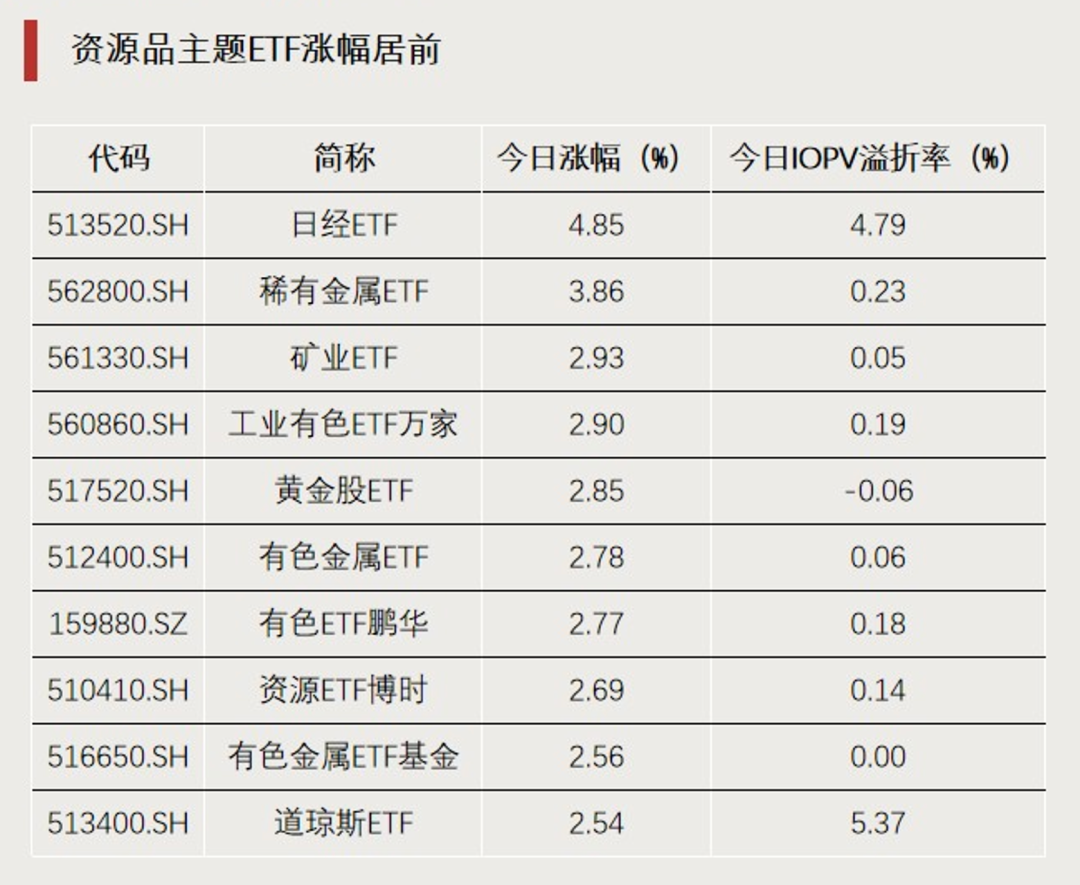
Group 1 - The resource sector has strengthened again, with multiple rare metal-themed ETFs rising over 3%, and mining, non-ferrous, gold, rare earth, and chemical ETFs generally increasing over 2% [1] - After significant gains, the film, media, and online consumption ETFs experienced a collective pullback, with the film ETF (159855) dropping nearly 6% [1] - AI application-related sectors saw a surge, with over 1.3 billion yuan net inflow into ETFs tracking the film and media indices on February 10 [1] Group 2 - Huatai Fund suggests gradually shifting focus to post-holiday market trends, emphasizing three main lines: AI hardware driven by overseas influences, high-end manufacturing in new energy and innovative pharmaceuticals, and domestic price increase chains in chemicals, building materials, and steel [2] - Fuguo Fund recommends focusing on sectors with high elasticity and growth potential, such as electronics, computers, and communications, which are sensitive to liquidity improvements and rising risk appetite [2]
加仓!资金“盯上”这些方向
Zhong Guo Zheng Quan Bao· 2026-02-11 12:17
Group 1 - The resource sector, represented by non-ferrous metals, showed strong performance with multiple rare metal ETFs rising over 3% and mining, non-ferrous, gold, rare earth, and chemical ETFs generally increasing over 2% [1][2] - The Nikkei 225 theme ETF rose by 4.85%, with a premium rate increasing to 4.79%, while the Dow Jones ETF also saw a premium rate rise above 5% as the Dow Jones Industrial Average reached a new high [2][3] - Bond ETFs experienced significant trading activity, with total transaction volume increasing by over 90 billion yuan compared to the previous day, and the short-term bond ETF Hai Futong reached a historical high transaction volume of over 63 billion yuan [5][6] Group 2 - Recent market trends indicate a shift of funds from broad-based ETFs to industry-specific theme ETFs, with significant net outflows from the CSI 300 and CSI A500 theme ETFs, while the tourism ETF maintained a net inflow for 17 consecutive trading days, reaching a historical high in scale [7][8] - The film and media ETFs, which benefited from AI applications, experienced a collective pullback, with the film ETF dropping nearly 6% and the media ETF declining over 2% [3][4] - Fund managers are focusing on three key areas for investment: AI hardware driven by overseas trends, high-end manufacturing in new energy and innovative pharmaceuticals, and domestic price increase chains in chemicals, building materials, and steel [9]

盘前资讯|影视主题ETF大涨 吸引超13亿元资金布局
Sou Hu Cai Jing· 2026-02-11 01:31
Group 1 - The AI application-related sectors experienced a significant surge on February 10, with the film ETFs (159855) hitting the daily limit and another film ETF (516620) rising over 9%, collectively attracting more than 1.3 billion yuan in net inflows [1] - In addition to film-themed ETFs, various other thematic ETFs, including those focused on gold, robotics, media, satellites, chemicals, and rare earths, also saw substantial capital allocation, while leading broad-based ETFs like the HuShen 300 ETF (510300) and the CSI 500 ETF (510500) experienced net outflows exceeding 1.4 billion yuan each [1] - The People's Bank of China released its monetary policy execution report for the fourth quarter of 2025, emphasizing the continuation of a moderately accommodative monetary policy aimed at stabilizing economic growth and ensuring reasonable price recovery, while carefully managing the implementation of policies based on domestic and international economic conditions [1]
备受资金青睐 化工主题ETF总规模突破500亿元
Shang Hai Zheng Quan Bao· 2026-02-01 18:28
Core Viewpoint - Chemical-themed ETFs are becoming a significant direction for capital inflow, with over 26 billion yuan net inflow this year, leading to a total scale exceeding 50 billion yuan [1][2]. Group 1: Fund Inflows and ETF Growth - As of January 29, 2026, the net inflow into chemical-themed ETFs reached 26.189 billion yuan, with notable contributions from Penghua Chemical ETF (14.42 billion yuan), Fortune Chemical 50 ETF (5.702 billion yuan), Huabao Chemical ETF (3.452 billion yuan), and Tianhong Chemical ETF (1.424 billion yuan) [2]. - The total scale of chemical-themed ETFs has increased over 20 times in the past year, growing from 2.159 billion yuan on January 1, 2025, to 53.957 billion yuan by January 29, 2026 [2]. - The number of listed chemical-themed ETFs has risen from 5 to 7 within the same period [2]. Group 2: Performance of Major ETFs - The largest chemical-themed ETF, Penghua Chemical ETF, saw its scale increase from 1.449 billion yuan at the beginning of last year to 33.967 billion yuan [2]. - Other ETFs also experienced significant growth, with Fortune Chemical 50 ETF rising from 0.174 billion yuan to 7.641 billion yuan, and Huabao Chemical ETF from 0.408 billion yuan to 7.815 billion yuan [2]. - Multiple chemical-themed ETFs have reached new highs in share volume, with Penghua Chemical ETF at 36.718 billion shares, Fortune Chemical 50 ETF at 7.604 billion shares, and Huabao Chemical ETF at 7.953 billion shares [2]. Group 3: Institutional Interest and Market Trends - Public funds have increased their allocation to the chemical sector, with the allocation ratio rising to 4.7% by the end of Q4 2025, reflecting a trend of bottom reversal [4]. - Key areas of focus include lithium battery materials, potassium fertilizers, polyurethane, and fluorochemical sectors, with significant stocks being Tianqi Lithium, Cangge Mining, and Yanhua Chemical [4]. - Analysts suggest that the chemical sector is expected to see improved profitability due to the end of the expansion cycle and favorable valuation and positioning [4]. Group 4: Fund Managers' Perspectives - Fund managers have expressed a positive outlook on the chemical sector, maintaining high allocations to cyclical chemical stocks, particularly in phosphorous and potassium fields [5]. - There is an emphasis on the potential for significant profit increases driven by sustained demand and supply-side disruptions [5]. - Future strategies include focusing on sectors with improving supply-demand dynamics and profitability recovery, particularly in refrigerants, coal chemicals, and potassium fertilizers [5].
