
匹妥布替尼片

Search documents
医保目录调整 为血液肿瘤患者提供可及用药支持
Ke Ji Ri Bao· 2025-12-08 03:32
Core Insights - The National Healthcare Security Administration has officially announced the 2025 National Basic Medical Insurance, Maternity Insurance, and Work Injury Insurance Drug Catalog, adding 114 new drugs, bringing the total to 3,253, covering various treatment areas including cancer, chronic diseases, and rare diseases [1][2] Group 1: Drug Inclusion and Coverage - The updated catalog includes multiple new blood cancer drugs, such as Maleate Acalabrutinib Tablets, which are significant for patients with chronic lymphocytic leukemia and other blood cancers [1] - The inclusion of Maleate Acalabrutinib Tablets for CLL/SLLL marks a comprehensive coverage for various stages of blood cancer treatment, addressing previously unmet needs [2] Group 2: Impact on Patients and Healthcare - The update enhances clinical treatment options for blood cancer patients, filling gaps in the treatment of chronic lymphocytic leukemia and supporting the goal of improving cancer survival rates as part of the "Healthy China 2030" initiative [2] - The new drug additions are expected to alleviate the economic burden on patients and provide more accessible medication support for clinical treatment [2]
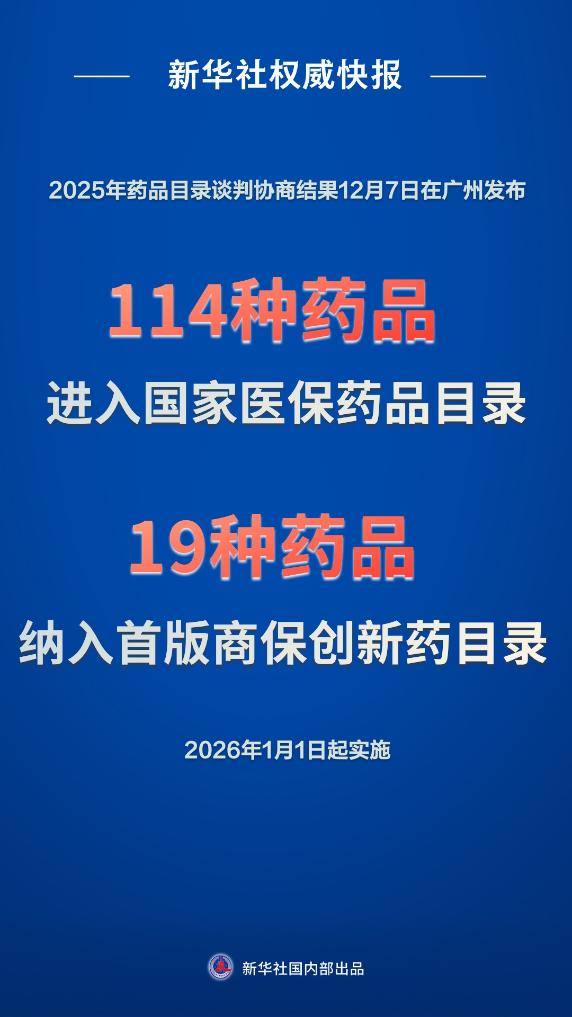
“药篮子”上新!2025年医保商保“双目录”发布
Xin Hua She· 2025-12-07 22:53
Core Insights - The annual adjustment of the National Medical Insurance Drug List has significant implications for public health and access to medications, with 114 new drugs added to the insurance coverage and 19 new drugs included in the commercial insurance innovation drug list [1][2]. Group 1: Drug List Adjustments - A total of 114 drugs have been added to the National Medical Insurance Drug List, including 36 cancer drugs, 12 diabetes medications, 13 anti-infective drugs, and 10 rare disease treatments [2]. - The new list includes essential drugs that fill gaps in basic medical insurance, such as drugs for triple-negative breast cancer and pancreatic cancer, which are critical for patient survival [2]. - The total number of drugs in the National Medical Insurance Drug List has increased to 3,253, comprising 1,857 Western medicines and 1,396 traditional Chinese medicines [2]. Group 2: Commercial Insurance Innovation Drug List - The commercial insurance innovation drug list includes 19 new drugs focusing on high innovation and significant clinical value, such as CAR-T therapies and treatments for rare diseases [3]. - The new policy allows for "three exclusions" for drugs in the commercial insurance innovation list, facilitating patient access to urgently needed medications [3]. Group 3: Market Impact and Future Outlook - The inclusion of high-cost innovative drugs in the commercial insurance list is expected to benefit more patients and encourage pharmaceutical companies to invest in research and development [4]. - Over the past eight years, the National Medical Insurance Drug List has added 949 drugs, with insurance expenditures reaching 460 billion yuan, significantly boosting the pharmaceutical market [5]. - The approval of 69 innovative drugs in 2025 and over 100 overseas authorizations exceeding 100 billion yuan indicates a rapid acceleration in the innovation drug sector in China [5].
新华鲜报丨“药篮子”上新!2025年医保商保“双目录”发布
Xin Hua Wang· 2025-12-07 13:49
Core Insights - The annual adjustment of the National Medical Insurance Drug List has significant implications for public health and access to medications, with 114 new drugs added to the insurance list and 19 new drugs included in the commercial insurance innovation drug list [1][3] Group 1: Drug Inclusion and Categories - The new insurance list includes 114 drugs, focusing on clinical needs and affordability, with 36 cancer drugs, 12 chronic disease medications, 13 anti-infective drugs, and 10 rare disease treatments [3] - Notable additions include life-saving drugs such as Alpelisib for triple-negative breast cancer and Irinotecan liposome for pancreatic cancer, as well as chronic disease medications like Icosapent ethyl and Tirzepatide [3] Group 2: Innovation and Market Impact - The adjustment features 50 innovative drugs, including recently approved medications like the flu treatment Baloxavir marboxil, indicating a trend towards faster access to innovative therapies [4] - The total number of drugs in the National Medical Insurance Directory has increased to 3,253, with 1,857 Western medicines and 1,396 traditional Chinese medicines [4] Group 3: Commercial Insurance Support - The commercial insurance innovation drug list includes high-value innovative drugs such as CAR-T therapies and treatments for rare diseases, totaling 19 new drugs [5] - The policy provides support for these drugs, allowing them to be excluded from basic insurance self-payment rates and monitoring for alternative products, enhancing patient access to necessary medications [5] Group 4: Industry Response and Future Outlook - Pharmaceutical companies view the directory as a guiding framework, encouraging them to focus on unmet medical needs and invest in research and development [7] - The National Medical Insurance Directory has added 949 drugs over the past eight years, with insurance funds covering significant expenditures, driving market growth and innovation [8] - The new drug lists are set to be implemented on January 1, 2026, marking a pivotal moment for the pharmaceutical industry in China [8]

圣诺生物预计上半年净利润高增长;上海莱士收购南岳生物完成工商变更登记|医药早参
Mei Ri Jing Ji Xin Wen· 2025-06-19 23:31
Group 1 - Shengnuo Bio expects a net profit attributable to shareholders of 77.03 million to 94.14 million yuan for the first half of 2025, representing a year-on-year increase of 253.54% to 332.10% [1] - The significant growth in Shengnuo Bio's performance is primarily attributed to the strong performance of its peptide raw material business, which is closely related to GLP-1 formulations [1] Group 2 - Shanghai Laishi has completed the acquisition of 100% equity in Nanyue Bio for 4.2 billion yuan, with an additional contingent payment of 50 million yuan if the company processes 305 tons of plasma by 2025 [2] - The completion of the acquisition and registration marks a significant step forward in Shanghai Laishi's "plasma expansion" strategy, although it is expected to add substantial goodwill, raising concerns about future impairment risks [2] Group 3 - Beijing Saisheng Pharmaceutical has signed a new drug technology transfer agreement with its affiliate, transferring technology related to the NeoAB33 new drug project for a total of 20 million yuan [3] - The transfer may optimize the asset structure of Huada Protein, which reported a loss of 8.3 million yuan in 2024, while Saisheng Pharmaceutical reported a net profit of 39.97 million yuan in the first quarter of 2025, indicating its financial capability to advance research and development [3] Group 4 - Eli Lilly's reversible BTK inhibitor, Pirtobrutinib, has had its new indication application accepted for review in China, targeting patients with chronic lymphocytic leukemia/small lymphocytic lymphoma who have previously received BTK inhibitor treatment [4] - If approved, Pirtobrutinib will provide a new treatment option for patients who have failed previous covalent BTK inhibitor therapies, further solidifying its market position in the treatment of B-cell malignancies [4] Group 5 - Innovent Biologics' CLDN-18.2 ADC product, IBI343, is proposed to be included as a breakthrough therapy for locally advanced or metastatic pancreatic cancer expressing CLDN 18.2, after at least two systemic treatments [5] - As the first CLDN18.2 ADC to achieve a breakthrough in pancreatic cancer, IBI343 is expected to fill a gap in second-line and later treatments, providing new options for patients [5]


信达生物:公司信息更新报告:利润超预期转正,CVM领域有望迎来快速发展-20250330
KAIYUAN SECURITIES· 2025-03-30 05:23
Investment Rating - The investment rating for the company is "Buy" (maintained) [1][6][14] Core Insights - The company achieved a significant turnaround in 2024, with total revenue reaching 94.22 billion yuan, a year-on-year increase of 51.8%. Product revenue was 82.28 billion yuan, up 43.6% year-on-year, and the company reported a Non-IFRS net profit of 3.32 billion yuan, marking a 164.4% year-on-year improvement [6][9] - The company maintains a strong growth trajectory, with a target of 20 billion yuan in revenue by 2027, supported by the robust performance of its leading product, Sintilimab (PD-1), and the rapid commercialization of new products [7][9] - The company plans to accelerate its pipeline development, aiming to have five innovative products enter global Phase III clinical trials by 2030, indicating strong potential for international expansion [7] Financial Summary - In 2024, the company reported a gross profit of 79.12 billion yuan, a 56.1% increase year-on-year, and a net loss of 0.95 billion yuan, which represents a 90.8% reduction in losses [6][9] - The company's financial projections for 2025 to 2027 indicate a steady increase in revenue and profitability, with expected net profits of 1.62 billion yuan in 2025, 11.29 billion yuan in 2026, and 27.21 billion yuan in 2027 [6][9] - Key financial ratios show an improvement in profitability, with a projected net profit margin of 14.6% by 2027 and a return on equity (ROE) of 18.4% [9][11]