半导体芯片ETF

Search documents
比炒股赚得稳,胜率超60%!这份ETF报告把ETF的赚钱秘籍说透了!
市值风云· 2025-12-22 10:07
Core Viewpoint - The report highlights that trading ETFs is generally more profitable than trading individual stocks, with a significant increase in ETF participation among investors in recent years [4][9][11]. Group 1: ETF Investor Behavior - The total number of ETF (non-money market) holders reached 20.95 million, a 10.8 times increase since June 2019 [9]. - ETF trading clients accounted for an average of 12% of total A-share trading clients, with this figure exceeding 20% in October 2024 [11]. - Approximately 23% of new and active investors during the "9.24" market surge participated in ETF trading, indicating a shift in investor behavior towards ETFs [13]. Group 2: Profitability of ETFs - About 55% of ETF investors made profits of over 2%, with 27% earning between 10% and 30%, and 12% achieving over 30% [16]. - The overall profitability of ETF clients is higher than that of stock clients by approximately 2.9 percentage points, particularly in the 10%-30% profit range where ETF clients outperform by 5.5 percentage points [18]. - The data shows that 27.25% of ETF clients earned between 10% and 30%, compared to 23.35% of stock clients [19]. Group 3: Investment Strategies and Holding Periods - The report indicates that over 51% of ETF investors hold their positions for less than one month, with nearly 32% holding for only one week [33]. - Investors who hold ETFs for more than 120 days have a win rate exceeding 60%, while those with an average holding period of less than 7 days have a win rate below 50% [36]. - The optimal trading frequency for ETFs is between 10 to 20 days, yielding an average return of 2.57% [38]. Group 4: Market Trends and Preferences - The most popular ETF categories among investors include those focused on innovation and semiconductor sectors, reflecting a preference for high-growth areas [27][29]. - Nearly 44% of investors hold less than 10,000 yuan in ETFs, indicating that many view ETFs as a supplementary investment rather than a primary strategy [31]. - The report suggests that ETFs have the potential to become a primary investment vehicle for many investors, with significant room for growth in management scale [33].

ETF日报-A股三大指数全线下跌,半导体ETF(159813)逆市获资金净流入达3.42亿元,连续五个交易日实现资金净流入
Xin Lang Cai Jing· 2025-10-15 01:24
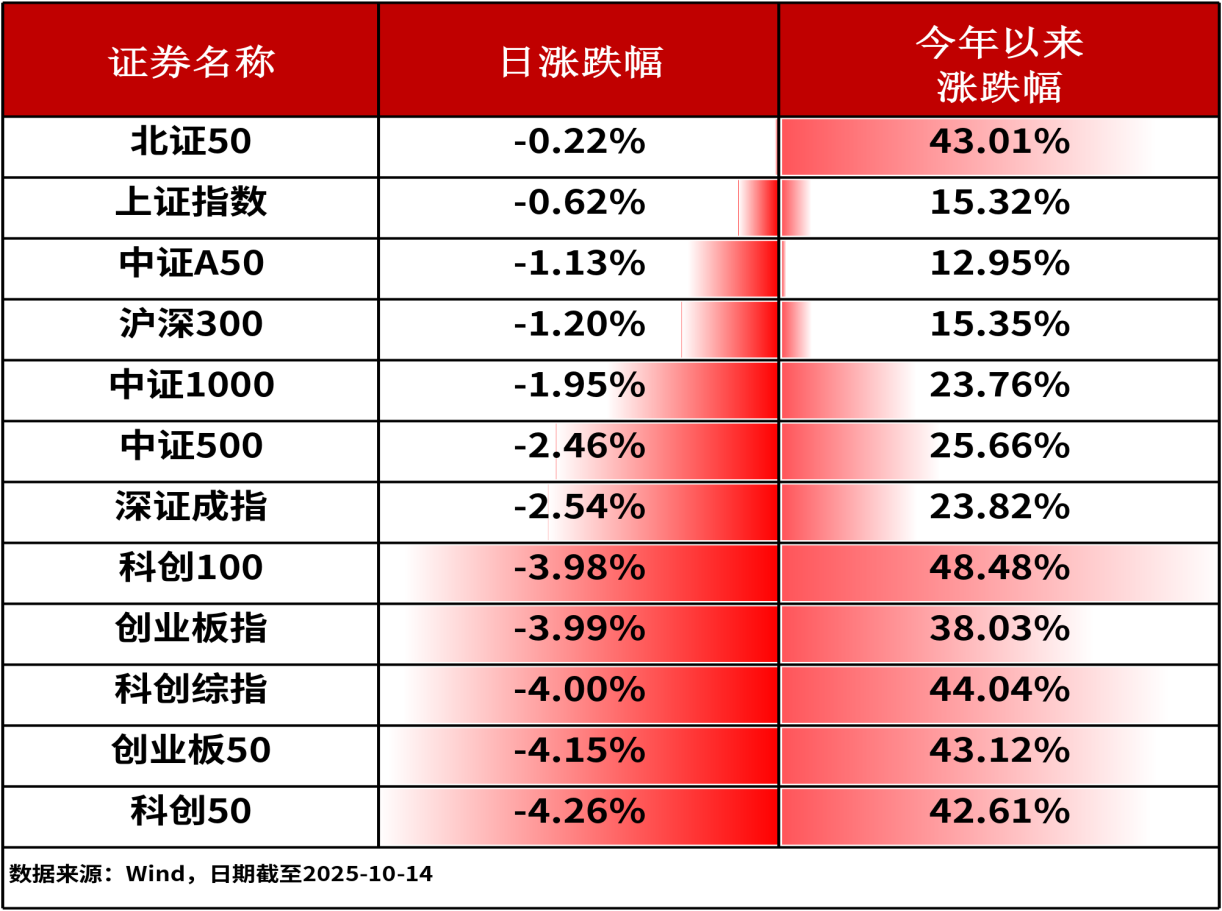
Market Overview - On October 14, A-shares experienced declines across major indices, with the Shanghai Composite Index down 0.62%, Shenzhen Component Index down 2.54%, and ChiNext Index down 3.99% [1] - The STAR 50 Index saw a significant drop of 4.26%, indicating a relatively poor performance among mainstream indices [1] - Only 1,740 stocks in the market recorded gains, highlighting a broad market downturn [1] - Hong Kong's main indices also closed lower, with the Hang Seng China Enterprises Index down 1.02% [3] - The trading volume in the Shanghai and Shenzhen markets reached 25,762 billion RMB, a substantial increase of 2,215 billion compared to the previous trading day [1] Index Performance - The following indices reported daily and year-to-date performance: - North China 50: -0.22% (YTD: +43.01%) - Shanghai Composite: -0.62% (YTD: +15.32%) - Shenzhen Component: -2.54% (YTD: +23.82%) - ChiNext Index: -3.99% (YTD: +38.03%) [2] Sector Performance - In sector performance, banking (2.51%), coal (2.18%), and food and beverage (1.69%) sectors showed the highest gains, while communication (-4.98%), electronics (-4.64%), and non-ferrous metals (-3.66%) sectors faced the largest declines [7] Fund Flow - In the ETF market, semiconductor chips (+5.81 billion), Hong Kong technology (+4.23 billion), and gold (+3.93 billion) saw the highest net inflows, each exceeding 3 billion [8] - The overall ETF market maintained a net inflow of 10.52 billion, although this was a decrease from the previous day [10] Industry Insights 1. **Photovoltaics**: - There are rumors of a regulatory document aimed at strengthening photovoltaic capacity control, with a target for the entire industry chain's operating rate to be below 65% [12] - Analysts suggest that the photovoltaic industry is showing signs of recovery, with upstream segments expected to significantly reduce losses in Q3 [12] 2. **Refrigerants**: - The refrigerant industry continues to show high growth, with companies like Yonghe Co. expecting a substantial profit increase of 211.59%-225.25% year-on-year for the first three quarters [13] - The supply-side constraints and steady demand growth are expected to sustain the high growth in the refrigerant market [13] 3. **Big Data**: - Shanghai has launched an action plan for the high-quality development of the smart terminal industry, aiming for a total industry scale exceeding 300 billion by 2027 [14] - The plan emphasizes the development of core technologies and supports the growth of the smart terminal industry [15] 4. **Artificial Intelligence**: - OpenAI is introducing AI into retail, allowing customers to use ChatGPT for instant checkout at Walmart, indicating a shift in traditional e-commerce models [16] - Analysts believe this AI-driven model will change the interaction methods in e-commerce [16] 5. **Chips**: - Oracle plans to deploy 50,000 AMD AI chips by 2026, challenging Nvidia's dominance in the AI computing market [17] - This move indicates a shift towards a more competitive landscape in AI computing, with Oracle needing to prove its operational efficiency [17]
超300亿,大举加仓!
Zhong Guo Ji Jin Bao· 2025-10-13 06:43
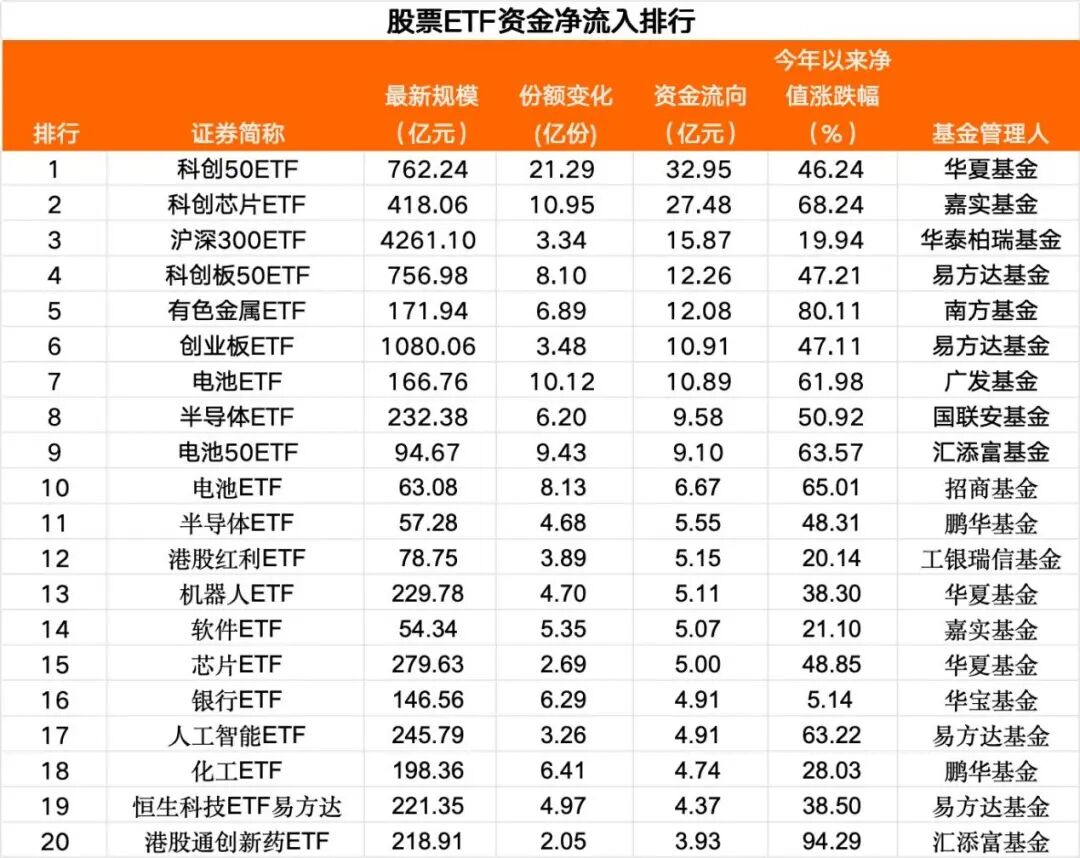
Core Insights - The stock ETF market experienced a significant net inflow of over 30 billion yuan on October 10, despite a notable decline in the A-share market, with the ChiNext index dropping more than 4.5% [1][2][3] Fund Flow Analysis - On October 10, the total scale of 1,224 stock ETFs (including cross-border ETFs) reached 4.59 trillion yuan, with a net inflow of approximately 31.5 billion yuan for the day [3] - The top three ETFs by net inflow were the Huaxia Science and Technology Innovation 50 ETF, the Harvest Science and Technology Chip ETF, and the Huatai-PB CSI 300 ETF, each with inflows exceeding 1.5 billion yuan [3][5] - The commodity gold ETFs also attracted significant interest, with a net inflow of over 2 billion yuan on the same day [3] Sector Performance - The inflow of funds was primarily directed towards broad-based ETFs such as the Science and Technology Innovation 50 ETF and sector-specific ETFs in semiconductors, batteries, and non-ferrous metals [2][3] - Conversely, several broad-based ETFs, including the CSI A500 ETF and CSI 1000 ETF, experienced substantial net outflows, with the former losing over 2.5 billion yuan [6][8] Recent Trends - In the first two trading days of October, stock ETFs saw a cumulative net inflow exceeding 40 billion yuan, with significant inflows into ETFs tracking the Science and Technology Innovation Board, ChiNext, and CSI 300 indices [7] - The market is characterized by a "high cut low" trend, indicating a shift in investor focus towards safer assets amid increasing volatility in overseas markets [9]
中概ETF逆势上涨1.7%,恒指上涨1%
Xin Lang Cai Jing· 2025-08-31 11:34
Group 1 - The Chinese concept ETFs showed a strong performance with a 1.7% increase in overnight trading, while the Hang Seng Index rose by 1% amidst a backdrop of declining European and American markets [1] - The Hang Seng Tech ETF has accumulated a 22% increase, indicating positive market sentiment towards its future performance, while the ChiNext and semiconductor ETFs faced sell-offs, reflecting cautious investor attitudes towards tech stocks [1] - A recent innovative investment portfolio reported significant returns, with some participants achieving earnings of 1.19 million within the year, outperforming 89% of market participants [1] Group 2 - The Chinese Ministry of Commerce and U.S. officials held talks aimed at easing international trade tensions, while the China Securities Regulatory Commission convened a meeting to strengthen market stability, potentially positively influencing market sentiment [2] - The market exhibited a pattern of initial gains followed by declines, with short-term support levels identified between 3775-3815 and resistance levels at 3885-3925 [2] - The expansion of the CSI 300 ETF saw a notable increase of nearly 400 billion, drawing significant market attention, while PMI data showed slight improvement, rising to 49.4%, suggesting potential economic recovery [2] - Several well-known companies reported their half-year earnings, with notable profit increases from SMIC and BYD, while China Shenhua experienced a decline in profits, highlighting the need for cautious investment selection [2]
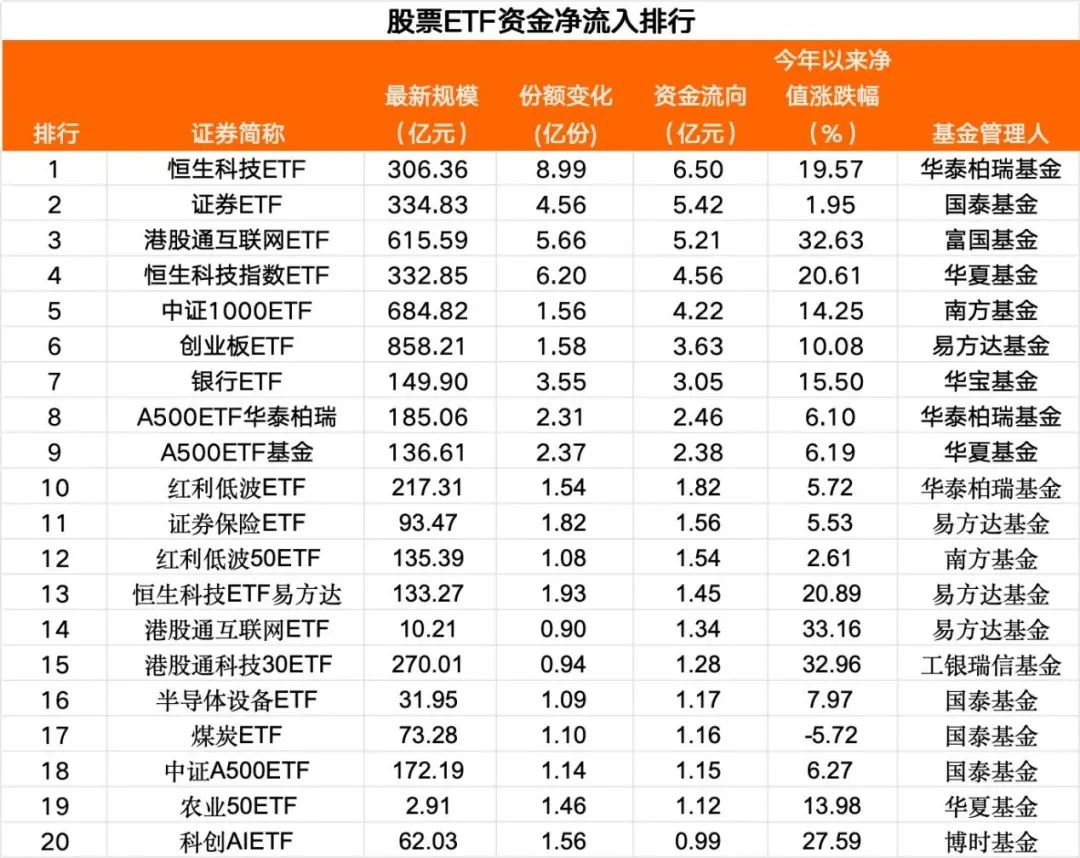
沸腾了!狂买百亿!
Zhong Guo Ji Jin Bao· 2025-08-05 06:25
Group 1 - The core viewpoint of the articles highlights a significant inflow of funds into the Hang Seng Technology Index, exceeding 10.2 billion yuan over the past five trading days, indicating strong investor interest in technology and internet sectors [1][2][3] - On August 4, the overall stock ETF market saw a net inflow of 551 million yuan, marking the second consecutive day of net inflows in August, with 19 ETFs experiencing net inflows exceeding 100 million yuan [2][3] - The top three ETFs by net inflow on August 4 were the Hang Seng Technology ETF, Securities ETF, and Hong Kong Stock Connect Internet ETF, each attracting over 500 million yuan [2][3] Group 2 - Conversely, certain broad-based and sector-specific ETFs experienced significant outflows, with 16 ETFs seeing net outflows exceeding 100 million yuan, particularly in the Sci-Tech 50, Shanghai Stock Exchange 50, and gaming sectors [5][6] - The Sci-Tech 50 ETF had a combined net outflow of over 1 billion yuan, while the Shanghai Stock Exchange 50 ETF saw net outflows exceeding 300 million yuan [6][7] - Market analysts suggest that the recent adjustments in the A-share market are normal after a period of continuous gains, with a focus on policy support and growth sectors such as technology innovation and consumer chains [6][7]