
华泰柏瑞上证红利ETF

Search documents
公募基金年内豪掷超364亿元“红包” 仅在春节假期后的两个交易日,就有37只公募产品合计分红达3.02亿元
Zheng Quan Ri Bao· 2026-02-25 22:40
Core Viewpoint - The public fund industry is increasingly focusing on investor returns, as evidenced by a significant rise in dividend distributions, with a total of 829 public funds distributing over 36.4 billion yuan in dividends since the beginning of the year [1] Group 1: Dividend Distribution Trends - In the two trading days following the Spring Festival (February 24-25), 37 public fund products distributed a total of 302 million yuan in dividends [1] - This year, over half of the total dividend amount has come from equity funds, marking a shift from previous years where bond funds dominated [1] - Major broad-based ETFs, such as Huatai-PB CSI 300 ETF, led the distribution with over 9.8 billion yuan in dividends, highlighting their significant role in this dividend wave [1] Group 2: Active Management Funds - Actively managed funds have also shown strong dividend distribution, with several funds like China Europe Dividend Enjoyment A and China Europe New Trend A distributing over 350 million yuan in a single payout [2] - Some funds have distributed dividends multiple times within two months, indicating a proactive and stable dividend strategy [2] - Dividend-themed funds have contributed significantly, with products like Huatai-PB SSE Dividend ETF and Fortune CSI Dividend Index Enhanced A collectively distributing over 2.8 billion yuan [2] Group 3: Market Outlook - Fund managers from institutions that have already distributed dividends maintain a positive outlook on the market, particularly for resource and financial sectors [3] - Factors such as declining risk-free rates, ongoing capital market reforms, and supportive domestic demand policies are expected to create a favorable liquidity environment for the A-share market [3] - The anticipated stabilization of the A-share market is supported by improving export conditions and advancements in new technology industries [3]
ETF规模速报 | 创业板ETF易方达净流入超10亿元,A500ETF南方净流出超6亿元
Mei Ri Jing Ji Xin Wen· 2026-02-12 01:42
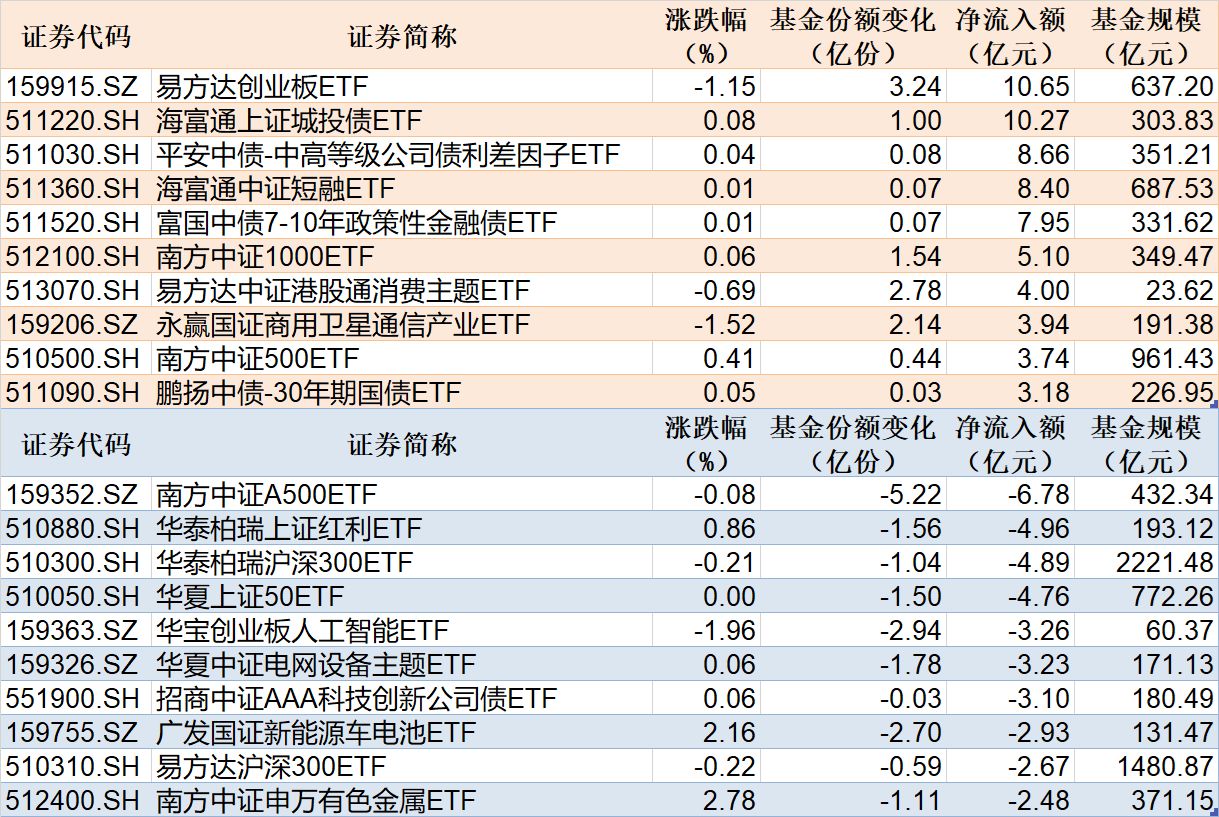
Market Overview - The three major indices showed mixed performance, with the ChiNext Index and the STAR 50 Index both declining over 1% [1] - The chemical sector has recently shown strength, particularly in the fiberglass concept, while the film and cinema sector experienced a collective decline [1] ETF Market Activity - On February 11, the non-monetary ETF market saw significant inflows, with the E Fund ChiNext ETF increasing by 324 million shares and a net inflow of 1.065 billion yuan [1] - The Hai Fu Tong Shanghai City Investment Bond ETF also saw an increase of 100 million shares with a net inflow of 1.027 billion yuan [1] - The Ping An Zhongdai High-Grade Corporate Bond Spread Factor ETF had an increase of 8 million shares and a net inflow of 866 million yuan [1] Fund Performance - The E Fund ChiNext ETF had a decline of 1.15%, despite the increase in shares and net inflow [2] - The Hai Fu Tong Shanghai City Investment Bond ETF had a slight increase of 0.08% with a net inflow of 1.027 billion yuan [2] - The Ping An Zhongdai High-Grade Corporate Bond Spread Factor ETF increased by 0.04% with a net inflow of 866 million yuan [2] Fund Outflows - The Southern CSI A500 ETF saw a reduction of 522 million shares and a net outflow of 678 million yuan [2] - The Huatai-PB Shanghai Dividend ETF experienced a decrease of 156 million shares with a net outflow of 496 million yuan [2] - The Huatai-PB CSI 300 ETF had a reduction of 104 million shares and a net outflow of 489 million yuan [2] Top ETF Inflows - The top 20 ETFs by net inflow for the month include the Huatai-PB Hang Seng Technology ETF with 3.885 billion yuan and the Hai Fu Tong CSI Short-term Bond ETF with 3.852 billion yuan [4] - Other notable inflows include the Huatai-PB Hang Seng Internet Technology ETF with 2.872 billion yuan and the E Fund ChiNext ETF with 1.772 billion yuan [4] Overall Market Statistics - As of February 11, the total ETF shares in the market reached 33,335.10 billion shares, with a total scale of 54,141.40 billion yuan [4] - The information sector saw the largest increase in shares, with four funds tracking it, while the largest thematic increase was in the CSI Robotics Index, tracked by nine funds [4]




开滦股份股价跌5.03%,华泰柏瑞基金旗下1只基金位居十大流通股东,持有5330.38万股浮亏损失1759.02万元
Xin Lang Cai Jing· 2026-02-05 05:30
Group 1 - The core point of the news is that Kailuan Energy Chemical Co., Ltd. experienced a 5.03% drop in stock price, closing at 6.23 yuan per share, with a trading volume of 177 million yuan and a turnover rate of 1.77%, resulting in a total market capitalization of 9.892 billion yuan [1] - The company, established on June 30, 2001, and listed on June 2, 2004, is primarily engaged in coal and associated resource mining, raw coal washing and processing, coal product sales, coking and its product production and sales, as well as the manufacturing and sales of coal chemical products [1] - The revenue composition of the company includes metallurgical coke at 48.61%, other coal chemical products at 27.06%, washed coal at 23.05%, adipic acid at 7.09%, pure benzene at 5.31%, polyoxymethylene at 2.74%, methanol at 2.13%, other washed coal at 1.96%, and other businesses at 0.50% [1] Group 2 - From the perspective of the top ten circulating shareholders, Huatai-PB Fund's Huatai-PB SSE Dividend ETF (510880) increased its holdings by 2.9824 million shares in the third quarter, holding a total of 53.3038 million shares, which accounts for 3.36% of the circulating shares [2] - The Huatai-PB SSE Dividend ETF (510880) was established on November 17, 2006, with a latest scale of 19.265 billion yuan, and has a year-to-date return of 3.46%, ranking 3287 out of 5566 in its category [2] - The fund manager, Liu Jun, has a tenure of 16 years and 251 days, with a total fund asset scale of 550.928 billion yuan, achieving a best fund return of 225.42% and a worst return of -45.64% during his tenure [2]

超130亿元,“跑了”!
Zhong Guo Ji Jin Bao· 2026-02-03 06:49
Group 1 - The stock ETF market experienced a significant net outflow of 790 billion yuan in January, with broad-based ETFs being the main contributors to this outflow [2] - On February 2, the first trading day of the month, stock ETFs saw a net outflow of 13.771 billion yuan, influenced by a sharp decline in the three major stock indices [2] - Broad-based ETFs and the metals sector were the largest "bloodletting" categories, while sector-specific ETFs like semiconductors and pharmaceuticals attracted significant inflows [2][3] Group 2 - As of February 2, the total scale of 1,321 stock ETFs (including cross-border ETFs) was 4.09 trillion yuan, showing a notable decrease due to the market downturn [3] - Sector-specific ETFs and Hong Kong stock ETFs saw substantial inflows, with 3.715 billion yuan and 3.346 billion yuan respectively on the previous trading day [3] - The semiconductor sector had a remarkable net inflow of 2.61 billion yuan on February 2, with the Guolian An CSI All-Share Semiconductor ETF leading with a net inflow of 903 million yuan [3] Group 3 - Over the past five days, the SGE Gold 9999 index saw inflows exceeding 13.9 billion yuan, while the specialized chemical index attracted over 7 billion yuan [4] - Leading institutions like E Fund reported a total ETF scale of 642.71 billion yuan, with a net inflow of 800 million yuan on the previous day [4] - Notable single product inflows included 526 million yuan for the ChiNext ETF and 352 million yuan for the Hang Seng Technology ETF [4] Group 4 - Broad-based ETFs continued to experience significant outflows, with a net outflow of 23.778 billion yuan on the previous day, leading to a scale decrease of 68.672 billion yuan [5] - The CSI 500 ETF had the largest single-day outflow of 13.02 billion yuan, followed by the CSI 300 ETF with 7.2 billion yuan [5] Group 5 - The metals sector also faced notable outflows, with a net outflow of 4.39 billion yuan, influenced by expectations surrounding the Federal Reserve's monetary policy and profit-taking sentiments [6] - Despite short-term volatility, the long-term investment logic for the metals sector remains solid, supported by global manufacturing cycles and energy transition demands [6] Group 6 - Current market adjustments are viewed as providing better valuation windows for long-term investments, with a stable long-term market outlook supported by policy measures and improving economic fundamentals [7] - Key factors include ongoing policy support, marginal improvements in economic indicators, and a favorable funding environment with increasing allocations to A-shares from various institutional investors [7]

恒源煤电股价跌5.06%,华泰柏瑞基金旗下1只基金位居十大流通股东,持有5098.18万股浮亏损失1784.36万元
Xin Lang Cai Jing· 2026-02-02 03:18
Group 1 - The core point of the article is that Hengyuan Coal Power's stock price has dropped by 5.06%, currently trading at 6.57 CNY per share, with a total market capitalization of 7.884 billion CNY [1] - Hengyuan Coal Power, established on December 29, 2000, and listed on August 17, 2004, primarily engages in coal mining, washing, transportation, sales, and production services, with coal accounting for 96.50% of its main business revenue [1] Group 2 - From the perspective of the top ten circulating shareholders, Huatai-PB Fund's ETF has reduced its holdings by 1.1711 million shares, now holding 50.9818 million shares, which is 4.25% of the circulating shares [2] - The Huatai-PB SSE Dividend ETF, established on November 17, 2006, has a latest scale of 19.265 billion CNY, with a year-to-date return of 3.36% and a one-year return of 5.94% [2] - The fund managers, Liu Jun and Li Qian, have significant experience, with Liu Jun having a tenure of 16 years and 248 days, and Li Qian with 6 years and 92 days [2]

分红110亿!中国ETF市场迎来分红里程碑
Sou Hu Cai Jing· 2026-01-12 10:36
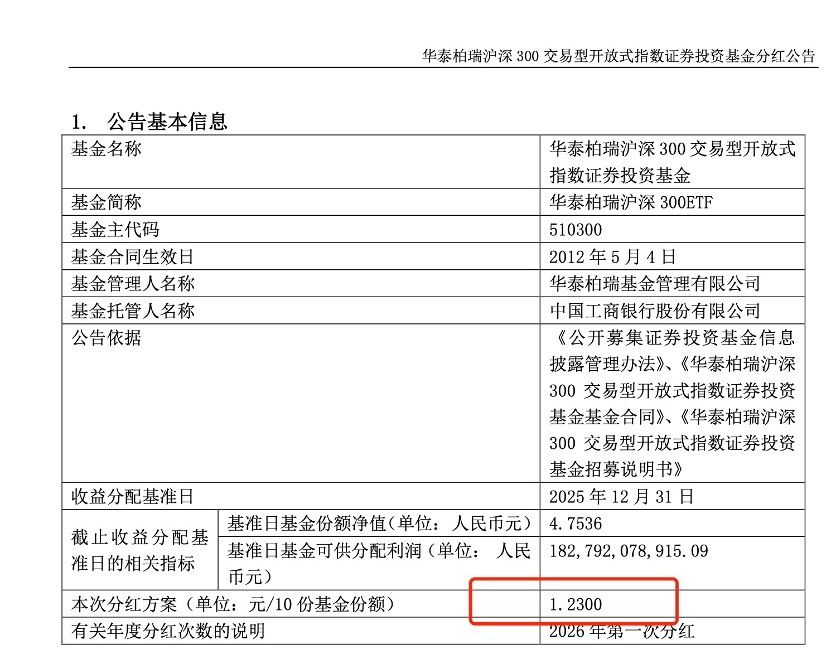
Core Insights - The Chinese ETF market is experiencing a historic moment with a record-breaking dividend distribution, highlighting its growth and the increasing importance of investor returns [2][4]. Group 1: Dividend Distribution - The record dividend distribution plan is set at 1.23 yuan per 10 fund shares, totaling 11 billion yuan, surpassing the previous record of 8.3 billion yuan set in June 2025 [4]. - The Huatai-PineBridge CSI 300 ETF, which is the largest stock ETF in China, has a combined scale of 437.35 billion yuan as of January 11, 2026 [4][6]. - In 2025, the top four CSI 300 ETFs, including Huatai-PineBridge, E Fund, Huaxia, and Harvest, collectively distributed dividends amounting to 26.5 billion yuan [5][8]. Group 2: Market Trends - The trend of regular dividend distributions has become a significant characteristic of the ETF market, with more products, especially broad-based and dividend-themed ETFs, adopting frequent dividend payouts [8]. - The "New Nine Articles" policy has strengthened dividend regulation for listed companies, providing ETFs with richer direct income sources [8]. - The public fund industry is shifting focus from scale expansion to enhancing investor experience through predictable dividends, driven by the demand from long-term funds like pensions and insurance [8][9]. Group 3: Understanding Dividends - Fund dividends represent a portion of the fund's earnings distributed to holders, which does not increase total wealth but provides flexibility in cash flow management for investors [9]. - Unlike traditional funds, ETFs primarily distribute dividends in cash, allowing investors to either cash out or reinvest for long-term compounding [10].

分红110亿!中国ETF市场迎来分红里程碑
市值风云· 2026-01-12 10:05
Core Viewpoint - The article highlights a historic moment in the Chinese ETF market with the announcement of a record cash dividend by the Huatai-PB CSI 300 ETF, signaling a growing emphasis on enhancing investor returns in the expanding ETF market [3][6]. Group 1: Dividend Announcement - On January 11, 2026, Huatai-PB Fund announced a cash dividend for its Huatai-PB CSI 300 ETF, which has a scale exceeding 430 billion RMB [3][4]. - The dividend plan is set at 1.23 RMB per 10 fund shares, totaling approximately 11 billion RMB, marking the highest single dividend record for domestic ETFs [5][6]. Group 2: Historical Context and Market Impact - This dividend comes just seven months after the previous record of 8.3 billion RMB set in June 2025 [6]. - The Huatai-PB CSI 300 ETF is the largest stock-type ETF in China, with a combined scale of 437.35 billion RMB as of January 11, 2026 [8]. Group 3: Broader Market Trends - Major broad-based index products, represented by the Huatai-PB CSI 300 ETF, have been the main contributors to dividends in the ETF market [9]. - In 2025, the top four ETFs from Huatai-PB, E Fund, Huaxia, and Harvest collectively distributed 26.5 billion RMB in dividends, accounting for nearly 60% of the total non-money market ETF dividends in the market [11]. Group 4: Factors Driving Dividend Trends - The new "National Nine Articles" has strengthened dividend regulations for listed companies, providing ETFs with richer direct income sources [12]. - The public fund industry is shifting focus from scale expansion to enhancing investor experience through predictable dividends [12]. - Increased allocations from long-term funds like pensions and insurance, which have a natural demand for stable cash flow, have made high-dividend ETFs more attractive [12][13]. Group 5: Understanding ETF Dividends - ETF dividends are primarily distributed in cash, providing investors with flexibility in managing cash flow [16]. - Investors can choose to cash out dividends for immediate returns or reinvest them for long-term compounding benefits [15][16].

中国ETF史上最大分红方案推出,沪深300ETF华泰柏瑞将派现110亿
Feng Huang Wang· 2026-01-12 01:44
Core Viewpoint - The Huatai-PB CSI 300 ETF is set to break the record for the largest single cash dividend in China's ETF history, with a proposed distribution of 1.23 yuan per 10 fund shares, totaling approximately 11 billion yuan [1][2][5]. Fund Details - The Huatai-PB CSI 300 ETF, the largest ETF in China, has a current scale of 437.35 billion yuan and will distribute a total of 11 billion yuan based on 895.09 million shares [1][5]. - This marks the first time the ETF's dividend per 10 shares has exceeded 1 yuan, following a previous distribution of 8.3 billion yuan in June 2025 [1][2][5]. Market Context - In 2025, the total dividend distribution for non-cash ETFs exceeded 54 billion yuan, a 155.48% increase from 21.14 billion yuan in 2024, setting a historical high [8]. - The top four CSI 300 ETFs, including Huatai-PB, accounted for 59% of the total non-cash ETF dividends in 2025, distributing a combined total of 14.5 billion yuan [8]. Dividend History - The Huatai-PB CSI 300 ETF has distributed dividends 13 times since its inception, with a total payout exceeding 16.5 billion yuan [9]. - Other leading ETFs, such as the E Fund and Huaxia CSI 300 ETFs, have also made significant contributions to the overall dividend landscape, with cumulative distributions of 12.45 billion yuan and 10.44 billion yuan, respectively [9]. Factors Driving Dividend Growth - Regulatory requirements have strengthened cash dividend policies for listed companies, leading to increased dividend amounts and ratios [10]. - Public funds are increasingly focusing on enhancing investor experience through active and continuous dividend distributions [11]. - The rapid expansion of the ETF market, with a total scale reaching 6.03 trillion yuan in 2025, has provided a solid foundation for substantial dividend distributions [12].
2025年ETF分红总额创新高
Jin Rong Shi Bao· 2026-01-08 01:01
Core Insights - The ETF market in China achieved remarkable growth in 2025, with the total product scale surpassing 6 trillion yuan and total dividends reaching a historical high of 45.013 billion yuan, representing a 113% increase from 2024 [1] Group 1: Dividend Distribution - Broad-based ETFs emerged as the main contributors to the total dividend increase, accounting for 31.288 billion yuan, or 69.51% of the total ETF dividends, a significant rise from approximately 55% in 2024 [2] - Several core broad-based ETFs saw their annual dividends exceed 1 billion yuan, with notable increases: Huatai-PB CSI 300 ETF at 8.394 billion yuan (up 236% from 2024), E Fund CSI 300 ETF at 7.15 billion yuan (up 260%), and others like Huaxia and Harvest ETFs also showing substantial growth [2][3] Group 2: Performance of Fund Companies - Leading fund companies increased both the frequency and amount of ETF dividends to attract long-term investors, resulting in a concentration of dividends among top firms [4] - In 2025, major fund companies like Huaxia, Huatai-PB, and E Fund reported significant growth in ETF dividends, with Huaxia Fund distributing 10.131 billion yuan (up 161%), Huatai-PB at 9.599 billion yuan (up 196%), and E Fund at 8.779 billion yuan (up 194%) [4][5] - The top five fund companies collectively distributed 38.174 billion yuan, accounting for 84.8% of total ETF dividends, indicating an expanding advantage for leading firms in the ETF market [5]
红利基金总规模已突破3100亿元
Zheng Quan Ri Bao· 2026-01-07 17:13
Core Viewpoint - The dividend fund sector is experiencing significant growth, with an increase in both the number of products and management scale, indicating a strong interest from public fund institutions in dividend strategies [1][2]. Group 1: Market Trends - The number of newly established dividend funds reached 65 in 2025, with a total fundraising scale exceeding 30 billion yuan, highlighting a rapid expansion in this sector [1]. - The total scale of dividend funds surpassed 310 billion yuan as of January 7, 2026, with several leading products exceeding 10 billion yuan in scale [1]. - The growth of dividend index funds has accelerated, with 35 and 30 new funds launched in 2024 and 2025 respectively, compared to single-digit numbers in previous years [2]. Group 2: Investment Strategies - Diverse strategies such as "dividend + low volatility" and "dividend + state-owned enterprises" are emerging, providing investors with a wider range of options in the dividend theme [2]. - The active dividend behavior of funds is attracting investor attention, with several funds announcing their first dividends for 2026, reflecting the appeal of stable income [2]. Group 3: Future Outlook - Long-term funds are expected to continue favoring dividend assets, particularly in the context of decreasing risk-free rates and increasing dividend payouts from listed companies [3]. - The dividend sector is anticipated to remain a focal point for funds seeking low volatility investments in 2026 [2].