
合成树脂

Search documents
中国石化:年报点评四季度油价下行,公司业绩承压-20260327
GUOTAI HAITONG SECURITIES· 2026-03-27 10:50
Investment Rating - The report assigns a rating of "Accumulate" for the company [6]. Core Insights - The report highlights that the company's performance is under pressure due to a decline in oil prices in Q4 2025, with a year-on-year decrease in total revenue and net profit [2][11]. - The expected earnings per share (EPS) for 2026-2028 are projected to be 0.41, 0.37, and 0.36 yuan respectively, with a target price of 6.83 yuan based on a price-to-book (PB) ratio of 1.0 [11][30]. Financial Summary - Total revenue for 2025 is projected at 2,783.58 billion yuan, a decrease of 9.5% year-on-year [4]. - Net profit attributable to shareholders is expected to be 31.81 billion yuan in 2025, down 36.8% year-on-year [4]. - The earnings per share (EPS) for 2025 is estimated at 0.26 yuan, with a return on equity (ROE) of 3.8% [4]. - The price-to-earnings (P/E) ratio is projected to be 22.35 for 2025 [4]. Quarterly Performance - In Q4 2025, the company achieved a revenue of 670.14 billion yuan, reflecting a year-on-year decrease of 5.35% and a quarter-on-quarter decrease of 4.83% [13]. - The net profit for Q4 2025 is reported at 1.83 billion yuan, showing a significant decline of 69.91% year-on-year and 78.53% quarter-on-quarter [13]. Business Segments Exploration and Production - The exploration and production segment reported a revenue of 70.80 billion yuan in Q4 2025, with a year-on-year decrease of 4.15% and a quarter-on-quarter increase of 0.39% [20]. - The Brent crude oil price averaged 63.08 USD per barrel in Q4 2025, impacting the segment's performance [20]. Refining - The refining segment generated a revenue of 322.40 billion yuan in Q4 2025, with a year-on-year decrease of 9.23% but a quarter-on-quarter increase of 7.36% [23]. - The crude oil processing volume was 6,392 million tons, reflecting a year-on-year increase of 3.75% [26]. Chemicals - The chemicals segment reported a revenue of 100.43 billion yuan in Q4 2025, down 23.42% year-on-year and a loss of 12.79 billion yuan [28]. - The EBIT contribution per ton of ethylene was reported at -3,465.73 yuan, indicating significant losses [28].

中东风险正在波及工业原材料
日经中文网· 2026-03-06 02:58
Core Viewpoint - The ongoing tensions in the Middle East are driving up international aluminum prices and causing supply shortages for industrial raw materials, including fertilizers and LNG [2][4]. Group 1: Supply Chain Disruptions - QatarEnergy has declared a "Force Majeure" affecting LNG and its derivatives due to damage from drone attacks, impacting aluminum production as well [4]. - Petronet LNG, India's largest LNG importer, has also issued a "Force Majeure" statement due to the blockade of the Strait of Hormuz, complicating LNG procurement from Qatar [4]. - Norsk Hydro's aluminum smelting plant in Qatar has halted production due to the inability to procure LNG, which is essential for power generation in aluminum production [5]. Group 2: Price Increases - The LME three-month aluminum futures price surged to approximately $3,418 per ton, marking a four-year high due to supply disruptions [5]. - Asian urea prices have increased by 20% compared to the previous week, driven by supply concerns from the Middle East, which accounts for 40% of global urea production [6]. - The price of naphtha, a key raw material for producing plastics, has risen by 23% in Japan, with about 40% of Japan's naphtha imports sourced from the Middle East [7]. Group 3: Market Implications - If the Strait of Hormuz remains blocked for an extended period, there may be significant challenges in procuring urea, leading to potential price hikes in fertilizers [6]. - The supply of helium, crucial for semiconductor manufacturing, has been affected as QatarEnergy has ceased helium supplies, although companies have alternative sources and inventories [8].

春节见闻⑧ | 天津:以油田为基,石化产业迈向高质量发展新阶段
申万宏源研究· 2026-02-21 06:26
Core Viewpoint - The article highlights the transformation of Tianjin's petrochemical industry from traditional refining to a modern materials industry, emphasizing modernization, intelligence, and high-end development. Group 1: Energy Awakening - Tianjin's oil production ranks first in the country, with an expected output of 40.92 million tons by 2025, accounting for 19% of national production. In 2024, natural crude oil production is projected to reach 39.99 million tons, representing 23% of the national total [4]. Group 2: Leapfrog Development - The petrochemical industry has become the leading industrial sector in Tianjin, achieving a production value of nearly 450 billion yuan by 2024, which constitutes over 20% of the city's industrial output [9]. - The industry has evolved through various stages: - Initial phase in 1970 with the establishment of refining capabilities - Growth phase in the early 2000s with the development of a comprehensive industrial structure - Maturity phase marked by significant projects like the 1 million-ton ethylene and 10 million-ton refining projects [7][9]. Group 3: New Era of High-Quality Transformation - The "14th Five-Year Plan" period is crucial for the optimization of the petrochemical industry, shifting from fuel-driven to material-driven growth, with a focus on strengthening supply chains [11]. - Tianjin's petrochemical sector is positioned to provide high-end chemical products and fine chemical raw materials, with a capacity of 2.5 million tons of ethylene annually [13]. - The South Port Industrial Park focuses on advanced materials and high-end chemical products, while the Dagu Petrochemical Industrial Park aims to attract high-performance materials projects [13].

【申万宏源研究春节见闻】天津:以油田为基,石化产业迈向高质量发展新阶段
Xin Lang Zheng Quan· 2026-02-21 04:17
Group 1 - The core viewpoint of the article emphasizes the transformation of Tianjin's petrochemical industry from traditional refining to a modern materials industry, highlighting its significant growth and development [1][10] - Tianjin's oil production reached 40.92 million tons in 2025, making it the highest in the country, accounting for 19% of national output [3][6] - The Bohai Oilfield continues to be a crucial contributor, with its oil and gas equivalent production exceeding 40 million tons in 2025, representing over 60% of the national increase in marine crude oil production [3][6] Group 2 - The petrochemical industry has become the leading industrial sector in Tianjin, with an output value of nearly 450 billion yuan in 2024, constituting over 20% of the city's industrial output [8][10] - The industry has evolved through three stages: initial establishment in the 1970s, growth in the early 2000s, and maturity by 2010, with significant projects like the 1 million-ton ethylene and 10 million-ton refining projects [6][10] - By the end of 2024, Tianjin's refining capacity reached 21 million tons per year, with ethylene production at 3 million tons per year, positioning it among the top producers in the country [6][10] Group 3 - The current period is critical for the high-quality transformation of the petrochemical industry, shifting from fuel-driven growth to material-driven development, with a focus on optimizing structure [10][12] - The South Port Industrial Park is central to this transformation, focusing on high-end chemical products and advanced materials, with strategic projects in various sub-sectors [10][12] - The Dagu Petrochemical Industrial Park aims to attract high-performance chemical projects, indicating a targeted approach to enhance the industry's capabilities [10][12]


全球石化市场有望“探底回升”,去年中国主要数据逆势增长
Di Yi Cai Jing· 2026-02-06 09:57
Core Viewpoint - The petrochemical industry in China is transitioning from a growth model based on "investment + export" to one focused on "innovation + domestic demand" to ensure sustainable development and address challenges in the global and domestic markets [4]. Group 1: Industry Growth and Performance - In 2025, the domestic petrochemical industry's industrial added value is expected to grow by 6.9%, surpassing the national industrial growth rate by 1 percentage point [1]. - The production of crude oil and natural gas, as well as crude oil processing and apparent consumption, reached historical highs, with crude oil and natural gas production increasing by 1.5% and 6.2%, respectively [2]. - Major chemical products' total output increased by 5.9%, and the export value of the petrochemical industry rose by 2.5% to $331.13 billion, with significant growth in exports of synthetic resins, fertilizers, synthetic rubber, and soda ash [2]. Group 2: Energy Transition and Market Dynamics - The trend towards energy transition is accelerating, with the penetration rate of new energy passenger vehicles exceeding 55%, and a shift from traditional fuels to cleaner energy sources [3]. - The domestic refined oil market is entering a slow decline phase, with both diesel and gasoline production and consumption expected to decrease for the first time in 2025 [3]. - Despite the challenges, the industry saw a 41.4% increase in revenue and a 36.2% increase in profit compared to the end of the 13th Five-Year Plan, indicating resilience in the face of price declines [3]. Group 3: Strategic Focus and Future Directions - The petrochemical industry must shift its growth model to focus on innovation and domestic demand, addressing issues such as low-end surplus and high-end shortages [4]. - Key tasks for the industry include stabilizing growth in oil and gas production, ensuring stable supply of agricultural products, and promoting high-end and green low-carbon growth [5]. - The industry aims to enhance original innovation and focus on key technologies in new materials, new energy, and biomanufacturing, while also adjusting regional and industrial structures to promote high-quality development [5]. Group 4: Immediate Priorities for 2026 - Ensuring a strong start in the first quarter of 2026 is critical, with a focus on stabilizing production and supply of fertilizers and pesticides to support agricultural productivity [6].
金发科技:公司持续推进越南、印尼、西班牙等海外基地的布局建设
Zheng Quan Ri Bao Wang· 2026-01-29 12:43
Core Viewpoint - The company is actively expanding its overseas operations and developing specialized engineering plastics projects, with several initiatives set to commence production between late 2025 and 2026 [1] Group 1: Overseas Expansion - The company is advancing its layout in overseas bases including Vietnam, Indonesia, Spain, Poland, Mexico, and South Africa [1] Group 2: Project Development - The company is focusing on the development of specialized engineering plastics, including a 15,000 tons/year LCP synthetic resin project and a 40,000 tons/year special polyamide project [1] - Additional projects include a kiloton-level polyimide project, a specialized engineering plastics blending and modification factory, and a green petrochemical integrated production line [1] - Some of these projects are expected to gradually commence production in the second half of 2025, with further plans for completion and production in 2026 [1]

中国石化:2025年原油产量微增,天然气产量增长,炼化业务原油加工量下降
Sou Hu Cai Jing· 2026-01-23 10:11
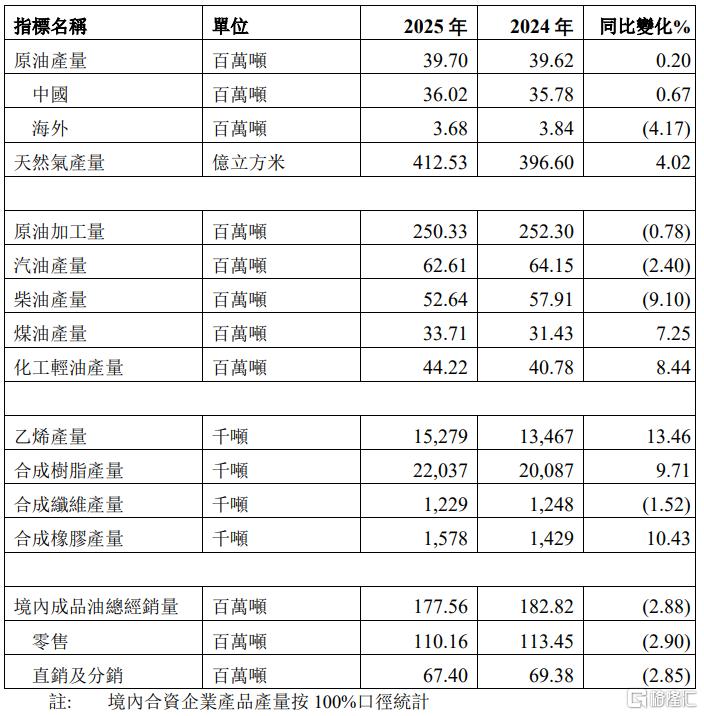
Upstream Business - Crude oil production reached 39.7 million tons, a year-on-year increase of 0.20%; domestic production increased by 0.67% to 36.02 million tons, while overseas production decreased by 4.17% to 3.68 million tons [2] - Natural gas production was 41.253 billion cubic meters, reflecting a year-on-year growth of 4.02% [2] Refining Business - Crude oil processing volume was 250.33 million tons, showing a year-on-year decline of 0.78% [2] - The structure of refined oil production saw a significant decrease in diesel by 9.10% to 52.64 million tons, while kerosene increased by 7.25% to 33.71 million tons, and chemical light oil rose by 8.44% to 44.22 million tons [2] Chemical Business - Ethylene production surged to 15.279 million tons, a substantial year-on-year increase of 13.46% [2] - Synthetic resin production reached 22.037 million tons, growing by 9.71% [2] - Synthetic rubber production was 1.578 million tons, marking a growth of 10.43% [2] Sales Business - Domestic refined oil sales volume was 177.56 million tons, a year-on-year decrease of 2.88% [1]
中国石油化工股份(00386.HK)2025年度原油产量3970万吨 同比增长0.2%
Ge Long Hui· 2026-01-23 09:07
Core Viewpoint - China Petroleum & Chemical Corporation (Sinopec) reported its production and sales figures for 2025, indicating slight growth in oil and gas production but a decline in refining and product sales [1][2]. Production and Sales Summary - Crude oil production is projected to be 39.70 million tons in 2025, reflecting a year-on-year increase of 0.2% from 39.62 million tons in 2024 [2]. - Natural gas production is expected to reach 41.253 billion cubic meters, marking a 4.02% increase from 39.66 billion cubic meters in 2024 [2]. - Crude oil processing volume is forecasted at 250.33 million tons, which represents a decrease of 0.78% compared to 252.30 million tons in 2024 [2]. - Total domestic refined oil sales are anticipated to be 177.56 million tons, down 2.88% from 182.82 million tons in 2024 [2]. Detailed Production Metrics - Daily crude oil production from China is estimated at 36.02 million tons, up 0.67% from 35.78 million tons in 2024 [2]. - Daily overseas crude oil production is projected to be 3.68 million tons, down 4.17% from 3.84 million tons in 2024 [2]. - Gasoline production is expected to be 62.61 million tons, a decrease of 2.40% from 64.15 million tons in 2024 [2]. - Diesel production is forecasted at 52.64 million tons, down 9.10% from 57.91 million tons in 2024 [2]. - Kerosene production is projected to increase to 33.71 million tons, up 7.25% from 31.43 million tons in 2024 [2]. - Chemical light oil production is expected to rise to 44.22 million tons, an increase of 8.44% from 40.78 million tons in 2024 [2]. - Ethylene inventory is projected to be 15,279 tons, up 13.46% from 13,467 tons in 2024 [2]. - Synthetic resin production is expected to reach 22,037 tons, a 9.71% increase from 20,087 tons in 2024 [2]. - Synthetic fiber production is projected to be 1,229 thousand tons, down 1.52% from 1,248 thousand tons in 2024 [2]. - Synthetic rubber production is expected to increase to 1,578 thousand tons, up 10.43% from 1,429 thousand tons in 2024 [2].

中国石化:公布2025年生产经营业绩相关数据
Xin Lang Cai Jing· 2026-01-23 08:47
Core Viewpoint - Sinopec announced its preliminary operational performance data for 2025, highlighting mixed results in production and sales metrics [1] Production Data - Crude oil production reached 39.7 million tons, a year-on-year increase of 0.2%, with domestic production rising by 0.67% and overseas production declining by 4.17% [1] - Natural gas production was 41.253 billion cubic meters, reflecting a year-on-year increase of 4.02% [1] - Crude oil processing volume was 250 million tons, showing a year-on-year decrease of 0.78% [1] Product Output - Gasoline and diesel production decreased, while kerosene and chemical light oil production increased [1] - Ethylene, synthetic resin, and synthetic rubber production saw growth, whereas synthetic fiber production declined [1] Sales Data - Domestic refined oil total sales volume was 17.8 million tons, representing a year-on-year decrease of 2.88% [1]
化外部“碳约束”为内部“绿动能” ——写在CBAM正式实施之际
Zhong Guo Hua Gong Bao· 2026-01-12 02:51
Core Viewpoint - The EU's Carbon Border Adjustment Mechanism (CBAM) has transitioned into a mandatory phase, posing significant challenges and opportunities for China's petroleum and chemical industries, necessitating a shift towards greener practices and compliance with international standards [1] Group 1: Fertilizer Industry - The default emission value for Chinese urea products is set at 2.85 tons of CO2 per ton, nearly double that of major natural gas-producing countries like Algeria, while anhydrous ammonia has a default value of 4.36 tons of CO2 per ton [2] - Fertilizer companies must transition from "extensive management" to "refined accounting" by establishing a Monitoring, Reporting, and Verification (MRV) system that meets international standards to counter unreasonable default values [2] Group 2: Hydrogen Industry - The hydrogen industry, although small, is crucial for the green development of the petrochemical sector, with a default emission intensity for Chinese hydrogen set at 26.64 tons of CO2 per ton [2] - The CBAM's inclusion of hydrogen signifies a rejection of traditional "grey hydrogen" production methods, pushing the industry towards green hydrogen production using renewable energy [2] Group 3: Refining and Chemical Industries - The refining and organic chemicals sectors are identified as potential main battlegrounds under CBAM, with the EU targeting organic chemicals and polymers to prevent "carbon leakage" [3] - Refining products will have their carbon footprints traced throughout the supply chain, and any expansion of CBAM will impact the entire petrochemical industry, including synthetic resins and plastics [3] Group 4: Data Management and Compliance - CBAM challenges companies not only in production processes but also in data governance, requiring transparent and verifiable supply chain data [4] - Companies need to establish a digital carbon management platform to track carbon footprints from raw material procurement to end products, while adhering to compliance standards [4] - The industry must view the CBAM as both a long-term and a critical challenge, transforming external carbon constraints into internal green momentum through technological innovation and management upgrades [4]