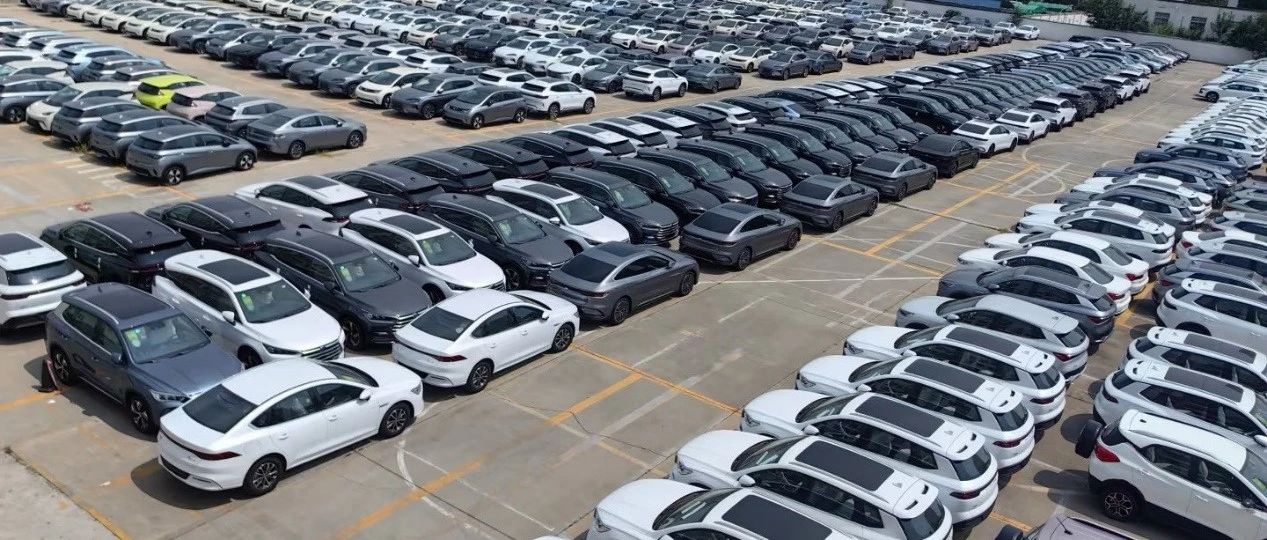
唐系列

Search documents
比亚迪“前少帅”赵长江加盟智界,携V9首战,MPV市场格局生变?
Guo Ji Jin Rong Bao· 2026-01-13 11:00
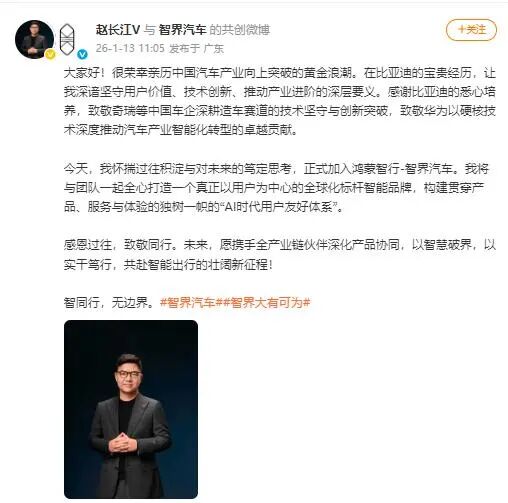
Core Insights - Zhao Changjiang officially announced his joining of Zhijie Automotive as Executive Director and Executive Vice President, responsible for overall brand marketing [2][7] - His previous experience includes significant roles at BYD, where he led substantial sales growth and brand transformation [3][5][6] Group 1: Zhao Changjiang's Background - Zhao Changjiang began his career at BYD in 2009, quickly rising through the ranks to become the youngest sales head in the company's history by 2017 [3] - He played a crucial role in increasing BYD's market share in the Beijing-Tianjin region to over 35% and achieving a tenfold sales increase [3] - In 2021, he took on the challenge of leading the Tengshi brand, which was struggling with low sales and profitability, and successfully revitalized it with the launch of the Tengshi D9 [4][5] Group 2: Tengshi Brand Performance - Under Zhao's leadership, Tengshi's sales doubled in 2022, nearing 10,000 units, with the D9 model becoming a market phenomenon [5][6] - By 2023, Tengshi's total sales surpassed 120,000 units, with the D9 accounting for 81.75% of those sales [6] Group 3: Zhijie Automotive's Market Position - Zhijie Automotive, a collaboration between Huawei and Chery, is positioned in the high-end MPV market, with the upcoming V9 model expected to compete directly with Tengshi D9 [10][13] - The V9 is designed with advanced technology and spacious luxury features, aiming to redefine the high-end MPV segment [12][15] - Zhijie plans to expand its product lineup and retail presence significantly in 2026, with the V9 being a key product launch [15]


已购车辆的这些安全隐患,谁来管一管?
3 6 Ke· 2025-10-24 03:38
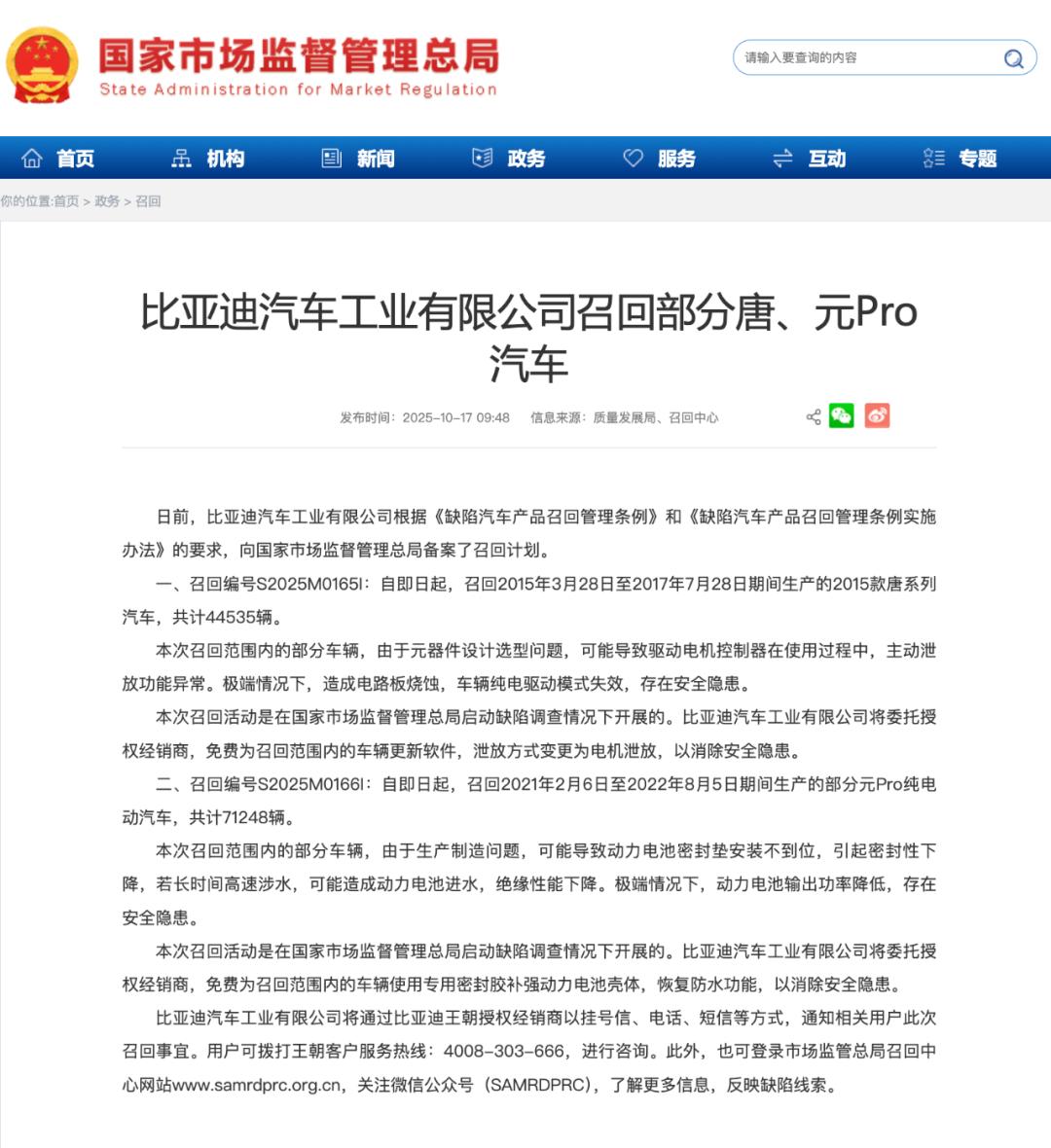
Core Viewpoint - The recent surge in recalls among electric vehicle manufacturers highlights significant safety concerns and the varying responses from companies, indicating a potential crisis in quality control within the industry [1][2][3]. Group 1: Recall Statistics and Implications - In the past two months, major recalls have been announced by companies such as BYD, Xiaomi, and XPeng, with BYD recalling 115,783 vehicles and Xiaomi recalling 116,887 vehicles [1][2]. - As of September 2025, a total of 3,230 recalls have been implemented in China, affecting 120 million vehicles, with 652 recalls influenced by regulatory investigations, accounting for 53.18% of total recalls [2]. Group 2: Specific Recall Issues - BYD's recalls involve the 2015 Tang series and Yuan Pro models, with issues ranging from design flaws in the drive motor controller to improper installation of battery seals, both posing serious safety risks [3][10]. - Xiaomi's recall of the SU7 is due to deficiencies in the L2 highway navigation assistance feature, while XPeng's P7+ recall addresses steering assist sensor issues [11][13]. Group 3: Quality Control Concerns - The frequency of recalls, particularly for BYD, raises questions about the company's quality management systems, especially as these models represent a significant portion of their sales [10][25]. - Complaints from consumers regarding various models, including the DM-i series, indicate ongoing quality issues that have not met recall standards but still affect vehicle safety [18][20]. Group 4: Industry Response and Future Considerations - The industry's rapid expansion has led to a neglect of quality control, with companies like BYD prioritizing market share over product safety, which may harm long-term growth [25][33]. - Regulatory bodies are beginning to impose stricter safety requirements, as seen in the recent ban on fully hidden door handle designs, reflecting a shift towards prioritizing consumer safety in automotive design [40][42].
BYD makes largest recall of over 115,000 cars due to design, battery issues
Reuters· 2025-10-17 03:13
Core Insights - Chinese car maker BYD is initiating its largest recall to date, affecting over 115,000 vehicles from the Tang series and Yuan Pro models produced between 2015 and 2022 due to design defects and battery-related safety risks [1] Group 1 - The recall involves more than 115,000 vehicles [1] - The affected models include the Tang series and Yuan Pro [1] - The production years of the recalled vehicles range from 2015 to 2022 [1]

为什么比亚迪突然再打价格战?
Xin Lang Cai Jing· 2025-05-29 10:10
Core Viewpoint - BYD has initiated a significant price reduction across 22 models, marking the largest discount yet, which signals the beginning of a new price war in the automotive industry [2][4] Group 1: Price Reductions and Market Impact - BYD's price cuts range from 12,000 to 53,000 yuan, and the promotion will last until the end of June [2] - This is the third price reduction since March, indicating a trend of aggressive pricing strategies in the industry [2] - Other manufacturers like Geely and Chery have also followed suit with substantial price cuts, with Chery's reductions nearing 50% for some models [2] - The automotive industry is facing a historical low profit margin of 4.3% in 2024, with cumulative retail losses approaching 200 billion yuan due to the price war [4] Group 2: BYD's Sales Performance - In 2024, BYD sold 4.2722 million vehicles, generating revenue of 617.38 billion yuan, with an average revenue contribution of 144,500 yuan per vehicle [4] - Despite a leading gross margin of 22.31%, the net profit per vehicle is less than 10,000 yuan, indicating lower profitability in the automotive sector [4] - BYD's sales target for 2025 is set at 5.5 million vehicles, with a domestic market goal of 4.7 million [6] Group 3: Competitive Landscape - BYD faces increasing competition in both the low-end and high-end markets, with competitors like Geely gaining market share [8][10] - The sales of BYD's A0-class models have declined, with competitors like Geely's Xingyuan surpassing them in sales [10] - The Han series has seen a significant drop in sales, reflecting challenges in the 200,000 yuan market segment [10][11] Group 4: Financial and Operational Challenges - BYD's asset-liability ratio stands at 74.64%, which is relatively lower compared to other domestic manufacturers [16] - The company has significantly increased its R&D investment, reaching 54.2 billion yuan in 2024, but faces high operational debts [18][19] - Maintaining high sales growth is crucial for BYD to manage its debt levels and support ongoing R&D investments [20] Group 5: Future Outlook - BYD is focusing on low-end models to stabilize its market position while aiming for overseas expansion, targeting over 800,000 units in international sales [22] - The company has sold approximately 290,000 vehicles overseas in the first four months of the year, indicating potential for exceeding its sales target [22]
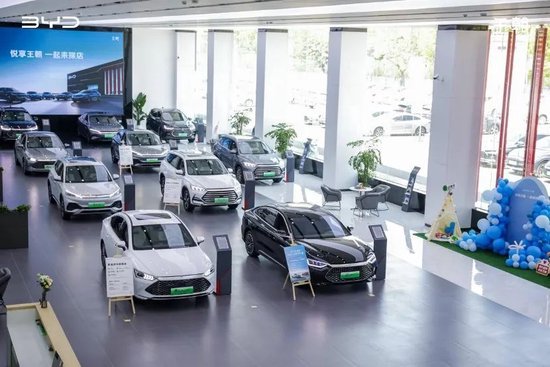
比亚迪行情:补贴拉满秦L DM-i只要5万多,海鸥降价9千硬刚竞品
车fans· 2025-05-22 00:29
Core Viewpoint - The article discusses the recent price trends and promotional strategies of BYD vehicles, highlighting significant cash discounts and the transition to intelligent driving versions across models [1][2]. Summary by Sections Qin L Series - The Qin L DM-i series offers a cash discount of 10,000, making the effective price very attractive, with a final price around 59,000 after subsidies [3][4]. - The vehicle boasts a range of 1500 km on a full charge and fuel consumption of 2.4L, emphasizing its value proposition [4]. - Compared to competitors, BYD has a significant cost and scale advantage in the plug-in hybrid market, ensuring lower prices for similar product capabilities [6]. - The technology platform of the Qin L DM-i is superior to earlier BYD models, such as the Han DM series [6][7]. - The vehicle's intelligent driving features provide safety redundancies, which are crucial for reducing accidents [6]. Qin PLUS Series - The Qin PLUS series also offers around 10,000 in cash discounts, with effective prices significantly lower than previous generations [10]. Yuan UP Series - The Yuan UP model has a cash discount of approximately 9,000, making it a competitive option in the market [11]. Yuan PLUS Series - The Yuan PLUS series has seen price reductions, with discounts around 8,000 to 11,000, enhancing its cost-effectiveness compared to previous models [14]. Song PRO Series - The Song Pro DM series offers discounts of 8,000, making it an appealing choice for consumers [17]. Song L Series - The Song L DM-i series has experienced rapid price reductions, with discounts reaching 20,000, raising concerns for early buyers [20]. Han Series - The Han DM-i series offers discounts between 12,000 and 15,000, while the Han L series has smaller discounts of 3,000 to 5,000 [22]. Tang Series - The Tang DM series has discounts of 13,000 to 15,000, while the Tang L series offers smaller discounts [25]. Summer Series - The Summer series has discounts ranging from 13,000 to 15,000, with adjustments in trade-in subsidies reflecting a price reduction strategy [28]. Seagull Series - The Seagull model has discounts of 8,000, with trade-in subsidies available [30]. Dolphin Series - The Dolphin series offers discounts of 10,000, making it a strong contender in the market [32]. Sea Lion Series - The Sea Lion EV and DM models have seen price adjustments, with discounts of 3,000 to 9,000 [35]. Sea Leopard Series - The Sea Leopard EV series offers discounts of 10,000, enhancing its market competitiveness [38]. Song PLUS Series - The Song PLUS series has significant cash discounts, particularly for the plug-in hybrid models, which are expected to increase further [39]. Sea Leopard 06 Series - The Sea Leopard 06 series offers competitive pricing with discounts of 10,000, positioning it favorably against the Qin L series [41].