商业营业用房

Search documents
商业地产库存压力对比研究
Lian He Zi Xin· 2026-01-20 05:20
Investment Rating - The report indicates a cautious outlook on the commercial real estate sector in China, highlighting significant inventory pressure and credit risks for certain companies [2]. Core Insights - The commercial real estate market in China has experienced severe inventory pressure compared to the residential market, with the inventory multiple for commercial properties exceeding 12 times as of November 2025, indicating a significant imbalance in supply and demand [5][7]. - The report emphasizes the need for a transformation in commercial real estate companies towards lower leverage, specialization, and differentiation, particularly for those with high asset constraints and non-core area investments [2]. - The recovery of the retail property market is supported by the resilience of consumer spending in China, while the office market faces substantial challenges due to oversupply and prolonged inventory adjustments [2][12]. Summary by Sections 1. Inventory Pressure in Commercial Real Estate - The inventory multiple for commercial properties has been on the rise, reaching over 12 times by November 2025, compared to residential properties which have also seen an increase to nearly 7 times [5][7]. - The office sector specifically shows a troubling inventory multiple nearing 15 times, indicating a significant oversupply situation [11]. 2. Price Dynamics and Supply-Demand Balance - The report discusses how asset prices in cities like Beijing and Shanghai have deviated from fundamentals, leading to high inventory multiples, while cities like Chongqing have maintained more stable prices and inventory levels [12][21]. - The historical context of Japan's real estate bubble is referenced, drawing parallels to the current situation in China, where rapid price increases have led to significant market imbalances [22][23]. 3. Recovery Path for Commercial Real Estate - The report outlines that the recovery of the commercial real estate market in China will require a prolonged period of inventory reduction and supply control, similar to Japan's experience post-bubble [29][41]. - It highlights that while Japan's retail market faced a prolonged downturn, China's retail sector shows signs of resilience, with consumer spending still holding up despite challenges [30][37]. 4. Corporate Strategies and Market Dynamics - The report notes that many residential developers have ventured into commercial real estate, leading to a mixed performance in the sector as companies face pressures to adapt to changing market conditions [53]. - It emphasizes the importance of learning from Japan's real estate recovery strategies, particularly the role of financial instruments like J-REITs in stabilizing the market [67].
房地产租赁经营行业2026年度信用风险展望(2025年12月)
Lian He Zi Xin· 2026-01-05 11:48
Investment Rating - The report does not explicitly state an investment rating for the real estate leasing industry Core Insights - The macroeconomic stability in 2025 supports the recovery of the real estate leasing industry, but cautious consumer expectations continue to pressure the operating environment [5][10] - The industry is experiencing a significant adjustment phase, with investment shrinking and sales showing initial signs of stabilization [5][10] - The competitive landscape is shifting towards a focus on asset management and property operation capabilities, with a low market concentration [5][46] - Revenue growth for the industry is expected to slow in 2026 due to macroeconomic factors and market supply-demand dynamics [5][50] - The credit status of the industry remains stable, with manageable debt repayment risks [5][61] Industry Fundamentals - The real estate leasing industry is closely tied to macroeconomic performance, population growth, urbanization, and social consumption capacity [7] - The industry has shown strong correlation with economic cycles, indicating significant cyclicality [7] Policy and Regulatory Environment - Recent policies aim to stabilize the rental market and promote sustainable development through operational and service-oriented models [11][12] - The introduction of the Housing Leasing Regulations and the pilot of commercial real estate REITs are expected to enhance market structure and provide exit channels for enterprises [11][13] Industry Operating Conditions Development Investment - In the first ten months of 2025, commercial property development investment decreased by 14.7%, with commercial and office building investments showing significant declines [14][50] - The commercial property development investment completed amounted to 5210.77 billion, down 11.20% year-on-year [14] Sales Performance - Sales of commercial properties reached 3947.68 billion, a decrease of 12.30%, while office building sales were 2233.71 billion, down 9.20% [18][19] - The overall sales decline is moderating as consumer recovery expectations strengthen [18] Supply and Demand Dynamics - The supply of new commercial properties is at a historical low, indicating a potential improvement in supply-demand relationships in the future [20] - The market is currently in a phase of inventory digestion, with significant pressure on supply and demand balance [20] Key City Performance Beijing - Retail properties show a slight increase in vacancy rates to 7.7%, with rents declining to 30.6 yuan/sqm/day [24] - Office vacancy rates have decreased to 19.7%, but rental prices continue to decline [24] Shanghai - Retail property vacancy rates remain stable at 8.8%, with rents at 31.7 yuan/sqm/day [28] - Office vacancy rates have risen to 22.4%, with ongoing downward pressure on rents [28] Guangzhou - Retail properties maintain a vacancy rate of 7.0%, with rents declining to 21.4 yuan/sqm/day [32] - Office vacancy rates have surged to 21.6%, the highest in nearly a decade [32] Shenzhen - Retail properties exhibit resilience with a low vacancy rate of 4.6%, but rents have adjusted to 18.0 yuan/sqm/day [37] - Office vacancy rates have increased to 23.1%, indicating significant operational challenges [37] Competitive Landscape - The industry is characterized by low concentration and intense competition, shifting towards multi-dimensional competition focused on asset management and operational capabilities [46][45] - The market is evolving with a focus on full lifecycle services and specialized operators in niche markets [46][45] Financial Performance Growth Metrics - Revenue and profit for the industry showed year-on-year growth in 2025, but growth is expected to slow in 2026 due to various economic pressures [50] - The industry has a cyclical nature, heavily influenced by macroeconomic conditions [50] Leverage Levels - The leverage levels in the industry are stable, but there are risks associated with declining asset valuations [56] - The industry is expected to maintain stable leverage levels in 2026 as investment strategies become more cautious [56] Debt Servicing Capability - The industry's debt servicing ability is showing significant divergence, with overall capacity expected to weaken slightly [60] - The rental levels and occupancy rates in key segments remain under pressure, impacting long-term debt servicing capabilities [60]
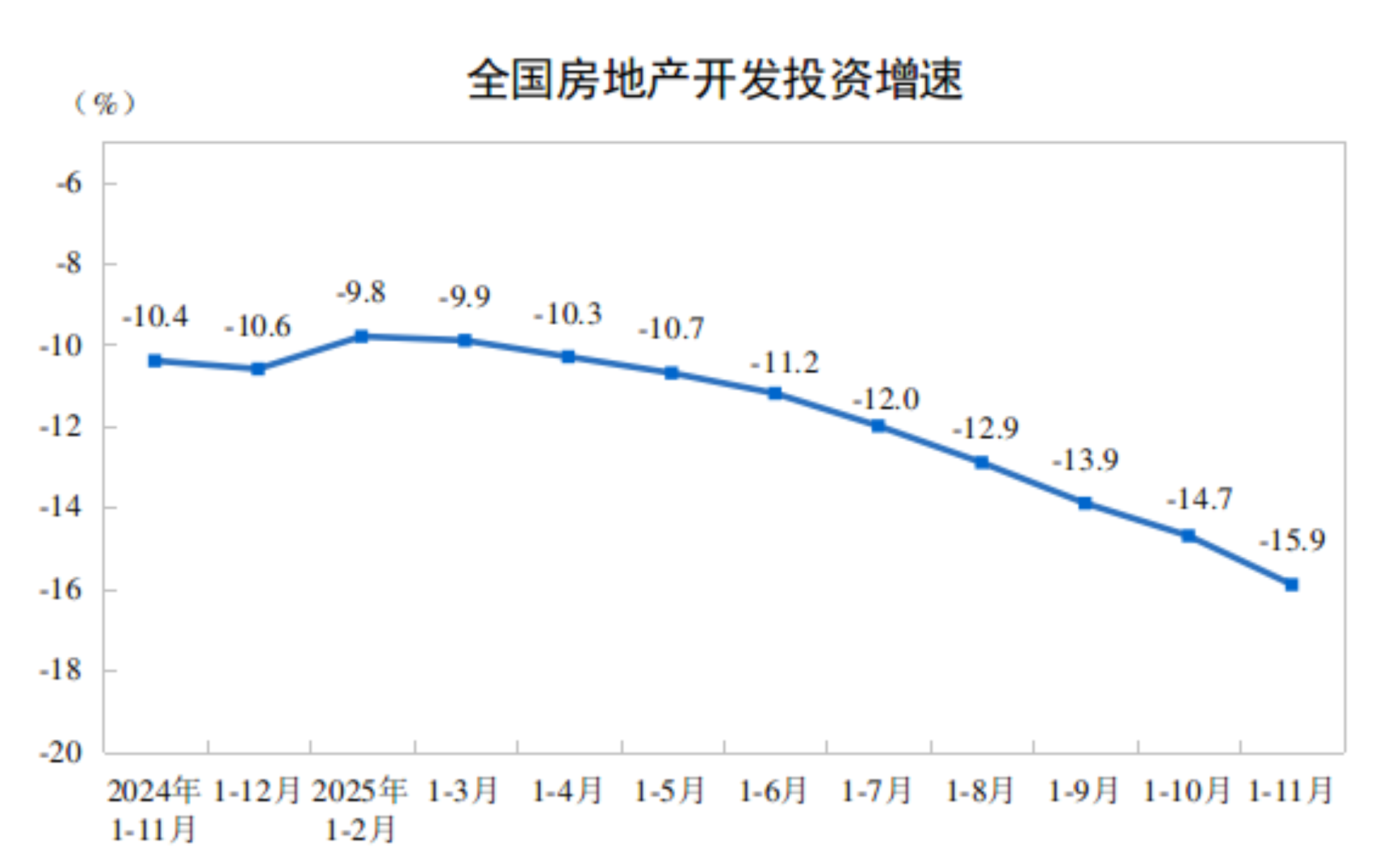
1—11月份全国房地产开发投资78591亿元 同比下降15.9%
Feng Huang Wang· 2025-12-16 00:46
Real Estate Development Investment Completion - In the first eleven months, national real estate development investment reached 78,591 billion yuan, a year-on-year decrease of 15.9% (on a comparable basis) [3] - Residential investment amounted to 60,432 billion yuan, down 15.0% [3] - The total construction area for real estate development was 656,066 million square meters, a decline of 9.6% year-on-year [3] - The new construction area was 53,457 million square meters, down 20.5%, with residential new construction area at 39,189 million square meters, a decrease of 19.9% [3] - The completed area was 39,454 million square meters, down 18.0%, with residential completed area at 28,105 million square meters, a decline of 20.1% [3] New Commodity Housing Sales and Inventory Situation - In the first eleven months, the sales area of new commodity housing was 78,702 million square meters, a year-on-year decrease of 7.8%, with residential sales area down 8.1% [4] - The sales revenue of new commodity housing reached 75,130 billion yuan, a decline of 11.1%, with residential sales revenue down 11.2% [4] - By the end of November, the inventory of commodity housing was 75,306 million square meters, a decrease of 301 million square meters compared to the end of October, with residential inventory down 284 million square meters [8] Real Estate Development Enterprises' Fund Availability - In the first eleven months, the funds available to real estate development enterprises totaled 85,145 billion yuan, a year-on-year decrease of 11.9% [9] - Domestic loans amounted to 13,149 billion yuan, down 2.5%, while foreign investment was 23 billion yuan, a decline of 24.6% [9] - Self-raised funds were 30,628 billion yuan, down 11.9%, and pre-sale deposits and advance payments were 25,098 billion yuan, a decrease of 15.2% [9] - Personal mortgage loans reached 11,786 billion yuan, down 15.1% [9] Real Estate Development Prosperity Index - In November, the real estate development prosperity index (National Real Estate Prosperity Index) was recorded at 91.90 [12]

北京楼市降温背后:815.9万平销售面积透露哪些信号?
Sou Hu Cai Jing· 2025-11-17 11:51
Core Viewpoint - The real estate market in Beijing is experiencing a significant divergence between residential and commercial properties, with overall new housing sales declining by 3.7% year-on-year, while certain segments of commercial real estate are seeing growth [1][9]. Group 1: Residential Market Challenges - The residential sales area reached 5.543 million square meters, marking a five-year low, with a year-on-year decline of 7.3%, indicating a deepening market adjustment [3]. - Contributing factors to the residential market's downturn include tightened credit policies, a surge in second-hand home listings, and adjustments to school district housing policies, collectively squeezing the new housing market [3]. - New residential construction area fell to 5.925 million square meters, down 8.4% year-on-year, as developers reduce construction scales in response to weak sales, potentially exacerbating future supply-demand imbalances [5]. Group 2: Commercial Real Estate Divergence - Despite the contraction in the residential market, commercial real estate is witnessing a peculiar split, with new office construction area increasing by 34.7% year-on-year to 267,000 square meters, while commercial property construction rose by 1.4% [5][7]. - This counterintuitive expansion in commercial real estate contrasts sharply with the declines in sales for office buildings (down 11.8%) and commercial properties (down 11.6%) [5]. - Analysts attribute this divergence to developers betting on the demand from emerging industries like digital economy and artificial intelligence, leading to a surge in customized office space development, despite a reduction in office space needs from small and medium enterprises [7]. Group 3: Policy Implications - The overall decline of 3.7% in the real estate market raises questions about potential policy responses, especially as the 7.3% drop in residential sales approaches regulatory thresholds [9]. - Historical data from 2019-2022 indicates that the fourth quarter is a sensitive period for policy adjustments, suggesting that measures such as easing purchase restrictions and optimizing housing standards may soon be implemented [9]. - Despite the sales pressure, the funding for real estate development reached 359.2 billion yuan, up 8.3% year-on-year, indicating that while sales are under strain, there is no systemic risk to the funding chain, which may explain the cautious approach of policymakers [9].