商品型黄金ETF

Search documents
加仓!本周三股票ETF资金净流入88亿元
Zhong Guo Ji Jin Bao· 2025-10-16 06:49
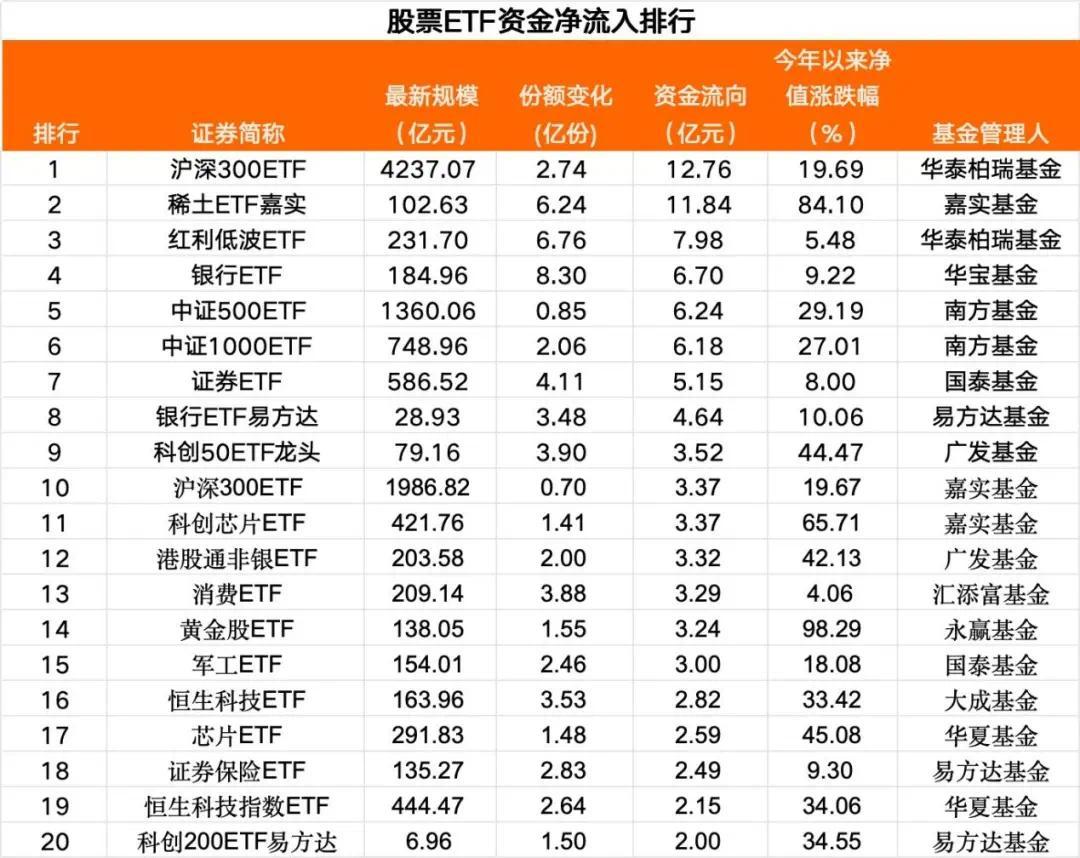
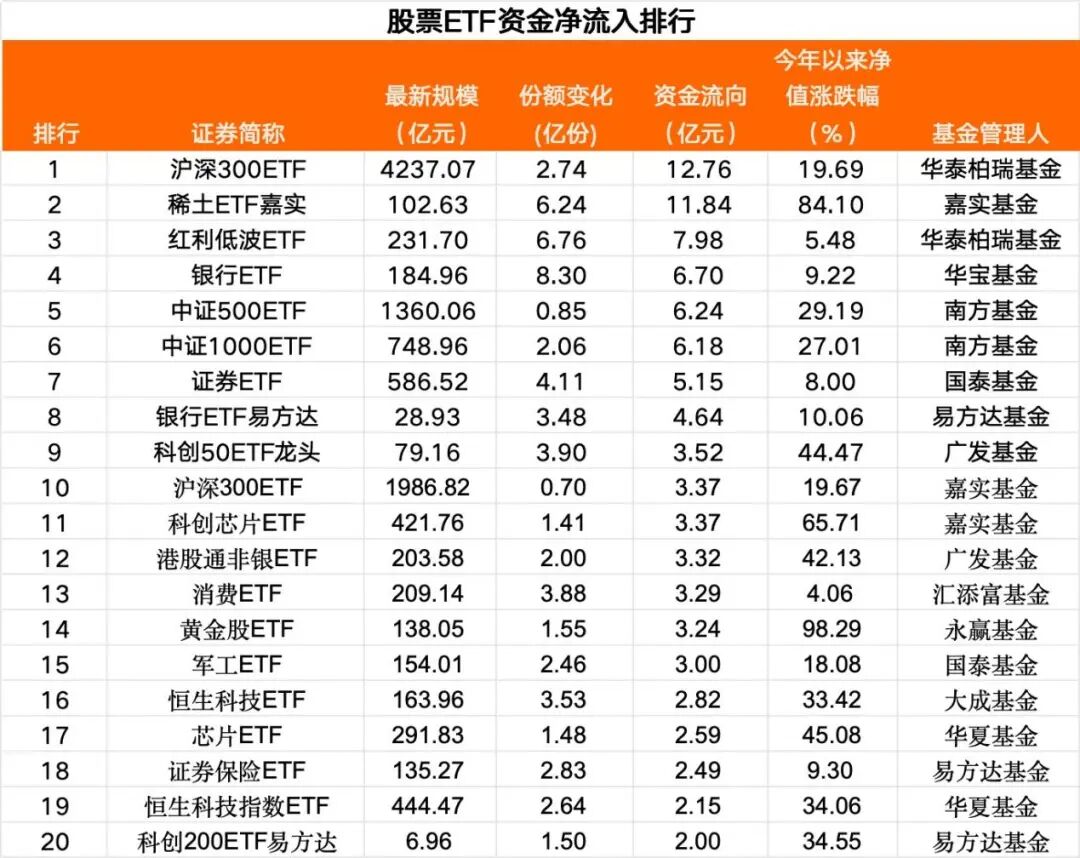
Core Insights - The A-share market experienced a rebound with major indices rising, as the Shanghai Composite Index returned to 3900 points and the ChiNext Index increased by over 2.3% [1] - There was a significant inflow of funds into stock ETFs, with a net inflow of 8.8 billion yuan on October 15, and a cumulative inflow exceeding 80 billion yuan in the first five trading days of October [2][7] - Key sectors attracting investment included technology, rare earths, banking, and securities, with the Hang Seng Technology ETF seeing a net inflow of nearly 9.5 billion yuan [2][3] ETF Market Overview - As of October 15, the total scale of stock ETFs in the market reached 4.59 trillion yuan, with 1228 stock ETFs recorded [2] - On October 15, 49 stock ETFs had a net inflow exceeding 1 billion yuan, with the top three being Huatai-PB CSI 300 ETF, Harvest Rare Earth ETF, and Huatai-PB Dividend Low Volatility ETF, each with inflows over 700 million yuan [2][3] - The top sectors for net inflows included the CSI 300 Index (1.89 billion yuan), dividends (1.48 billion yuan), banking (1.36 billion yuan), and rare earths (1.27 billion yuan) [2] Fund Performance - The top 20 stock ETFs by net inflow included two CSI 300 ETFs, one each from the CSI 500, CSI 1000, STAR 50, STAR 200, and Hang Seng Technology ETFs, with significant inflows into chip and securities ETFs [3] - Notable inflows were recorded in the ETFs managed by leading fund companies, with E Fund's banking ETF seeing a net inflow of 470 million yuan, reaching a historical high of 2.9 billion yuan [3][4] Outflow Trends - On the same day, 22 stock ETFs experienced net outflows exceeding 1 billion yuan, particularly in sectors like internet, ChiNext, and healthcare [7] - The top outflowing ETFs included three ChiNext ETFs with a combined outflow of nearly 1.4 billion yuan and three STAR-related ETFs with an outflow of nearly 1.2 billion yuan [7][9] Market Outlook - Analysts suggest that October may be a critical window for policy and earnings verification, with structural opportunities and volatility expected [7] - The upcoming third-quarter reports are anticipated to reinforce profit-driven logic, particularly in technology manufacturing and resource sectors [7][8]

加仓!加仓!
Zhong Guo Ji Jin Bao· 2025-10-16 06:43
Core Insights - On October 15, the A-share market experienced a rebound, with major indices rising and the Shanghai Composite Index returning to 3900 points, while the ChiNext Index increased by over 2.3% [1][3] - Stock ETFs saw a net inflow of 8.8 billion yuan on the same day, marking the fifth consecutive trading day of positive net inflows, totaling over 80 billion yuan for October [1][3][7] - The inflow was primarily driven by ETFs related to the Hang Seng Technology, rare earths, semiconductor technology, banks, and securities, with the Hang Seng Technology ETF alone attracting nearly 9.5 billion yuan [1][3][4] ETF Market Overview - As of October 15, the total scale of 1,228 stock ETFs (including cross-border ETFs) reached 4.59 trillion yuan [3] - On October 15, 49 stock ETFs recorded net inflows exceeding 100 million yuan, with the top three being Huatai-PB CSI 300 ETF, Jiashi Rare Earth ETF, and Huatai-PB Dividend Low Volatility ETF, each with inflows over 700 million yuan [3][4] - The top sectors attracting funds included the CSI 300 Index (1.89 billion yuan), dividends (1.48 billion yuan), banks (1.36 billion yuan), and rare earths (1.27 billion yuan) [3][4] Fund Management Insights - Among leading fund companies, E Fund's bank ETF saw a net inflow of 470 million yuan, reaching a historical high of 2.9 billion yuan [4] - Huaxia Fund's chip ETF and Hang Seng Technology Index ETF led the inflows on October 15, with net inflows of 259 million yuan and 215 million yuan, respectively [5] - The recent inflows indicate a strong interest in sectors such as technology and resources, with a focus on sustainable growth and potential policy catalysts following the Fourth Plenary Session [7][8]
加仓!加仓!
中国基金报· 2025-10-16 06:16
Core Viewpoint - The A-share market has shown signs of recovery with a significant inflow of funds into stock ETFs, indicating renewed investor interest and confidence in the market [2][4]. Fund Inflows - On October 15, stock ETFs experienced a net inflow of 8.8 billion yuan, marking the fifth consecutive trading day of positive inflows in October, totaling over 80 billion yuan [2][4][9]. - The leading sectors attracting investment include technology, rare earths, banking, and securities, with the Hang Seng Technology ETF alone seeing nearly 9.5 billion yuan in inflows [4][5]. ETF Performance - As of October 15, the total scale of stock ETFs in the market reached 4.59 trillion yuan, with 49 ETFs recording net inflows exceeding 1 billion yuan [4][5]. - The top three ETFs by net inflow on that day were the Huatai-PB CSI 300 ETF, the Jiashi Rare Earth ETF, and the Huatai-PB Dividend Low Volatility ETF, each with inflows exceeding 700 million yuan [4][5]. Sector Analysis - The banking sector saw a net inflow of 1.36 billion yuan, while the rare earth sector attracted 1.27 billion yuan [4][5]. - Conversely, certain sectors such as internet, ChiNext, and healthcare ETFs experienced significant outflows, with the top three losing nearly 1.4 billion yuan collectively [9][11]. Market Outlook - Analysts suggest that October may serve as a critical window for policy and earnings verification, with structural opportunities and volatility expected to coexist [10]. - The upcoming third-quarter earnings reports are anticipated to reinforce the logic of profit-driven investment, particularly in technology and resource sectors [10].

比金价涨得更猛!西部黄金等多股涨停,5只黄金股ETF年内已涨超100%
Sou Hu Cai Jing· 2025-10-09 08:40
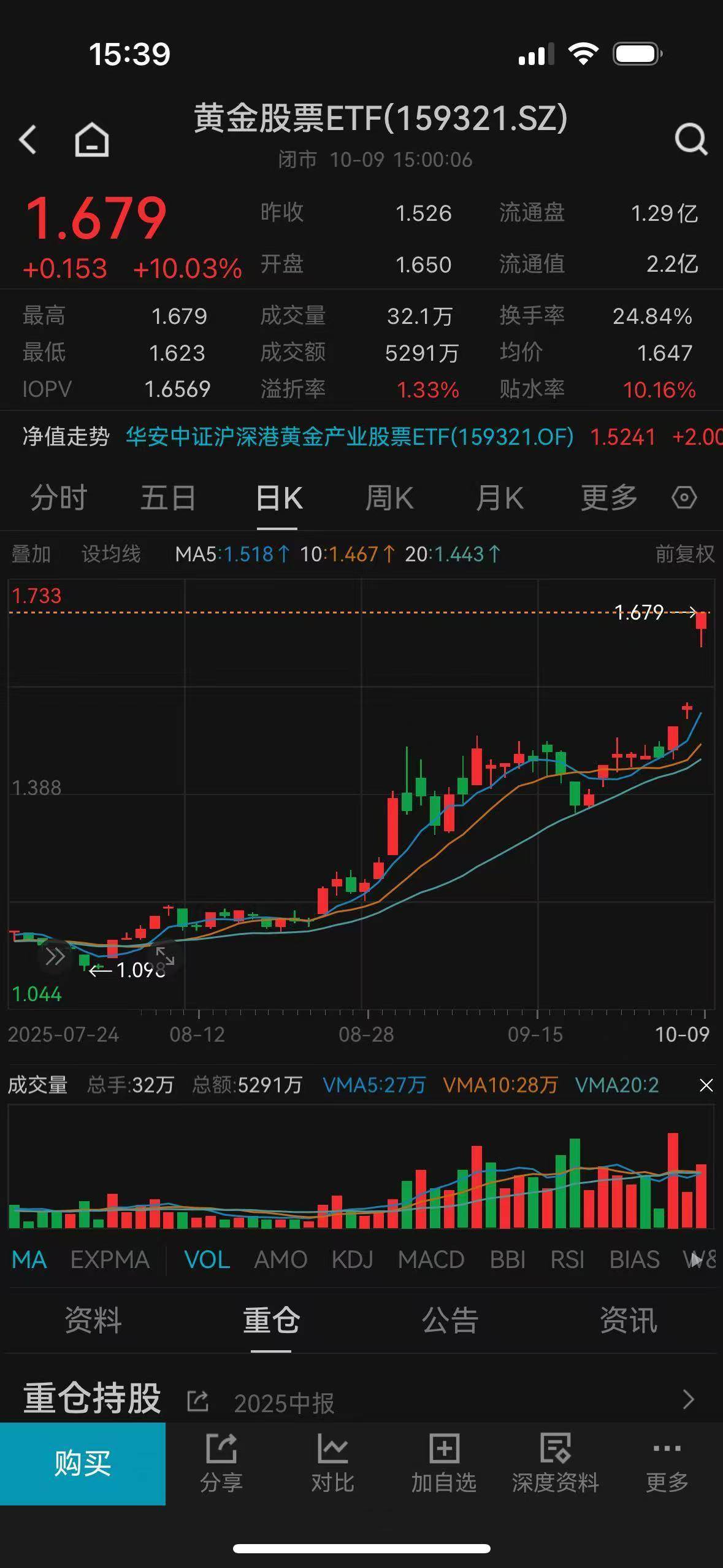
Core Viewpoint - The international gold price has surpassed $4000 per ounce, significantly impacting the A-share gold sector, leading to a surge in related stocks and ETFs [1][5]. Group 1: Market Performance - On October 9, the precious metals and non-ferrous metals sectors experienced a collective surge, with over ten stocks, including Zijin Mining and Shandong Gold, hitting the daily limit [1]. - The precious metals index rose by 9.28% on the same day [1]. - Gold-related ETFs in the A-share market also saw significant gains, with the gold stock ETF (159321) leading with a rise of 10.03% and other ETFs increasing by over 8.95% [2]. Group 2: Year-to-Date Performance - As of October 9, all 14 commodity gold ETFs have recorded year-to-date returns exceeding 47%, while the London spot gold has risen over 53% in the same period [5]. - Notably, one of the gold stock ETFs has seen a staggering year-to-date increase of 99.88%, with five others also surpassing 100% [2]. Group 3: Future Outlook - Analysts from CITIC Futures suggest that the gold market's support system remains robust, driven by factors such as the restructuring of the global monetary credit system and ongoing central bank gold purchases [6]. - The long-term bullish trend for gold is expected to continue, with predictions of an average gold price of $4250 per ounce next year and potentially reaching $4400 per ounce in the first half of 2026 [6].



落袋为安!13亿“跑了”
Zhong Guo Ji Jin Bao· 2025-05-15 06:58
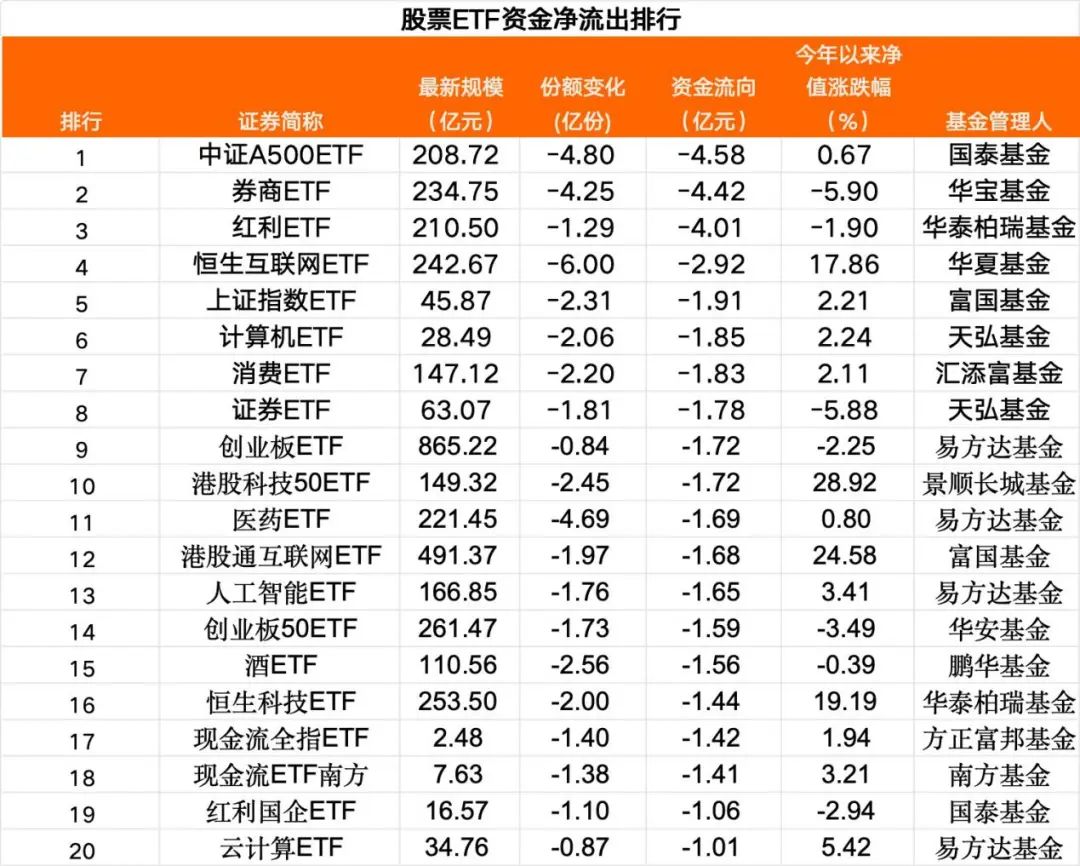
Core Insights - On May 14, the stock ETF market experienced a net outflow of 1.3 billion yuan, marking the third consecutive day of outflows this week [1][3] - Since late April, stock ETFs have seen over 10 consecutive trading days of net outflows, totaling more than 50 billion yuan [1][5] - The total number of stock ETFs in the market reached 1,089, with a total scale of 3.58 trillion yuan as of May 14 [2] Fund Flow Analysis - On May 14, 14 stock ETFs recorded net inflows exceeding 100 million yuan, with the top three being Huatai-PB CSI 300 ETF, Southern CSI 500 ETF, and Huaxia CSI A500 ETF, each with inflows over 400 million yuan [3][4] - The leading sectors for net inflows included CSI 300 (net inflow of 790 million yuan), CSI 500 (net inflow of 710 million yuan), and CSI A500 (net inflow of 680 million yuan) [3] - Conversely, the commodity-based gold ETFs experienced a net outflow of 1.6 billion yuan on the same day, continuing a trend of outflows over the past five trading days [3] Sector Performance - On May 14, 20 stock ETFs experienced net outflows exceeding 100 million yuan, with significant losses in sectors such as brokerage and Hong Kong technology and internet ETFs [5] - The top three ETFs with the highest net outflows included CSI A500 ETF, brokerage ETF, and dividend ETF, with outflows of 458 million yuan, 442 million yuan, and 401 million yuan respectively [7] - The recent market dynamics suggest that while there is support for the capital market from current policies, investor sentiment remains cautious due to ongoing trade negotiations and economic data releases [5][6]
5月7日ETF晚报丨多只国防军工板块ETF上涨;4月近三千亿资金借道ETF
Sou Hu Cai Jing· 2025-05-07 12:04
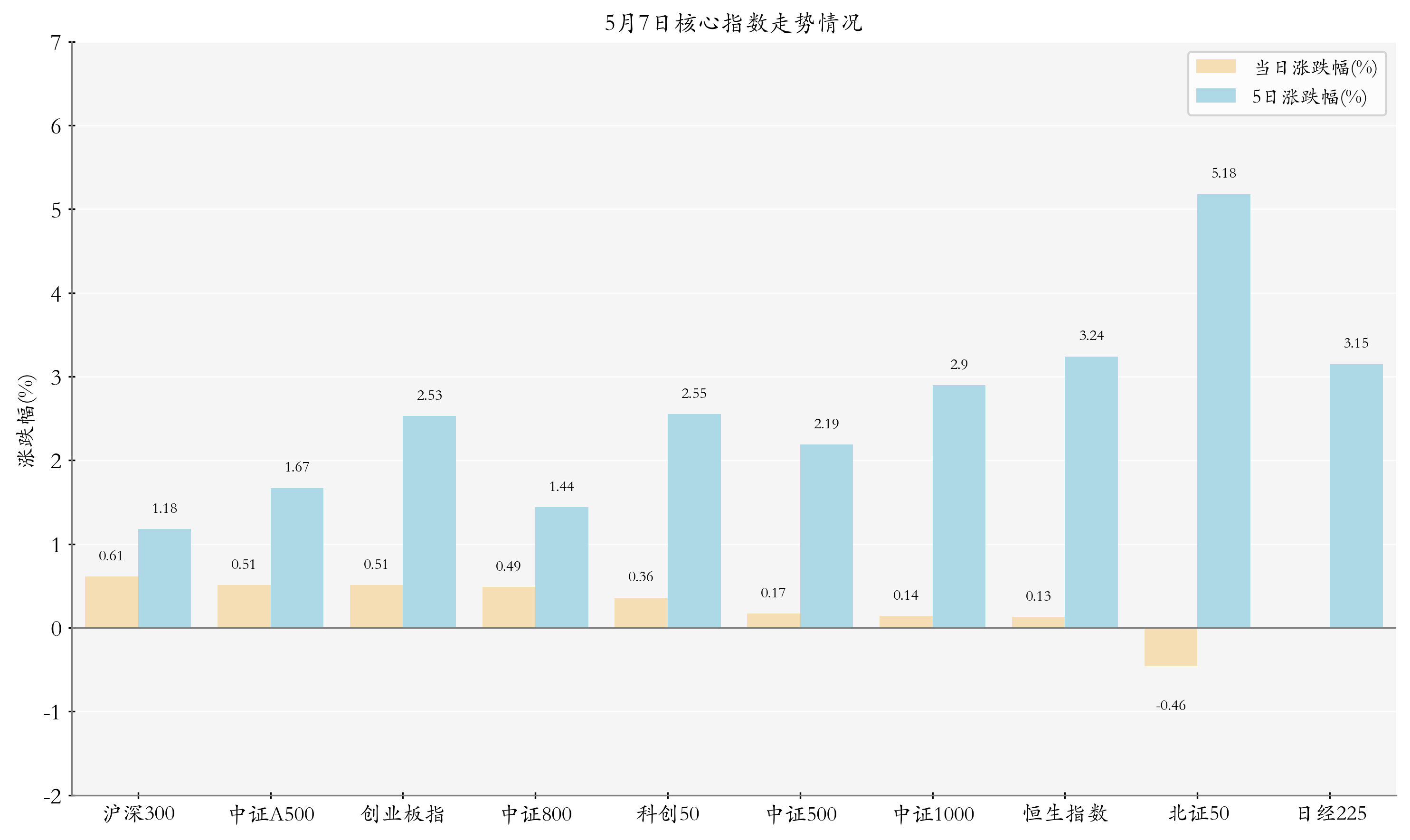
ETF Industry News - The three major indices collectively rose, with the Shanghai Composite Index increasing by 0.8%, the Shenzhen Component Index by 0.22%, and the ChiNext Index by 0.51. Multiple ETFs in the defense and military sector saw significant gains, including the Military Leader ETF (512710.SH) up by 4.24%, the Defense ETF (512670.SH) up by 3.78%, and the High-end Equipment ETF (159638.SZ) up by 3.73% [1][5][8] Military Industry Performance - According to Huatai Securities, the military industry is expected to see a significant decline in performance in 2024 due to factors such as mid-term adjustments during the 14th Five-Year Plan, personnel changes, and low-cost procurement. The defense and military sector is projected to achieve revenue of 419.18 billion yuan in 2024, a year-on-year decrease of 12.85%, and a net profit attributable to shareholders of 15.26 billion yuan, down 45.03% year-on-year. In Q1 2025, the sector is expected to generate revenue of 77.33 billion yuan, a decline of 14.36%, and a net profit of 4.20 billion yuan, down 28.87% year-on-year. However, some upstream sectors such as information technology and new materials are showing signs of improvement in demand and orders, indicating a potential rebound in the military sector's fundamentals [2] ETF Fund Inflows - In April, significant capital flowed into ETFs, with nearly 300 billion yuan net inflow into non-monetary ETFs. Major funds like Central Huijin, China National New, and China Chengtong actively increased their holdings in ETFs to stabilize the capital market. The top four non-monetary ETFs by net inflow were the Huatai-PineBridge Fund, Huaxia Fund, E Fund, and Jiashi Fund, collectively attracting nearly 130 billion yuan. Additionally, commodity gold ETFs and Hong Kong technology and internet-themed ETFs were also major beneficiaries, with gold ETFs alone receiving over 49 billion yuan in net inflows [3] Public Fund Distributions - Public funds have distributed over 80 billion yuan in dividends this year, with a total of 1,745 funds distributing 83.94 billion yuan as of April 30. This represents a 47.04% increase compared to the same period last year, marking a new high for 2023. ETFs are leading in dividend distributions, with the top two funds being the Huaxia CSI 300 ETF and the Jiashi CSI 300 ETF, distributing 2.683 billion yuan and 2.461 billion yuan respectively [4] ETF Market Overview - The overall performance of ETFs varied by category, with commodity ETFs showing the best average performance at 0.71% increase, while cross-border ETFs had the worst average performance at -0.50% [11]