
埃斯顿机器人

Search documents
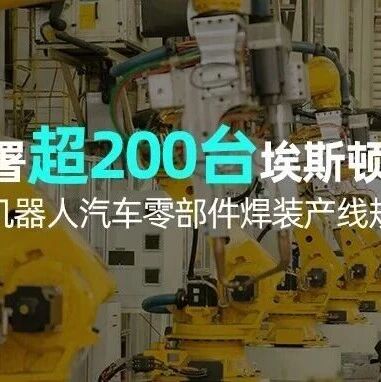
单线部署超200台埃斯顿机器人!全自主化机器人汽车零部件焊装产线规模化投产
机器人大讲堂· 2026-03-13 09:09
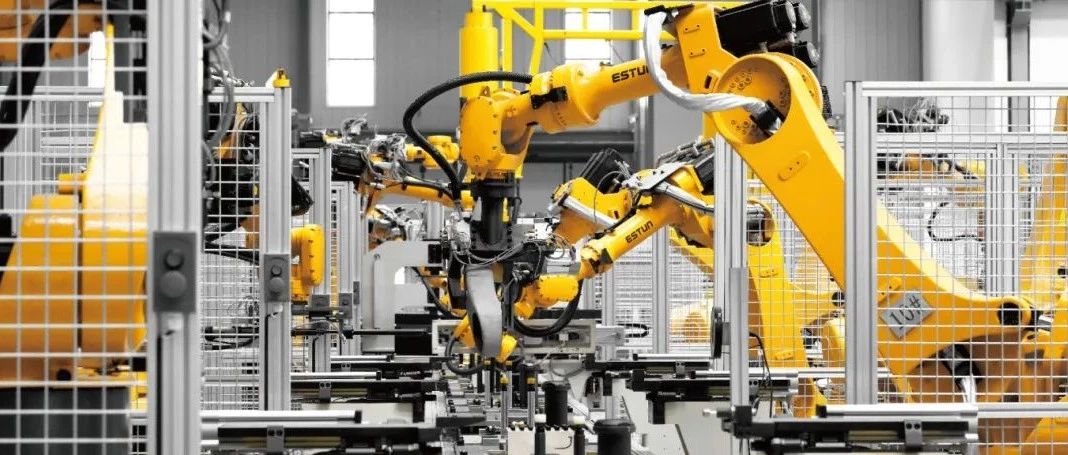
Core Insights - China is positioned as a global leader in the electric vehicle (EV) industry, with an expected production of 16.626 million EVs by 2025, accounting for approximately 74.5% of global EV production [1] - The automotive equipment manufacturing industry in China is characterized by autonomous technology, leading efficiency, and customization capabilities, setting a benchmark for global automotive equipment manufacturing [1] Group 1: Automation and Robotics in Manufacturing - Estun has partnered with a well-known domestic smart car brand to create an intelligent manufacturing factory for automotive components, achieving a 90% automation level in core processes [1] - Over 200 Estun robots have been installed and commissioned within 60 days, marking a significant breakthrough in large-scale, full-process applications in high-end automotive manufacturing [1] - The new intelligent factory is designed to meet an annual production capacity of 300,000 automotive components, with robots capable of handling loads ranging from 6 kg to 500 kg [3] Group 2: Specific Applications of Robotics - Estun's industrial robots for spot welding have achieved a mean time between failures (MTBF) of 120,000 hours, demonstrating top-tier stability, reliability, and durability [4] - The robots have a repeat positioning accuracy of ±0.06 mm, significantly enhancing production efficiency and reducing debugging time from days to hours [4] - Estun robots are also capable of adapting to SPR (Self-Piercing Riveting) and FDS (Thermal Melt Fastening) processes, withstanding a reaction force of 4000N, ensuring high-quality connections for lightweight materials [7] Group 3: Additional Robotic Applications - Estun's arc welding robots ensure stable and reliable welding quality in confined spaces due to their high trajectory precision and vibration suppression capabilities [10] - The handling robots excel in transporting and assembling large sheet metal and assembly parts, with load capacities ranging from 3 kg to 1200 kg [10] - In adhesive dispensing, Estun robots achieve a trajectory precision of ±0.1 mm, ensuring uniform and uninterrupted adhesive application [10] Group 4: Comprehensive Solutions and Services - As a comprehensive automation brand in China, Estun offers a wide range of industrial robots tailored for various automotive welding line processes [14] - The company provides professional and customizable product solutions based on its core technology system, supporting clients in building digital factories and ensuring stable, efficient operations [14] - The establishment of a fully autonomous automotive component welding line demonstrates Estun's capability in developing high-end equipment and intelligent solutions, validating the performance and engineering resilience of domestic high-end equipment [14]


向“新”求“质”,扎实推进高质量发展
Nan Jing Ri Bao· 2026-02-03 08:39
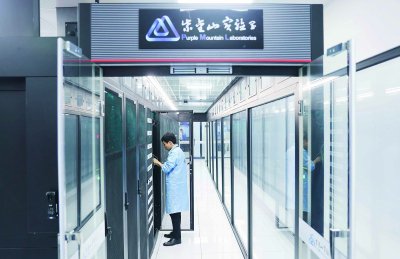
Core Viewpoint - Nanjing is positioning itself as a leader in high-quality development through innovation and technology, leveraging its strong educational and research institutions to drive industrial growth and transformation [6][7][14]. Group 1: Innovation and Technology Development - Nanjing has established a robust innovation ecosystem, comprising 54 universities and 61 research institutes, which supports its ambition to lead in high-quality development [6]. - The city aims to become a "6G City" by 2027, with goals including full coverage of 6G networks and the establishment of over 100 new enterprises, driven by the achievements of the Zijinshan Laboratory [8][9]. - The Zijinshan Laboratory has made significant advancements in 6G technology, achieving world records in wireless communication transmission rates, including a recent 1Tbps transmission speed [9]. Group 2: Industrial Growth and Economic Impact - High-tech industries in Nanjing accounted for 55.2% of the total industrial output value, with significant growth in sectors such as aerospace manufacturing and new energy vehicles, which saw production increases of 99.0% and 28.2%, respectively [14][15]. - The city is witnessing a surge in high-energy platforms, attracting leading companies like Dassault Systems and BMW to establish major operations in Nanjing, enhancing its innovation network [10]. Group 3: Collaborative Innovation and Research - Nanjing is fostering a "Double High Coordination" strategy, integrating higher education and industry to enhance technology transfer and innovation, exemplified by the establishment of the Nanjing Atomic Manufacturing Research Institute [11][12]. - Collaborative efforts between universities and enterprises have led to the creation of numerous innovation platforms, facilitating the transfer of research outcomes to specialized enterprises [13]. Group 4: Future Development Strategies - The city has outlined a strategic plan to cultivate new productive forces and promote high-quality development, emphasizing the importance of advanced manufacturing clusters and supportive policies [16].
看好镁合金加速上车
2025-12-08 00:41
Summary of Key Points from Conference Call Industry Overview - The focus is on the magnesium alloy industry, particularly its application in the automotive and robotics sectors, driven by the need for lightweight materials and cost reduction strategies in electric vehicles [1][3]. Core Insights and Arguments - **Cost Pressure on Electric Vehicle Manufacturers**: Electric vehicle companies are under significant cost pressure, making magnesium alloys an attractive option due to their lightweight properties and relatively low prices, especially in light of potential changes in subsidy policies [1][3]. - **Price Dynamics of Magnesium and Aluminum**: Currently, the price ratio of magnesium to aluminum is deviating from the theoretical value of 1.3, with the current ratio at 0.8. This indicates a cost advantage for magnesium alloys, especially as aluminum prices may rise due to electricity shortages [1][3]. - **Policy Support for Lightweighting**: Future changes in consumption tax from displacement-based to weight-based taxation will further incentivize the use of magnesium alloys in vehicles, as the penetration rate of aluminum alloys is already high [1][3]. - **Advancements in Production Technology**: Improvements in production processes, such as semi-solid die casting, have increased yield rates and expanded the application of magnesium alloys from small components to larger parts like transmission housings and electric drive housings [1][3]. - **Performance in Robotics**: Magnesium alloys exhibit superior performance in robotics, including a 30% weight reduction and a 40%-50% increase in impact energy absorption compared to aluminum. This makes them suitable for critical components in robots, enhancing overall performance and battery life [4]. Challenges in Transitioning to Magnesium Alloys - **Barriers for Aluminum Companies**: Companies transitioning from aluminum to magnesium face challenges such as mold changes, process adjustments, and equipment tuning. This transition typically requires 9-12 months for technical adjustments and an additional 1.5-2 years for mass production [5]. Market Positioning and Competitive Advantage - **First-Mover Advantage**: Companies like Xianju Pharmaceutical, Huayang Group, and Wan Feng Aowei's Meiriding, which have already established production capacity, are expected to gain a competitive edge as they can quickly respond to market demands and secure a stable supply chain [2][6].
从“大力士”到“逆行者”,南京机器人藏着什么秘密?
Yang Zi Wan Bao Wang· 2025-11-13 09:17
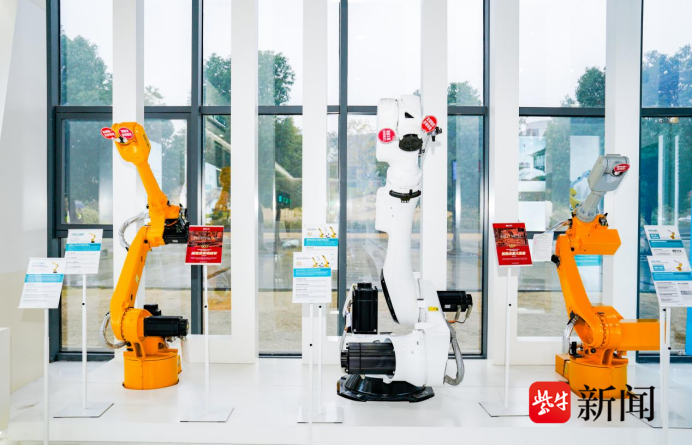
Core Viewpoint - The 2025 World Intelligent Manufacturing Conference will be held in Nanjing from November 27 to 29, showcasing advancements in industrial and embodied intelligent robots, highlighting Nanjing's comprehensive robotics industry chain [1][10]. Group 1: Company Highlights - Estun Automation has over 90 robot products with payloads ranging from 3 to 1200 kilograms, achieving a market share of 10.5% in the first half of the year, ranking first in China's robot market for two consecutive quarters [3]. - Estun's ER1200-3300, a six-axis robot with a payload of 1200 kg, represents a significant advancement in domestic heavy-duty robotics, supporting China's intelligent manufacturing [3]. - Tianchuang Robotics focuses on special robots, with its Tian Kui series being the world's first industrial robot certified for explosive environments, capable of handling tasks in hazardous scenarios [5][7]. Group 2: Technological Innovations - Estun is exploring the integration of AI and embodied intelligence, launching advanced products such as semantic AI models and collaborative robots, playing a crucial role in the transformation of the manufacturing industry [5]. - Tianchuang's upcoming humanoid robot will feature autonomous operation capabilities, integrating new technologies like VTLA large models and reinforcement learning [7]. - Nanjing Craft Equipment Manufacturing specializes in key components for robots, producing essential parts that support various robotic applications [9][10]. Group 3: Industry Development - Nanjing's robotics industry has established a full-chain system encompassing complete machines, key components, and system integration applications [1][10]. - The upcoming conference aims to facilitate substantial cooperation and exchange of global experiences, enhancing the role of Nanjing's robotics enterprises on the international stage [10].

2025上半年中国机器人市场新格局:埃斯顿位列销量榜首
机器人圈· 2025-08-08 11:10
Core Viewpoint - Estun has maintained its position as the leading player in China's industrial robot market for two consecutive quarters, achieving a market share of 10.5% by the first half of 2025, which has contributed to an increase in the domestic production rate of industrial robots to 55.3% [1][3]. Group 1: Core Competitiveness Upgrade - The integration of AI and robotics has led to the development of industrial intelligent bodies, enhancing usability and deployment ease through solutions like teach-free welding and visual-guided random grabbing [5]. - Estun's NGC control platform and ERI implementation control platform support high openness for secondary development, facilitating multi-robot collaboration and real-time data processing [5]. - The evolution of intelligent robots is transforming ordinary workers into skilled technicians, particularly in low-density application scenarios, thereby expanding the market size for robots [5]. Group 2: Scene-based Process Integration - The incorporation of AI technology has broadened the application scenarios for robots, while advancements in scene-based software are crucial for deepening these applications [6]. - Estun's certification of its explosion-proof spraying robot in July 2025 demonstrates its capability to cover various processes in metal processing, establishing a strong foundation for entering the automotive sector [6]. - The strategy of combining horizontal processes with vertical industries allows Estun to offer modular solutions tailored to customer needs, marking a significant shift from single machine sales to comprehensive solutions [6]. Group 3: Equal Opportunities for Domestic and Foreign Brands - China's robot industry has emerged as a core player in the global market, enhancing competitiveness and ensuring the safety of the domestic industrial chain [7]. - By the end of 2024, Estun will have established 75 business outlets globally, with the completion of its Poland factory, creating a supply chain structure that includes three overseas and five domestic production bases [7]. - The shift from following to surpassing foreign brands reflects the robust competitiveness of China's robot industry [7]. Group 4: Market Transformation - The transformation in the Chinese robot market is driven by high quality, high-value scenarios, and the integration of intelligent technologies, shifting industrial robots from mere programming devices to self-judging equipment [9]. - This evolution allows for the realization of flexible production advantages in multi-category, small-batch manufacturing, leveraging the universal applicability and low entry barriers of AI technology [9].
国产渗透率提升:埃斯顿登顶中国机器人市场销量第一
机器人大讲堂· 2025-04-30 08:53
在全球制造业智能化转型的浪潮中,中国工业机器人行业正迎来结构性变化。一方面,"智能化升级"与"设 备更新"政策红利持续释放,加速机器人向下沉市场渗透;另一方面,国产机器人技术平台不断升级,向汽 车、医药等高端场景开拓。 01 国产品牌登顶中国机器人市场第一 工业机器人作为推动全球制造业转型的关键驱动力,近年来取得了飞速的发展,中国工业机器人市场销量 从2015年的6.1万台增长至2024年的29.4万台,中国更是连续10多年稳居全球最大机器人市场宝座。随 着智能制造产业的发展,中国机器人市场进入调整期,行业迈入新增长阶段。 2015-2024年中国工业机器人整体市场销售规模推移(台) 数据来源:MIR DATABANK 注:*工业机器人产品包括:≤20kg 6-axis(包括其他垂直多关节)、>20kg 6-axis (包括其他垂直多关节) 、 据MIR DATABANK最新数据统计, 2025年Q1,中国工业机器人整体市场销量同比增长11.6%,国产机 器人渗透率同比提升2个百分点 。 埃斯顿机器人实现近20%的同比增长,占比中国机器人市场份额10.3% (注:含埃斯顿酷卓的市场份额) , 成为首个登顶中国 ...