
子午工程二期

Search documents
怀柔科学城29个科学设施全部进入运行状态
Xin Lang Cai Jing· 2026-01-07 22:24
Core Insights - Huairou Science City has laid out 37 technology facility platform projects, aiming for comprehensive operation and efficient utilization of 29 facilities by 2026, while also preparing over 30 projects for the 14th Five-Year Plan [1][2] Group 1: Technology Infrastructure - The 37 technology facility platform projects include 6 major national scientific infrastructure, 17 educational and research facilities, and 14 interdisciplinary research platforms, making it one of the most densely populated areas for major scientific infrastructure globally [1] - By 2025, 21 breakthrough technologies addressing critical issues will be introduced, including the new far-red light dopamine probe, with 110 significant achievements produced, and 28 awards received from Beijing Science and Technology [1] Group 2: Innovation and Development - The Laser Acceleration Innovation Center has nearly completed the world's first laser proton cancer treatment device, and breakthroughs in "iodine ion glue" technology have addressed the challenge of achieving 1,000 kilometers of range with a 100-kilogram battery [1] - The city plans to establish an internationally leading strategic technology integration development demonstration zone by 2026, focusing on enhancing public services in education, healthcare, and commercial sectors [2]
视频丨追星、探月、深空探测……向极宏观拓展中国不断突破
Yang Shi Xin Wen Ke Hu Duan· 2026-01-02 13:13
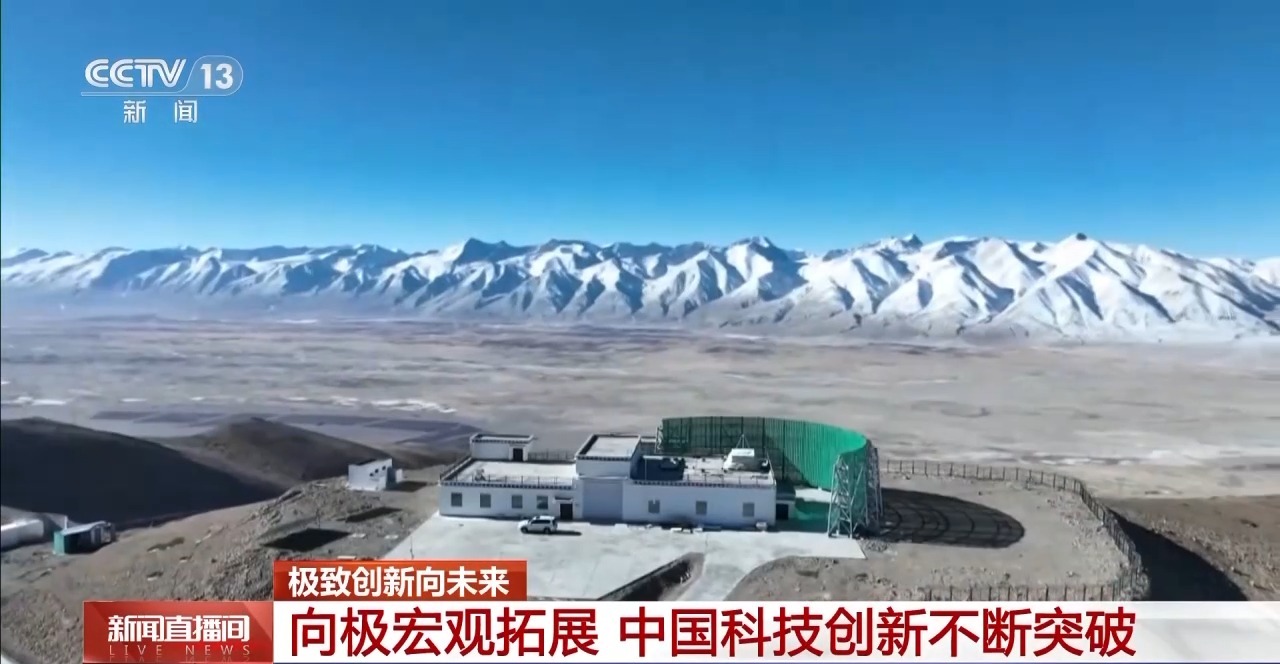
Core Insights - The article discusses China's advancements in scientific research and technology as it aims for breakthroughs in macro-scale exploration by 2025, highlighting significant achievements in space and astronomical research. Group 1: Major Scientific Infrastructure Developments - The "Meridian Project" Phase II was accepted by the state in March 2025, featuring 31 stations and nearly 300 devices for comprehensive detection of space weather, enhancing China's forecasting capabilities [3] - The Ali Gravitational Wave Detection Experiment, located at an altitude of 5250 meters, achieved its first light observation in July 2025, capturing clear images of radiation from the Moon and Jupiter at 150GHz [6] Group 2: Astronomical Discoveries - The Guo Shoujing Telescope (LAMOST) has released a total of 28.07 million spectra and 11.59 million stellar parameters by October 2025, maintaining the largest data volume globally [9] - The FAST telescope discovered over 1,170 pulsars by the end of 2025, surpassing the total number found by other telescopes during the same period, significantly enhancing China's research capabilities in cosmic navigation and gravitational wave detection [12] Group 3: Lunar and Deep Space Exploration - The Tianwen-2 probe was launched in May 2025 to study the asteroid 2016HO3, equipped with 11 scientific payloads for comprehensive data collection [18] - Research on samples from the Chang'e 6 mission revealed significant findings regarding lunar volcanic activity, ancient magnetic fields, and water content in the lunar mantle, marking a breakthrough in understanding the Moon's evolution [24] Group 4: Future Exploration Plans - The Chang'e 7 mission is planned for 2026, targeting the Moon's south pole for scientific exploration, with a new 50-meter antenna under construction to support data reception [29] - The "14th Five-Year Plan" includes ambitious projects like the "Hongmeng Plan" and "Kuafu II," focusing on cosmic origins and space weather, aiming for breakthroughs in various fields of space exploration [31]

追星、探月、深空探测……向极宏观拓展中国不断突破
Huan Qiu Wang Zi Xun· 2026-01-01 10:17
Core Viewpoint - The article discusses China's advancements in scientific research and technology innovation, particularly focusing on the macro-scale exploration of the universe, highlighting significant achievements by 2025 in various scientific projects and infrastructure. Group 1: Major Scientific Infrastructure Developments - The Zhiwu Project Phase II was accepted by the state in March 2025, featuring 31 stations and nearly 300 devices, enhancing China's space weather forecasting capabilities [2] - The Ali Gravitational Wave Detection Experiment, located at an altitude of 5250 meters, achieved its first light observation in July 2025, capturing clear images of radiation from the Moon and Jupiter at the 150GHz frequency [5] Group 2: Astronomical Discoveries - By October 2025, the Guoshoujing Telescope (LAMOST) had released 28.07 million spectral data and 11.59 million stellar parameters, maintaining the world's largest data volume [6] - The FAST telescope discovered over 1170 pulsars by the end of 2025, surpassing the total number found by other telescopes during the same period, significantly enhancing China's research capabilities in cosmic navigation and gravitational wave detection [8] Group 3: Lunar and Deep Space Exploration - The China National Astronomical Observatory's Moon and Deep Space Exploration Scientific Application Center is involved in ongoing research, including the analysis of lunar samples from the Chang'e 5 and Chang'e 6 missions [9][12] - The Chang'e 6 mission returned a 9-gram lunar sample from the Moon's far side, marking the largest basalt sample collected from that region [14] - Research on the Chang'e 6 samples revealed insights into lunar volcanic activity, ancient magnetic fields, and water content in the lunar mantle, providing a clearer understanding of the Moon's evolution [16] Group 4: Future Exploration Plans - The Chang'e 7 mission is planned for 2026, aiming to explore the Moon's south pole, with a new 50-meter antenna under construction to support data reception for this mission [20] - The "15th Five-Year Plan" includes ambitious extraterrestrial exploration initiatives, focusing on cosmic origins, space weather, and life origins, with projects like the "Hongmeng Plan" and "Kuafu II" set to achieve breakthroughs in various fields [23]
新思想引领新征程丨协同聚力 京津冀科技创新开启新征程
Yang Guang Wang· 2025-12-20 03:52
Core Insights - The Chinese government is accelerating the construction of Beijing as an international technology innovation center and a high-level talent hub, aiming to make it a key source of independent and original innovation [1][2]. Group 1: Technological Infrastructure - Beijing has made significant progress in establishing a high-density technological infrastructure, ranking among the top globally, transitioning from single-point construction to cluster operations [2]. - The completion of the high-energy synchrotron radiation source in Beijing's Huairou district marks a milestone, being the world's highest brightness fourth-generation synchrotron radiation source, fulfilling national strategic and technological innovation needs [1][3]. Group 2: Collaborative Innovation - The Beijing-Tianjin-Hebei region has jointly funded over 220 basic research cooperation projects, forming innovation alliances to enhance regional innovation quality and efficiency [3]. - A collaborative model is emerging where research and development occur in Beijing while technology is transferred to Tianjin and Hebei, fostering a synergistic industrial structure [3]. Group 3: Strategic Goals and Achievements - The central government emphasizes the integration of Beijing's technological advantages with Tianjin's advanced manufacturing capabilities to drive innovation in Hebei, outlining a practical path for regional collaboration [2]. - Beijing has been recognized as the global leader in the "science center" dimension of the 2025 International Technology Innovation Center Index, solidifying its position at the forefront of global scientific and innovation activities [2].
星空有约丨太阳“打喷嚏”,地球会“感冒”吗?
Xin Hua Wang· 2025-11-10 14:24
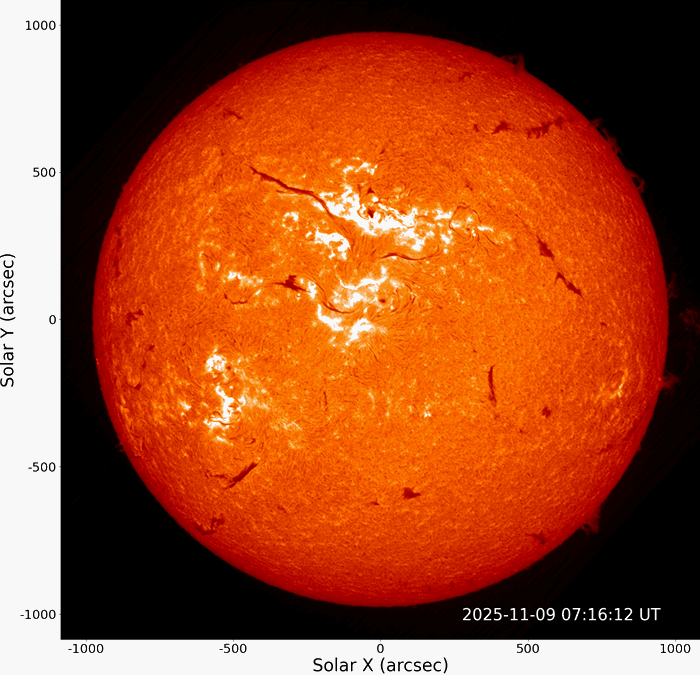
Core Points - Recent solar activity has seen multiple significant solar flares, including X1.8, X1.1, M7.4, M8.6, and X1.7 flares, indicating heightened solar activity [1][2] - Solar flares and coronal mass ejections (CMEs) can impact space weather, which affects high-tech fields such as aerospace, aviation, and communications, although ground-level human health is not at risk [2][5] - The current solar activity is reportedly weaker compared to last year, with solar flares categorized by intensity levels (C, M, X) and geomagnetic storms classified as weak, medium, or strong [2][5] Industry Developments - The "Xihe" satellite, China's first solar exploration satellite, is part of a broader initiative to enhance space weather monitoring capabilities [2][5] - The completion of the Meridian Project Phase II marks a significant advancement in China's ground-based monitoring of space weather across all layers of the sun-Earth system [5] - Plans for the "Xihe II" solar exploration project aim to position a satellite at the L5 Lagrange point, enabling advanced observation and tracking of solar activities directed towards Earth, enhancing predictive capabilities for space weather [5]
星空有约|太阳“打喷嚏”,地球会“感冒”吗?
Xin Hua She· 2025-11-10 11:14
Core Viewpoint - Recent solar activity has increased significantly, with multiple solar flares occurring in early November, which may impact space weather and technology on Earth [1][2] Group 1: Solar Activity - The sun has recently experienced several significant flares, including X1.8, X1.1, M7.4, M8.6, and X1.7 levels [1] - Solar flares and coronal mass ejections are part of solar activity, with flares likened to volcanic eruptions on the sun's surface, ejecting massive amounts of material at high speeds [1] Group 2: Space Weather Impact - Space weather refers to changes in the space environment caused by solar activity, with geomagnetic storms being one of the effects [1][2] - While humans on the ground are generally safe from geomagnetic storms, these events can disrupt high-tech sectors such as aerospace, aviation, and communications [1] Group 3: Monitoring and Forecasting - The National Space Weather Monitoring and Early Warning Center has issued warnings for potential geomagnetic activity, indicating possible small to moderate geomagnetic storms [2] - China has made advancements in space weather monitoring capabilities, including the completion of the Meridian Project Phase II and the launch of the "Fengyun Space" system [2] - The upcoming "Xihe II" solar probe is expected to enhance predictive capabilities for solar activity, providing timely warnings and data support for space weather forecasting [2]