
关键核心技术

Search documents
2026年两会定调,A股五大重要信号
21世纪经济报道· 2026-03-12 09:13
Core Viewpoint - The article outlines five key signals indicating a clear direction for the A-share market following the 2026 macro policy guidance, emphasizing the comprehensive deepening of capital market reforms. Group 1: Green Channels for Key Technology Enterprises - Key technology enterprises will benefit from three "green channels" for listing, financing, and mergers and acquisitions, as highlighted in the 2026 government work report [2][3][4] - The government report emphasizes the importance of "smart economy," marking a significant policy shift towards supporting artificial intelligence and related industries [2][3] - The Shanghai Stock Exchange has committed to normalizing the processes for listing, financing, and mergers for key technology enterprises, enhancing overall capital market support [3][4] Group 2: Opportunities for New Consumption and Modern Service Industries - The IPO market will open up to new consumption and modern service industries, allowing quality innovative enterprises in these sectors to list on the ChiNext board [6][7] - The recent policy shift aims to encourage not only tech companies but also those providing support services to tech firms, expanding the scope of eligible IPO candidates [7][9] Group 3: Reforms in the ChiNext Board - The ChiNext board will implement six reform measures focusing on new industries, new business models, and new technologies, enhancing its inclusivity and coverage [8][10] - New listing standards will be introduced to better support innovative enterprises, with a focus on those linked to the encouraged sectors [8][10] Group 4: Optimization of Re-financing Mechanisms - A new round of re-financing policies will be introduced, emphasizing support for high-quality companies and innovative tech firms, with a projected re-financing amount of 950.9 billion yuan in 2025, a 326% increase year-on-year [13] - The reforms will streamline the re-financing process for well-governed and recognized companies, while maintaining strict regulatory oversight [12][13] Group 5: Continued Emphasis on Risk Prevention and Strong Regulation - The regulatory environment will remain stringent, with a focus on combating financial fraud and market manipulation, as indicated by the ongoing efforts to enhance oversight [15][16] - New regulations will empower the China Securities Regulatory Commission to impose administrative penalties on third parties involved in financial fraud, aiming to improve overall market integrity [15][16]


视频丨最高检:保护核心技术 依法从严打击商业间谍犯罪
Yang Shi Xin Wen Ke Hu Duan· 2026-02-25 23:49
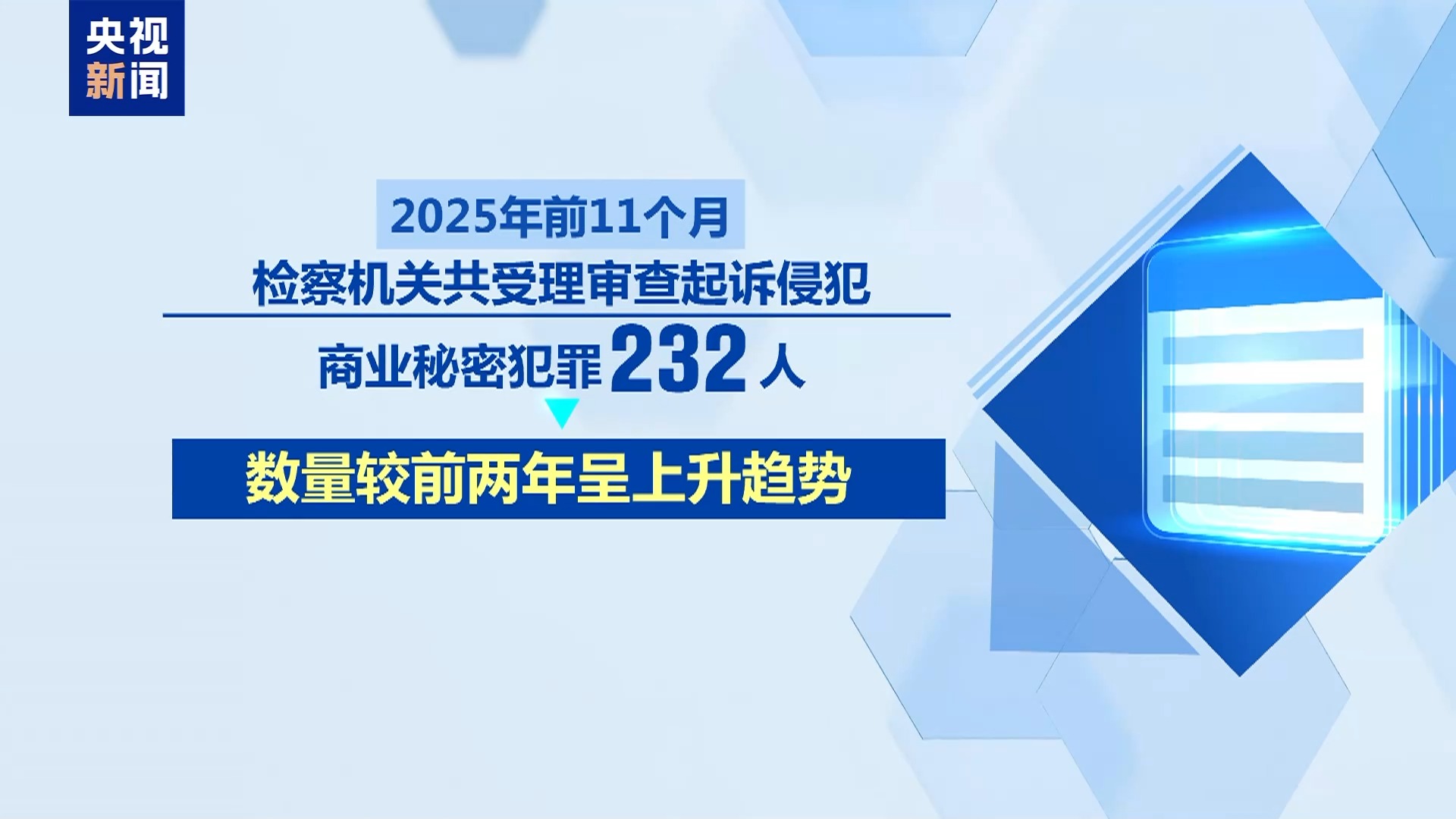
Group 1 - The core focus of the prosecutorial authorities in 2025 is to enhance judicial protection of original innovations and key core technologies, particularly in emerging industries such as information technology, artificial intelligence, high-end equipment, biomanufacturing, new energy, and new materials [1] - There has been a notable increase in the prosecution of commercial secret infringement cases, with 232 individuals prosecuted in the first 11 months of 2025, indicating a rising trend compared to the previous two years [3] - A significant case involved the infringement of Huawei's HiSilicon chip technology, with a total amount of 317 million yuan involved, leading to the prosecution of 14 defendants who were all sentenced [3] Group 2 - The prosecutorial authorities are actively addressing the multidimensional risks associated with technology outflow, applying Article 219 of the Criminal Law regarding the conviction and sentencing for commercial secret infringement to safeguard national technological and economic security [3] - In addition to criminal prosecution, there is an emphasis on strengthening civil and administrative litigation supervision, with the aim of ensuring uniform application of legal standards and addressing erroneous cases through appeals or retrial suggestions [3]
最高检:保护核心技术 依法从严打击商业间谍犯罪
Yang Shi Xin Wen· 2026-02-25 23:28
Core Viewpoint - The article highlights the efforts of the Chinese judicial system in 2025 to strengthen the protection of original innovations and key core technologies, particularly in emerging industries, while addressing the rise in commercial espionage and infringement of trade secrets [1] Group 1: Judicial Actions and Trends - In 2025, the judicial authorities focused on protecting original innovations and key technologies in sectors such as information technology, artificial intelligence, high-end equipment, biomanufacturing, new energy, and new materials [1] - A total of 232 individuals were prosecuted for commercial secret infringement in the first 11 months of 2025, indicating an upward trend compared to the previous two years [1] - A notable case involved the infringement of Huawei's HiSilicon chip technology, with the case amounting to 317 million yuan, leading to the prosecution of 14 defendants who received criminal penalties [1] Group 2: Legal Framework and Enforcement - The judicial system is applying Article 219 of the Criminal Law regarding the conviction and sentencing for commercial secret infringement to safeguard national technological and economic security [1] - The Supreme People's Procuratorate is enhancing civil and administrative litigation supervision, ensuring uniform application of legal standards by proposing appeals or retrials for cases with errors [1]
新思想引领新征程丨“十四五”期间 我国科学谋划、全局统筹 加大重点领域关键核心技术攻关力度 未来产业发展呈现良好势头
Yang Guang Wang· 2026-02-25 07:12
Core Insights - The article emphasizes the strategic importance of advancing future industries in China, focusing on key technologies and sectors that can drive economic growth and national rejuvenation [1] Group 1: Future Industry Development - The "14th Five-Year Plan" outlines a comprehensive approach to future industry development, highlighting the need for breakthroughs in key core technologies [1] - The Beijing Humanoid Robot Innovation Center has launched the "Embodied Tiangong 3.0," a new generation of general-purpose robots with significant improvements in motion control and autonomous operation [1] - The "15th Five-Year Plan" suggests forward-looking layouts for future industries, including quantum technology, biomanufacturing, hydrogen energy, nuclear fusion, brain-machine interfaces, embodied intelligence, and 6G mobile communication [1] Group 2: Brain-Machine Interface - In Guangzhou, a clinical research ward for brain-machine interfaces is helping patients with severe conditions regain mobility through non-invasive training methods [2] Group 3: Quantum Technology and Hydrogen Energy - Anhui Province has made significant advancements in quantum technology, achieving a breakthrough in scalable quantum relay modules and quantum key distribution over distances exceeding 100 kilometers [3] - Jiangxi Province is developing a comprehensive hydrogen energy ecosystem, with a recent project enabling hydrogen-powered trucks to achieve over 600 kilometers of range with quick refueling [3] Group 4: Policy Support and Innovation - The Chinese government is focusing on enhancing the collaboration between industry, academia, and research to promote key technological advancements [4] - During the "14th Five-Year Plan," China accounted for over 20% of global patent applications in biomanufacturing and produced 70% of global bio-fermentation products [4] - The development of the 6G industry is entering a critical phase of technological innovation and clearer industrial direction [4] Group 5: Investment and Support Systems - The National Venture Capital Guidance Fund will be launched in December 2025 to increase support for strategic emerging industries and future industries [5] - The National Development and Reform Commission plans to create a high-quality, comprehensive venture capital service system to support enterprise growth through governance, strategic planning, and industry collaboration [6]
德企业界警告:“欧洲正在全球竞争中掉队”
Xin Lang Cai Jing· 2026-02-11 22:53
Group 1 - The core message emphasizes that European companies are losing global competitiveness and require significant reforms to enhance their position in the market [1] - A coalition of over 100 companies and investors, including Siemens and Deutsche Bank, has called for the EU to prioritize economic growth and reduce excessive regulation to strengthen capital markets and expedite free trade agreements [1] - The CEOs of Siemens and Deutsche Bank highlighted the need for Europe to master key technologies that support industry, energy supply, and security, indicating a failure to leverage its advantages [1] Group 2 - To boost the economy and enhance competitiveness, the German government, along with Siemens and Deutsche Bank, has initiated a large-scale investment initiative called "Made in Germany," committing to invest several hundred billion euros by 2028 for new factories, research and development, and infrastructure [1]


理论月刊丨赵忠秀:中美体系竞争下的中国战略突围
Sou Hu Cai Jing· 2026-02-05 04:22
Core Viewpoint - The core strategy of the U.S. towards China is to contain its development, shifting from indirect economic means to direct technological restrictions [3][4][5] Group 1: Current State of U.S.-China Competition - The U.S.-China trade disputes, which began in 2018, have escalated from tariff conflicts to investment and personnel flow restrictions, fundamentally rooted in a technological competition [4][5] - The U.S. is increasingly using technology wars as a tool to limit China's growth, indicating a shift in policy focus from economic engagement to strategic competition [3][4] Group 2: Key Areas of Technological Competition - The global competition in "key core technologies" such as semiconductors, artificial intelligence, quantum information, new materials, and energy storage is intensifying, with these areas becoming the main battleground for technological and industrial competition [5][6] - The global semiconductor market is projected to reach $630.6 billion in 2024 and nearly $1 trillion by 2026, highlighting its critical role in industrial and national security [5] - In artificial intelligence, China accounted for 69.7% of global AI patent grants in 2023, while the U.S. share dropped from 42.8% in 2015 to 14.2% [5] Group 3: U.S. Strategies to Restrict China - The U.S. has implemented technology blockades against China, focusing on investment restrictions and export controls, alongside limiting the flow of researchers [8][9] - The U.S. aims to restructure supply chains and has enacted laws to limit tax credits for companies associated with "prohibited foreign entities," targeting Chinese firms [8][9] - The U.S. is also striving to establish standards in emerging technologies, emphasizing the importance of standards for economic and national security [8][9] Group 4: Challenges and Advantages for China - China faces challenges in R&D spending, which, while increasing, remains lower than that of the U.S. and some European countries, and there is a need to enhance the originality of patents and influence in international standard-setting [9][10] - However, China possesses a complete industrial system across all categories, forming a self-sufficient and efficient supply chain that is difficult for developed and developing economies to replicate [9][10] Group 5: Strategic Recommendations for China - China should enhance its technological self-reliance and effectively utilize global innovation resources by increasing R&D investment and fostering collaboration between academia and industry [11][12] - There is a need to support foundational sciences and original research, focusing on critical issues and encouraging talent to propose new theories and explore new fields [11][12] - Improving the standard-setting system and maintaining international cooperation in standards is crucial for enhancing China's influence in global technology [12][20]

学习贯彻党的二十届四中全会精神|以高水平科技自立自强引领发展新质生产力
Xin Lang Cai Jing· 2026-01-18 22:33
Core Viewpoint - The article emphasizes the importance of high-level technological self-reliance and the development of new productive forces as a strategic support system for economic growth and national strength [1][2]. Group 1: High-Level Technological Self-Reliance - High-level technological self-reliance is fundamental for the development of new productive forces and is increasingly becoming a core strategic point in global competition [1]. - Original innovation and key core technologies are essential for achieving self-reliance, which in turn supports the development of new productive forces [1][2]. Group 2: Foundation of Core Elements - The accumulation of core elements is crucial for generating new productive forces, and high-level technological self-reliance acts as a catalyst for transforming these elements into a solid industrial foundation [3]. - The integration of digital innovation and process innovation is necessary for upgrading traditional industries, enhancing overall productivity, and transitioning from "labor-intensive" to "intelligent" production [3]. Group 3: Innovation and Industry Integration - A precise connection between the innovation chain and the industrial chain is vital for the growth of emerging industrial clusters, focusing on autonomous supply of key technological elements [4]. - The article advocates for the development of new industries such as satellite internet and low-altitude economy, aiming to create billion-level industrial clusters [4]. Group 4: Internal Motivation and Talent Development - The evolution of new productive forces relies on continuous internal motivation, which can be achieved through a comprehensive approach to education, technology, and talent development [6]. - The establishment of a new production relationship that supports innovation and talent cultivation is essential for aligning educational outcomes with industry needs [6]. Group 5: Digital Transformation - Digital transformation is identified as a key variable for maximizing development potential, enabling the integration of data elements into innovation and industrial processes [7]. - The construction of a robust digital infrastructure is necessary to unlock the potential value of data, driving fundamental changes in production methods [7][8].
怀柔科学城29个科学设施全部进入运行状态
Xin Lang Cai Jing· 2026-01-07 22:24
Core Insights - Huairou Science City has laid out 37 technology facility platform projects, aiming for comprehensive operation and efficient utilization of 29 facilities by 2026, while also preparing over 30 projects for the 14th Five-Year Plan [1][2] Group 1: Technology Infrastructure - The 37 technology facility platform projects include 6 major national scientific infrastructure, 17 educational and research facilities, and 14 interdisciplinary research platforms, making it one of the most densely populated areas for major scientific infrastructure globally [1] - By 2025, 21 breakthrough technologies addressing critical issues will be introduced, including the new far-red light dopamine probe, with 110 significant achievements produced, and 28 awards received from Beijing Science and Technology [1] Group 2: Innovation and Development - The Laser Acceleration Innovation Center has nearly completed the world's first laser proton cancer treatment device, and breakthroughs in "iodine ion glue" technology have addressed the challenge of achieving 1,000 kilometers of range with a 100-kilogram battery [1] - The city plans to establish an internationally leading strategic technology integration development demonstration zone by 2026, focusing on enhancing public services in education, healthcare, and commercial sectors [2]
八部门:到2027年,我国关键核心技术实现安全可靠供给!
Xin Lang Cai Jing· 2026-01-07 14:23
Group 1 - The core viewpoint of the article emphasizes that by 2027, China aims to achieve a secure and reliable supply of key core technologies in artificial intelligence [2] - The initiative involves collaboration among eight departments to enhance the development and application of artificial intelligence technologies [2] - The focus is on ensuring that these technologies meet national security standards and contribute to the overall technological advancement of the country [2] Group 2 - The plan outlines specific goals and milestones for the development of artificial intelligence, indicating a strategic approach to technology advancement [2] - It highlights the importance of self-sufficiency in critical technologies to reduce reliance on foreign technology [2] - The initiative is expected to drive innovation and economic growth within the artificial intelligence sector in China [2]
李强在广东调研时强调 只争朝夕做好“十五五”开局之年工作
Zhong Guo Zheng Quan Bao· 2026-01-05 22:49
Group 1 - The core message emphasizes the importance of high-quality development and innovation in driving economic growth, as highlighted by Premier Li Qiang during his visit to Guangdong [1][2] - The focus on technological innovation is crucial for future competitiveness, with a call for enhanced support for enterprises in terms of policies, funding, and talent [1] - The development of the Guangdong-Hong Kong-Macao Greater Bay Area is seen as a key opportunity to gather innovative resources and strengthen research collaboration in emerging fields and core technologies [1] Group 2 - The visit included an inspection of the digital and intelligent production lines at Midea Kitchen Appliances, indicating a shift towards meeting new consumer demands through quality product development [2] - Emphasis was placed on the integration of infrastructure and regulatory standards to enhance connectivity and collaborative development within the Greater Bay Area [2] - The government is encouraged to deepen reforms in key areas, improve service efficiency, and optimize the business environment to stimulate economic growth [2]