
定开债基

Search documents
高管频繁更迭,新华基金治理的稳定性堪忧
Xin Lang Cai Jing· 2025-12-29 07:50
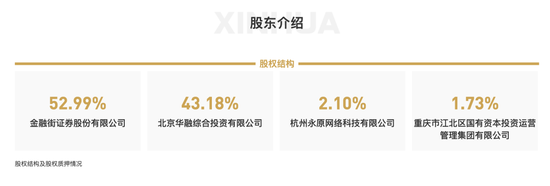
Core Viewpoint - Xinhua Fund is undergoing significant changes in branding, ownership, and management, signaling a strong "restart" amid the public fund industry's shift towards high-quality development [1][8]. Group 1: Ownership and Management Changes - Xinhua Fund has introduced a new brand visual system, incorporating the logo of its controlling shareholder, Beijing Financial Street Investment Group, to enhance market perception [1][9]. - In December 2024, the China Securities Regulatory Commission approved Beijing Huarong Comprehensive Investment Co., Ltd. to acquire approximately 30.31% of Xinhua Fund's shares, becoming a major shareholder [9]. - Concurrently, a management change occurred with Yin Guohong, former Deputy Secretary of the Party Committee and President of Hengtai Securities, appointed as Chairman, replacing Yu Chunling who resigned for personal reasons [9]. Group 2: Capital Increase and Structural Adjustments - In late December, Xinhua Fund announced a capital increase, with Hengtai Securities and Beijing Huarong injecting approximately 800 million yuan, raising the registered capital from 218 million yuan to 628 million yuan [2][10]. - Post-capital increase, Hengtai Securities holds 52.99% and Beijing Huarong holds 43.18%, further marginalizing other shareholders [2][10]. - The simultaneous adjustments in ownership, capital, and management indicate a preparation for a systematic overhaul, although the real challenges lie beyond the capital level [2]. Group 3: Research and Investment Team Challenges - Xinhua Fund faces significant challenges with a high turnover in its investment research team, with seven fund managers leaving in 2024 alone, including both long-serving and newly appointed managers [3][11]. - The fund has only added three new fund managers during the same period, indicating a net outflow in its research team [11]. - Historical performance shows that under the leadership of "Bond Queen" Zhai Chenxi, the fund's public management scale peaked at 86.8 billion yuan in Q2 2022, but fell to around 50 billion yuan within a year after her departure [11]. Group 4: Fund Structure and Compliance Issues - As of now, Xinhua Fund's public management scale stands at 54.215 billion yuan, with 37.669 billion yuan in non-monetary assets and a significant reliance on bond funds, which total 30.86 billion yuan [3][12]. - The fund's active equity products are notably small, with only 1.119 billion yuan in stock funds and 5.689 billion yuan in mixed funds [3][12]. - The concentration of bond fund assets in a few institutional customized products raises concerns about the sustainability of its scale and the long-term support for brand and research capabilities [12]. Group 5: Compliance and Trust Issues - Xinhua Fund has faced compliance risks, with over 200 million yuan in enforcement actions related to historical issues with separate account products [5][13]. - The fund has been involved in multiple disputes over the years, with cumulative amounts exceeding 1 billion yuan, which undermines investor trust [14]. - In 2022, the fund was also cited for failing to disclose equity changes during a reduction in a specific asset, highlighting weaknesses in its internal control systems [14]. Group 6: Industry Context and Future Outlook - The public fund industry is transitioning to a focus on sustainable scale, healthy structure, and stable research capabilities rather than just size [7][16]. - For Xinhua Fund, the key to future success lies in rebuilding its research core, restoring compliance foundations, and re-establishing its presence in the active equity space [16].

2026年展望系列五:理财风光仍在,债基格局重塑
China Post Securities· 2025-12-11 08:28
1. Report Industry Investment Rating There is no information provided regarding the report's industry investment rating in the given content. 2. Core Views of the Report - Residents' investment preference is rising, but there is still a demand for safe assets. They show a contradiction of "declining risk preference but still having a desire for returns" [3]. - The scale of wealth management products is expected to continue growing, but their yields still face challenges. In the context of deposit disintermediation, there is still room for growth in the scale of wealth management in 2026 [4]. - Public - offering bond funds and wealth management are interacting more deeply. Attention should be paid to the changing trends in product structure. The public - offering bond fund market is undergoing a pattern reshaping [5]. 3. Summary According to the Directory 3.1 Liability Side: Residents' Investment Preference Rises, and the Demand for Safe Assets Remains - **Limited Asset Allocation Options and Sustained Demand for Safe Assets**: Residents' asset allocation shows a contradiction between balancing safety and returns. They have a reduced risk - bearing capacity on the asset side and a demand for "elastic returns" in low - risk assets [11][13]. - **Strengthened Deposit Disintermediation and Changed Investment Will**: Deposit rate cuts have strengthened the deposit disintermediation trend. The improvement of the equity market has made residents more willing to invest, and they prefer fund trusts over stocks [16][18]. 3.2 Wealth Management Products: Scale Expected to Continue Growing, Yields Still Facing Challenges - **Wealth Management Scale: Returned Above 30 Trillion, Investment Returns Under Pressure**: In Q3 2025, the bank wealth management scale reached 32.13 trillion yuan. The number of products increased steadily, with fixed - income products dominating. The number of participants also continued to grow. However, the yields of underlying assets of wealth management products have declined [19][24]. - **Wealth Management Behavior: Strategies for Stable Scale and Reduced Volatility**: To achieve stable scale and reduced volatility, wealth management has adjusted its asset allocation. It has increased the proportion of cash and deposits and changed its bond investment preferences, such as increasing the preference for inter - bank certificates of deposit and avoiding corporate bonds [26][29]. - **Regulatory Environment: Systemic Tightening Continues, a Major Source of Risk**: The regulatory environment for wealth management is tightening. Net - value reform and regulatory policies such as the "Asset Management Trust New Regulations" may affect the underlying assets of wealth management products. In the future, wealth management will focus more on high - liquidity assets [32][34]. 3.3 Public - Offering Bond Funds: Deep Interaction with Wealth Management, Focus on Product Structure Changes - **Public - Offering Scale Keeps Growing, Bond Fund Redemption Pressure Emerges**: As of the end of November 2025, the total scale of public - offering funds exceeded 36 trillion yuan. The combined proportion of bond funds and money market funds decreased compared to the end of 2024. The scale of bond funds fluctuated upward, but they faced redemption pressure [38]. - **During the Concentrated Opening Period of Fixed - Open Funds, Wealth Management Takes Over as the Main Allocator**: From December 2025 to May 2026, fixed - open bond funds will have a concentrated opening period. Wealth management is likely to increase its allocation of credit - type coupon assets through these funds and reduce the allocation of interest - rate products such as policy - financial bonds [42][45]. - **Expansion of ETF Bond Funds, Growing Interest from Wealth Management**: In 2025, the scale of bond ETFs expanded significantly. Wealth management products may become an important force in bond ETF allocation. In the future, the public - offering bond fund market will undergo a pattern reshaping [46][52].
浦银安盛基金张弛:聚焦三大业务发展战略,践行高质量发展之路
2 1 Shi Ji Jing Ji Bao Dao· 2025-08-18 08:13
Group 1: Industry Overview - The public fund industry is experiencing new opportunities for development due to favorable external and internal factors, including the release of the "Action Plan for Promoting High-Quality Development of Public Funds" by the CSRC [1] - The macroeconomic environment shows positive trends, with GDP growth rates of 5.4% in Q1 and 5.2% in Q2, leading to a cumulative growth of 5.3% in the first half of the year [3] - The contribution of domestic demand to GDP reached 66.8%, with final consumption expenditure contributing 52%, highlighting the importance of domestic consumption in economic development [3] Group 2: Company Strategy - The company has established three main business strategies: "Global Sci-Tech Family," "Index Family," and "Fixed Income Family," which are in the early stages of development [1] - The company is optimizing its product strategy by launching new products and upgrading existing ones, focusing on niche strategies in various technology sectors and enhancing index funds [2] - The company is enhancing its talent acquisition and development by combining internal team building with external talent recruitment, focusing on key areas such as technology innovation and new fixed income strategies [2] Group 3: Market Dynamics - Long-term capital is seen as an effective counter-cyclical stabilizer that reduces market volatility and boosts investor confidence, with state investments diversifying into various indices [4] - The investment scope of state-backed funds has expanded to include strategic emerging industries such as semiconductors and AI computing power, improving market structure and reducing speculative trading [4]