基金规模

Search documents
【干货】一图看懂2025年4季报,投顾组合基金背后的投资秘诀
银行螺丝钉· 2026-01-29 14:04
Core Viewpoint - The article provides an overview of the updated active fund manager pool information for the 2025 Q4 reports, highlighting key metrics such as investment style, stock ratio, industry preference, turnover rate, valuation of major holdings, concentration of holdings, and fund size [1][2][3]. Summary by Sections Fund Manager Information - The article includes a comprehensive list of fund managers categorized by investment style, such as deep value, growth, and balanced strategies, along with their respective fund names and codes [4][5][10][11]. Investment Style - Investment styles are crucial as they reflect the types of stocks held by the funds. The article notes that different styles have their strong and weak phases, with historical data showing a rotation between value and growth styles over the years [36][40]. Industry Preference - Fund managers typically focus on specific industries where they have expertise. The article emphasizes the importance of understanding these preferences to gauge potential performance [48][50]. Stock Ratio - The article discusses the stock ratio, indicating that active funds usually maintain a stock ratio around 85% to 90%, which affects the fund's volatility [45][46]. Concentration of Holdings - The concentration of holdings, defined as the proportion of the top ten stocks in the fund's net assets, is highlighted as a significant factor influencing fund volatility [53]. Valuation of Major Holdings - The article mentions that the valuation of major holdings is assessed based on the top ten stocks disclosed in the fund's reports, which may not always reflect real-time adjustments made by fund managers [56][58]. Turnover Rate - The turnover rate, which indicates how frequently stocks are bought and sold within the fund, is discussed. A turnover rate below 200% is considered low for active funds [59][60]. Fund Size - The size of the fund is noted as a critical factor, with larger funds potentially facing challenges in achieving excess returns due to management complexities [62][64]. Fund Manager's Perspective - The article emphasizes the importance of the fund manager's insights, which can provide valuable context regarding past performance and future market outlooks [70][74].


二级债基规模增幅较大,权益端增持非银金融和通信
Ping An Securities· 2026-01-28 01:32
1. Report Industry Investment Rating - Not provided in the given content. 2. Core Viewpoints of the Report - As of the end of Q4 2025, the total number of active bond - type funds (excluding amortized cost method funds) was 3,399, a 1.5% increase from the previous quarter, and the fund scale was 7.80 trillion yuan, a 1.6% increase [2][5][7]. - In Q4 2025, 93 active bond - type funds were issued, 18 more than the previous quarter, a 24.0% increase. The total issuance scale was 62.49 billion yuan, a 24% increase [2][9][10]. - In Q4 2025, the performance of medium - and long - term pure bond funds was better than that of short - term pure bond funds. Affected by the equity market, the performance of secondary bond funds was slightly weaker [2][14][16]. - Different types of active bond funds had different changes in leverage, duration, and asset allocation. For example, medium - and long - term pure bond funds' heavy - position bond duration decreased, while short - term bond funds' leverage ratio slightly increased [2][19][34]. - The mixed secondary bond funds reduced their stock positions and increased their holdings in non - banking finance and communication sectors [2][54][61]. 3. Summary According to the Table of Contents 3.1 Active Bond - type Fund Scale and Issuance - **Scale Change**: The total number of active bond - type funds increased by 1.5% to 3,399. The scale increased by 1.6% to 7.80 trillion yuan. The number of medium - and long - term pure bond funds, short - term pure bond funds, and mixed secondary bond funds increased by 0.6%, 0.6%, and 5.8% respectively, while the number of mixed primary bond funds decreased by 0.2%. The scale of medium - and long - term pure bond funds and mixed primary bond funds decreased by 4.0% and 2.1% respectively, and the scale of short - term pure bond funds and mixed secondary bond funds increased by 6.2% and 19.7% respectively [2][5][7]. - **Fund Issuance**: In Q4 2025, 93 active bond - type funds were issued, an increase of 18 from the previous quarter. Among them, 52 were mixed secondary bond funds. The total issuance scale was 62.49 billion yuan, a 24% increase. The issuance scale of medium - and long - term pure bond funds and mixed primary bond funds decreased by 21.0% and 79.9% respectively, while the issuance scale of mixed secondary bond funds increased by 117.2% [2][9][10]. 3.2 Active Bond - type Fund Performance - **Performance of Pure Bond Funds**: In Q4 2025, the yields of medium - and long - term pure bond funds were better than those of short - term pure bond funds. The yields of short - term and medium - and long - term pure bond fund indexes were 0.47% and 0.54% respectively [2][14]. - **Performance of Secondary Bond Funds**: Affected by the equity market, the performance of secondary bond funds was slightly weaker. The yields of mixed primary and secondary bond fund indexes were 0.55% and 0.38% respectively, and the maximum drawdowns were - 0.51% and - 1.04% respectively [2][16]. 3.3 Active Bond Fund Position Analysis - **Medium - and Long - term Pure Bond Funds**: The leverage ratio of closed - end medium - and long - term pure bond funds increased, while that of open - end ones decreased. The bond position of closed - end funds increased, while that of open - end funds decreased. Closed - end funds increased their holdings of credit bonds and reduced their holdings of interest - rate bonds, and vice versa for open - end funds. Both types of funds reduced their holdings of financial bonds. The weighted duration of the top five heavy - position bonds of both types of funds decreased [19][22][31]. - **Short - term Bond Funds**: The median leverage ratio increased by 1.5pct to 110.1%. The median bond position increased by 1.2pct to 106.7%. They reduced their holdings of credit bonds and increased their holdings of interest - rate bonds, and the median financial bond position increased by 2.1pct. The weighted duration of the top five heavy - position bonds increased slightly by 0.01 year [34][36][40]. - **Mixed Primary Bond Funds**: The median leverage ratio and bond position increased by 3.1pct and 4.1pct respectively. They increased their holdings of credit and interest - rate bonds, the median financial bond position increased slightly, the median convertible bond position increased by 0.64pct, and the weighted duration of the top five heavy - position bonds decreased by 0.21 year [42][45][49]. - **Mixed Secondary Bond Funds**: The median leverage ratio decreased slightly by 0.3pct to 107.5%. The stock position decreased by 0.80pct to 13.85%, and the bond position increased by 0.40pct to 87.85%. The median convertible bond position decreased by 0.97pct. The weighted duration of the top five heavy - position bonds decreased by 0.08 year. They increased their holdings in non - banking finance, communication, and non - ferrous metals sectors, and reduced their holdings in pharmaceutical biology, media, and electronics sectors. Zijin Mining was the largest heavy - position stock, and the heavy - position holding scale of Zijin Mining, Zhongji Innolight, and Ping An of China increased by more than 2 billion yuan [51][54][64].
年内超280只基金清盘!混合型127只占半壁江山,博时基金共16只成“清盘王”,多只绩优基金亦难幸免
Xin Lang Cai Jing· 2025-12-29 07:56
Core Insights - The public fund industry is experiencing a normalization of fund liquidations, with over 280 funds entering liquidation by December 29, 2025, which is comparable to the 293 funds liquidated in 2024, indicating a trend of survival of the fittest in the industry [12][10][20] Fund Liquidation Overview - Among the 281 liquidated funds, mixed funds lead with 127 funds, accounting for over 45%, followed by bond funds (53) and equity funds (51) [3][14] - The distribution of liquidated funds shows significant differentiation among institutions, with Bosera Fund having the highest number of liquidations at 16, followed by several others with 9 and 8 liquidations [3][14] Fund Age and Performance - The liquidated funds include both long-standing funds over ten years old and newly established funds under one year, highlighting a diverse age range [4][15] - Notably, some funds, despite achieving positive returns, were still liquidated due to insufficient asset size, such as Huabao Yuanxi A, which had a return of 11.35% but was terminated due to net asset value falling below 50 million [6][16] Reasons for Liquidation - A significant majority of the liquidated funds, 235 out of 281, were forced to liquidate due to triggering contract termination clauses, primarily because their size remained below 50 million [7][17] - Even high-performing funds like Southern Carbon Neutral A, which had a return of 71.03%, faced liquidation due to not meeting asset size requirements, indicating a trend where investors redeem funds after achieving returns, leading to rapid size decline [8][18] Industry Implications - The trend of fund liquidations reflects a shift in the industry from a focus on initial launches to an emphasis on sustained performance, with investors encouraged to select funds with moderate sizes and avoid those with high institutional ownership [10][20] - The reduction in the "shell" value of funds, due to lower approval and issuance thresholds, has led to a market environment where underperforming funds are not maintained, resulting in a natural selection process within the industry [10][20]
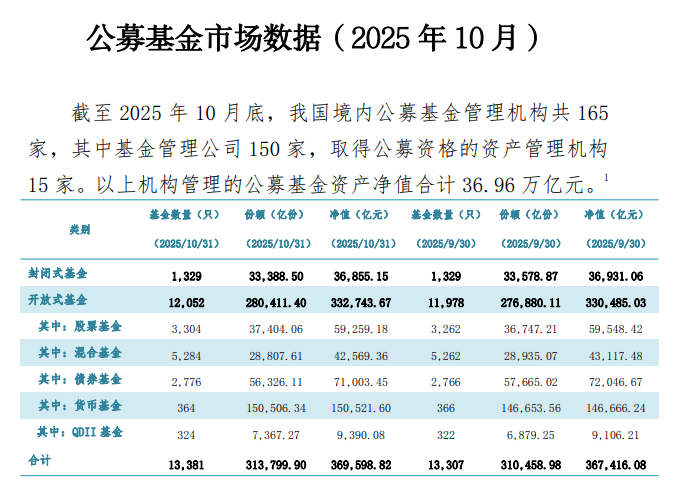
创新高!10月末公募基金规模达36.96万亿元
Guo Ji Jin Rong Bao· 2025-11-29 01:03
Core Insights - As of October 31, 2025, the total net asset value of public funds in China reached a record high of 36.96 trillion yuan, reflecting a month-on-month increase of 0.59% from 36.74 trillion yuan at the end of September 2025 [1] Fund Management Institutions - There are 165 public fund management institutions in China, including 150 fund management companies and 15 asset management institutions with public qualifications [1] Fund Categories Overview - The total number of funds is 13,381, with a total share of 313.80 billion and a net value of 369.60 billion yuan as of October 31, 2025 [3] - The number of closed-end funds stands at 1,329, with a net value of 36,855.15 billion yuan [3] - The number of open-end funds is 12,052, with a net value of 332,743.67 billion yuan [3] Specific Fund Types - Stock funds reached a net value of 5.93 trillion yuan, while mixed funds and bond funds had net values of 4.26 trillion yuan and 7.1 trillion yuan, respectively, showing slight month-on-month declines [3] - QDII funds and money market funds achieved net values of 9.39 trillion yuan and 15.05 trillion yuan, with month-on-month growth rates of 3.12% and 2.63% respectively [3]
【干货】一图看懂2025年3季报,投顾组合基金背后的投资秘诀
银行螺丝钉· 2025-11-20 12:54
Core Viewpoint - The article provides an overview of the updated active fund manager pool information for the third quarter of 2025, highlighting various metrics such as investment style, stock allocation, industry preferences, turnover rates, and fund sizes. Group 1: Fund Manager Information - The article includes a detailed summary of fund managers categorized by their investment styles, such as value and growth, along with their respective fund names and codes [4][5][6]. - Key metrics for each fund manager include their experience, stock allocation percentages, and the concentration of holdings [11][12][21][22]. Group 2: Fund Characteristics - The article discusses the importance of analyzing fund characteristics such as investment style, industry preference, and stock concentration when evaluating fund performance [34][36][48][53]. - It emphasizes that different investment styles exhibit varying performance over time, with value and growth styles alternating in strength [36][48]. Group 3: Fund Performance Metrics - The article outlines critical performance metrics such as stock allocation, turnover rates, and fund sizes, which are essential for assessing fund managers' effectiveness [43][59][61]. - It notes that a higher stock allocation typically leads to greater volatility in fund performance [45]. Group 4: Fund Manager Insights - The article highlights the significance of fund managers' insights in their reports, which include reflections on past performance and future market outlooks [62][63]. - It points out that the depth and detail of these insights can vary significantly among fund managers, impacting investor understanding [63].

“指数基金”不是“随便买”,得看“跟踪标的与费率”
Sou Hu Cai Jing· 2025-10-12 14:16
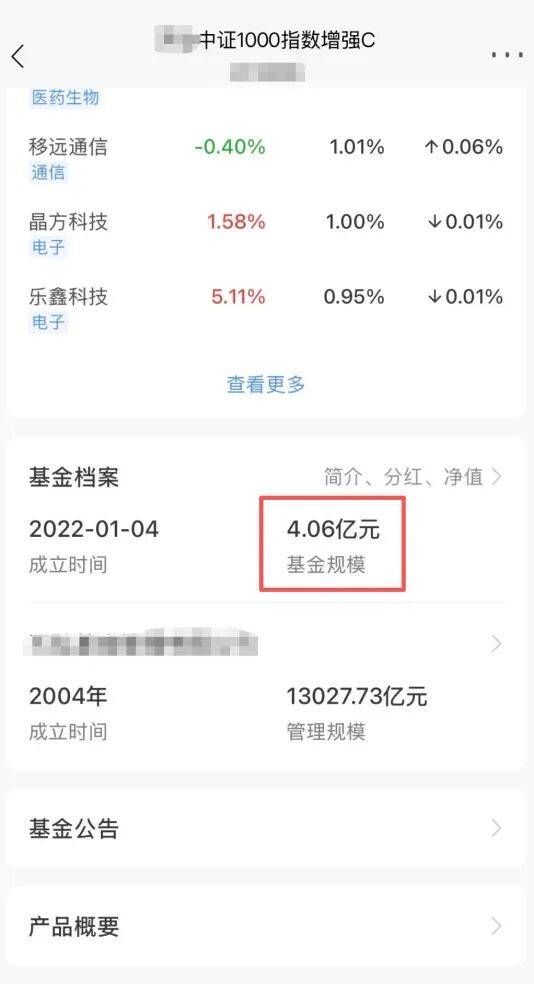
Group 1 - The core concept of index funds is to replicate the performance of a specific index, such as the CSI 300 Index, which means the fund should rise and fall in line with the index [1][2] - Different index funds can have significant differences in performance due to tracking errors, management fees, and fund size, which can affect overall returns [2][3] - Key selection criteria for index funds include checking the tracking index, ensuring a low tracking error (preferably less than 0.3% over the past year), keeping management and custody fees below 0.5%, and selecting funds with a size greater than 500 million to avoid liquidation risks [2][3] Group 2 - High management fees can erode profits over time, with a 1.5% fee compared to a 0.5% fee resulting in double the cost, impacting long-term returns [2] - Funds with small sizes (below 200 million) are at risk of being liquidated, which can delay access to invested capital [2][3] - Investors should choose funds that align with their investment goals, such as large-cap stocks through the CSI 300 Index or growth stocks through the CSI 500 Index, avoiding mismatches between fund names and tracking indices [2][3]

买基金要看基金的资金规模吗?规模多少合适?
Sou Hu Cai Jing· 2025-10-09 11:48
Core Insights - The size of a fund, often overlooked, significantly impacts investment decisions and reflects market recognition of the fund [4][8] - Fund size is strictly regulated in China, with specific thresholds for initial fundraising and ongoing maintenance to avoid forced liquidation [4] Fund Size Implications - A larger fund size provides stability and risk resistance, akin to a large ocean liner that can weather market fluctuations without severe impacts [4] - Large funds can leverage resources such as experienced fund managers and robust research teams, enhancing their operational capabilities [4] - Conversely, large funds may lack flexibility, making it difficult to adjust portfolios quickly in response to market changes [5] Small Fund Dynamics - Smaller funds are more agile, allowing for rapid adjustments to investment strategies and the ability to capitalize on short-term market opportunities [5] - However, smaller funds have weaker risk resistance, making them more susceptible to market volatility [5] Choosing the Right Fund Size - Investors should avoid funds with sizes close to 50 million yuan, as they face stability issues and liquidation risks [6] - For money market funds, larger sizes are preferable to ensure liquidity and manage redemption effectively [6] - In bond funds, sizes below 1 billion yuan may struggle to secure competitive trading conditions, while excessively large funds may be forced into lower-yield investments [6] - Equity funds with sizes between 200 million and 1 billion yuan tend to show the best long-term performance, balancing flexibility and risk [7] Conclusion - Fund size is a critical factor influencing stability, flexibility, and potential returns, making it essential for investors to consider when selecting funds [8]
暴增1.17万亿,新高
Hua Er Jie Jian Wen· 2025-09-25 22:38
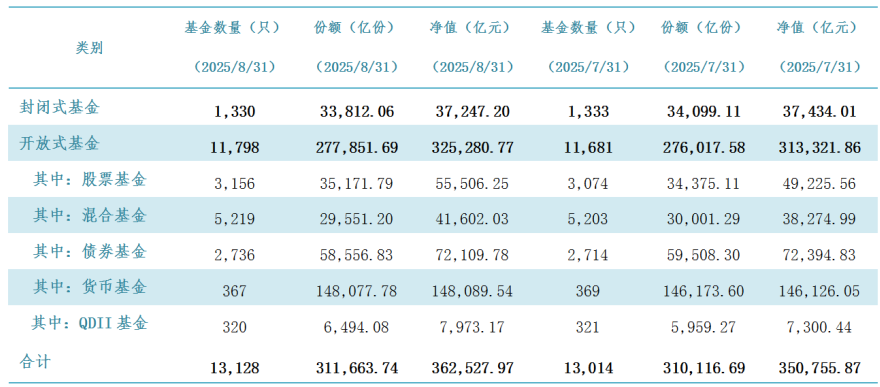
Core Insights - The total net asset value of public funds in China reached a new high of 36.25 trillion yuan as of August 31, 2025, an increase of 1.177 trillion yuan from the previous high in July 2025 [1] Fund Categories Summary - The number of public fund management institutions in China stands at 164, including 149 fund management companies and 15 asset management institutions with public qualifications [1] - Equity funds saw a significant increase in both share and scale, with a growth of 628.069 billion yuan [2] - Mixed funds continued the trend from July, experiencing a reduction in shares but achieving a scale increase of over 332.7 billion yuan due to net value growth [3] - Bond funds experienced a rare dual decline in both shares and scale [3] Fund Data Overview - As of August 31, 2025, the following data was reported: - Closed-end funds: 1,330 funds, 3,381.206 million shares, 372.472 billion yuan net value; slight decrease in fund numbers and net value from July [4] - Open-end funds: 11,798 funds, 27,785.169 million shares, 325.280 billion yuan net value; increase in both shares and net value from July [4] - Equity funds: 3,156 funds, 3,517.179 million shares, 555.0625 billion yuan net value; increase in shares and net value from July [4] - Mixed funds: 5,219 funds, 2,955.120 million shares, 416.0203 billion yuan net value; slight decrease in shares but increase in net value from July [4] - Bond funds: 2,736 funds, 5,855.683 million shares, 721.0978 billion yuan net value; slight decrease in shares and net value from July [4] - Money market funds: 367 funds, 14,807.778 million shares, 148.08954 billion yuan net value; increase in shares and net value from July [4] - QDII funds: 320 funds, 649.408 million shares, 79.7317 billion yuan net value; increase in shares and net value from July [4]
高位发行基金仍在“潜水” 投资者信心待恢复
Zheng Quan Shi Bao· 2025-09-01 00:10
Core Insights - A total of 817 active equity funds are currently in a "submerged" state with net asset values below 1 yuan as of August 29, 2023, with 726 of these funds established between 2020 and 2022, accounting for over 88% [1][4] - The latest 2025 semi-annual report indicates a significant reduction in both the scale and number of investors in these high-positioned funds, with 648 equity funds experiencing a decline of over 1 trillion yuan in total scale and a drop in investor accounts from 51.12 million to 24.05 million, a decrease of over 50% [1][4] Fund Performance - Among the 94 ordinary stock funds with net asset values below 1 yuan, 78 were established during the market peak from 2020 to 2022, representing 82.98% [2] - Notable funds include "Open Vision," which was launched in July 2020 with a fundraising scale of nearly 17 billion yuan, currently showing a cumulative loss of 22.48% since inception despite a 20.11% return this year [2] - The "Growth Pioneer" fund, established in June 2020 with over 32 billion yuan, has a cumulative loss of 16.31% since inception, despite a 28% return this year [3] Scale and Investor Reduction - The total scale of the 78 stock funds with net values below 1 yuan has decreased from 202.72 billion yuan to 59.23 billion yuan, a reduction of over 70% [4] - The 648 high-positioned equity funds have seen their total scale shrink from 1,620.99 billion yuan to 540.94 billion yuan, a decline of over 1 trillion yuan, or more than 66% [4] - The number of investors in these funds has also significantly decreased, with the 78 stock funds reporting a drop from 5.20 million to 2.56 million accounts, a reduction of over 50% [4][5] Investor Confidence - Despite a new market rally in 2025, investor confidence in actively managed equity funds remains low, with many funds still below the 1 yuan threshold [7] - The industry is undergoing a transformation, moving away from extreme thematic investments and focusing on improving research mechanisms and investor experiences [7]
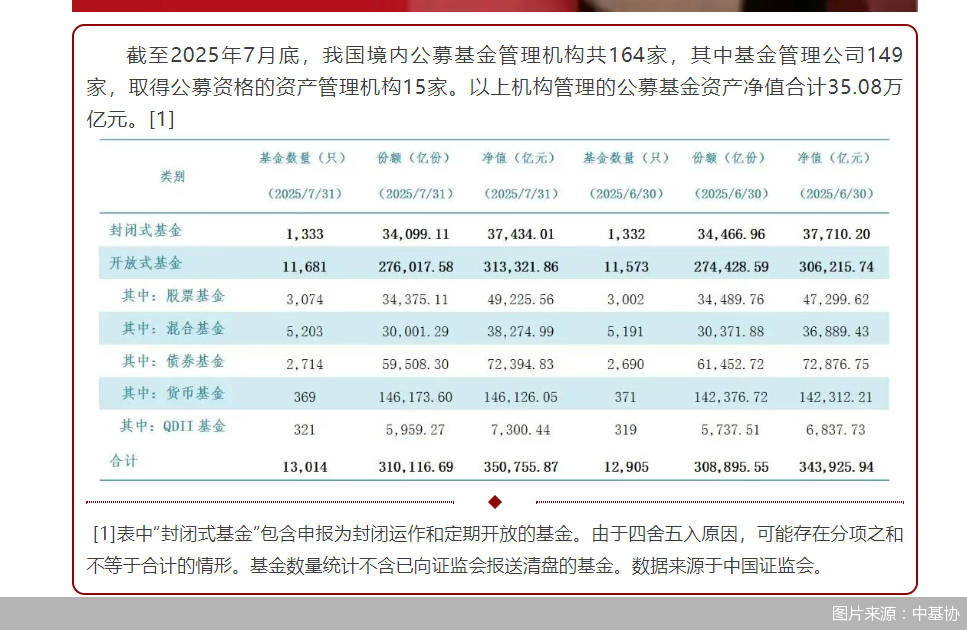
35.08万亿元!公募基金规模再创新高
Bei Jing Shang Bao· 2025-08-26 10:30
Core Insights - As of July 31, 2025, there are 164 public fund management institutions in China, including 149 fund management companies and 15 asset management institutions with public qualifications, managing a total net asset value of 35.08 trillion yuan [1][2] Fund Size and Growth - The latest scale of various fund types has increased month-on-month, except for bond funds. The sizes of stock funds, mixed funds, money market funds, and QDII funds as of the end of July are 4.92 trillion yuan, 3.83 trillion yuan, 14.61 trillion yuan, and 730.44 billion yuan, reflecting month-on-month growth rates of 4.07%, 3.76%, 2.68%, and 6.77% respectively [1][2] - In contrast, the size of bond funds has decreased by 0.66%, with a current value of 7.24 trillion yuan [1][2] Fund Categories Overview - The total number of funds is 13,014, with a total net value of 350.76 billion yuan, showing an increase from the previous month [2] - The breakdown of fund categories includes: - Closed-end funds: 1,333 funds with a net value of 37,434.01 billion yuan - Open-end funds: 11,681 funds with a net value of 313,321.86 billion yuan - Stock funds: 3,074 funds with a net value of 49,225.56 billion yuan - Mixed funds: 5,203 funds with a net value of 38,274.99 billion yuan - Bond funds: 2,714 funds with a net value of 72,394.83 billion yuan - Money market funds: 369 funds with a net value of 146,126.05 billion yuan - QDII funds: 321 funds with a net value of 7,300.44 billion yuan [2]