中欧红利优享A

Search documents
“顶流”基金经理大起底
Zhong Guo Ji Jin Bao· 2026-02-08 03:13
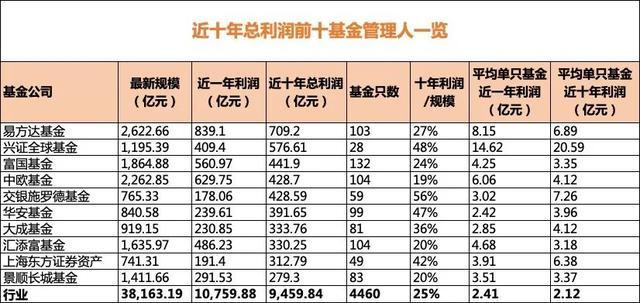
Core Insights - The active equity fund industry in China has generated nearly 1 trillion yuan in profits over the past decade, with significant contributions from leading fund companies [2][4] - Among 29 fund managers managing over 20 billion yuan, only 11 have consistently outperformed benchmarks over 1, 3, and 5 years, indicating a notable divergence in management capabilities [1][6] Industry Performance - The total profit generated by active equity funds in the last ten years reached 9,459.84 billion yuan, with an annual profit of 10,759.88 billion yuan in 2025 [2][4] - The top ten fund management companies contributed nearly 40% of the total profits, with E Fund, Xingzheng Global Fund, and Fortune Fund leading the profit rankings [3][4] Fund Manager Analysis - E Fund achieved the highest total profit of 709.20 billion yuan over ten years, while Xingzheng Global Fund demonstrated high profitability relative to its size, with a profit-to-scale ratio of 48% [4][6] - A select group of fund managers, including Yang Dong and Liu Jianwei, have shown exceptional performance, with some achieving over 100% excess returns over various time frames [7][8] Future Industry Trends - The industry is entering a new phase where the focus is shifting from mere scale growth to long-term value creation efficiency and the ability to manage large funds effectively [9] - Developing a robust investment research system that is resilient to market style changes and nurturing talent capable of managing large-scale funds will be crucial for high-quality development in the future [9]

金融工程专题研究:公募FOF基金2025年四季报解析
Guoxin Securities· 2026-01-27 14:18
- The report categorizes FOFs into three types based on the proportion of equity assets: debt-biased FOFs, balanced FOFs, and equity-biased FOFs[2][13] - The total number of FOF products established by the end of Q4 2025 is 549, with a combined scale of 2441.88 billion yuan, an increase of 26.20% compared to Q3 2025[2][12] - The scale of debt-biased FOFs, balanced FOFs, and equity-biased FOFs in Q4 2025 are 1611.13 billion yuan, 454.77 billion yuan, and 375.98 billion yuan respectively[2][13] - The median returns for debt-biased FOFs, balanced FOFs, and equity-biased FOFs in Q4 2025 are 0.33%, -0.64%, and -1.21% respectively[2][24] - The most heavily allocated active equity funds by FOFs are 富国稳健增长A, 博道久航C, and 中欧红利优享A[3][32] - The active equity funds with the largest FOF holdings are 兴全商业模式优选A, 易方达信息行业精选C, and 易方达科融[3][33] - The most heavily allocated passive index equity funds by FOFs are 永赢中证沪深港黄金产业股票ETF, 华夏恒生科技ETF, and 富国中证港股通互联网ETF[36] - The passive index equity funds with the largest FOF holdings are 华夏恒生ETF, 永赢中证沪深港黄金产业股票ETF, and 华夏恒生科技ETF[36] - The most heavily allocated enhanced index funds by FOFs are 汇添富国证2000指数增强A, 招商沪深300指数增强C, and 招商中证500等权重指数增强C[37] - The enhanced index funds with the largest FOF holdings are 汇添富国证2000指数增强A, 国泰海通中证500C, and 汇添富中证1000指数增强A[37] - The most heavily allocated bond funds by FOFs are 广发纯债A, 易方达岁丰添利A, and 兴全稳泰A[40] - The bond funds with the largest FOF holdings are 国泰利享中短债A, 富国国有企业债C, and 富国产业债A[40] - The most heavily allocated "fixed income+" funds by FOFs are 景顺长城景颐双利A, 西部利得汇享A, and 华泰保兴尊合A[42] - The "fixed income+" funds with the largest FOF holdings are 富国天利增长债券A, 易方达裕祥回报A, and 易方达稳健收益A[42] - The active equity funds with the highest estimated net increase in FOF holdings in Q4 2025 are 易方达改革红利, 景顺长城稳健回报C, and 中欧小盘成长C[44][48] - The active equity funds with the largest estimated net increase in FOF holdings in Q4 2025 are 景顺长城稳健回报C, 国泰海通量化选股D, and 西部利得研究精选C[44][48] - The bond funds with the highest estimated net increase in FOF holdings in Q4 2025 are 天弘信利C, 华夏短债A, and 鹏华丰恒A[50] - The bond funds with the largest estimated net increase in FOF holdings in Q4 2025 are 国泰利享中短债A, 富国国有企业债C, and 富国产业债A[50] - The top three active equity fund managers with the most FOF allocations in Q4 2025 are 杨梦, 范妍, and 刘健维[52][53] - The top three "fixed income+" fund managers with the most FOF allocations in Q4 2025 are 李怡文, 王晓晨, and 彭成军[54] - By the end of Q4 2025, 168 FOFs directly invested in stocks, with balanced FOFs having the highest proportion of stock investments, followed by equity-biased FOFs[60][61] - The top three stocks most heavily allocated by FOFs are 紫金矿业, 宁德时代, and 寒武纪-U[63] - The stocks with the largest FOF holdings are 宁德时代, 中国东航, and 盛达资源[63]





对话中欧价值派:一场关于长期、理性与专注的深谈
雪球· 2025-12-26 07:51
Core Viewpoint - Value investing remains a timeless topic in the Chinese capital market, with few investors successfully implementing its core principles over the long term [2][3]. Group 1: Value Investment Characteristics - Excellent value fund managers possess traits such as independence, objectivity, long-term investment focus, contrarian decision-making, perseverance, and prudence [3]. - The CSI 800 Value Index has shown superior performance compared to the CSI 800 Growth Index over the past decade, with better annualized returns and lower maximum drawdowns [3]. Group 2: Long-term Value Investment in Domestic Fund Companies - China Europe Fund is one of the few companies with a strong tradition of long-term value investing, boasting a team of seven value fund managers with an average experience of over 13 years [6]. - The value team at China Europe Fund has generated over 10 billion in profits this year, indicating the effectiveness of a diversified value team built on an "industrialized" research system [6]. Group 3: Individual Fund Manager Insights - Blue Xiaokang, head of the value team at China Europe Fund, manages over 25 billion and has consistently outperformed benchmarks since 2019 [8]. - Blue Xiaokang emphasizes insights, valuation, systematic thinking, rationality, and altruism in his investment philosophy, focusing on macroeconomic trends [8][9]. - He believes that the valuation of Chinese financial stocks is underestimated and that the bad debt ratio in the domestic banking sector will not be as pessimistic as previously thought [9]. Group 4: Team Dynamics and Decision-Making - The decision-making process within the value team at China Europe Fund is characterized by equality and open communication, with the team leader fostering a collaborative environment [14][16]. - Each fund manager in the team has unique characteristics and investment styles, contributing to a diverse and effective investment approach [15][21]. Group 5: Long-term Investment Philosophy - The long-term thinking of the management and shareholders at China Europe Fund supports the implementation of a long-term strategy, enhancing governance advantages [26]. - The company is committed to continuous organizational innovation and has introduced an "industrialized" research system to support its long-term investment philosophy [26][27].

焦点关注:年末权益基金攻防分化,谁更适配跨年行情?
Di Yi Cai Jing· 2025-12-04 13:35
Core Viewpoint - The year-end market dynamics reveal a split among institutional investors, with some adopting a cautious approach to lock in gains while others see market fluctuations as a buying opportunity [3][4][7]. Group 1: Market Performance and Fund Strategies - As of December 3, the average return of 4,686 active equity funds since November has been -2.67%, indicating a significant reduction in performance volatility compared to previous months [3]. - Notably, several high-performing funds with over 50% annual returns have shown reduced monthly volatility, suggesting that fund managers have likely made adjustments to their portfolios [4]. - A significant number of funds, 223, have implemented purchase limits to manage scale and protect existing investors, with some funds limiting daily purchases to as low as 1,000 yuan [5]. Group 2: Investment Outlook and Strategies - Analysts expect that the A-share market will experience a positive trend despite short-term fluctuations, with a potential opening for cross-year investment opportunities [7][8]. - The technology sector is highlighted as a key area for investment, with expectations of continued growth driven by AI and other technological advancements [8][9]. - There is a focus on sectors with high economic vitality, such as technology manufacturing and materials, as well as consumer goods that have already priced in pessimistic forecasts [9].

年末权益基金攻防分化,谁更适配跨年行情?
Di Yi Cai Jing· 2025-12-04 12:48
Core Viewpoint - The year-end market dynamics show a divergence in strategies among institutional investors, with some adopting a cautious approach while others see opportunities in market fluctuations [1][4]. Group 1: Year-End Market Dynamics - As of December 3, the average return of 4,686 active equity funds since November has been -2.67%, indicating a significant reduction in performance volatility compared to previous months [1]. - Notably, several high-performing funds with over 50% annual returns have shown a marked decrease in monthly volatility, suggesting that fund managers have likely made adjustments to their portfolios [2]. - A total of 223 active equity funds have suspended large-scale subscriptions, with 28 funds limiting daily subscriptions to no more than 10,000 yuan to protect existing investors [2][3]. Group 2: Fund Manager Strategies - Some fund managers have reduced stock positions and adjusted their holdings to mitigate risks, while others believe that current market fluctuations may present new buying opportunities [2][4]. - New funds launched in the fourth quarter are rapidly building positions, with nearly 90% of 69 newly established active equity products experiencing net value fluctuations, indicating active investment strategies [3]. Group 3: Market Expectations - Analysts expect that the A-share market will enter a period of upward momentum, with short-term fluctuations not altering the overall positive trend [4][5]. - The market is anticipated to benefit from improved economic conditions, favorable liquidity, and supportive policies, which are expected to strengthen A-shares [5]. Group 4: Sector Focus - The technology sector is highlighted as a key area for investment, with analysts suggesting that high-growth and potential reversal opportunities should be prioritized [5][6]. - Traditional consumer goods, particularly in the leisure food and white goods sectors, are also noted for their attractive dividend yields, making them worthy of attention in the context of year-end valuation adjustments [6].
富国基金女将手握170亿,基民却有点急了
Sou Hu Cai Jing· 2025-11-22 15:15
Core Insights - The article highlights the significant growth in assets under management (AUM) for certain fund managers, particularly noting the rise of manager Fan Yan from 3.4 billion to 17.1 billion within a year, attributed to institutional investments and the launch of new funds [2][3][5]. Fund Performance and Management - Fan Yan's management of the "Fuguo Stable Growth Fund" saw AUM increase from 520 million to 3.4 billion shortly after she took over, with the fund's performance historically poor before her arrival [2][3]. - The fund's institutional ownership surged from 0% to 80.64% over a year, indicating strong institutional interest [3]. - Despite the AUM growth, Fan Yan's fund performance has been underwhelming compared to peers, with a one-year return of 20.73%, significantly trailing the average return of 26.46% for similar funds [5][6]. Comparison with Peers - Other fund managers, such as Lan Xiaokang from China Europe Fund, have outperformed Fan Yan, achieving returns of 38.93% over the same period [6][7]. - Newer fund managers like Ren Jie from Yongying Fund have seen explosive growth, with returns of 196.95% and AUM increasing from 25.2 million to 11.5 billion [6][7]. Investment Strategy - Fan Yan's investment strategy is characterized by a balanced and diversified approach, with the top ten holdings only accounting for 14.20% of the fund's net value, which contrasts with peers who have higher concentrations in their top holdings [9][10]. - The diversified nature of her portfolio, while aimed at risk mitigation, has resulted in less aggressive performance compared to more concentrated strategies employed by other successful fund managers [10]. Company Performance - Fuguo Fund, despite its historical success, has faced declining profits, with net profit dropping from 25.64 billion in 2021 to 1.75 billion by the end of 2024 [14]. - The company has been actively recruiting well-known fund managers to improve performance, but the results have yet to reflect a significant turnaround [12][14].

权益投资求稳优选 中欧价值领航今起正式发行
Xin Lang Ji Jin· 2025-10-16 01:18
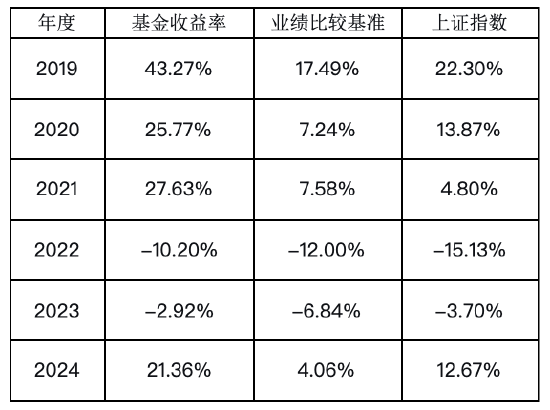
Group 1 - The core viewpoint of the articles highlights the supportive policies for the domestic capital market in response to various challenges, leading to a significant boost in market sentiment, with the Shanghai Composite Index surpassing 3900 points for the first time in nearly a decade [1][2] - The launch of the China Europe Value Navigation Mixed Securities Investment Fund aims to provide a value-focused, actively managed equity product that emphasizes risk control, catering to investors in a volatile market environment [1][2] - The fund is positioned as a value-style fund with a flexible investment strategy that combines large-cap value and growth strategies, along with a reversal strategy for dynamic portfolio adjustments [2][6] Group 2 - The fund's proposed manager, Lan Xiaokang, has over 14 years of experience in the securities industry and has developed a mature investment framework that balances macroeconomic trends with in-depth analysis of undervalued, high-quality stocks [2][3] - Lan Xiaokang's management of existing funds has shown significant outperformance against benchmarks, with the China Europe Dividend Preferred A fund achieving a consistent track record of excess returns over six years [3][4] - The fund's risk management approach includes careful stock selection, focusing on large-cap, low-volatility stocks, and maintaining industry diversification to mitigate concentrated risks [6][7] Group 3 - The China Europe Dividend Preferred A fund has demonstrated strong performance, with annual returns significantly exceeding its benchmark in multiple years, showcasing its ability to navigate market fluctuations [4][7] - The fund's maximum drawdown has been controlled effectively, with a maximum drawdown of -25%, which is lower than the benchmark's -26% and significantly better than the broader market's -45% [6][7] - Looking ahead, the manager identifies investment opportunities in traditional industries and emphasizes the importance of identifying high-quality companies with low price-to-book ratios across various sectors [6][7]
“不扎堆”也能赢 基金经理练就多元配置硬实力
Zhong Guo Zheng Quan Bao· 2025-08-08 07:16
Core Viewpoint - The performance of public funds in the first half of the year has shown a significant focus on thematic investments, particularly in the innovative pharmaceutical sector, leading to high returns but also high volatility, which may deter ordinary investors from participating [1][2]. Group 1: Fund Performance - Many actively managed equity funds that ranked highly in performance during the first half of the year primarily focused on thematic investments such as innovative drugs, the Beijing Stock Exchange, and robotics [2]. - Fund managers like Gao Nan achieved over 25% returns by diversifying investments across high-growth sectors like innovative drugs and semiconductors, while also including more stable sectors [2]. - Value-oriented fund manager Lan Xiaokang reported returns of 17.44% and 16.20% for his funds, focusing on high-dividend stocks and cyclical commodities [3]. - The cyclical fund managed by Ye Yong achieved a return of 26.62%, emphasizing investments in precious metals and oil [3]. - Quantitative fund managers Yao Jiahong and Ma Fang reported a return of 20.02%, with a diversified portfolio across various industries [4]. Group 2: Investment Strategies - The China Securities Regulatory Commission's new action plan aims to bind fund manager compensation to fund performance, potentially leading to a shift towards more conservative investment strategies [5][6]. - Fund managers are expected to focus more on absolute valuation metrics, cash flow, and shareholder returns, reducing short-term trading motivations [5][6]. - Looking ahead, fund managers anticipate opportunities for fundamental resonance as the economy continues to recover, with a focus on high ROE and high-dividend assets [6][7]. - The "barbell strategy" is favored, combining stable assets with growth-oriented investments, particularly in sectors like technology and military [6][7].
“不扎堆”也能赢基金经理练就多元配置硬实力
Zhong Guo Zheng Quan Bao· 2025-07-02 20:16
Core Insights - The performance of public funds in the first half of the year has been significantly influenced by thematic investments, particularly in the innovative pharmaceutical sector and the Beijing Stock Exchange [1][2] - Despite the high volatility associated with concentrated investment strategies, some fund managers have successfully achieved stable returns through diversified approaches [1][2] Group 1: Fund Performance - Many top-performing active equity funds in the first half of the year focused heavily on thematic investments, such as innovative pharmaceuticals and robotics [2] - Growth-oriented fund manager Gao Nan achieved over 25% returns with a strategy that included both high-growth sectors like innovative pharmaceuticals and semiconductor industries, as well as more stable sectors like home furnishings [2] - Value-oriented fund manager Lan Xiaokang's fund achieved a return of 17.44%, focusing on high-dividend stocks and sectors like finance and precious metals [3] - The cyclical fund managed by Ye Yong recorded a return of 26.62%, emphasizing investments in resource stocks such as precious metals and oil [4] - The quantitative fund managed by Yao Jiahong and Ma Fang achieved a return of 20.02%, with a diversified portfolio across various industries [4] Group 2: Investment Strategies - The China Securities Regulatory Commission's new action plan aims to link fund manager compensation more closely to fund performance, potentially leading to a shift in investment strategies [5] - Fund managers are expected to focus more on absolute valuation metrics, emphasizing cash flow, competitive advantages, and dividend capabilities [5] - The outlook for the equity market in the second half of the year is optimistic, with expectations of economic recovery and opportunities for fundamental resonance [6] - The "barbell strategy" is favored, focusing on both high-return, high-dividend assets and growth-oriented sectors, particularly in the technology and military industries [6]
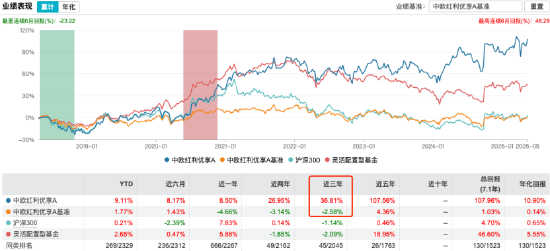
新规下的价值派突围:中欧蓝小康以39%超额收益重塑“高股息战略”,中欧红利优享近五年回报108%
Xin Lang Ji Jin· 2025-05-15 09:55
Core Insights - The China Securities Regulatory Commission (CSRC) has implemented the "Action Plan for Promoting High-Quality Development of Public Funds," which ties fund manager compensation to long-term performance, shifting the industry focus from "scale expansion" to "performance-driven" strategies [1] - Fund manager Lan Xiaokang from China Europe Fund has gained market attention for his value investment approach, emphasizing the importance of systemic stability and the interconnectivity of industries for generating excess returns [1][5] Summary by Sections Policy Changes - The new policy aims to enhance the quality of public funds by linking manager compensation to sustained performance, promoting a culture of value investment [1] - This shift is expected to accelerate the transition of the public fund industry towards prioritizing performance over mere asset growth [1] Fund Performance - Lan Xiaokang manages four funds with a total scale of 11.912 billion yuan, with his flagship product, China Europe Dividend Enjoyment A, achieving a three-year return of 36.81%, significantly outperforming its benchmark by over 39% [1][3] - The fund has consistently ranked among the top in its category, with a five-year return of 107.56%, and has outperformed benchmarks by 103% over the same period [3] Investment Strategy - The investment strategy focuses on "safe assets," with significant holdings in banking, resources, and high-end manufacturing sectors [3] - The top ten holdings include major companies such as China Construction Bank and Sany Heavy Industry, reflecting a concentrated approach towards undervalued and high-dividend assets [4] Market Insights - Lan Xiaokang has expressed that Chinese banks are currently undervalued compared to their net assets, especially in contrast to U.S. banks, suggesting a potential systemic uplift in valuations [5] - He identifies key sectors such as technology, defense, and financial security as critical to China's long-term competitiveness, advocating for a focus on high-dividend investments and traditional industries [5][6] Challenges and Considerations - The new performance-linked compensation structure highlights the need for fund managers to balance policy benefits with market trends, presenting a long-term challenge for value-oriented fund managers [6]