
小核酸(siRNA)管线产品

Search documents
守好管线“方寸地” 亮出中国创新药“新底气”
Xin Lang Cai Jing· 2026-02-27 23:18
Core Insights - The article highlights the significant collaboration between Frontier Biopharmaceuticals and GSK, marking a pivotal moment for Chinese innovative drugs as they transition from "following" to "leading" in the global market [1] Group 1: Strategic Alignment - The partnership between Frontier Biopharmaceuticals and GSK is based on mutual strategic alignment, focusing on the complementarity of assets and the competitive strength of the products [2] - GSK's selection criteria for partners include strategic synergy, asset competitiveness, and the overall strength of the partner, emphasizing the importance of a robust research team and effective resource integration [2][3] Group 2: Technological Depth - Frontier Biopharmaceuticals has built a strong foundation in technology and pipeline development, focusing on multi-target and multi-indication small nucleic acid pipelines that address major diseases [4] - The company emphasizes a "full-chain layout and differentiated R&D" approach, integrating research, clinical, production, and commercialization into a comprehensive system [5] Group 3: Pipeline Development - The company has several small nucleic acid pipelines, including FB7013, FB7011, FB7023, and FB7033, with a structured approach to development and a focus on clinical differentiation [6] - The company aims to leverage its long-standing expertise in peptide drug development to enhance the delivery technology for small nucleic acids, which is a critical barrier in this field [6][7] Group 4: Innovative Collaboration Model - The collaboration with GSK is expected to yield significant potential revenue, including an upfront payment of $40 million, milestone payments totaling $1.3 billion, and tiered royalties on global net sales [8] - Frontier Biopharmaceuticals will lead the Phase I clinical trials in China, benefiting from lower costs and efficient project progression while gaining valuable experience in early clinical research [8] Group 5: Future Directions - The company will not transition solely to an early-stage licensing model but will maintain a diverse portfolio, including innovative drugs and high-end generics, to support ongoing R&D [9] - Frontier Biopharmaceuticals plans to adopt flexible business models for global collaborations while retaining control over strategically aligned pipelines [9]


创新药海外授权合作密集落地 中国药企加速全球化布局
Zhong Guo Zheng Quan Bao· 2026-02-27 21:50
Core Insights - The domestic innovative pharmaceutical industry is experiencing a surge in overseas business development (BD) collaborations, with companies like Xianweida, Frontier Biotech, and HAPO Pharmaceuticals announcing significant overseas licensing agreements, indicating a shift from single product licensing to technology transfer and global collaboration [1][4] Group 1: Recent Collaborations - Xianweida and Pfizer China have entered a commercialization strategic cooperation agreement for the GLP-1 receptor agonist Enogratide, with potential payments totaling up to $495 million [2] - Frontier Biotech has signed an exclusive licensing agreement with GlaxoSmithKline (GSK) for two small RNA products, receiving an upfront payment of $40 million and potential milestone payments totaling up to $950 million [2] - HAPO Pharmaceuticals has partnered with Solstice Oncology for the exclusive development and commercialization rights of HBM4003 outside Greater China, with an upfront payment of over $105 million and potential milestone payments of up to $1.1 billion [3] Group 2: Market Trends and Growth - The overseas BD transactions for Chinese innovative drugs are projected to grow significantly, with total transaction amounts increasing from $2.562 billion in 2017 to $140.274 billion by 2025, indicating a robust growth trajectory [5] - In January 2026, several companies, including Rongchang Biotech and Shiyao Group, have already established overseas licensing agreements, showcasing the ongoing momentum in international collaborations [4] Group 3: Financial Performance and Projections - Companies like Frontier Biotech and HAPO Pharmaceuticals are expected to see improved cash flow and financial structures due to their recent collaborations, which will support core pipeline development and technology platform upgrades [5] - HAPO Pharmaceuticals anticipates a net profit between $88 million and $95 million for 2025, driven by recurring revenue from international collaborations [6] - Three Life Health reported a revenue of 4.199 billion yuan for 2025, a 251.81% increase year-on-year, largely attributed to its collaboration with Pfizer [7] Group 4: Future Trends and Strategic Focus - The internationalization of Chinese innovative drugs is driven by both demand from multinational pharmaceutical companies facing patent cliffs and the recognition of the quality of Chinese drug research and development [8] - The BD landscape in 2026 is expected to focus on unmet clinical needs, technological differentiation, and global value, particularly in oncology and metabolic disease sectors [8] - Analysts suggest that the BD transactions will evolve towards technology output combined with product licensing, platform collaborations, and global innovation, emphasizing the importance of evaluating companies' platform capabilities and clinical milestone achievements [8]
创新药海外授权合作密集落地中国药企加速全球化布局
Zhong Guo Zheng Quan Bao· 2026-02-27 20:43
Core Insights - The domestic innovative pharmaceutical companies are increasingly engaging in overseas business development (BD) collaborations, marking a shift from single product licensing to technology transfer and platform co-construction, indicating a globalized value realization in China's innovative drug industry [1][4]. Group 1: Multi-Track Collaborations - Xianweida and Pfizer China have entered a commercialization strategic cooperation agreement for the GLP-1 receptor agonist, with potential payments totaling up to $495 million [1]. - Frontier Biotech has signed an exclusive licensing agreement with GSK for two small RNA products, receiving an upfront payment of $40 million and potential milestone payments totaling up to $950 million [2]. - HAPO Pharma has partnered with Solstice Oncology for the exclusive development and commercialization rights of HBM4003 outside Greater China, with an upfront payment of $50 million and potential milestone payments of up to $1.1 billion [3]. Group 2: Performance and Financial Impact - The surge in overseas licensing agreements is expected to enhance cash flow and support R&D for companies like Frontier Biotech, which anticipates improved financial structure and long-term revenue from tiered royalties based on global net sales [4]. - The total value of overseas licensing transactions for Chinese innovative drugs is projected to grow from $2.562 billion in 2017 to $140.274 billion by 2025, indicating a significant increase in international competitiveness [5]. - Companies like HAPO Pharma and Qian Sheng Pharmaceutical are forecasting substantial revenue growth for 2025, driven by overseas licensing income and strategic collaborations [6]. Group 3: Trends and Future Outlook - The internationalization of Chinese innovative drugs is driven by both demand from multinational pharmaceutical companies facing patent cliffs and the recognition of the quality of Chinese drug R&D [7]. - The BD landscape in 2026 is expected to focus on unmet clinical needs, technological differentiation, and global value, with a particular emphasis on oncology and metabolic disease therapies [7]. - The successful performance of the innovative drug sector validates the effectiveness of the business model, with a shift towards companies demonstrating solid profitability and differentiated core products [7].
前沿生物董事长、总经理谢东:守好管线“方寸地” 亮出中国创新药“新底气”
Zheng Quan Ri Bao· 2026-02-27 16:22
Core Insights - The article highlights the rapid evolution of global pharmaceutical innovation, emphasizing that Chinese innovative drugs are transitioning from a "follower" to a "runner" and striving for "local leadership" in the industry [1] Group 1: Strategic Collaboration - Frontier Biopharmaceuticals (Nanjing) Co., Ltd. has entered a global exclusive licensing agreement with GlaxoSmithKline (GSK) for two early-stage small RNA (siRNA) pipeline products, potentially yielding over $1 billion in revenue [1][2] - The collaboration is based on strategic alignment, asset competitiveness, and the comprehensive strength of both companies, with GSK's robust R&D team and global commercialization capabilities being significant factors [2][3] Group 2: Technological Foundation - The recognition from GSK reflects Frontier Biopharmaceuticals' long-term commitment to technology and pipeline development, having established a multi-target, multi-indication pipeline matrix covering major diseases such as kidney disease and cardiovascular conditions [4] - The company's core competitiveness in the small RNA field is attributed to its "full-chain layout + differentiated R&D" approach, which integrates R&D, clinical, production, and commercialization [5][6] Group 3: Pipeline Development - Frontier Biopharmaceuticals has several small RNA pipelines, including FB7013, FB7011, FB7023, and FB7033, with plans for clinical data acquisition within 1-2 years for two products and IND submissions for others by 2027 [6] - The company is focusing on clinical differentiation and aims to avoid "Me-too" type developments by leveraging its dual-target and delivery technology advantages [6] Group 4: Business Model Innovation - The partnership with GSK not only provides substantial potential revenue but also serves as a benchmark for international standards, with Frontier Biopharmaceuticals managing the Phase I clinical trials in China [7][8] - The company maintains a flexible business model, balancing between global collaborations and retaining control over strategically aligned pipelines, ensuring a stable cash flow from existing innovative and high-end generic drugs [8]
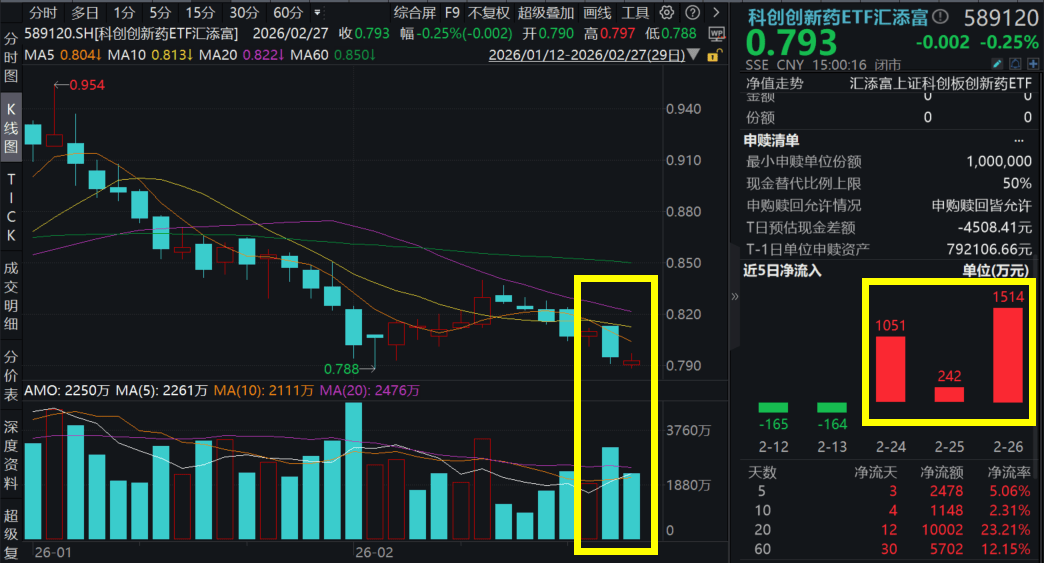
科创板小核酸龙头斩获BD大单!创新药行情承压,资金逆势涌入!科创创新药ETF汇添富(589120)连续3日吸金超2800万元!AI+脑机接口持续催化
Sou Hu Cai Jing· 2026-02-27 08:59
Core Viewpoint - The A-share market experienced fluctuations with the innovative drug sector under pressure, yet the Huatai-PineBridge Innovation Drug ETF (589120) saw a continuous inflow of funds, attracting over 28 million yuan in three days despite a slight decline of 0.25% [1][3]. Group 1: Market Performance - The Huatai-PineBridge Innovation Drug ETF (589120) showed mixed performance among its constituent stocks, with notable gains from Kangxinuo (up over 6%), Borui Pharmaceutical (up over 4%), and Yifang Bio (up over 3%), while Baijie Shenzhou and Baili Tianheng experienced declines [3][4]. - The ETF's top ten constituent stocks include Baijie Shenzhou-U with a decline of 2.18% and Ailis with a minimal decline of 0.02%, while Borui Pharmaceutical and Yifang Bio showed positive growth [4]. Group 2: Industry Developments - Kangxinuo reported a revenue of approximately 1.068 billion yuan for 2025, marking a year-on-year increase of 26.18%, and achieved profitability with a net profit of about 27.87 million yuan [5]. - A significant licensing agreement was established between Frontier Bio and GlaxoSmithKline (GSK), with an upfront payment of 40 million USD and a total deal value exceeding 1 billion USD for two early-stage siRNA products [5]. - The FDA's new review policy, which allows for a single key clinical trial plus confirmatory evidence for drug approval, is expected to significantly reduce development costs and timelines, benefiting the innovative drug sector [7][8]. Group 3: R&D and Financial Trends - By 2025, the funding levels for Chinese pharmaceutical companies are projected to increase significantly, with a total of 201.5 billion yuan expected from IPOs and other financing activities, reflecting a 145% year-on-year growth [9]. - The willingness of Chinese innovative drug companies to invest in R&D is on the rise, driven by new business models that enhance return rates and reduce risks [9][10]. - The innovative drug sector is transitioning from a phase of R&D investment to a phase of commercial returns, with over 70% of companies expected to achieve revenue growth by 2025 [10][11].

前沿生物:事件点评与GSK达成2个小核酸合作,有望谱写全球发展新篇章-20260226
Guolian Minsheng Securities· 2026-02-26 00:25
Investment Rating - The report maintains a "Buy" rating for the company [4]. Core Insights - The collaboration with GSK represents a significant opportunity for the company, enhancing its global development strategy and improving cash flow through upfront and milestone payments [2][9]. - The company is well-positioned in the siRNA drug discovery and development field, gaining international recognition and leveraging GSK's resources for clinical development and commercialization [2][9]. - The small nucleic acid drugs are a key focus area, with a broad pipeline addressing various diseases, indicating a promising market outlook [9]. Financial Projections - Revenue is projected to grow from 1.29 billion CNY in 2024 to 2.85 billion CNY in 2027, with growth rates of 13.3%, 23.1%, 38.0%, and 29.5% respectively [3][10]. - The net profit attributable to shareholders is expected to improve from -201 million CNY in 2024 to -174 million CNY in 2027, with growth rates of 38.8%, 7.5%, 2.1%, and 4.8% respectively [3][10]. - Earnings per share (EPS) is projected to gradually improve from -0.54 CNY in 2024 to -0.46 CNY in 2027 [3][10]. Market Position and Strategy - The company has established a comprehensive pipeline for small nucleic acid drugs, targeting conditions such as IgA nephropathy, hyperuricemia, cancer, and cardiovascular diseases [9]. - The collaboration with GSK is expected to accelerate the internationalization of the company's pipeline and lay a solid foundation for future product commercialization and global partnerships [2][9].
中国创新药“出海”势头强劲 年内海外授权总金额突破530亿美元
Zheng Quan Ri Bao· 2026-02-25 15:45
Core Insights - In 2026, China's innovative drug licensing-out transactions are experiencing strong momentum, with 44 licensing events reported by February 25, totaling approximately $31.23 billion in upfront payments and $53.28 billion in total deal value [1] - The trend indicates a shift in China's innovative drug industry from "catching up" to "keeping pace" and even "leading," marking a structural transition from "importing imitation" to "exporting innovation" [1] - The total value of China's innovative drug licensing-out transactions reached a record high of $135.66 billion in 2025, with 157 transactions and $7 billion in upfront payments [1] Group 1 - On January 16, 2026, Xibiman Biotech announced a deal with AstraZeneca for a 50% stake in the development and commercialization rights of C-CAR031 in China [2] - On January 30, 2026, CSPC Pharmaceutical Group signed a strategic R&D cooperation and licensing agreement with AstraZeneca to develop innovative long-acting peptide drugs [2] - On February 8, 2026, Innovent Biologics announced a strategic collaboration with Eli Lilly to advance global R&D of innovative drugs in oncology and immunology, with an upfront payment of $350 million and potential milestone payments of up to $8.5 billion [2] Group 2 - On February 24, 2026, Frontier Biotech announced an exclusive licensing agreement with GlaxoSmithKline (GSK) for two early-stage siRNA products, with an upfront payment of $40 million and potential milestone payments totaling up to $950 million [3] - On February 25, 2026, Dasheng Pharmaceutical announced an exclusive licensing agreement with Slate Medicines for a monoclonal antibody targeting PACAP, excluding Greater China [3] - The overall trend in cross-border cooperation is characterized by faster technological iterations, increased transaction scales, and deeper collaboration models [4] Group 3 - The new collaboration models are evolving from sporadic large projects to a more normalized and platform-based approach, indicating strong industry representation and long-term resilience [4] - Heptares Therapeutics announced a collaboration with Solstice Oncology, including an exclusive licensing and equity cooperation agreement, with an upfront payment exceeding $105 million [5] - The transaction models are shifting from early-stage "selling seedlings" to joint development and regional licensing, reflecting a transition towards quality and value competition in the industry [5]
开年迎超10亿美元授权,前沿生物“押宝”百亿小核酸药物赛道
Bei Ke Cai Jing· 2026-02-25 06:44
Core Viewpoint - Frontier Biopharmaceuticals (Nanjing) Co., Ltd. has entered into an exclusive licensing agreement with GlaxoSmithKline (GSK) for two early-stage small interfering RNA (siRNA) pipeline products, which will allow GSK to develop, manufacture, and commercialize these products globally. The total value of the collaboration exceeds $1 billion, with an initial payment of $40 million to Frontier Biopharmaceuticals [1][2]. Group 1 - The licensing agreement grants GSK exclusive rights to develop, manufacture, and commercialize two siRNA pipeline products globally, one of which is in the Investigational New Drug (IND) application stage, while the other is in preclinical development [2]. - Frontier Biopharmaceuticals will receive an upfront payment of $40 million and an additional $13 million in milestone payments, with potential for up to $950 million based on successful development, regulatory, and commercialization milestones, along with tiered royalties on global net sales [2]. - The collaboration is expected to improve Frontier Biopharmaceuticals' cash flow, providing solid financial support for core pipeline development and technology platform upgrades [4]. Group 2 - The small RNA drug sector remains a hot topic, with the market projected to grow from $5.7 billion in 2024 to $20.6 billion by 2029, driven by breakthroughs in chronic disease treatment [4]. - Currently, no domestic small RNA drugs have been approved for market release in China, but numerous candidates are in clinical research stages, indicating a growing interest and investment in this area [4]. - The collaboration with GSK is seen as a significant opportunity for Frontier Biopharmaceuticals, especially as small RNA therapies are becoming a popular treatment paradigm due to their ability to precisely intervene in disease mechanisms at the genetic level [3].
这家创新药企股价突然暴跌,成A股跌幅最大个股
Di Yi Cai Jing Zi Xun· 2026-02-25 04:06
Group 1 - Frontier Biotech's stock price plummeted by 16.19% on February 25, 2023, after a significant drop of 15.59% earlier in the day, making it the largest decline in the A-share market, with a market capitalization of 7.806 billion yuan [2] - The stock's decline followed the announcement of an exclusive licensing agreement with GlaxoSmithKline (GSK) on February 23, 2023, which granted GSK exclusive rights to develop, manufacture, and commercialize two small RNA (siRNA) pipeline products globally [2] - The agreement includes an upfront payment of 40 million USD and a milestone payment of 13 million USD, with potential additional payments of up to 950 million USD based on successful development, regulatory, and commercialization milestones, along with tiered royalties on global net sales [2] Group 2 - Prior to the stock drop, Frontier Biotech's stock had increased by 9.29% on February 24, 2023, due to the positive impact of the licensing agreement, but the subsequent decline erased those gains [3] - The company has commercialized products but is still operating at a loss, with a projected revenue of approximately 140 million to 145 million yuan for the fiscal year 2025, representing a year-on-year increase of 8.13% to 11.99% [3] - The expected net loss attributable to shareholders for 2025 is estimated to be between 255 million and 290 million yuan [3]

市值不到80亿元的创新药企,股价突然暴跌,成A股跌幅最大个股
Di Yi Cai Jing· 2026-02-25 03:27
Group 1 - The core viewpoint of the news is that Frontier Biotech has entered into a significant licensing agreement with GlaxoSmithKline (GSK) for two small RNA products, despite experiencing a sharp decline in stock price shortly after the announcement [1][2] - The licensing agreement includes an upfront payment of $40 million and potential milestone payments totaling up to $950 million based on successful development and commercialization, along with tiered royalties on global net sales [1] - Following the announcement, Frontier Biotech's stock initially rose by 9.29% but subsequently fell by 15.59%, erasing the previous day's gains [2] Group 2 - Frontier Biotech has products that have achieved commercial sales, but the company is still operating at a loss [3] - The company projects a revenue of approximately 140 million to 145 million yuan for the fiscal year 2025, representing a year-on-year increase of 8.13% to 11.99% [3] - The expected net loss attributable to shareholders for 2025 is estimated to be between 255 million to 290 million yuan [3]