
小米14系列

Search documents
“一带一路”俄罗斯钛材市场发展环境及投资建议评估预测报告(2026版)
Sou Hu Cai Jing· 2025-12-26 01:53
Group 1: Industry Overview - Titanium materials, derived from sponge titanium through melting and processing, are categorized into pure titanium and titanium alloys, with applications in aerospace, defense, and chemical industries [2][3] - The global titanium market is dominated by advanced countries, with significant usage in high-tech sectors, particularly aerospace, where titanium accounts for 46% of consumption [4] - China's titanium consumption is projected to grow from 57,000 tons in 2018 to 151,000 tons by 2024, with a compound annual growth rate of 17.63% [3][4] Group 2: Market Demand and Applications - The demand for titanium in high-end sectors like aerospace and defense is increasing, with a notable gap in domestic sponge titanium consumption [4] - In 2024, the consumption of titanium in the chemical and aerospace sectors is expected to reach 73,200 tons and 32,200 tons, respectively, accounting for 48.5% and 21.3% of total consumption [4] - The introduction of titanium alloys in consumer electronics, such as the iPhone 15 series, is expected to accelerate the penetration of titanium in this market [5] Group 3: Strategic Opportunities - China's push for deep-sea development and domestic aircraft manufacturing is anticipated to drive rapid growth in high-end titanium demand, presenting market opportunities for sponge titanium producers [4] - The increasing application of titanium in various industries, including medical, automotive, and construction, highlights its versatility and potential for future growth [3][4]

小米十五年:增长天花板近了吗?
3 6 Ke· 2025-10-27 10:21
Core Insights - The article discusses the recent controversies surrounding Xiaomi, highlighting the company's growth trajectory and the challenges it faces in the consumer electronics and automotive sectors [4][9][15] - Xiaomi's market value has significantly increased, reaching approximately 1.2 trillion HKD, driven by its dual focus on smartphones and electric vehicles [4][8][15] Company Growth and Market Position - Xiaomi has evolved from a smartphone manufacturer to a technology platform, leveraging its "mobile + AIoT" strategy to create an ecosystem that enhances its market valuation [6][14] - The company has experienced explosive growth in both its smartphone and automotive sectors, with smartphone shipments reaching 43.5 million units in Q3 2025, maintaining a 13.5% global market share [7][10] - In the automotive sector, Xiaomi has delivered around 400,000 vehicles, with monthly deliveries surpassing 40,000 units [7][12] Marketing and Brand Perception - Xiaomi's marketing strategy has been a point of contention, with critics arguing that the company relies heavily on marketing rather than technological innovation [5][9] - Despite the criticisms, Xiaomi's founder, Lei Jun, defends the company's technological capabilities and emphasizes the importance of overcoming public misconceptions [4][5] Challenges and Competition - Xiaomi faces significant competition in the high-end smartphone market, where brands like Huawei and Apple dominate, impacting its brand premium and user recognition [9][10] - The automotive sector also presents challenges, particularly regarding safety concerns and the need for continuous investment in core technologies [12][15] Future Outlook - Xiaomi's home appliance business is showing promising growth, with air conditioner shipments exceeding 5.4 million units in Q2 2025, indicating a potential third growth curve for the company [14] - The company plans to enter the European market by 2027, leveraging its existing mobile business channels to explore new growth opportunities [15]
雷军风评逆转!背后是什么信号?
Xin Lang Cai Jing· 2025-09-29 01:31
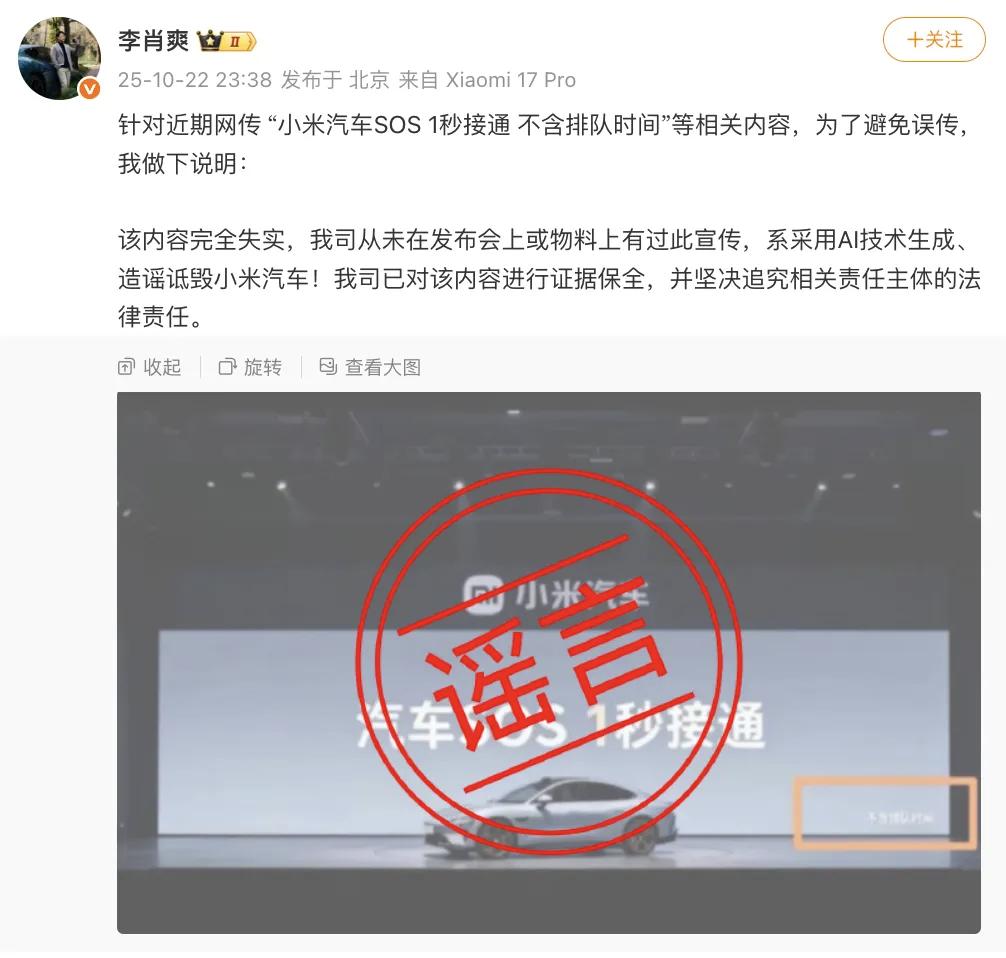
Core Points - The article discusses the significant shift in public perception of Xiaomi and its founder Lei Jun, highlighting the growing skepticism towards the company's marketing tactics and product quality [2][3][5][22]. Group 1: Product Issues - Xiaomi's reputation as the "king of cost-performance" is under threat due to allegations of exaggerated product claims, particularly regarding the Xiaomi SU7 Ultra's carbon fiber hood, which was marketed with high-performance features that were not delivered [5][7]. - Other product quality concerns include incidents such as a Xiaomi refrigerator explosion and high return rates for Xiaomi AI glasses, with a reported 40% return rate on the latter, indicating widespread consumer dissatisfaction [7][9]. Group 2: Marketing Strategies - Xiaomi's marketing strategies, which were once effective, are now perceived as overhyped and manipulative, leading to consumer fatigue and backlash against the brand [9][10]. - The company has been criticized for turning serious incidents, like the SU7 explosion, into marketing opportunities rather than addressing the underlying issues, which has further eroded trust [11][20]. Group 3: Consumer Sentiment - There is a noticeable shift in consumer sentiment from blind loyalty to critical evaluation of product quality and performance, with former fans now voicing their concerns and demanding accountability from Xiaomi [13][15][16]. - Consumers are increasingly prioritizing actual product performance over brand reputation, reflecting a broader trend towards more informed and discerning purchasing decisions [16][24]. Group 4: Brand Image and Leadership - Lei Jun's carefully crafted public persona as a relatable and tech-savvy leader is facing challenges as product issues and marketing controversies come to light, leading to questions about his integrity and the company's commitment to quality [18][20]. - The article suggests that for Xiaomi to regain consumer trust, it must address its product shortcomings and focus on genuine improvements rather than relying solely on marketing [22][23].

手机、汽车、家电齐战:小米的增长会见顶吗?
Xin Lang Cai Jing· 2025-09-10 07:08
Core Viewpoint - The article discusses Xiaomi's recent performance and challenges in the smartphone and electric vehicle markets, highlighting its growth trajectory, competitive pressures, and strategic shifts towards high-end products and ecosystem expansion [1][3]. Group 1: Growth and Performance - Xiaomi achieved a revenue of 1159.6 billion RMB in Q2, marking a 30.5% year-on-year increase, and a net profit of 108.3 billion RMB, up 75.4%, both reaching historical highs [1][3]. - The company's market share in the online air conditioning sector reached 16.71%, surpassing Gree for the first time [1]. - Since the launch of the Xiaomi 15 Ultra and SU7 Ultra, Xiaomi's market capitalization has surged by 1.3 trillion HKD, reaching 1.46 trillion HKD [3]. Group 2: Challenges in Smartphone Business - Xiaomi's smartphone revenue in Q2 2025 was 455 billion RMB, with a gross margin of 11.5%, reflecting a 2.1% year-on-year decline in revenue despite a slight increase in shipment volume [7][10]. - The global smartphone market is experiencing saturation, with a 2.7% decline in shipments, and Xiaomi's growth rate is lagging behind competitors like Apple and Samsung [10][11]. - The average selling price of Xiaomi smartphones decreased by 2.7%, attributed to intense competition and promotional activities [7]. Group 3: Electric Vehicle Business - Xiaomi's electric vehicle segment reported a revenue of 213 billion RMB, a 233.9% increase year-on-year, with 206 billion RMB coming from automotive sales, although it still incurred a loss of 3 billion RMB [14][15]. - The company delivered 81,300 electric vehicles in Q2, a 197.7% increase from the previous year, but faces significant competition in the Chinese EV market [14][15]. - Xiaomi's automotive strategy emphasizes not engaging in price wars, focusing instead on scaling production and securing delivery orders [15][16]. Group 4: Ecosystem Expansion - Xiaomi's air conditioning sales exceeded 5.4 million units in Q2, with a year-on-year growth of over 60%, while refrigerator and washing machine sales also saw significant increases [17][18]. - The company aims to become a leading player in the home appliance market by 2030, competing against established brands like Midea and Gree [18]. - Xiaomi's reliance on third-party manufacturing and its need to enhance brand perception and technological differentiation are highlighted as challenges in the home appliance sector [17][18].

华为Mate40手机已支持5.5G
Guan Cha Zhe Wang· 2025-06-05 04:23
Group 1 - Huawei's Mate40 series (5G) smartphones now support 5G-A, while other products do not [1] - The Huawei nova14 ultra model also supports 5A speed, which enhances network stability and performance in congested areas [3] - 5G-A is an enhanced version of 5G technology, while 5A is a marketing term used by Huawei to denote advanced network capabilities [3] Group 2 - 5G-A, also known as 5.5G, is seen as a transitional phase towards 6G, improving bandwidth speed, latency, connection density, and positioning accuracy [4] - As of April this year, China has built over 4.395 million 5G base stations, with 5G applications integrated into 86 out of 97 categories of the national economy [4] - The higher-speed 5G-A network is expected to be piloted in various production and life scenarios, covering over 300 key cities nationwide by the end of the year [4]
