山西小米

Search documents
力推更多优质粮走上百姓餐桌|粮食大事
Xin Lang Cai Jing· 2026-02-12 06:10
Core Viewpoint - The article discusses the structural imbalance in China's grain supply, highlighting the need for optimizing agricultural production and improving the quality of grain to meet the evolving consumer demand for high-quality food products [1][2]. Group 1: Current Situation - There is a mismatch between the supply of high-quality grain and the increasing consumer demand for nutritious and healthy food, leading to a situation where "good rice is hard to find" and "high-quality wheat is expensive" [1][2]. - The grain industry is currently characterized by a "heavyweight light quality" dependency, focusing more on quantity rather than quality, which results in many high-quality grains not reaching consumers effectively [2]. Group 2: Challenges in Production - High technical barriers, low planting returns, and poor supply-demand connections hinder the production of high-quality grain, causing farmers to be reluctant or unable to grow these crops [2]. - There is a need for agricultural social services to promote high-quality grain production, including training for farmers and improving market mechanisms to ensure better prices for quality grains [2]. Group 3: Improving Distribution - To ensure high-quality grain reaches consumers, it is essential to streamline the distribution process, including clear classification of grain quality and strict implementation of quality pricing policies [3]. - Embracing new sales channels such as e-commerce and community group buying can help shorten the distance from production to consumption, allowing local specialty grains to reach consumers more quickly [3]. Group 4: Role of Government - Local governments should create tailored industrial plans and enhance infrastructure to support high-quality grain production [4]. - Agricultural research departments need to focus on developing high-yield, nutritious, and resilient crop varieties while promoting key technologies for green production and quality testing [4]. - Strengthening market regulation and combating counterfeit products are crucial for maintaining brand reputation and market order, creating a favorable environment for the healthy development of high-quality grain [4].
中经评论:力推更多优质粮走上百姓餐桌
Jing Ji Ri Bao· 2026-02-11 23:57
Core Viewpoint - The structure of staple foods on Chinese consumers' tables is changing, with a growing demand for quality, nutrition, and health, necessitating improvements in the grain industry's quality and efficiency [1][2]. Group 1: Current Challenges in the Grain Industry - There is a structural imbalance in grain supply, with ordinary grains being surplus while high-quality grains are in short supply, leading to a mismatch between production and consumer demand [1][2]. - The grain industry is still reliant on a "heavyweight light quality" approach, focusing on yield rather than quality, resulting in a lack of high-value processed products that meet diverse consumer needs [2]. Group 2: Solutions for Quality Grain Production - To address the challenges in quality grain production, it is essential to promote agricultural social services and provide technical support to farmers, enabling them to improve their production capabilities [2]. - Enhancing market mechanisms for quality grains through order agriculture and brand development can motivate farmers to grow high-quality grains [2]. Group 3: Improving Grain Distribution and Consumer Access - The grain distribution system needs to be streamlined by clarifying quality grading standards and implementing strict quality-price policies to ensure high-quality grains reach consumers efficiently [3]. - Embracing new sales channels such as e-commerce and community group buying can shorten the supply chain from farm to table, ensuring that local high-quality grains are accessible to consumers nationwide [3]. Group 4: Role of Government and Infrastructure - Local governments should tailor industrial planning and strengthen infrastructure to support high-quality grain production [4]. - Agricultural research departments must focus on developing high-yield, nutritious, and resilient crop varieties while promoting key technologies for green production and quality testing [4]. - Strengthening market regulation and combating counterfeit products are crucial for maintaining brand integrity and market order, creating a favorable environment for the healthy development of quality grains [4].
【回眸二〇二五】守护粮食安全的坚实底气
Jing Ji Ri Bao· 2026-01-19 01:19
Core Insights - The article emphasizes the importance of food security in China, highlighting the government's efforts to enhance food safety governance and build a resilient food security system by 2025 [2][3][4]. Group 1: Food Security and Production - By 2025, China's total grain production is projected to reach 14,297.5 billion jin, a year-on-year increase of 1.2%, ensuring basic self-sufficiency in grains and absolute safety in staple foods [3]. - The planting structure is continuously optimized, with corn production expected to reach 6,024.7 billion jin (up 2.1%) and soybean production at 418.1 billion jin (up 1.3%), alleviating feed grain supply pressures [3][4]. - The national grain industry is expected to maintain a total output value of over 4 trillion yuan, showcasing strong development resilience and market potential [4]. Group 2: Nutritional Safety and Quality - Nutritional safety is becoming a key aspect of food security, with initiatives to promote whole grain consumption and diversify food sources, including the development of biotechnology and facility agriculture [4]. - The government is implementing a grain quality traceability system, utilizing modern technologies like blockchain and big data to ensure food safety from farm to table [5]. Group 3: Price Stability and Market Dynamics - The government is taking measures to maintain reasonable grain prices amidst downward pressure, including organized large-scale grain purchases and policy reserves [6][7]. - In 2025, the total grain purchase volume is expected to reach 8,300 billion jin, with 450 billion jin of wheat and rice purchased at minimum prices, effectively stabilizing market expectations [7]. Group 4: Import Strategies and International Trade - China is enhancing its import strategies to maintain control over grain imports, implementing tariffs on certain agricultural products from the U.S. while expanding zero-tariff coverage for developing countries [9][11]. - The total grain import volume is expected to stabilize with a slight decrease, while soybean imports are projected to increase due to fluctuations in U.S.-China trade relations [10][12]. Group 5: Emergency Response and Resilience - China's food security system has been strengthened to respond effectively to emergencies, with a well-established four-level emergency response plan and a network of emergency supply points [14][15]. - The government is optimizing grain reserves and storage facilities, ensuring that urban areas maintain sufficient reserves to meet emergency needs [15].
守护粮食安全的坚实底气
Jing Ji Ri Bao· 2026-01-18 22:32
Core Viewpoint - China is enhancing its food security governance capabilities and building a more resilient food security system to address multiple challenges such as extreme weather, low grain prices, and trade protectionism by 2025 [1] Group 1: Food Security Foundation - The food security foundation is solid, with a projected national grain output of 14,297.5 billion jin in 2025, a 1.2% increase year-on-year, ensuring basic self-sufficiency in grains and absolute safety in staple foods [2] - The planting structure is continuously optimized, with corn production expected to reach 6,024.7 billion jin (up 2.1%) and soybean production at 418.1 billion jin (up 1.3%), alleviating feed grain supply pressure and enhancing domestic oil supply capacity [2] Group 2: Nutritional Security - Nutritional security is becoming a key aspect of food security, with initiatives to diversify food sources and promote whole grain consumption to improve public health [3] - The national quality grain project aims to enhance the quality of grain products, with a total grain industry output value expected to stabilize above 4 trillion yuan, showcasing strong development resilience and market potential [3] Group 3: Food Quality Safety - Food quality safety is crucial, with the government implementing a comprehensive quality traceability system and utilizing modern technologies like blockchain and big data to ensure food safety from farm to table [4] - Efforts to reduce food loss and waste are ongoing, with an estimated annual loss of about 2% of grain production in storage, transportation, and processing [4] Group 4: Grain Price Stability - The government is taking measures to maintain reasonable grain prices amid downward pressure, with a total grain purchase volume of 8,300 billion jin expected in 2025 [5][6] - The minimum purchase price policy is being implemented effectively, with significant quantities of wheat and rice being purchased at minimum prices to stabilize market expectations [6] Group 5: Import Strategy - China is reinforcing its import strategy amid global trade uncertainties, imposing tariffs on certain agricultural products from the U.S. while maintaining a stable import quota system for key grains [8] - The total grain import volume is expected to stabilize with an increase in soybean imports due to fluctuations in U.S.-China trade relations, reflecting China's flexible response in international trade [9][10] Group 6: Resilience Against Shocks - China's food security resilience is being strengthened to effectively respond to various risks, with enhanced agricultural disaster prevention and mitigation capabilities [11] - The food emergency guarantee system has been established, ensuring rapid response and effective supply during crises, with a robust network of emergency processing enterprises and supply points [12][13]
杭州将办一场“饭碗”盛会
Hang Zhou Ri Bao· 2025-10-29 03:06
Core Insights - The 21st China International Grain and Oil Expo will be held in Hangzhou from October 30 to November 1, focusing on the development of new productivity in the grain industry and creating a professional platform for communication and sales across the entire industry chain [1] Group 1: Event Overview - The expo will cover an exhibition area of approximately 40,000 square meters, featuring six major exhibition zones including grain and oil products, brand enterprises, grain machinery, technology information, themed sections, and international exhibits [1] - Nearly 700 enterprises are expected to participate, with an anticipated attendance of over 30,000 visitors, including key distributors and buyers [1] Group 2: Participating Regions and Companies - The expo will showcase resources from 22 provinces, including Zhejiang, Heilongjiang, Jilin, Liaoning, Hubei, Shandong, Sichuan, and Guangdong, with a special focus on local specialties in the 400 square meter Zhejiang and Hangzhou exhibition area [2] - Leading companies such as COFCO Group, Xiangyu Group, and Wudeli Flour Group will present well-known regional brands like "Qilu Grain and Oil" and "Shanxi Millet" [2] Group 3: Innovations and Highlights - The expo emphasizes three main innovations: multi-dimensional display of the entire industry chain, showcasing new productivity through advanced technologies like unmanned storage and AI-assisted planting, and promoting collaboration to drive industry ecosystem development [2] - Activities will include on-site signing, business matching, brand promotion, and specialized meetings for rice and miscellaneous grains [2] Group 4: Hangzhou's Role and Initiatives - Hangzhou, known for its commitment to food security, will highlight its advanced experiences in "future grain storage," "digital procurement," and "green storage" [3][4] - The city is developing the world's largest dual-use underground temperature-controlled grain storage and a highly automated grain reserve facility, ensuring food security for its large population [3] - Hangzhou is also establishing a comprehensive online and offline market system with an annual trading volume exceeding 4 million tons to secure regional grain supply [3]
进出口总值突破3万亿元!黄河流域打造内陆对外开放新高地
Yang Shi Wang· 2025-08-08 02:15
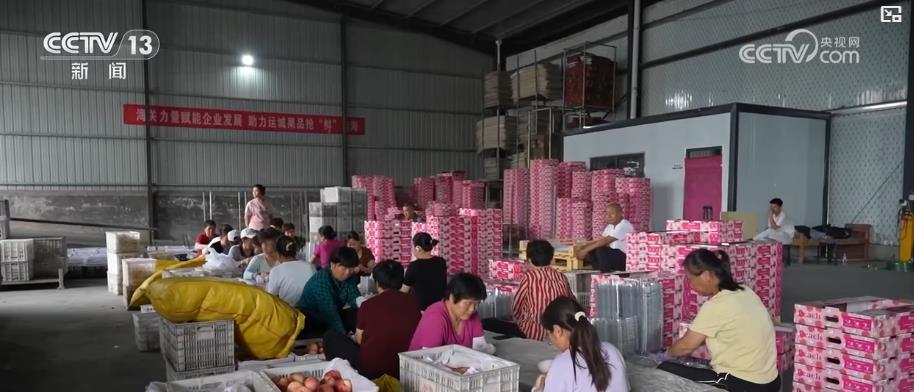
Core Insights - The Yellow River Basin has achieved a record high in foreign trade, with total import and export value exceeding 3 trillion yuan this year, marking a significant milestone for the region's economic development [1] - Shanxi province has implemented a "zero foreign trade blank county" initiative, resulting in all 117 counties engaging in foreign trade, thereby increasing the international market presence of local products [1] Trade and Export Growth - Shanxi's fruit orchard area is nearly 6 million mu, producing over 11 million tons of fruit, with exports reaching new highs this year due to customs support for agricultural product exports [3] - The province has seen a 10.9% increase in export weight and a 12.7% increase in export value year-on-year in the first half of the year, with 14 categories and 73 varieties of fruits exported to 78 countries and regions [3] Seasonal Export Trends - The peak season for Shanxi fruit exports is currently underway, with significant contributions from local varieties such as oil peaches, crisp pears, and apples, with fresh peach exports accounting for nearly 40% of the national total [4] Diverse Product Export - Shanxi's unique flavors have gained international recognition, with products like aged vinegar, millet, and traditional snacks making their way to markets in Chile, Mongolia, Thailand, and Canada [6] Logistics and Infrastructure - Shanxi has developed a logistics network centered around Taiyuan, with multiple routes connecting to cities like Yuncheng and Datong, and has established regular rail-sea intermodal services to Tianjin and Qingdao ports [8] - The province operates 23 regular China-Europe freight train routes, reaching 48 cities across 16 countries, enhancing its trade connectivity [8]