
广丰铂智3X

Search documents
小米华为合体之作!轴距超 3 米的丰田铂智 7 来了
Xin Lang Cai Jing· 2026-01-21 10:30
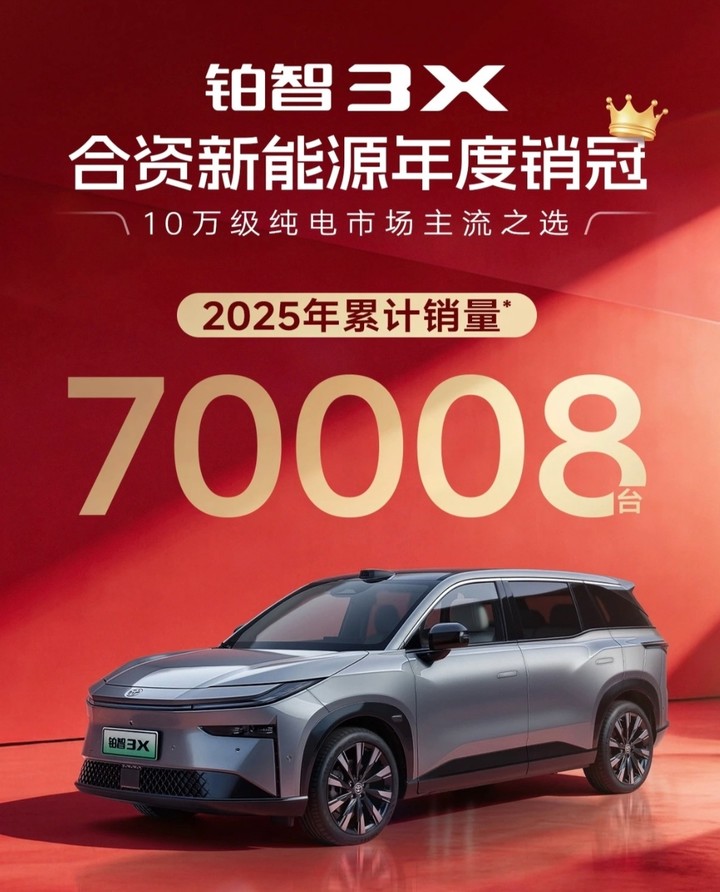
Core Insights - The year 2025 is a significant turning point for joint venture automakers in their electrification transformation, with models like Nissan N7 and GAC Toyota's Aion S3 making notable market impacts [1][30] - GAC Toyota's Aion S3 has achieved impressive sales, surpassing 70,000 units in its first year and becoming the "joint venture pure electric sales champion" [1][30] Group 1: Product Performance and Market Positioning - Aion S3's aggressive configuration, including a price point of 150,000 RMB with lidar and high-level intelligent driving, challenges the stereotype that joint venture brands lack intelligence [3][32] - The upcoming Aion S7 aims to penetrate the mid-to-high-end market segment priced around 200,000 RMB, focusing on brand premium in the electrification era [4][33] Group 2: Design and Features - Aion S7 features a minimalist front design and a lower visual center of gravity, enhancing its technological appeal with a new lighting design [6][35] - The vehicle dimensions of Aion S7 are 5130mm in length, 1965mm in width, and 1500mm in height, with a wheelbase of 3020mm, positioning it closer to executive sedan standards [8][37] Group 3: Technological Advancements - Aion S7 incorporates Huawei's HarmonyOS 5.0, marking a shift from traditional functionality to a more intelligent user experience, supporting over 50 Harmony applications and 50,000 mobile applications [12][42] - The vehicle introduces a universal model (MoLA) for navigation and vehicle control, allowing for a more interactive user experience and integration with Xiaomi's ecosystem for smart home control [15][44] Group 4: Safety and Performance - Aion S7 continues the path of Aion S3 by utilizing the Momenta R6 high-level solution and lidar for intelligent driving, adhering to Toyota's TSS safety standards [18][47] - The powertrain features a dual-motor system with a maximum power of 207kW and a top speed of 180 km/h, with battery options of 88.13kWh and 71.35kWh offering ranges of up to 710km and 600km respectively [20][49] Group 5: Strategic Goals and Market Ambitions - GAC Toyota aims for ambitious targets, projecting that by 2026, new energy vehicle sales will exceed 20%, and by 2028, they will achieve a production and sales target of one million units [25][55] - The success of Aion S3 sets a positive precedent, but Aion S7 faces the challenge of not only contributing to sales but also enhancing brand perception in the competitive landscape [29][57]

13万元起!北京现代首款纯电SUV开启预售,明年将推一款10万元以内的纯电车
Mei Ri Jing Ji Xin Wen· 2025-10-16 13:19
Core Viewpoint - Beijing Hyundai has officially launched the pre-sale of its first pure electric SUV, EO Yiou, with a price range of 130,000 to 150,000 yuan, marking the beginning of its electrification transformation [1][3]. Group 1: Product Launch and Features - The EO Yiou is based on Hyundai's E-GMP global electric platform and features a maximum CLTC range of 722 km, with the ability to charge the battery from 30% to 80% in 27 minutes [3]. - A promotional policy allows customers to secure the vehicle with a deposit of 88 yuan, receiving a 12,000 yuan value-added benefit and priority delivery rights during the pre-sale period [1][3]. Group 2: Market Strategy and Sales Goals - Beijing Hyundai aims to increase its annual sales volume to 500,000 units over the next three to five years, planning to launch 20 new models with an equal split between gasoline and electric vehicles [3][5]. - The company is responding to a growing trend in the 100,000 to 150,000 yuan price range for new energy vehicles, which has seen increased sales compared to the 150,000 to 200,000 yuan range [4]. Group 3: Future Plans and Export Strategy - Over the next four years, Beijing Hyundai plans to introduce 2 to 3 new energy vehicles annually, covering various segments including sedans, SUVs, and MPVs, achieving full coverage of pure electric, hybrid, and extended-range vehicles [5]. - The company aims to establish a global export base, targeting an export of 50,000 units in 2024 and doubling that number to 100,000 units in 2025, with China as the production hub for global markets [5].

做高端电动车,别克要先撕掉“杂牌”标签
Di Yi Cai Jing· 2025-09-17 09:26
Core Viewpoint - Buick's new high-end electric sub-brand "Zhijing" faces challenges in the competitive market for mid-to-large range electric vehicles priced between 200,000 to 300,000 yuan, as the success of joint venture brands in this segment remains limited [2][3]. Group 1: Market Dynamics - The current market reality indicates that joint venture brands must offer higher cost-performance ratios than domestic brands to succeed [2]. - Traditional luxury brands have struggled in the high-end electric vehicle market, with sales of models like the BMW i3 and Mercedes-Benz electric vehicles remaining low compared to more competitively priced offerings from joint venture brands [3]. - The Buick GL8 plug-in hybrid has emerged as a notable exception, ranking third in sales among joint venture electric vehicles in August, with retail sales of 5,490 units, surpassing its fuel-powered counterpart [3]. Group 2: Strategic Shifts - Joint venture brands have shifted their strategies from a "high-end" approach to offering high cost-performance electric vehicles, often at lower prices than domestic brands, leading to the emergence of popular models like the Nissan N7 and Guangfeng Bozhi 3X [3]. - Buick's decision to launch a high-end sub-brand is supported by a fully localized development approach and improved collaboration between joint venture partners, allowing for greater autonomy in product development [4]. Group 3: Product and Brand Perception - The perception of a brand as "generic" is fundamentally tied to the product itself, emphasizing the importance of product strength alongside cost-performance and emotional value in driving market success [5]. - The pricing strategy for the Buick Zhijing L7 is critical, as it must balance market impact with the positioning of a high-end electric brand, a challenge faced by many luxury brands today [5].
做高端电动车,别克要先撕掉“杂牌”标签
第一财经· 2025-09-17 09:10
Core Viewpoint - The article discusses the challenges and strategies of joint venture brands in the high-end new energy vehicle market, highlighting the launch of Buick's new sub-brand "Zhijing" and its first model, the Zhijing L7, which is positioned in the 200,000 to 300,000 yuan range [3][4]. Group 1: Market Dynamics - The current market reality indicates that joint venture brands must offer higher cost-performance ratios than domestic brands to succeed [4]. - Traditional luxury brands' new energy vehicles are often perceived as "mixed-brand electric vehicles," making it difficult for them to penetrate the market effectively [4]. - The sales performance of joint venture brands has improved recently, with models like the Nissan N7 and Guangfeng Bozhi 3X achieving significant sales figures [4]. Group 2: Product Strategy - The Buick GL8 plug-in hybrid has emerged as a standout model, with sales surpassing its fuel-powered counterpart, indicating a strong market foundation [5]. - The Vice President of SAIC General Motors emphasized that while lower prices can boost sales, solely focusing on cost-cutting could harm brand reputation in the long run [6]. - Buick's decision to launch a high-end sub-brand is supported by a shift to 100% locally developed products and improved collaboration between joint venture partners [6]. Group 3: Consumer Perception - Consumer perception of a brand as "mixed" ultimately hinges on product quality, which must be complemented by cost-performance and emotional value to maximize market impact [7]. - The pricing strategy for the Buick Zhijing L7 is crucial, as it needs to create a strong market presence while maintaining the positioning of a high-end new energy brand [7][8].
做高端电动车,别克要先撕掉“杂牌”标签|有点逸思
Di Yi Cai Jing· 2025-09-17 03:34
Core Viewpoint - The article discusses the challenges faced by joint venture high-end electric vehicle brands in China, emphasizing the need for competitive pricing and value propositions to succeed in a market dominated by cost-effective options. Group 1: Market Dynamics - Joint venture brands initially adopted a "high-end" market strategy but have shifted to offering high-value electric vehicles in response to market challenges [2] - The current market reality indicates that joint venture brands must offer better value than domestic brands to achieve sales success [1] - Sales data shows that popular models from joint venture brands, such as the Nissan N7 and Guangfeng Bozhi 3X, have emerged, while traditional luxury electric vehicles struggle with low sales figures [2] Group 2: Product Development and Strategy - Buick's introduction of the high-end sub-brand "Zhijing" is driven by a recognition of past shortcomings and a commitment to 100% local development for the Chinese market [3] - Enhanced communication and cooperation between joint venture partners have facilitated product launches, with foreign partners granting more autonomy to local teams [3] Group 3: Consumer Perception and Product Value - Consumer perception of a brand as "generic" is fundamentally linked to product quality, highlighting the importance of product strength alongside pricing and emotional value [4] - The success of the Buick Zhijing L7 hinges on its pricing strategy, which must balance market impact and the positioning of a high-end electric vehicle brand [4]
广汽集团第一季度营业收入达196.5亿元 首次公布AI+布局全景图
Zheng Quan Ri Bao Wang· 2025-04-25 11:45
Group 1 - GAC Group reported a revenue of 19.65 billion yuan and total vehicle sales of 371,100 units in Q1 2025, with a month-on-month growth rate of 76.2% in March [1] - The company has implemented a valuation enhancement plan, completing the repurchase of 299 million shares by the end of Q1 [1] - GAC's integrated reform has significantly improved operational efficiency, with new models launched including AION UT, GAC Trumpchi Xiangwang S7, and others, achieving substantial order volumes [1] Group 2 - AI technology and applications are becoming key factors influencing the future competitive landscape of the global automotive industry [2] - GAC showcased its AI+ layout for the first time in Q1, focusing on core elements of "computing power, data, and algorithms" [2] - The company announced the expansion of collaborations with leading tech firms like Huawei and Tencent to build an AI smart ecosystem called Golink [2]
