张量处理单元(TPU)芯片

Search documents
两大科技巨头,蚕食英伟达
半导体芯闻· 2026-01-30 11:22
Core Insights - The rise of artificial intelligence has led to a consensus that Nvidia's chips are essential for large AI projects, but Amazon and Google have begun to challenge Nvidia's dominance by developing their own AI chips [1][2]. Group 1: Market Dynamics - Nvidia holds a commanding 92% market share in the AI chip sector, with projected revenues nearing $200 billion by 2025 [2]. - Amazon's self-developed AI chip, Trainium, is expected to generate "tens of billions" in revenue by 2025, while Google's Tensor Processing Unit (TPU) has already reached hundreds of billions in revenue [2]. - The competition from Amazon and Google is particularly significant as they are both expanding their chip businesses while still relying on Nvidia as a core supplier [2][3]. Group 2: Strategic Partnerships - Anthropic, a leading AI company, is reducing its reliance on Nvidia chips and has secured significant chip sales for Amazon and Google, totaling hundreds of billions [3][4]. - Google has allowed Anthropic to install its chips in non-Google data centers, marking a new collaborative model in the industry [3][4]. - Amazon's investment of $4 billion in Anthropic was motivated by the promise of using Amazon's chips for AI system development, aiming to create a competitive alternative to Nvidia [5][6]. Group 3: Industry Implications - The rapid growth of Amazon's chip business, driven by partnerships with companies like Anthropic, is expected to lead to significant industry changes, signaling that Nvidia chips are not the only option available [6][7]. - Other chip manufacturers, such as AMD and Cerebras, are also seeking partnerships with AI companies to expand their market presence [6][7]. - The increasing acceptance of non-Nvidia chips by companies like Anthropic and OpenAI is likely to encourage broader industry adoption of alternative chip solutions [7].




六天蒸发两千亿 苹果跌落神坛 谷歌凭Gemini逆袭
Ge Long Hui A P P· 2026-01-08 15:00
Core Viewpoint - Alphabet has surpassed Apple to become the second most valuable company globally, reflecting its significant position as a winner in the artificial intelligence sector [1] Group 1: Market Performance - Alphabet's stock price increased by 2.4%, closing at a valuation of $3.89 trillion, surpassing Apple's market cap of $3.85 trillion [1] - Apple's stock experienced a decline of nearly 5%, equating to approximately $200 billion in market value loss over six consecutive days [1] - On the following day, Apple opened down by 1.2%, while Alphabet rose by 1.1%, further widening the gap between the two companies [1] Group 2: Historical Context - This marks the first time since 2019 that Alphabet's market value has exceeded that of Apple [1] - Nvidia remains the largest company by market capitalization, valued at approximately $4.6 trillion [1] Group 3: Growth and Future Prospects - Alphabet's stock has surged over 65% during 2025, making it the best-performing company among the "Big Seven" in the U.S. stock market [1] - The market consensus is increasingly recognizing Alphabet's strong advantages in several key areas of artificial intelligence [1] - The company's latest GeminiAI model has received positive reviews, alleviating concerns about competition from firms like OpenAI [1] - Alphabet's tensor processing unit (TPU) chips are viewed as a potential significant driver for future revenue growth [1]

谷歌AI芯片被誉为「独门秘籍」 或可为其创收近万亿美元
Xin Lang Ke Ji· 2025-12-05 01:29
Group 1 - Alphabet's chip business, particularly the Tensor Processing Unit (TPU), is expected to become a significant revenue growth engine for the company in the future [1] - The success of TPU contributed to a 31% increase in Alphabet's stock price in Q4, ranking it tenth among S&P 500 constituents [1] - There is growing optimism in the market regarding Alphabet's potential to sell TPU to third parties, which could open a new revenue stream valued at nearly $1 trillion [1] Group 2 - DA Davidson's technology research head, Gil Luria, believes that if companies seek diversification beyond Nvidia, TPU presents a promising avenue, potentially exceeding the value of Google Cloud [3] - Luria estimates that if Alphabet actively pursues TPU sales, it could capture 20% of the AI market within a few years, translating to a business worth approximately $900 billion [3] - TPU is an application-specific integrated circuit (ASIC) designed for specific purposes, such as accelerating machine learning, offering a cost advantage compared to Nvidia's chips [5] Group 3 - Mark Iong from Homestead Advisers highlights that while Nvidia's chips are more expensive and harder to obtain, Alphabet's ASIC chips position the company as a leading choice in the market [5] - Iong emphasizes that Alphabet is the only company with a leading position across all levels of artificial intelligence, including Gemini, Google Cloud, and TPU, providing it with a significant competitive advantage [5]
Alphabet的AI芯片被誉为“独门秘籍” 或可为其创收近万亿美元
Xin Lang Cai Jing· 2025-12-04 15:52
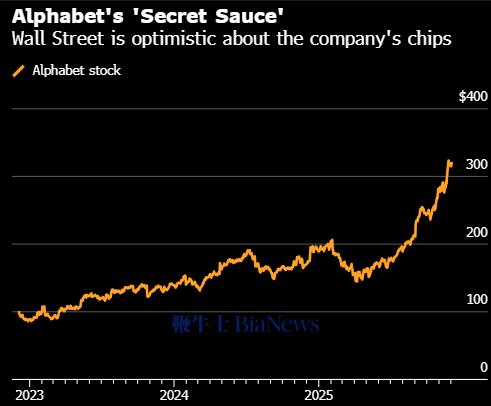
Core Viewpoint - Investors are increasingly confident that Alphabet Inc.'s chip business will become a significant growth engine for future revenue [1][2] Group 1: Chip Business Success - The success of Alphabet's Tensor Processing Unit (TPU) chips is a major reason for the company's stock price soaring by 31% in the fourth quarter, ranking tenth among S&P 500 constituents [1][2] - TPUs have traditionally been viewed as a core advantage for the company, accelerating growth in its cloud computing business [1][2] Group 2: Market Outlook - The market is becoming more optimistic about Alphabet's potential to sell these chips to third parties, which could open a new revenue stream [1][2] - This new revenue channel has the potential to be valued at nearly one trillion dollars [1][2]
谷歌AI芯片被誉为“独门秘籍” 或可为其创收近万亿美元
Xin Lang Cai Jing· 2025-12-04 13:52
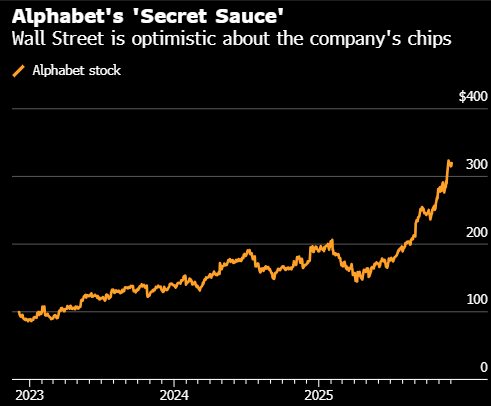
Core Viewpoint - Investors are increasingly confident that Alphabet's chip business, particularly its Tensor Processing Unit (TPU), will become a significant growth engine for future revenue [1][6]. Group 1: TPU's Impact on Alphabet's Stock - The success of TPU has been a major reason for Alphabet's stock price soaring by 31% in the fourth quarter, ranking tenth among S&P 500 constituents [6]. - TPU is viewed internally as a core advantage that accelerates the growth of Alphabet's cloud computing business [6]. Group 2: Market Potential and Future Projections - The market is optimistic about Alphabet's potential to sell TPU to third parties, which could open a new revenue stream valued at nearly $1 trillion [6][8]. - Gil Luria from DA Davidson suggests that if Alphabet seriously pursues TPU sales, it could capture 20% of the AI market, potentially becoming a $900 billion business [8]. Group 3: Competitive Advantages of TPU - TPU is an application-specific integrated circuit (ASIC) designed for specific purposes, particularly to accelerate machine learning, offering lower costs compared to NVIDIA's chips [10]. - Mark Iong from Homestead Advisers highlights that while Alphabet may not control the entire market, its ASIC chips provide a unique advantage, making it a leading player in the market [11]. - Alphabet is recognized as the only company with a leading position across various AI domains, including Gemini, Google Cloud, and TPU, which provides it with significant competitive advantages [11].
AMD正在人工智能基础设施领域挑战英伟达
美股研究社· 2025-12-03 11:42
Core Viewpoint - Nvidia has experienced a significant surge in its stock performance following the release of its Q1 2024 earnings, marking a pivotal moment akin to an "iPhone moment" for the company. Meanwhile, AMD, traditionally seen as a secondary player, is now poised to compete directly with Nvidia under CEO Lisa Su's leadership [2]. Market Size and AI Bubble - The global AI chip market is currently valued at $94.5 billion, with a compound annual growth rate (CAGR) of 29%, up from approximately 20% over the past three years. Analysts suggest that while discussions about an "AI bubble" are prevalent, such phenomena are typical during transformative technological advancements [4][3]. Competitive Landscape - The AI semiconductor industry exhibits high entry barriers, weak supplier bargaining power, and moderate buyer bargaining power due to strong demand. Nvidia's proprietary software products, such as CUDA and its data center software stack, create significant competitive advantages [5][6]. AMD's Strategy and Market Share - AMD has launched the ROCm platform to compete with Nvidia's CUDA, offering cost savings of 10%-40% despite being less feature-rich. Analysts believe AMD's market share could increase to around 10% as buyers leverage AMD in negotiations with Nvidia, although achieving a 30% share remains a significant challenge [9][14]. Recent Performance Metrics - Both Nvidia and AMD reported strong quarterly earnings, with Nvidia achieving a gross margin of 73.6% and a year-over-year revenue growth of 62.5%. AMD's data center revenue grew by 22%, but its gross margin of 54% remains lower than Nvidia's [12][13]. Future Growth Projections - AMD anticipates a compound annual growth rate of 26% in revenue from 2016 to 2025, potentially accelerating to 35% or higher post-2026 due to significant AI collaborations with companies like OpenAI and Oracle [14]. Valuation Analysis - Nvidia's price-to-earnings (P/E) ratio of approximately 39 is considered low given its industry leadership and growth potential, while AMD's P/E ratio of about 52 reflects its transition to profitability and potential for significant earnings growth [17][18]. Conclusion - Both Nvidia and AMD are recognized as strong companies, but AMD is favored for its limited downside risk and substantial upside potential. Nvidia's dominant market position may limit its growth opportunities, while evolving market dynamics introduce volatility and risk for the company [20][21].

英伟达首席财务官:公司“绝对没有”在AI竞赛中失去领先地位
Sou Hu Cai Jing· 2025-12-03 06:04
Core Viewpoint - Nvidia's CFO Colette Kress refuted claims that competitors are catching up and asserted that the AI economy is not in a bubble [1][3] Group 1: Company Position and Market Dynamics - Nvidia briefly surpassed a market capitalization of $5 trillion in October, becoming the first company to reach this milestone, but its stock has since dropped over 11% due to concerns about increasing competition [3] - Kress emphasized that Nvidia has "absolutely not" lost its leading position and noted that "all companies are using our platform" [3] - At the UBS Global Technology and AI Conference, Kress stated that the global economy is still in the "early stages" of transitioning to the data center infrastructure needed to support AI [3] Group 2: Future Investment and Collaborations - Nvidia expects total global investment in AI to reach between $3 trillion and $4 trillion by the end of this decade [3] - Kress revealed that Nvidia's recent announcement of a potential investment of up to $10 billion in OpenAI has not yet been finalized, indicating ongoing collaboration without a binding agreement [4] - She expressed confidence that the partnership with OpenAI will never cease [4]