
恒生港股通中国央企红利指数

Search documents
平安恒生中国央企红利ETF今日起发售
Zheng Quan Shi Bao Wang· 2025-12-15 01:41
Group 1 - The Ping An Heng Seng China Central Enterprises Dividend ETF (159143) will be launched for subscription from December 15 to December 24, 2025, with a maximum initial fundraising scale of 1 billion yuan [1] - The fund will be managed by Ping An Fund, with Qian Jing and Weng Xin as the fund managers [1] - The performance benchmark for the fund is the Hang Seng Hong Kong Stock Connect China Central Enterprises Dividend Index return (adjusted for exchange rates) [1]
恒生科技没跑赢港股红利!红利资产最强的窗口期,小白怎么选择指数?
Jin Rong Jie· 2025-12-09 11:13
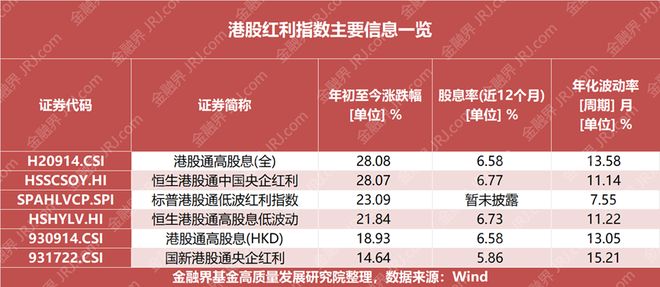
Group 1 - The core viewpoint of the articles highlights the increasing interest in dividend assets as they outperform growth sectors amid market volatility, with the Hong Kong High Dividend Index showing a notable performance compared to the Hang Seng Technology Index [1] - As of December 8, the Hang Seng Technology Index has risen by 26.73% over the past year, while the Hong Kong High Dividend Index (total return) has increased by 28.08%, indicating a slight outperformance [1] - The volatility of the Hong Kong High Dividend Index is significantly lower at 13.58%, compared to the Hang Seng Technology Index's volatility of 28.21% [1] Group 2 - According to Guangfa Securities, the Hong Kong dividend assets are entering a strong "calendar effect" window from December to mid-January, with a historical increase probability of 90.9% during this period since 2014, and a median increase of 3.4% [1] - The excess return probability of the Hong Kong High Dividend Index compared to the CSI 300 and Hang Seng Index also exceeds 80% [1] Group 3 - The Hang Seng Hong Kong Stock Connect China Central Enterprise Dividend Index has been one of the best performers this year, with a year-to-date increase of 28.07%, closely following the Hong Kong High Dividend Index [3] - This index selects high-dividend companies within the Stock Connect range, primarily those with state-owned enterprises as the largest shareholders, while applying multiple quality filters such as trading volume and volatility [3] - The S&P Hong Kong Stock Connect Low Volatility Dividend Index has a year-to-date volatility of only 7.55%, significantly lower than other indices, which generally exceed 11% [3]

红利ETF还值得买吗?盘一盘几个有代表性的红利ETF
2 1 Shi Ji Jing Ji Bao Dao· 2025-07-23 08:02
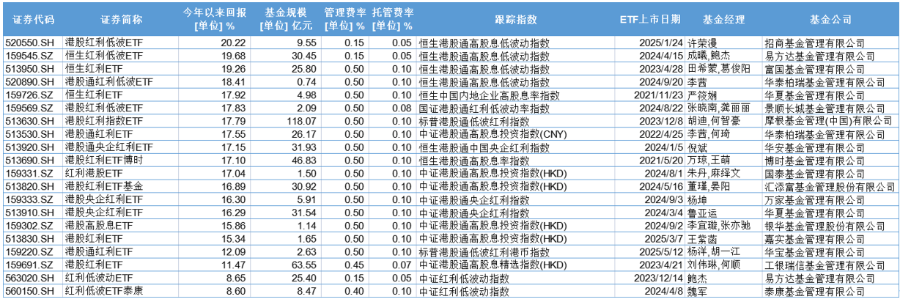
Core Viewpoint - Dividend strategies have gained market attention since last year, characterized by their defensive attributes and high dividend yields, making them attractive to investors. However, with the rise of technology and pharmaceutical sectors in 2025, growth stocks have overshadowed dividend assets, despite institutional investments still favoring dividend-related sectors, particularly in Hong Kong stocks [1]. Group 1: Market Performance and Trends - As of July 18, 2025, the total scale of listed dividend-themed ETFs has exceeded 150 billion, with 58 out of 61 ETFs achieving positive returns this year [1]. - The Hang Seng Hong Kong Stock Connect High Dividend Low Volatility Index has shown a year-to-date increase of 17.52%, benefiting the ETFs that track it [3]. - The largest ETF by scale, the E Fund Hang Seng Dividend Low Volatility ETF, has surpassed 30 billion in assets, demonstrating significant growth since its inception in April 2024 [3]. Group 2: ETF Characteristics and Performance - The top-performing ETFs are primarily those tracking the Hang Seng Hong Kong Stock Connect High Dividend Low Volatility Index, which selects stocks based on high dividend yields and low volatility [3][4]. - The China Securities Dividend Low Volatility Index, tracked by the largest dividend ETF, has maintained a consistent performance with a year-to-date return of 8.21% [9]. - The Morgan Hong Kong Dividend Index ETF, the first cross-border strategy ETF to exceed 10 billion in scale, has a year-to-date return of 17.79% [11]. Group 3: Sector Allocation and Composition - The financial sector accounts for over 30% of the index composition, followed by energy, real estate, and industrial sectors, each exceeding 10% [4]. - The index maintains a diversified approach, with no single stock exceeding 5% weight, ensuring a balanced exposure to various companies [4]. Group 4: Future Outlook and Valuation - Despite concerns over high relative valuations, the absolute valuations of major dividend low volatility indices remain around 7 times, indicating potential for long-term investment [14]. - The current market dynamics suggest a valuation recovery rather than a bubble, with stable dividend assets expected to retain their allocation value in the long term [14].

华安恒生港股通中国央企红利ETF:高股息央企港股多轮驱动资产
Xinda Securities· 2025-04-03 02:01
Quantitative Factors and Construction Factor Name: EP(TTM) (Earnings-to-Price Ratio) - **Construction Idea**: This factor represents the earnings-to-price ratio, used as a value factor to identify undervalued stocks[23] - **Construction Process**: - The factor is calculated as the ratio of earnings per share (EPS) to the stock price - Stocks are ranked based on their EP(TTM) values, and the top 20% are selected as the long portfolio, while the bottom 20% are selected as the short portfolio - Monthly rebalancing is performed on the first trading day of each month using the opening price[23] - **Evaluation**: The factor demonstrates strong historical performance, with significant excess returns and high Rank IC values, indicating its effectiveness in capturing value[23][26] - **Formula**: $ EP(TTM) = \frac{\text{Earnings Per Share (TTM)}}{\text{Stock Price}} $[23] Factor Name: BP(LF) (Book-to-Price Ratio) - **Construction Idea**: This factor represents the book-to-price ratio, another value factor used to identify undervalued stocks[23] - **Construction Process**: - The factor is calculated as the ratio of book value per share to the stock price - Stocks are ranked based on their BP(LF) values, and the top 20% are selected as the long portfolio, while the bottom 20% are selected as the short portfolio - Monthly rebalancing is performed on the first trading day of each month using the opening price[23] - **Evaluation**: The factor shows strong historical performance, with high excess returns and Rank IC values, indicating its robustness in identifying value opportunities[23][27] - **Formula**: $ BP(LF) = \frac{\text{Book Value Per Share}}{\text{Stock Price}} $[23] Factor Name: Dividend Yield (TTM) - **Construction Idea**: This factor represents the trailing twelve-month dividend yield, used as a dividend factor to identify high-yield stocks[23] - **Construction Process**: - The factor is calculated as the ratio of dividends per share (TTM) to the stock price - Stocks are ranked based on their dividend yield values, and the top 20% are selected as the long portfolio, while the bottom 20% are selected as the short portfolio - Monthly rebalancing is performed on the first trading day of each month using the opening price[23] - **Evaluation**: The factor has demonstrated consistent performance, with significant excess returns and Rank IC values, highlighting its effectiveness in capturing high-yield opportunities[23][28] - **Formula**: $ \text{Dividend Yield (TTM)} = \frac{\text{Dividends Per Share (TTM)}}{\text{Stock Price}} $[23] --- Factor Backtesting Results EP(TTM) Factor - **Rank IC**: 5.56%[26] - **Excess Return**: 9.14%[26] - **Sharpe Ratio**: 1.19[26] BP(LF) Factor - **Rank IC**: 6.80%[27] - **Excess Return**: 11.41%[27] - **Sharpe Ratio**: 1.37[27] Dividend Yield (TTM) Factor - **Rank IC**: 5.81%[28] - **Excess Return**: 8.96%[28] - **Sharpe Ratio**: 1.37[28]