
房地产抵押贷款

Search documents
跌至“2字头”!银行打响“开门红”信贷战 个人经营贷“卷利率也卷风控”
Xin Lang Cai Jing· 2026-01-08 05:09
Core Viewpoint - The banking sector is engaged in an "opening red" marketing battle, with personal business loans and real estate mortgage rates dropping to the "2s" range, driven by competitive lending policies and simplified approval processes [1][8]. Group 1: Interest Rates and Loan Products - Personal business loan rates are around 2.5%, with potential reductions for those with real estate collateral [2][9]. - In major cities, the average interest rate for business loans is approximately 3.1% for one year and 3.4% for one to three years, with stable rates despite the new year [4][11]. - Some banks, like Guangfa Bank, offer mortgage business loans at rates as low as 2.35%, with flexible repayment options and long credit validity [4][11]. Group 2: Approval Processes and Risk Management - Banks have significantly improved approval efficiency, reducing the process from two weeks to about ten days, and even faster for credit loans [5][12]. - Despite lower rates, banks maintain strict borrower qualification standards, requiring at least one year of actual business operation and a minimum holding period for collateral properties [6][13]. Group 3: Market Dynamics and Regulatory Concerns - The decline in personal mortgage growth has led banks to increase their consumer and business loan volumes, resulting in competitive pricing strategies [6][14]. - Regulatory bodies are closely monitoring the use of personal business loans, with recent penalties imposed for mismanagement and misuse of funds, highlighting the legal risks associated with loan purpose violations [7][15].


韩国四大金融控股公司利息收入时隔五年首现负增长
Sou Hu Cai Jing· 2025-12-07 09:42
Core Insights - The interest income of South Korea's four major financial holding companies is expected to decline for the first time in five years, while net profits are projected to grow by over 10%, reaching a historical high [1][3]. Group 1: Interest Income Trends - The total interest income for KB Financial, Shinhan Financial, Hana Financial, and Woori Financial is projected to be 101.4737 trillion KRW (approximately 486.1 billion RMB), representing a 4% year-on-year decrease [1][3]. - This decline in interest income is attributed to sustained high benchmark interest rates and a slowdown in loan growth, particularly in real estate mortgage loans [3]. - Specific forecasts for interest income include KB Financial at 29.7128 trillion KRW (down 2.6%), Shinhan Financial at 27.4129 trillion KRW (down 6.2%), Hana Financial at 23.0083 trillion KRW (down 4.5%), and Woori Financial at 21.3397 trillion KRW (down 3.1%) [3]. Group 2: Net Profit Projections - Despite the decline in interest income, the total net profit for the four financial holding companies is expected to reach 18.5454 trillion KRW, marking a 10% increase year-on-year and setting a new historical record for the second consecutive year [5][6]. - Individual net profit forecasts include KB Financial at 5.752 trillion KRW (up 14.4%), Shinhan Financial at 5.2513 trillion KRW (up 15%), Hana Financial at 4.1215 trillion KRW (up 9%), and Woori Financial at 3.4206 trillion KRW (up 8%) [5][6]. - Industry experts note that the anticipated interest rate cuts were expected to compress net interest margins; however, sustained high rates have led to relatively stable profit performance [6].

金融推动农机产业发展的探索与提升路径 基于吉林省四平市农机产业的调查
Jin Rong Shi Bao· 2025-11-27 05:11
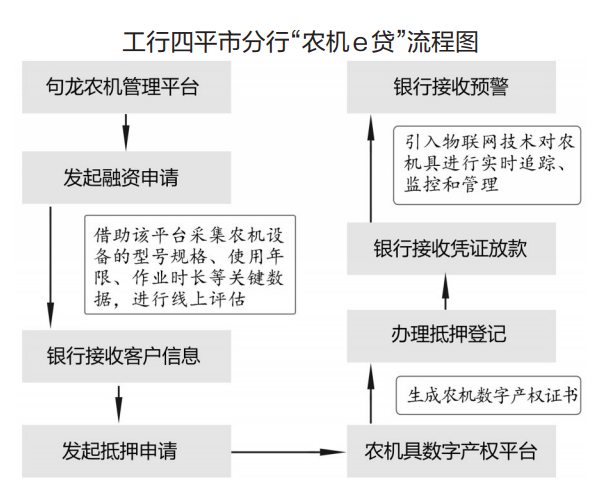
Core Viewpoint - The 2025 Central Document No. 1 emphasizes the promotion of high-quality development in agricultural machinery, highlighting its increasing role in agricultural production [1] Group 1: Current Development of Agricultural Machinery Industry in Siping - Siping is a significant agricultural machinery manufacturing base in China, with over 30 production enterprises, including 7 large-scale enterprises and 2 national-level specialized "little giant" enterprises. The total output value of large-scale agricultural machinery enterprises in 2024 is projected to be 800 million yuan, accounting for approximately 50% of the province's total [3] - The city is accelerating industrial clustering and platform construction, with a planned area of 4.4 square kilometers for the China Black Land Protection Agricultural Machinery Industry Innovation Demonstration Base, aiming for a total investment of 10.9 billion yuan [3] - Financial subsidies and policy support are being implemented, with the central government providing preferential subsidies for high-performance agricultural machinery, and Siping actively promoting enterprises to apply for various support policies [3] Group 2: Financial Support Practices for Agricultural Machinery Industry - Financial institutions in Siping have explored effective ways to support the agricultural machinery industry, with a total loan balance of 97.368 million yuan and cumulative investment of 181.517 million yuan as of September [5] - Four typical financing guarantee models have been established to support the agricultural machinery industry [5] Group 3: Financing Guarantee Models - The "Agricultural Machinery e-Loan" online mortgage model by ICBC Siping Branch utilizes a digital property rights platform to standardize and streamline the mortgage process, with a total of 30.266 million yuan disbursed [6] - The "Patent + Asset" combination pledge model by Jilin Bank Siping Branch allows for financing through the pledge of core patents and real estate, with a total of 75 million yuan in loans issued [7] - The "Real Estate Mortgage" loan model by Postal Savings Bank Siping Branch provides loans based on real estate collateral, with a total of 43 million yuan disbursed [8] - The "Online + Offline" credit quick loan model by Construction Bank Siping Branch offers flexible credit solutions for agricultural machinery enterprises, with a total of 21.062 million yuan disbursed [9] Group 4: Challenges Facing Financial Support for Agricultural Machinery Industry - The agricultural machinery industry faces significant cyclical risks, with a projected decline in output value of 16.7% in 2024 due to various factors, including reduced market demand and cash flow unpredictability [10] - Difficulties in valuing and disposing of collateral, particularly for rapidly depreciating agricultural machinery, pose risks for financial institutions [11][12] - Insufficient collaboration between financial institutions and government guarantee agencies leads to ineffective risk-sharing and support [13] - Poor information-sharing channels among agricultural departments, financial institutions, and enterprises hinder decision-making efficiency [14] Group 5: Recommendations - Establish a risk monitoring platform to predict industry risks and design differentiated credit products for cyclical enterprises [15] - Innovate mortgage methods and improve disposal channels for collateral to reduce loan loss risks [16] - Optimize cooperation between financial institutions and government guarantee agencies to clarify responsibilities and improve risk-sharing [17] - Create an information-sharing platform to enhance data accuracy and improve credit assessment efficiency [18]

美国地区银行信贷警报再次拉响
21世纪经济报道· 2025-10-21 10:10
Core Viewpoint - Recent events in the U.S. banking sector, including the failures of Zions Bank and West Alliance Bank due to credit fraud linked to New Fortress Energy, have raised concerns about the stability of regional banks and the broader financial market [1][8]. Group 1: Bank Failures and Legal Issues - Zions Bank is involved in legal disputes related to two real estate mortgage loans totaling $60 million, which were manipulated by fund managers, leading to significant losses for the bank [4][5]. - The bank has reported a $60 million loss provision due to "obvious misrepresentations and defaults" related to these loans, indicating a potential shift of these loans to non-performing status [5][9]. - West Alliance Bank has also filed a fraud lawsuit against a borrower for failing to provide collateral, seeking to recover approximately $100 million [5][6]. Group 2: Financial Performance and Market Reaction - As of mid-October, the KBW Regional Banking Index fell over 4%, marking its lowest level since August, with Zions Bank's stock dropping more than 13% [1][6]. - The VIX index, a measure of market volatility, surged over 22% on October 16, reflecting heightened investor anxiety [1][6]. - Despite recent challenges, Zions Bank's financials show stability, with total assets around $87 billion and a loan portfolio of approximately $60 billion [5][6]. Group 3: Broader Industry Risks - The regional banking sector is facing significant risks, particularly due to concentrated exposure to real estate loans, which could lead to vulnerabilities if the housing market declines [9][10]. - The floating losses on securities investments in the banking sector remain high, nearing $400 billion, posing a risk to capital management if interest rates do not decrease [9][10]. - Economic pressures, including rising inflation and increased debt burdens on households and businesses, could lead to higher default rates and increased credit losses for banks [10][12]. Group 4: Economic Context and Uncertainty - The current economic environment is characterized by uncertainty, with government shutdowns affecting data collection and economic reporting, complicating the assessment of the banking sector's health [12]. - The upcoming Consumer Price Index report is anticipated to provide insights into inflationary pressures, which could further influence market sentiment [12].



美国地区银行信贷警报再次拉响 个别现象还是行业问题?
2 1 Shi Ji Jing Ji Bao Dao· 2025-10-20 23:24
Core Viewpoint - Recent failures of regional banks Zions Bank and West Alliance highlight vulnerabilities in the U.S. banking sector, exacerbated by credit fraud and defaults, raising concerns about the stability of both small and large banks [1][2][3] Group 1: Bank Failures and Legal Issues - Zions Bank is involved in legal disputes related to two real estate mortgage loans totaling $60 million, which were allegedly manipulated by fund managers, leading to significant losses for the bank [2][3] - The bank has reported a $60 million loss provision due to "obvious false statements and defaults" related to these loans, indicating a serious breach of trust [2][3] - West Alliance has also filed a fraud lawsuit against a borrower for failing to provide collateral, seeking to recover approximately $100 million [3] Group 2: Financial Performance and Market Reaction - The KBW Regional Banking Index dropped over 4% on October 16, marking its lowest level since August, with Zions Bank's stock falling by over 13% and West Alliance by nearly 8% [1] - The VIX index, a measure of market volatility, surged above 22, reflecting heightened investor anxiety, although it later retreated to 20.78 [1] Group 3: Broader Industry Concerns - The S&P Regional Banking Index has underperformed compared to the S&P 500, with a cumulative decline of 2.16% this year, while the S&P 500 has risen by 13.3% [4] - The regional banking sector, which serves local communities and small businesses, is facing significant risks due to concentrated exposure in real estate loans [6] - The overall banking industry shows stability, but underlying risks remain, particularly with floating losses in securities investments nearing $400 billion [6][7] Group 4: Economic Context and Future Outlook - Rising inflation and increased debt pressures on households and businesses could lead to higher default rates, posing further challenges for banks [7] - The U.S. federal government's total debt has reached $37.92 trillion, complicating the financial landscape for banks and increasing borrowing costs [7] - Economic uncertainty is heightened due to the government shutdown, which hampers the collection of economic data, leaving investors in the dark about the true state of the economy [8]
中国汇融发布中期业绩,公司权益拥有人应占利润3276.2万元 同比增加7%
Zhi Tong Cai Jing· 2025-08-29 15:54
Core Viewpoint - China Huirong (01290) reported a decrease in operating revenue for the six months ending June 30, 2025, primarily due to external factors affecting the macroeconomic environment and the real estate sector [1] Financial Performance - The company achieved operating revenue of 346 million yuan, representing a year-on-year decrease of 2% [1] - Profit attributable to equity holders amounted to 32.76 million yuan, reflecting a year-on-year increase of 7% [1] - Basic earnings per share were reported at 0.03 yuan [1] Factors Influencing Performance - The decline in operating revenue was mainly attributed to the contraction in debt-related business, particularly real estate mortgage loans, which led to a decrease in interest income [1] - The increase in profit attributable to equity holders was due to a reduction in the proportion of non-controlling interests, despite the overall profit decline [1]
中国汇融(01290)发布中期业绩,公司权益拥有人应占利润3276.2万元 同比增加7%
智通财经网· 2025-08-29 15:52
Core Viewpoint - China Huirong (01290) reported a decrease in operating revenue for the six months ending June 30, 2025, primarily due to external factors affecting the macroeconomic environment and the real estate sector [1] Financial Performance - The company achieved operating revenue of 346 million yuan, representing a year-on-year decrease of 2% [1] - Profit attributable to equity holders amounted to 32.76 million yuan, reflecting a year-on-year increase of 7% [1] - Basic earnings per share were reported at 0.03 yuan [1] Reasons for Revenue Change - The decline in operating revenue was mainly attributed to the contraction of debt-related business, particularly real estate mortgage loans, which led to a decrease in interest income [1] - The increase in profit attributable to equity holders was due to a reduction in the proportion of non-controlling interests, despite the overall profit decline [1]