
无线通信设备

Search documents
伊朗逮捕41名间谍
21世纪经济报道· 2026-03-19 11:52
Group 1 - Iranian security forces arrested 41 spies in multiple operations near Tehran, indicating a response to foreign satellite channels revealing the locations of security personnel [1] - The seized spy equipment included "Starlink" devices, wireless communication tools, and electronic chips, highlighting the technological aspect of espionage activities [2] Group 2 - Brent crude oil prices surged by 8%, surpassing $110, with Citigroup predicting prices could rise to $130, reflecting volatility in the oil market [3] - The U.S. Director of National Intelligence stated that the Iranian regime is "intact but severely weakened," suggesting ongoing geopolitical tensions and their impact on regional stability [3]

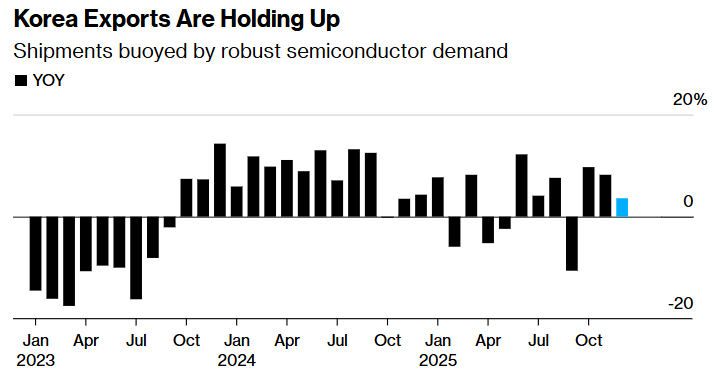
“金丝雀”报喜!韩国1月出口初步增长14.9%,芯片出口激增70%
Hua Er Jie Jian Wen· 2026-01-21 10:31
Core Insights - South Korea's exports saw a significant increase of 14.9% year-on-year in the first 20 days of January, primarily driven by a surge in semiconductor demand due to the global AI boom [1][2] - Semiconductor exports skyrocketed by 70.2%, continuing the growth trend fueled by strong investments in AI and data centers, which helped offset declines in traditional sectors like automotive and shipbuilding [1][2] - Despite structural pressures from U.S. tariffs and a slowdown in global demand, the robust performance of high-tech exports has narrowed the trade deficit to $626 million [1] Semiconductor Sector - The semiconductor sector remains the core engine of South Korea's export growth, with a notable 70.2% increase in chip exports in January, driven by AI-related demand [2] - South Korea's position in the global semiconductor supply chain is further emphasized, with projected exports reaching a record $709.4 billion in 2025, a 3.8% year-on-year increase, and a 22% rise in semiconductor shipments [2] - The U.S. has imposed a 25% import tariff on certain semiconductors and related equipment, which could impact South Korean manufacturers if they do not increase production in the U.S. [2] Regional Export Performance - Exports to China increased by 30.2%, and exports to the U.S. rose by 19.3%, indicating stable demand in major markets [3] - However, exports to the EU and Japan fell by approximately 15% and 13%, respectively, highlighting structural market disparities amid global economic and policy differences [3] Automotive Sector Challenges - The automotive sector faced significant challenges, with exports declining nearly 11% due to U.S. tariff policies and a slowdown in global demand [4] - Shipbuilding exports also dropped by 18%, reflecting the headwinds faced by traditional manufacturing industries [4] - Despite a trade agreement that set a 15% cap on import tariffs, the current rates remain higher than previous free trade arrangements, continuing to pressure the automotive sector [4] Currency Effects - The weakening of the Korean won has provided crucial support for exports, with the currency depreciating over 8% against the dollar since June [6] - While currency depreciation enhances the price competitiveness of export products, it also raises import costs, contributing to inflationary pressures [6] - The Bank of Korea has maintained the benchmark interest rate at 2.5% for the fifth consecutive time, indicating a neutral policy stance amid mixed economic outlooks [6]
韩国1月出口加速 汽车疲软与贸易逆差凸显结构性挑战
Xin Hua Cai Jing· 2026-01-21 07:47
Group 1 - The core viewpoint of the articles highlights that South Korea's exports have shown a significant increase driven primarily by the semiconductor industry, with a year-on-year growth of 14.9% in January 2026, surpassing the revised growth of 13.3% in December 2025 [1] - The semiconductor exports surged by 70.2%, fueled by global AI and data center investment trends, while wireless communication devices and petrochemical products also saw increases of 48% and 18% respectively [1] - However, there is a notable decline in the automotive sector, with exports dropping nearly 11%, and shipbuilding exports decreasing by 18%, indicating a divergence in industry performance [1] Group 2 - The weakening of the Korean won, which has depreciated over 8% against the US dollar since late June 2025, has provided support for exports by enhancing price competitiveness in international markets [2] - Despite the benefits of currency depreciation for exports, it has also raised import costs, contributing to inflationary pressures, with overall inflation and core inflation exceeding the Bank of Korea's target of 2% [2] - Exports to major trading partners have shown mixed results, with exports to China and the US increasing by 30.2% and 19.3% respectively, while exports to the EU and Japan have declined by approximately 15% and 13%, reflecting a growing divergence in regional demand [2]
韩国1月出口强势开局!半导体需求强劲抵消汽车关税冲击
智通财经网· 2026-01-21 02:09
Core Insights - South Korea's exports accelerated in the first 20 days of January, primarily driven by strong semiconductor demand, while automotive exports weakened due to increased tariffs in the U.S. [1] - The export growth rate reached 14.9% year-on-year, surpassing the revised 13.3% growth for the entire month of December [1] - Semiconductor exports surged by 70.2%, supported by global AI and data center investment trends, while automotive exports fell nearly 11% [1] Export Performance - The total export value for the first 20 days of January was 14.9% higher year-on-year, with imports increasing by 4.2%, resulting in a trade deficit of $626 million [1] - Wireless communication devices and petrochemical products also saw significant export growth, increasing by 48% and 18% respectively [1] - The decline in automotive exports reflects a slowdown in global demand and the impact of U.S. tariffs, with shipbuilding exports also down by 18% [1] Economic Context - The strong export growth is seen as a key driver for South Korea's economy in 2023, with semiconductor demand expected to offset declines in other sectors [1] - The recent trade agreement with the U.S. set a tariff cap of 15% on imported goods, including automobiles, which has raised concerns about long-term export challenges for the economy [2] - The depreciation of the Korean won against the U.S. dollar has improved price competitiveness for exports but has also increased inflationary pressures [2] Monetary Policy - The Bank of Korea maintained the benchmark interest rate at 2.5% for the fifth consecutive meeting, signaling a neutral stance amid mixed economic growth risks [2] - Core inflation and overall inflation have exceeded the central bank's target of 2%, raising concerns about rising import costs due to a weak won [2] Trade Partner Dynamics - Exports to China and the U.S. grew by 30.2% and 19.3% respectively, while exports to the EU and Japan declined by approximately 15% and 13% [2]
韩国2025年出口同比增3.8%刷新纪录
Xin Lang Cai Jing· 2026-01-01 10:33
Core Insights - South Korea's total exports reached a record high of $709.7 billion in 2024, marking a year-on-year increase of 3.8% [1] Export Performance - Semiconductor exports surged by 22.2% year-on-year, totaling $173.4 billion, setting a new historical peak for the second consecutive year [1] - Automotive exports increased by 1.7%, reaching $72 billion, also achieving a record high [1] - Biopharmaceutical exports rose by 7.9% to $16.3 billion, maintaining growth for two consecutive years [1] - Other sectors such as shipbuilding, computers, wireless communication devices, agricultural products, cosmetics, and electrical equipment also experienced growth [1] Decline in Specific Sectors - Exports of petroleum products decreased by 9.6% to $45.5 billion [1] - Petrochemical product exports fell by 11.4% to $42.5 billion [1] - Steel exports dropped by 9% to $30.3 billion [1]
韩国经济凸显“芯片依赖症”:12月前20天出口增长放缓,半导体需求飙升掩盖经济结构性疲软
Zhi Tong Cai Jing· 2025-12-22 03:45
Group 1: Semiconductor Industry Performance - South Korea's semiconductor exports increased by nearly 42%, driven by demand from artificial intelligence and data centers, helping to offset declines in other sectors [1] - The overall export value for the first 20 days of December grew by 3.6% year-on-year, with a previous month's growth rate of 8.2% [1] - Wireless communication equipment shipments also saw a growth of nearly 18% [1] Group 2: Economic Outlook and Monetary Policy - Excluding the semiconductor sector, economic data remains weak, highlighting the strong performance of the semiconductor industry [3] - The Bank of Korea maintained the benchmark interest rate at 2.5% and raised the 2026 economic growth forecast to 1.8%, primarily due to growth in the chip and information technology sectors [3] - Barclays Bank forecasts a 2.1% growth in South Korean exports next year, but only 1.1% when excluding semiconductor-related exports, imports, and investments [3] Group 3: Trade Agreements and Currency Impact - A significant tariff agreement was reached between Seoul and Washington, setting the maximum tariff on South Korean goods at 15%, effective from November 1 [4] - The Korean won has depreciated over 8% against the US dollar since the second half of 2025, raising concerns about inflation [4] - Both the core consumer price index and overall consumer price index in South Korea have exceeded the Bank of Korea's target of 2% [4]
烽火电子:公司是国家高新通信及雷达科研生产核心骨干企业
Zheng Quan Ri Bao Wang· 2025-12-18 14:11
Core Viewpoint - The company, Fenghuo Electronics, is recognized as a core backbone enterprise in national high-tech communication and radar research and production, and is acknowledged as a high-tech enterprise by the Ministry of Science and Technology [1] Group 1: Company Overview - The company specializes in various products including wireless communication equipment, aviation search and rescue positioning devices, in-car audio control systems, radio altimeters, Doppler radars, navigation equipment, and electroacoustic devices [1] - The company maintains a strong focus on the development of the national aerospace industry and continuously monitors market opportunities in related fields [1] Group 2: Industry Position - The company holds relevant industry qualifications and certifications, reinforcing its position in the high-tech sector [1] - The company emphasizes the importance of referring to its periodic reports for detailed business information [1]

烽火电子:公司成立了民航项目管理部
Zheng Quan Ri Bao Wang· 2025-12-18 11:43
Core Viewpoint - The company has established an aviation project management department to explore applications of its technology in the civil aviation sector, responding to policies promoting the development of the aviation manufacturing industry and the gradual opening of low-altitude airspace [1] Group 1: Company Initiatives - The company is initiating market development related to civil aviation, focusing on airborne equipment research and development [1] - The company plans to leverage its research strengths to expand into wireless communication, emergency rescue communication, in-flight communication, and active noise reduction technologies for civil aviation [1] - The company aims to provide technical services for products related to civil aviation business through the development of various equipment [1]
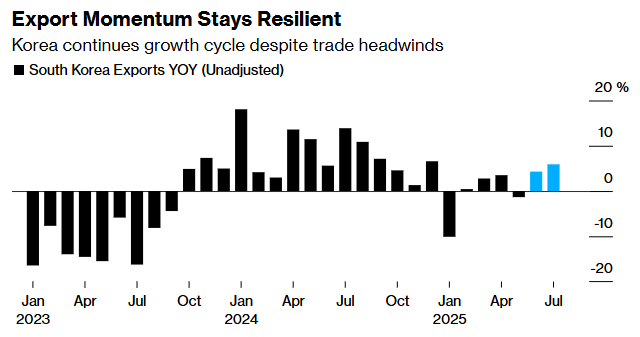
关税前抢跑效应显现,韩国贸易获短期提振:7月出口超预期增长5.9%
智通财经网· 2025-08-01 03:11
Group 1 - South Korea's exports increased by 5.9% in July compared to the same period last year, driven by strong semiconductor exports and stable automobile sales [1] - The increase in exports was higher than the market expectation of 5.1%, with a trade surplus of $6.6 billion due to a slight rise of 0.7% in imports [1] - The data reflects exporters' efforts to ship goods before the U.S. imposed higher tariffs on August 1, with a new 15% tariff rate replacing the previously threatened 25% [4] Group 2 - The trade agreement with the U.S. alleviated some uncertainties for the South Korean economy, which had contracted in the first quarter but showed growth in the second quarter [5] - The South Korean government approved a supplementary budget of 31.8 trillion won (approximately $23 billion) to support its trade-dependent economy [5] - Semiconductor exports were boosted by demand for high-performance chips used in artificial intelligence applications, while automobile exports grew by 8.8% due to strong demand outside the U.S. [5] Group 3 - Exports to China decreased by 3% in July due to reduced shipments of key products like petrochemicals and wireless communication devices [6] - Exports to the U.S. increased by 1.4%, driven by strong performance in semiconductors, wireless devices, cosmetics, and electrical equipment [6] - Concerns remain for the semiconductor industry, as recent growth is linked to increased demand for HBM chips, and future global trade may slow down [6]
通鼎互联: 关于增加经营范围及修订《公司章程》的公告
Zheng Quan Zhi Xing· 2025-07-28 16:39
Core Viewpoint - Tongding Internet Information Co., Ltd. is expanding its business scope to include new material technology research and development, technical glass product manufacturing, and sales, which requires shareholder approval [1][2]. Group 1: Business Scope Expansion - The company plans to add "general projects: new material technology research and development; new material technology promotion services; technical glass product manufacturing; technical glass product sales" to its business scope [1][2]. - The expansion is driven by the company's operational and developmental needs [1]. Group 2: Amendment of Articles of Association - The company intends to revise its Articles of Association to reflect the new business scope, while other provisions will remain unchanged [2]. - The previous and revised business scope includes various telecommunications and internet-related services, with the addition of new material technology and technical glass products [1][2]. Group 3: Other Matters - The final results of registration and amendment of the Articles of Association will be subject to the approval of the relevant business registration authority [2].
