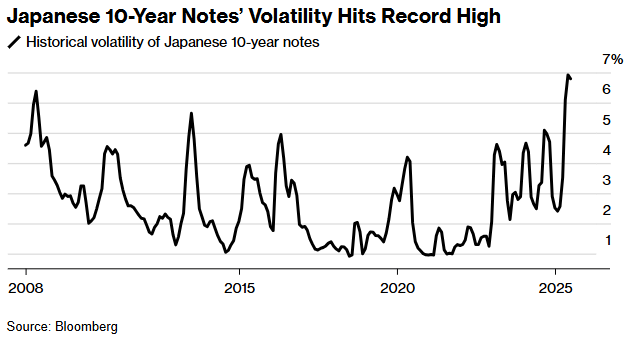
日本十年期国债

Search documents
市场紧盯植田和男讲话!日本加息后十年期日债收益率突破2% 日元震荡走低
Zhi Tong Cai Jing· 2025-12-19 06:40
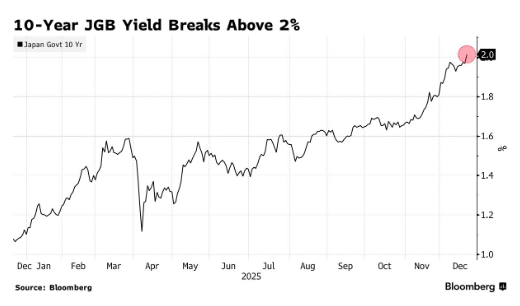
Group 1 - The Bank of Japan raised its policy interest rate by 25 basis points to 0.75%, the highest level in 30 years, leading to a surge in the 10-year government bond yield to 2.015%, the highest since 1999 [1][3] - The Japanese yen continued its downward trend, briefly falling 0.4% to 156.16 against the US dollar, amidst market volatility [1] - Investors are focusing on the upcoming press conference by Governor Kazuo Ueda for clues on future interest rate hikes, as inflation remains high and the interest rate differential with major economies is significant [3] Group 2 - Market expectations for a December rate hike have increased, with the yen rebounding over 1% from its low at the end of November, after briefly hitting a ten-month low against the dollar [3] - There are indications from Bank of Japan officials that rates may rise above 0.75% before the end of the tightening cycle, with suggestions that there could be up to four rate hikes by 2027 [3]

美联储降息遇上日本加息,人民币竟成意外走强?这波操作太狠了
Sou Hu Cai Jing· 2025-12-09 17:40
Core Viewpoint - The article discusses the contrasting monetary policies of the US and Japan, highlighting the potential market impacts of Japan's anticipated interest rate hike and the US Federal Reserve's expected rate cut. Group 1: Japan's Monetary Policy - Japan's central bank is expected to raise interest rates by 25 basis points on December 19, following a strong indication from Governor Kazuo Ueda [1][7] - The market's expectation for Japan's rate hike increased significantly from 50% to over 70% after Ueda's statement, with the 2-year Japanese government bond yield rising by 3 basis points [7] - Previous rate hikes in Japan have been managed with better communication, reducing panic in the markets compared to the sudden hike in July 2024 [5][7] Group 2: Impact on Currency and Global Markets - The anticipated rate hike in Japan aims to strengthen the yen, which has been weak against the dollar, thus alleviating imported inflation pressures [9] - The US Federal Reserve has cut rates by a total of 75 basis points since September, leading to a decline in the dollar index from around 100 to approximately 98 [9] - The depreciation of the dollar has lessened external pressure on the Chinese yuan, which has only slightly declined by 1.77% against the dollar this year [9] Group 3: Effects on A-shares and Hong Kong Market - The strengthening of the yuan is expected to enhance the attractiveness of Chinese assets to foreign investors, as they can purchase more assets with converted dollars [13] - The Hong Kong market, particularly the Hang Seng Tech Index, has shown signs of recovery as the dollar weakens, making dollar-denominated assets more valuable in yuan terms [11] - The upcoming Central Economic Work Conference is anticipated to set a positive tone for economic policies, historically leading to an increase in market indices [13] Group 4: Bond Market Dynamics - The bond market, particularly the 30-year government bonds, has seen declines due to changing market expectations regarding interest rate cuts by the Chinese central bank [15] - Despite recent declines, there is potential for support in the bond market due to expectations of further rate cuts in the coming year [15][16] - The emphasis on "macro-prudential management" by the central bank suggests a focus on preventing financial risks, indicating lower volatility for government bonds [16] Group 5: Investment Strategy Outlook - The article suggests a potential shift in investment focus from bonds to equities, driven by the expected strengthening of the yuan and global liquidity conditions [18] - Investors are advised to monitor key upcoming meetings, including the Federal Reserve's meeting on December 11 and the Central Economic Work Conference, for insights into future policy directions [18] - Recommendations include reallocating funds from government bonds to sectors benefiting from yuan appreciation and policy expectations, such as resource, technology, and dividend-paying stocks [18]
日本10年期国债需求创14个月新高 市场聚焦周四30年期国债发售
Zhi Tong Cai Jing· 2025-06-03 07:04
Group 1 - The demand for Japan's 10-year government bonds has unexpectedly strengthened, providing a boost to the recently volatile bond market, with a key demand indicator reaching a new high since April 2024 [1] - The 10-year government bond futures rose slightly to 139.14 yen, corresponding to a yield decrease of 2.5 basis points to 1.48%, despite rising yields in major global economies [1][4] - The upcoming 30-year government bond auction is seen as a critical test of market sentiment towards ultra-long-term bonds, with traders remaining cautious [1][4] Group 2 - Senior interest rate strategist Miki Den from Sumitomo Mitsui Trust Securities noted that the 1.5% yield level is attractive for allocation funds, which is key to the recovery in demand [4] - However, he warned that the downward yield potential may be limited due to the upcoming 30-year bond issuance, indicating that the market needs to digest the supply pressure from ultra-long-term bonds [4] - The global bond market is currently experiencing a crisis of confidence, with concerns over large fiscal deficits in major economies increasing debt burdens, compounded by the Bank of Japan's gradual exit from large-scale bond purchases [4][5] Group 3 - Recent auction data shows that the subscription multiple for the 2.6 trillion yen 10-year government bonds significantly increased to above the one-year average, despite yields rising over 50 basis points from the 2023 low [5] - The attractiveness of Japanese bonds relative to other developed countries is a primary reason for the influx of allocation funds [5] - The upcoming 30-year bond auction is expected to be a crucial observation point, as its yield has reached the highest level since issuance, which will directly impact global investors' risk assessment of the Japanese bond market [5]