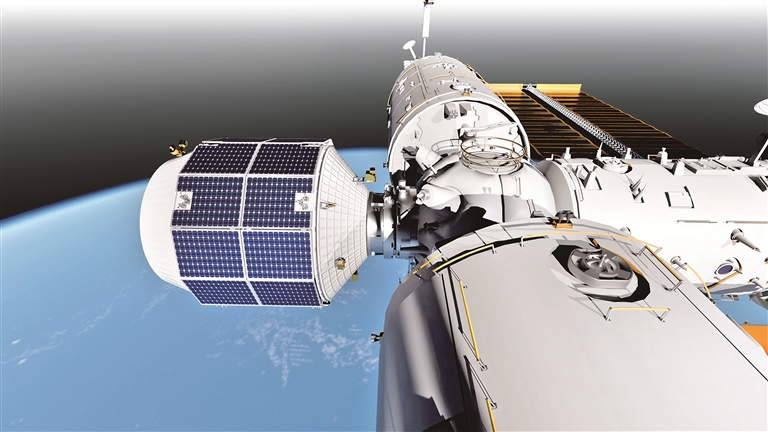
昊龙货运航天飞机

Search documents
天奥电子(002935.SZ):暂无产品用于昊龙货运航天飞机
Ge Long Hui· 2026-02-12 07:17
Core Viewpoint - Tianao Electronics (002935.SZ) has stated that it currently does not have any products used in the Haolong cargo spacecraft [1] Company Summary - Tianao Electronics confirmed on an interactive platform that it does not supply products for the Haolong cargo spacecraft [1]

中国成功发射可重复使用试验航天器,它究竟是什么?
Xin Lang Cai Jing· 2026-02-08 03:09
Core Insights - China has made significant advancements in the aerospace sector, particularly in reusable spacecraft technology, with recent successful launches and ongoing developments aimed at enhancing space exploration capabilities [1][12]. Group 1: Recent Developments - On February 7, China successfully launched a reusable experimental spacecraft using the Long March 2F rocket from the Jiuquan Satellite Launch Center, aimed at validating reusable spacecraft technology [1]. - The Long March 2F rocket is primarily used for launching crewed Shenzhou spacecraft and large target vehicles into low Earth orbit [1]. - Previous successful tests include a reusable spacecraft that flew for 276 days before returning on May 8, 2023, marking a significant breakthrough in China's reusable spacecraft technology [12]. Group 2: Technical Characteristics - Reusable spacecraft can include crewed ships, cargo ships, propulsion vehicles, planetary landers, and space shuttles, designed for rapid atmospheric re-entry and return to Earth [13]. - The ability to reuse spacecraft is crucial for reducing operational costs and shortening development cycles, making it a focal point in current aerospace research [14]. Group 3: International Comparisons - China's reusable spacecraft have achieved impressive in-orbit durations, with a record of 276 days, surpassing the U.S. X-37B's 224 days [15]. - The U.S. SpaceX has developed reusable systems like the Dragon cargo and crew spacecraft, which have significantly reduced costs for space missions [14]. Group 4: Future Plans and Innovations - The "Haolong" cargo spaceplane, designed by the Aviation Industry Corporation of China, is set to be a low-cost reusable vehicle for transporting goods to the Chinese space station [16]. - The new generation of crewed reusable spacecraft, "Mengzhou," is planned for its first flight in 2026 [17]. - Private companies like Ziwei Technology and ChuanYueZhe are also developing reusable spacecraft, with plans for various missions and commercial space operations by 2026 [18][19].


利好来了!商业航天,突传大消息!发射成功!
券商中国· 2026-02-07 09:44
Core Viewpoint - China's commercial space industry is making significant advancements, particularly with the successful launch of a reusable experimental spacecraft, which is expected to lead to a normalization of high-frequency launches by 2026 [2][4]. Group 1: China's Achievements in Commercial Space - On February 7, China successfully launched a reusable experimental spacecraft using the Long March 2F rocket from the Jiuquan Satellite Launch Center [2][3]. - The reusable spacecraft is set to conduct technology validation tests to support peaceful space utilization, marking a significant step in China's space capabilities [4]. - Previous launches of reusable spacecraft in 2020 and 2022 demonstrated increasing durations in orbit, with flights lasting 2 days and 276 days respectively, indicating improvements in technology reliability and performance [5]. Group 2: Future Developments in China's Space Technology - China is currently developing a new generation of reusable spacecraft, including the "Haolong" cargo spacecraft, which is approximately 10 meters long and 8 meters wide, designed for both cargo transport to and from space stations [5]. - The focus on fully reusable spacecraft technology is seen as a key area of research, promising to significantly reduce costs and increase the efficiency of space exploration [6]. Group 3: SpaceX's Strategic Shift - SpaceX has reportedly postponed its Mars mission, prioritizing a lunar landing plan in collaboration with NASA, aiming for a potential unmanned lunar landing by March 2027 [7][8]. - This strategic shift comes amid pressures from the U.S. government for SpaceX to focus on lunar missions, as highlighted by previous comments from transportation officials [9]. - SpaceX is also advancing plans to establish AI data centers in space, which could support future lunar and Martian colonization efforts [8].

中航成飞(302132.SZ):公司“昊龙”货运航天飞机项目目前进展正常
Ge Long Hui· 2026-02-02 13:32
Core Viewpoint - The company is making steady progress on its "Haolong" cargo spacecraft project, which is advancing as planned and aims to contribute to the development of China's aerospace industry [1] Group 1 - The company is actively promoting research and production work related to the "Haolong" cargo spacecraft project [1] - The project is expected to empower the company's high-quality development [1] - The company aims to contribute to the development of the aerospace industry in China [1]
中航成飞(302132) - 中航成飞股份有限公司投资者关系活动记录表(2026年1月27日-1月29日)
2026-01-30 14:26
Group 1: Company Overview - The company is a major base for military aviation and defense equipment, as well as a significant manufacturer of large civil unmanned aircraft and key components for civil aircraft [2][3] - In January 2025, the company completed a major asset restructuring, achieving overall listing of its core military assets [2][3] - The company has developed various military aircraft, including J-5, J-7, and J-20, and has capabilities across the entire chain of high-end aviation equipment [3] Group 2: Development Plans - During the "14th Five-Year Plan" period, the company aims to establish a new pattern of coordinated development across defense equipment, civil aviation, and military trade, focusing on technological innovation [4] - The goal is to enhance production capacity and combat effectiveness, while building a high-level aviation talent center and innovation hub [4] Group 3: Aerospace Business - The aerospace industry is a key component of the national strategic emerging industries, with the company focusing on innovation and structural optimization [5] - The company’s subsidiary is responsible for the research and production of the "Haolong" cargo spacecraft, marking a significant breakthrough in aerospace equipment [5] Group 4: Military Trade - The company has over 40 years of experience in military trade and is a major export base for aviation equipment [6] - Since May 2025, following international regional conflicts, the company has seen increased attention on its military trade products and has engaged in various market promotion activities [6] Group 5: Reforms and Innovations - The company is implementing multi-dimensional measures to support the reform of Guifei, focusing on enhancing manufacturing capabilities and optimizing product structure [7] - The National High-end Aviation Equipment Technology Innovation Center, established with government approval, aims to foster technological innovation and produce high-level aerospace products [7]
中航成飞:昊龙为货运航天飞机,公司将积极推进该项目科研生产工作
Mei Ri Jing Ji Xin Wen· 2026-01-29 01:42
Group 1 - The core viewpoint of the article is that the company, 中航成飞, is actively involved in the昊龙 cargo spacecraft project and is committed to advancing its research and production efforts to contribute to the development of China's aerospace industry [2][3] - The company responded to an investor inquiry regarding the potential for manned space tourism, indicating that the昊龙 project is currently focused on cargo transport rather than passenger travel [2] - 中航成飞 emphasizes its role in promoting high-quality development within the aerospace sector through its ongoing projects [2]
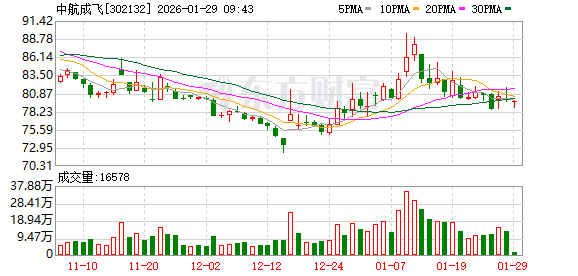
中航成飞重组落地首年预盈34亿 进军商业航天10亿布局空天装配
Chang Jiang Shang Bao· 2026-01-29 01:16
Core Viewpoint - AVIC Chengfei (中航成飞) is expected to achieve significant profit growth in 2025, with net profit projected to increase by approximately 30 times compared to the previous year, highlighting the company's strong growth momentum and strategic value following its restructuring [1][2][3]. Financial Performance - The company forecasts a net profit attributable to shareholders of 3.4 billion to 3.6 billion yuan for 2025, representing a year-on-year growth of 2927.37% to 3105.45% compared to pre-restructuring figures [1][3]. - The net profit after deducting non-recurring gains is expected to be between 3.2 billion and 3.4 billion yuan, with a year-on-year increase of 3280.31% to 3491.58% [1][3]. - Prior to the restructuring, the company's annual revenue was around 1 billion yuan, with significant fluctuations in performance [2]. Restructuring and Asset Growth - The restructuring involved a transaction valued at 17.439 billion yuan, where AVIC Chengfei acquired 100% of Chengdu Aircraft Industrial Group, marking a significant event in the professional integration of AVIC [2][3]. - As of September 2025, the total assets of AVIC Chengfei reached 117.75 billion yuan, a substantial increase from 4.136 billion yuan before the restructuring [4]. Strategic Initiatives - AVIC Chengfei is focusing on its core aviation business while also accelerating the development of new industries, particularly in commercial aerospace [1][7]. - The company plans to invest approximately 1 billion yuan in the construction of a space equipment assembly base, which will support the production of the "Haolong" cargo spacecraft [5][7]. - The project aims to enhance the company's capabilities in space equipment assembly and is seen as a critical move to support national strategies and high-quality development [7]. Technological Advancements - The company has established a complete industrial system post-restructuring, enhancing its control over the industry chain and improving its core competitiveness [6]. - AVIC Chengfei is actively pursuing technological breakthroughs in key areas such as advanced material forming processes, digital manufacturing, and assembly integration [6].
中航机载:公司是昊龙货运航天飞机的主要供应商
Zheng Quan Ri Bao Wang· 2026-01-05 14:12
Core Viewpoint - The company, AVIC Aircraft (中航机载), is a key supplier for the Haolong cargo aerospace aircraft, providing various system-level products, equipment-level products, and components [1] Group 1 - The company will continue to leverage its aviation onboard technology to expand its business into the aerospace sector [1]

中航机载:公司目前已经是昊龙货运航天飞机的主要供应商
Zheng Quan Ri Bao· 2026-01-05 13:36
Group 1 - The core viewpoint of the article highlights that 中航机载 is expanding its business from aviation to the aerospace sector, becoming a key supplier for the 昊龙 cargo spacecraft [2] - 中航机载 has developed multiple system-level products, equipment-level products, and various components and devices for the aerospace industry [2] - The company's subsidiary is providing equipment-level products for various types of rockets and satellites, including sensors and inertial measurement devices [2]
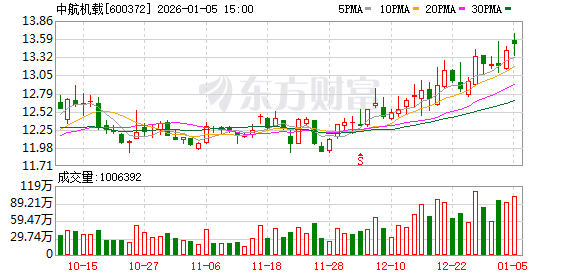
走近大国重器丨探访我国新一代货运飞船“轻舟”
Zhong Yang Ji Wei Guo Jia Jian Wei Wang Zhan· 2025-12-28 23:58
Core Viewpoint - The "Qingzhou" cargo spacecraft, developed by the Chinese Academy of Micro-Satellite Innovation Research Institute, is a significant addition to China's space station logistics system, focusing on low-cost and high-efficiency cargo transport [4][5][6]. Group 1: Overview of "Qingzhou" - "Qingzhou" is designed to complement the existing Tianzhou series and the Haolong cargo spacecraft, enhancing the overall cargo transport capabilities of the Chinese space station [4][5]. - The spacecraft features a compact design with a payload capacity of 1.8 tons for upward transport and approximately 2 tons for waste disposal, making it agile and efficient [6][8]. Group 2: Cost Control and Efficiency - The development of "Qingzhou" emphasizes a shift towards cost-effective solutions, with the goal of reducing transportation costs to about 100,000 yuan per kilogram [7][8]. - The design incorporates an integrated single-cabin structure, optimizing space utilization and allowing compatibility with various rocket types, which enhances launch efficiency [6][7]. Group 3: Design Philosophy - The design philosophy centers around the needs of astronauts, ensuring that the spacecraft can effectively deliver supplies and remove waste from the space station [8][9]. - Innovations such as a modular cold chain system and an intelligent cargo management system are included to improve operational efficiency and safety [9][10]. Group 4: Development Challenges and Solutions - The development team faced significant challenges, including a critical test where the spacecraft's structure failed under simulated space conditions, leading to design modifications that improved its integrity without increasing costs [11][12]. - The rigorous testing and validation process is aimed at identifying and addressing potential design flaws early in the development cycle [11][12]. Group 5: Future Steps and Goals - Following the completion of initial testing, the team will transition to formal production preparations, with a focus on overcoming upcoming challenges [13]. - The overarching goal is to ensure that "Qingzhou" meets the high standards required for space operations, contributing to China's ambitions in space exploration [15][16].